
Translated material
Defeat mobilization - Layout
Defeat mobilization
Daria Kucherenko, “Layout” Editorial Board September 19, 2023 |How Russians sue over their mobilization - and win

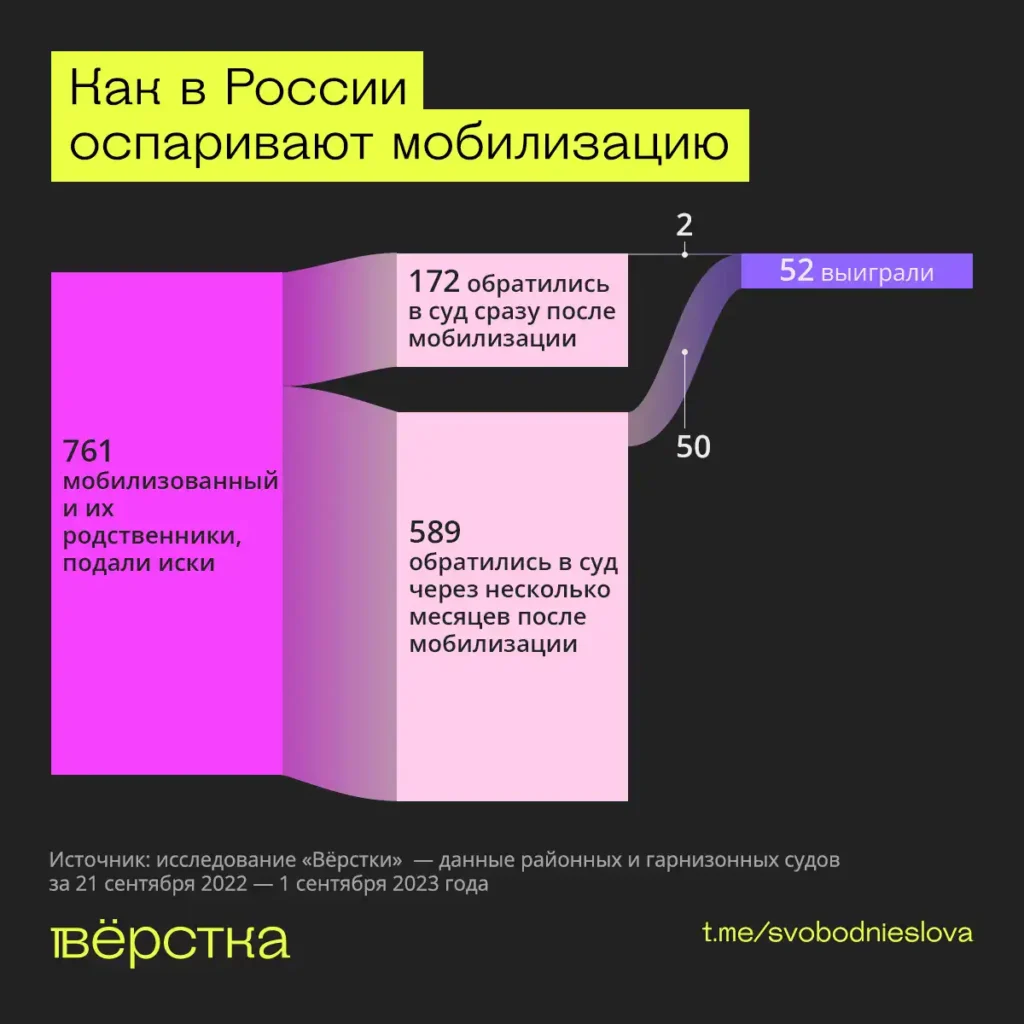
During mobilization, many Russians voluntarily went to the military registration and enlistment office, but at the same time thousands of men tried in various ways to avoid participating in the war - they left the country, hid in the country, or, as Vorstka found out, tried to sue the military registration and enlistment offices. In Russian courts, “Verstka” found claims from 761 people who received a summons. Of these, every 15th mobilized won the case and returned home from the army.
In order not to miss new texts from “Layout”, subscribe to our telegram channel
52 people won court cases against military registration and enlistment offices
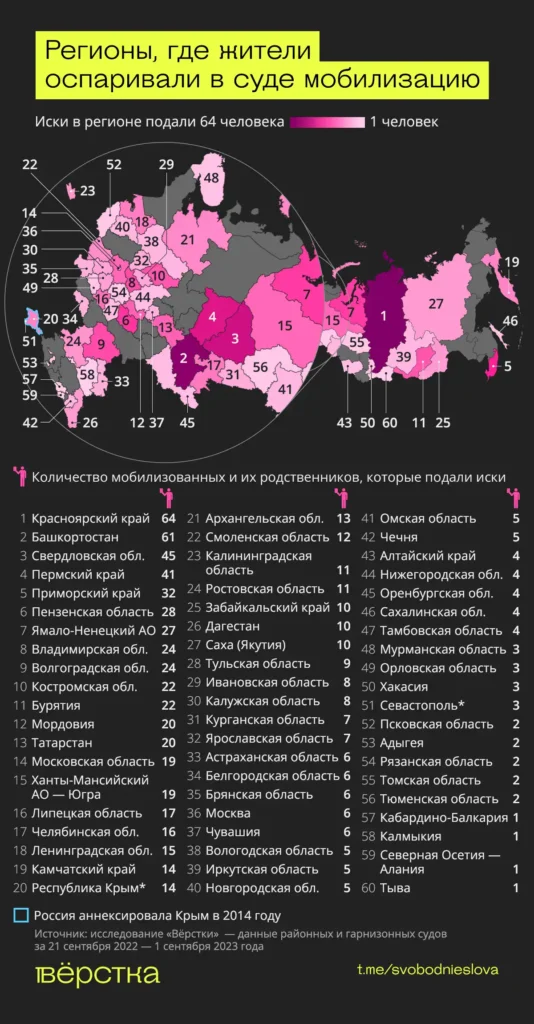
At least 761 Russians mobilized from September 2022 to September 2023 tried to appeal through the courts against being drafted into the army and into war, Vorstka found out after analyzing the databases of all district and garrison courts in Russia.
What did we think?
Expand ↓On the websites of district and military garrison courts in Russia and annexed Crimea, we found decisions on administrative cases to draft mobilization commissions. We downloaded all the solutions found, read, analyzed and generated statistics based on them.
52 mobilized won. 51 people proved in court that they were mobilized illegally and returned home. At least one person who received a summons did not end up in the army at all, because he quickly filed a lawsuit and won in court.
172 people filed claims in the first month after mobilization . Some managed to gain time in this way - the courts applied preliminary protection measures and prohibited military registration and enlistment offices from sending conscripts to the front until the claim was considered.
589 people went to court several months after they were mobilized. To do this, they hired lawyers and issued a power of attorney for their spouse or mother. Many filed claims on their own via the Internet, filling out a form on the GAS Justice website.
Men from the Krasnoyarsk Territory (64), the Republic of Bashkortostan (61), the Sverdlovsk Region (44), the Perm Territory (41) and the Primorsky Territory (32) tried to appeal the mobilization most actively. Moreover, every third person mobilized from the Krasnoyarsk Territory who decided to go to court won the case.
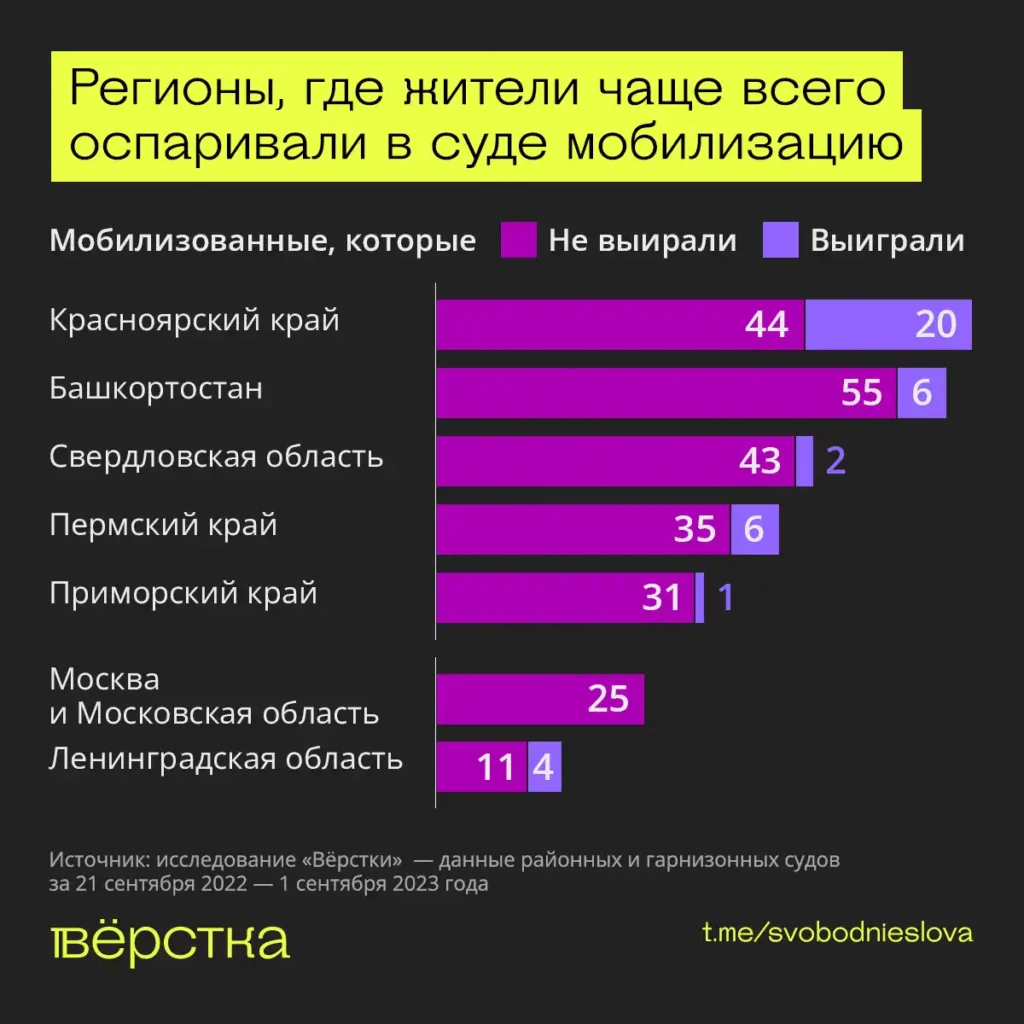
In Moscow and the Moscow region, 25 conscripts sued the draft commissions, but not a single claim was satisfied. In the Leningrad region , 15 people challenged the mobilization, four of them won.
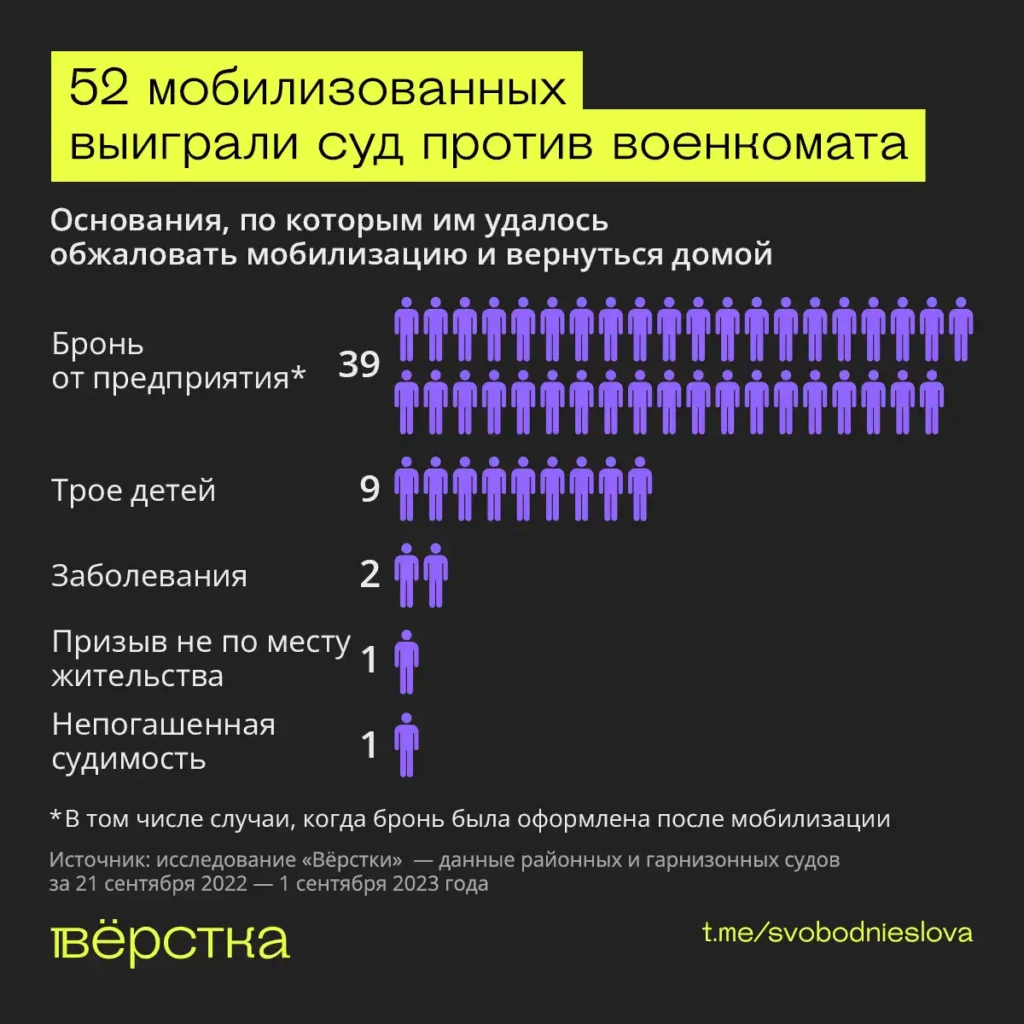
The highest chances of winning in court were those who were able to get a reservation at their place of work - most often, at a military enterprise.
Of the 52 mobilized who won in court, 39 people had such a reservation. Nine people returned home due to the fact that the family raised three children. Two proved that they were seriously ill. One left the front after it turned out in court that at the time of mobilization he had an outstanding criminal record. Another mobilized person won the trial because military registration and enlistment office employees violated the law and served him a summons at a location other than his place of residence.
Anyone who tried to challenge mobilization based on their age or need to care for a sick relative lost .
How they were mobilized at defense factories
Despite the fact that, according to the decree on partial mobilization, men working at defense enterprises should have received a deferment, in practice everything turned out differently. Workers involved in the defense industry were mobilized along with the rest, “Verstka” found out after analyzing court decisions.
Of the 39 enterprise employees who won lawsuits against the military registration and enlistment offices, 11 worked at the RUSAL aluminum smelters in Siberia, five at the Rosneft Achinsk oil refinery in the Krasnoyarsk Territory, and three at the Beloretsk Metallurgical Plant in Bashkortostan. Among the remaining 20 mobilized are employees of Russian Railways, Lukoil, banks and state-owned strategic enterprises.
Judging by what representatives of enterprises talked about at the meetings, military registration and enlistment offices sought to recruit quickly and a lot of people, so they did not understand the details of where exactly the mobilized person worked .
A resident of Gatchina in the Leningrad region, Ivan Belousov worked as a mechanic and assembler of radio-electronic equipment at the local Krizo plant. The company carries out defense orders and makes fire extinguishing installations for naval ships. In September 2022, when mobilization began, the personnel department issued a summons to Belousov. The man went to the military registration and enlistment office to clarify the situation. He was sure that he would not be taken to the front - in his pocket was a certificate stating that he worked at a defense plant and was included in the list of reserved employees. But at the military registration and enlistment office no one was interested in Belousov’s documents and he was mobilized on the same day. Belousov ended up in the engineering sapper troops, and the plant where he worked, as it later turned out in court, tried in vain throughout October 2022 to return the employee.
In November 2022, Belousov, while on duty, with the support of the plant, filed a lawsuit in the Gatchina District Court. At the meeting, a representative of Krizo said that the company sent its employees to the military registration and enlistment office, thinking that there would only be a data reconciliation, but the commissioners mobilized all the workers, with the exception of one person with serious illnesses. The plant entered into negotiations with the draft commission and convinced it to recall almost all of its “reserved” workers from the army. The military registration and enlistment office refused to hand over Belousov. A representative of Crizo explained this in court as follows: “We were told that although we are a defense company, someone still has to be called up.”
The plant asked the court to return the specialist, arguing that without him it would not be able to fulfill the state defense order. The court was convinced by the arguments - the decision of the draft commission was canceled, and Belousov returned home. The military registration and enlistment office tried to appeal the decision, but lost .
Enterprises are returning workers from the front
At some enterprises whose employees were mobilized, as Vorstka learned after studying court decisions, the personnel department did not have time to prepare lists of reserved workers in time. At the same time, the military registration and enlistment offices did not try to help with reservations.
“Vorstka” discovered in the database of the Frolovsky City Court of the Volgograd Region a claim by a LUKOIL subsidiary, Ritek LLC. The company develops oil production technologies. In February 2023, the company went to court in defense of its mobilized employee, fourth-class compressor unit operator Andrey Kozlovtsev. At the meeting, a representative of Ritek said that in September the military registration and enlistment office refused to issue special forms for reservation, so the company did not have time to book Kozlovtsev. Ritek managed to convince the court that their employee had grounds for a deferment, and Kozlovtsev returned home.
Before mobilization, Pavel Kharchevsky from Achinsk worked as a turner at the Engineering Construction Maintenance company. On September 27, he was mobilized, and only a month later the employer issued him a reservation.
Kharchevsky failed to appeal the mobilization through the prosecutor's office of the Central Military District, and he filed a lawsuit in the Achinsk City Court. Turner told Vorstka that his wife contacted the prosecutor’s office, but they found no violations. The court decided that the mobilization was legal, but since circumstances changed and Kharchevsky received a reservation, he must be returned from the front.
In order not to miss new texts from “Layout”, subscribe to our telegram channel
Fathers of many children received a reprieve
In October 2022, Russian authorities responded to the indignation of large families and allowed a deferment from mobilization not only for fathers of four children, but also for those raising three . Those who had already been mobilized began to be returned home. True, the political will of the country’s leadership was not enough, and military registration and enlistment offices in different regions refused to change decisions on mobilization, citing the fact that the law did not stipulate a deferment for fathers of three children. Some of those mobilized decided to sue, and at least nine men from the Perm region, Chelyabinsk, Sverdlovsk, Vladimir regions, Bashkortostan and Buryatia won their cases.
“The initiative to sue was a family one, but initially the wife started talking about it. I resisted, for me it was a very difficult choice between staying there with the guys and staying with my family. But after realizing the whole situation, I decided to stay with my family,” Pavel Yuzhakov, a 39-year-old father of three sons from Berezniki in the Perm region, told Vorstka.
Reserve lieutenant Yuzhakov worked as an electrolysis worker at the AVISMA metallurgical plant in Berezniki, and in his free time he organized paintball games. He did not have armor due to the fact that the plant did not fulfill defense orders, and on September 30, 2022, Yuzhakov went to a training center in Elani, Sverdlovsk region. In October, upon learning that the fathers of three children might not participate in the war, he submitted his resignation. But the commander refused to let him go home . Yuzhakov’s wife filed a statement with the military commissariat, but was told that they saw no reason to cancel the decision. The family decided to try the last option - to sue.
At the end of December, Yuzhakov filed a lawsuit in the Berezniki City Court and asked to cancel the decision to call for mobilization. While the lawsuit was being considered, the court established interim measures and prohibited the Ministry of Defense from sending the man to the combat zone. Two weeks later, the court granted Yuzhakov’s claim, but the military registration and enlistment office was not satisfied with this decision. Representatives of the military registration and enlistment office filed an appeal, and having not achieved their goal, they also appealed to the cassation authority.
The Seventh Cassation Court of General Jurisdiction returned the case for a new trial, citing the need to involve in the process not only the commission for the mobilization of Berezniki, but also the commission of the Perm Territory. In July 2023, the Berezniki City Court re-examined Yuzhakov’s case and again decided that the father of three children was not subject to mobilization. But the military registration and enlistment office again filed an appeal.
Now Yuzhakov is at home - he returned in the winter of 2023, went to work, and his wife became pregnant with their fourth child. “ After the court took interim measures, I became a civilian and was deprived of my salary. Was there any point in staying in the unit? I need to feed my family ,” he told Vorstka.
Illness, outstanding criminal record and summons not at the place of residence
At least two people, “Vestka” found out, received a deferment due to illness after they were mobilized.
Before mobilization, doctors discovered a cyst in the brain of Fanis Ganiev from Salavat in Bashkortostan. When he filed a claim with the Salavat City Court, it ordered an independent medical examination in absentia. Doctors confirmed that the diagnosis was real. By law, someone with such a disease can be drafted into the army, but the court decided that mobilization was still illegal. The judge pointed out that the doctors at the military registration and enlistment office approached the examination formally - they did not examine Ganiev and incorrectly established his fitness category.
Rustam Gilimyanov was mobilized from Norilsk in September 2022, and already in October he was admitted to a military hospital - due to physical exertion at the training center, he became ill. Doctors diagnosed him with a disease of the cardiovascular system and assigned him a fitness category of “G” - “temporarily unfit for military service.” The command, despite Gilimyanov’s diagnosis, refused to let him go home. Then the man filed a lawsuit. In a statement, he said that he suffered from cardiovascular disease before September 2022, but during mobilization he did not have time to show doctors medical certificates due to the fact that the conscription took place in a hurry. In 2023, Gilimyanov managed to win the court and overturn the decision to mobilize.
33-year-old Denis Gorchakov from Kineshma, Ivanovo region, avoided mobilization altogether due to the fact that he filed a lawsuit four days after receiving the summons. On October 7, 2022, Gorchakov was passing through Moscow and spent the night with a friend in a hostel. At four in the morning, the police and the military commissar entered the room where they were sleeping. All men in the room were given summonses. That same morning, Gorchakov went to the military registration and enlistment office of the Golovinsky district of Moscow and learned that in a few days they were going to send him to war. Then the man decided to hurry up and return home as soon as possible - he bought a train ticket to Kineshma and filed a lawsuit in his hometown. Gorchakov avoided mobilization and won the trial in November 2022. He managed to prove that the Moscow commissar did not have the right to issue him a summons; only the commissariat at his place of residence could do this .
Another mobilized man, 45-year-old Vitaly Chukhir from the city of Polevskaya, Sverdlovsk region, returned from the war, proving that the military registration and enlistment office should not have drafted him with an outstanding criminal record. “I hired a lawyer when I realized that I’d had enough,” Vitaly Chukhir told Vorstka. “I’m very glad to have returned home.”
In 2011, Chukhir received a four-year suspended sentence for robbery (Part 2 of Article 162 of the Criminal Code). On a winter evening, he drank vodka with a friend at a local club. On the way home, he met a pensioner and attacked her - he beat the woman with a bottle of vodka that he had with him, and then stole a wallet with a thousand rubles . The suspended sentence was soon replaced with a real one, but Chukhir was released earlier on parole. In 2019, he was put on trial again - this time for drunk driving - and received a suspended sentence. Over the next two years, he was repeatedly fined for drunkenness and disorderly conduct in public places. In 2021, at the request of the Ministry of Internal Affairs, administrative supervision was established over him. Chukhir had to report to the police every month and not go out after 10 pm. This did not prevent the military commissariat from mobilizing him on September 29 and then sending him to war.
“Once we were taken to the shooting range, and then straight to the front line,” Chukhir told Vorstka. In the winter of 2023, he was wounded, spent two weeks in the hospital and decided to find a way not to return to the front. After consulting with a lawyer, he learned that there was a chance to cancel the decision to mobilize. Chukhir filed a lawsuit and won - the court decided that it was impossible to mobilize those who had an outstanding criminal record. Chukhir returned to Polevskoy and there, according to him, he got a job at a local metallurgical plant - “to get a reservation, just in case.”
“I’m incredibly glad to be back,” he says. “There you don’t know when artillery will hit you, you live one day at a time.” And the conditions at that time when we were at the Northern Military District were inhumane. This must be seen."
You can support “Layout” from any country in the world - it is still safe and very important. We really need your support now. How to help us →
Cover: Dmitry Osinnikov
Infographic: El