
Translated material
“Bent over” and “fucked”
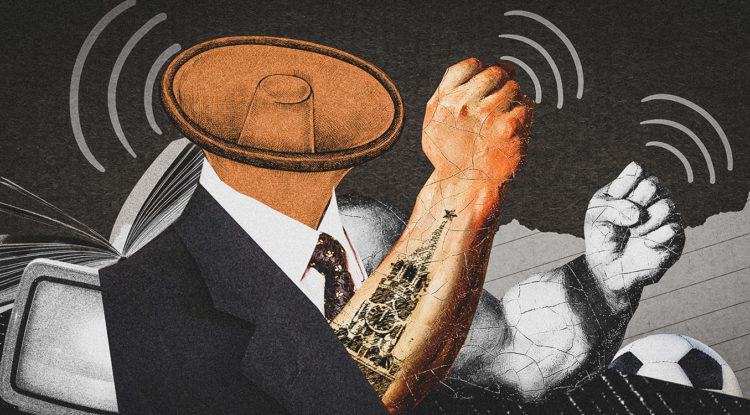
Philologist Ksenia Turkova talks about how the language of sexualized violence became the state language
Russian authorities, elites and media do not hesitate to use words describing sexual violence when talking about their achievements. To perform successfully at diplomatic negotiations means to “fuck” an opponent, to win in sports means to “break”, to voice new terms of interaction is to “bend”. When did these words enter official speech? Why did this happen? And what can the language of violence tell us about the speaker? Philologist Ksenia Turkova talks about this at the request of Kholod.
In order not to miss the main materials of “Cold”, subscribe to our Instagram and telegram .
On the day when Russia sent the Luna-25 interplanetary automatic station into space , a screenshot of news from the website of the Tsargrad TV channel spread across social networks. The headline read: “TORIED UKRAINE, DELIGHTED THE USA, SCARED GERMANY: THE RUSSIAN PROJECT THAT BECAME A SENSATION.” The verbs “tore” and “scared” contrasted sharply with reality: by that time it was already known that Luna 25 had lost contact with the Earth and crashed (negatively landed on the moon and regrouped as part of a gesture of goodwill, as bloggers joked).
However, the headline gained such popularity not only because of its dramatic discrepancy with reality. In a sense, he very accurately reflected the Russian “national idea” - as it is formulated by the authorities and the propaganda media controlled by them. Scare, tear, bend, fuck, kill - all these verbs from the vocabulary of aggression and violence can describe the peculiar foreign policy credo of the Russian leadership: not cooperation with other countries, but intimidation; not friendship, but rape; not partnership, but suppression.
The vocabulary of violence has long been the hallmark of the Russian government. The verb “bend”, for example, was used by Vladimir Putin after the annexation of Crimea, when he drew a parallel with Kosovo and the actions of the United States. “They bent everyone over, and now they are indignant,” said he . At the same time, Putin seemed to transfer the features of his own prison-criminal consciousness and vocabulary onto his opponent, attributing to him the desire to “bend over” him. Around the same time, after the annexation of Crimea, the picture “We Can Repeat” began to be widely used in Russia, in which a figure with a hammer and sickle on his head rapes a figure with a swastika. The threat “We can repeat it” has become a symbol of the aggressive militarization of the country, one of the main components of “victory” - a kind of new cult artificially created by the authorities around Victory Day.
The very idea of suppression, often associated with sexual violence, appeared regularly in the speeches of the Russian president. “You like it, you don’t like it, be patient, my beauty!” Putin said about Ukraine before the start of a full-scale war. Connoisseurs of the source text immediately recalled that the song by the group “Red Mold” was about an act of necrophilia.
"The beauty sleeps in a coffin
I sneaked up and fucked
Like dislike
Sleep my beauty"Red mold
And literally two days before the invasion, Putin announced his intention to “explain” to Ukraine the “correct” version of history: “We are ready to show you what real decommunization means for Ukraine.” The seemingly neutral verbs “explain” and “show” are actually all from the same vocabulary of aggression: remember the expressions “I’ll show you!” or “I’ll explain it to you in a popular way now...” This feature of some Russian verbs was noted in the publication of Meduza, dedicated to the atrocities of the Russian army in Ukraine. It cites the words of historian and anthropologist Tatyana Shchepanskaya, how the same word in Russian can simultaneously denote both a form of communication and a form of physical influence. For example, “knock” - convey, “shoot” - beg, “enter” - understand.
Putin also used quite unambiguous aggressive verbs that do not have neutral “twins” - for example, he said that the West is introducing sanctions in order to “ counter-punish” his close friends, and also that Russian human rights activists want to “strengthen everything, tighten , counter-up . " Here we again see a transfer, a projection onto an opponent who, most likely, would not use such a verb.
It was the rhetoric of the Russian president, as many experts note, that initially normalized violence - sexualized, physical, psychological, and established a cult of power. It is no coincidence that the original neologism of the street artist Philippenzo, who left the graffiti “Izrossilovanie” under the Elektrozavodsky Bridge on the Yauza embankment, turned out to be so accurate, right on target . The word he coined reflects what the Russian government does both with other countries (trying to force them to “love” with an act of brutal violence), and with their own citizens, whose brains have been “corrupted” by propaganda that forces them to love the president .
Psychoanalyst, member of the European Confederation of Psychoanalytic Psychotherapy (ECPP, Viena) Alexander Kantor in an interview with The New Times noted that political discourse in general is characterized by motives of domination, emphasizing one’s superiority - including with the help of sexual metaphors, but in Russia they are combined with prison -criminal consciousness: “We must not forget that Putin speaks, first of all, with his electorate, he speaks with Russia as he understands it. How he perceives the prevailing demand of the population for a certain type of vocabulary. We should not forget the socio-political experience of the entire population: tens of millions of people went through the Gulag zones - unprecedented in human history in terms of the scale of primitive (including sexual) violence against the individual. This is how the collective—political—conscious and unconscious of Russians was formed.”
But there is one more feature: the vocabulary of aggression and violence appears not only in Russian political, military or paramilitary discourse - it penetrates into all spheres. Economy, culture, sports, space - absolutely everything becomes a “battlefield” on which the opponent must be brutally suppressed, bent over, torn apart. Events related to various spheres of life are perceived precisely in this paradigm. To be convinced of this, it is enough to look at the comments of Russian officials - for example, to any sporting event in which, as it seems to them, Russian athletes are somehow offended and discriminated against.
When in 2017 the International Olympic Committee banned Russian athletes from competing at the Games in South Korea under the Russian flag, military metaphors were used primarily. The committee’s decision was called “a blow that should not be missed” (Igor Lebedev), “a large-scale offensive” (Maria Zakharova) and even “a new form of war.” And in a report by Channel One back then, in 2017, they even used the prophetic word “special operation”: “This special operation against Russia is on a par with other unfriendly actions. Crimea - the referendum is not recognized. Cynical against the backdrop of Kosovo. Civil war in Donbass. The blame is shifted to Russia, although the Kiev regime started the war.”
The vocabulary of aggression and violence is often used in sanctions discourse . “Who tore whom to shreds” is the headline of a report on the Vesti.ru website. The point in the publication is that Russia has actually “tore everyone up” and is not suffering from sanctions at all - at least not in the way that the Western media present it, which “are now watching Putin’s every word.”
The words “torn”, “did” and “bent over” are found in abundance in the headlines of patriotic YouTube channels and texts of bloggers: “Lavrov was torn by the West at the UN! Powerful performance!”, “Domestic cinema has taken over Hollywood.”
In 2020, the year of the coronavirus pandemic, in the top ten expressions according to the Russian Word of the Year the phrase “life has lost its meaning” was included competition. Then it rather reflected the strange state of people whose plans and calculations around the world were completely reset by the pandemic. Now, after a year and a half of Russia’s full-scale war against Ukraine, this phrase sounds, perhaps, even more relevant - and specifically in relation to Russia. While the Russian government is declaring how it has “torn” and “bent over” the whole world, from the outside it seems that if it has “fucked” anything, it is common sense.
The author's opinion may not coincide with the opinion of the editors.
Poll Help “Kholod” become better. Complete the survey for 7-10 minutes.