
Translated material
Deeply believing militarists
Vladimir Sharov is a writer who tried to understand the main idea of Russian history and, it seems, understood
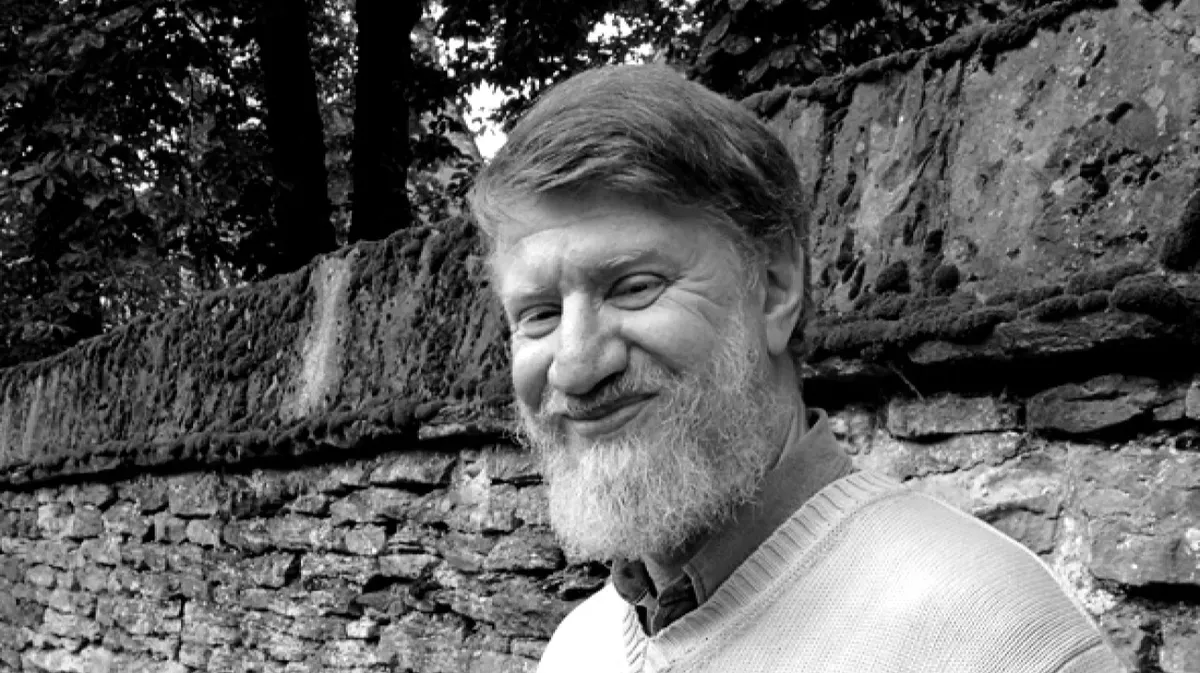
Vladimir Sharov. Photo: Britishcouncil.ru
After February 24, the literature on history, especially about its turning points, captured reader attention, and of course there is nothing strange in this. Such reading helps to reflect the past, which otherwise can deftly replace the present and cling to raking hands for the future. The war and regime will end earlier than all kinds of internal stalinisms and nihilisms, which will surely try to snatch a warm place in the "obscure Russia of the future." It would be nice to prepare an antidote now. Books and journalism of Vladimir Sharov, one of the most powerful and original authors of post -Soviet times, will definitely be among the necessary ingredients.
Throughout the creative path, the candidate of historical sciences of the balls consistently turned an original view of Russian history and the ideas moving, while trying to understand the nature of the empire, the radical Soviet project, the Stalinist terror and religion in Russia. In a paradoxically, pictures of the present and the future are visible in the Sharovsky past - no less reliable than in the Sorokinsky “Drying Day”. All this is a good reason to recall the work of the writer who passed away 5 years ago, in August 2018.
One of the most popular epithets applied to Sharov is “underestimated”. Partly, of course, this is true. The wide audience of the writer underestimated, but rather - simply did not find out about him. However, in the professional community, its name has long been very seriously. This is confirmed by the fact that such venerable writers as Evgeny Vodolazkin, Mikhail Elizarov and Mikhail Shishkin are called the influence of Sharov.
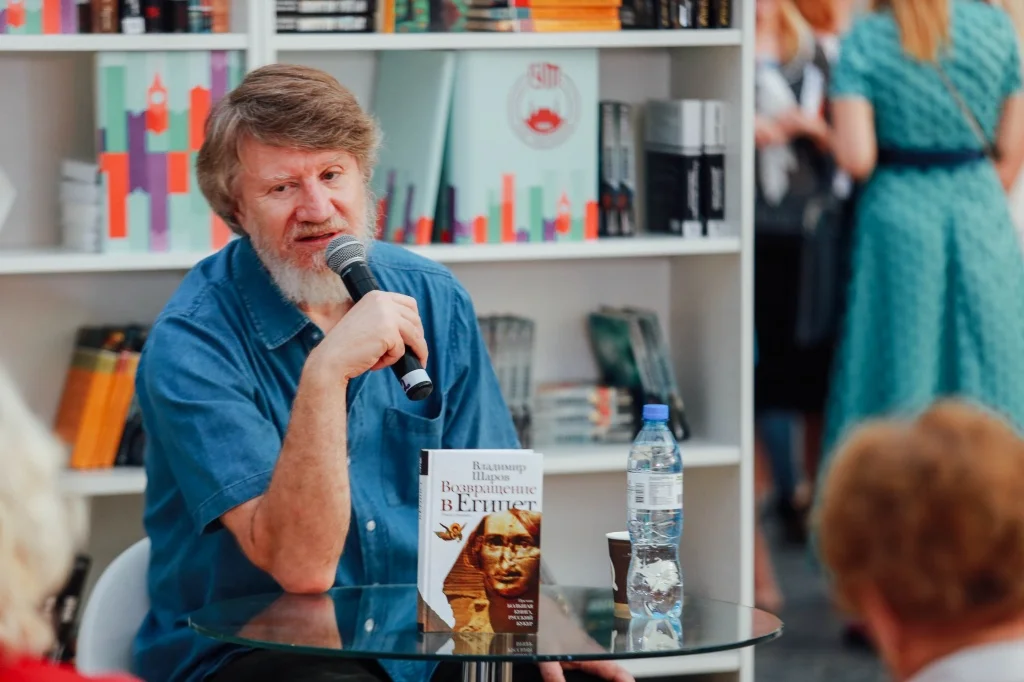
Sharov’s novels can hardly be called historical. He densely mixes the documentary texture and speculation. At the metaphor level, these “collages” look convincing, but of course, they do not claim realism. The definition of "historiosophical" is better. Moreover, we are not talking about events, but about the ideas moving them. Sharov stories from the outside may seem provocative. In 1993, immediately after the publication of his third novel “before and during”, a scandal even erupted in the literary community, provoked, it seems, by the fact that Stalin in the novel turned out to be an illegitimate son of the reborn French writer Madame de Steel, and the original religious philosopher Nikolai Fedorov is almost the main inspirer of the October Revolution. Over time, they got used to such stamps. No one seems to be surprised when the elderly Lenin in “Be like Children” (2008) tried to organize the crusade of children in Jerusalem on the waters of the Black Sea, and the descendants of N.V. Gogol in “Return to Egypt” (2013), surviving in the hurricane shocks of the twentieth century, strive to add the second and third parts of “Dead Souls” (Gogol in the dialogue with Dante only managed to finish only “Hell”, but failed with the “purge” and “paradise”) to save Russia.
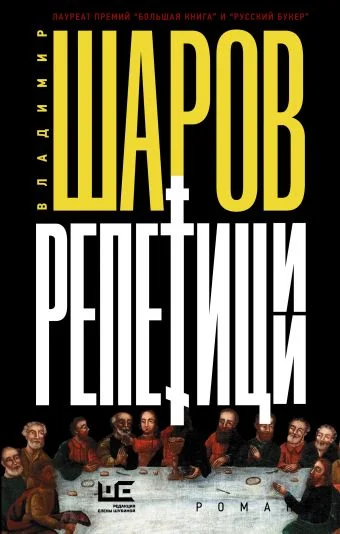
The novel “Rehearsals” (1992) recently surfaced in an unexpected context: I appeared in the list of recommended literature from the propaganda textbook of recent history - and, I must say, looked no less defiant for the authorities than “Cursed and the already mentioned“ Opipher's Day ”. The plot of the novel is built around the fate of the French theater director from the XVII century, by the will of the chance to find himself in the new Jerusalem with Patriarch Nikon. The Patriarch is waiting for the early end of the world and requires the director to put a Christian mystery with a vacant place for Jesus Christ, who will certainly appear. Heroes rehearse the second coming, even being in the Siberian link after the fall of the Patriarch. Gradually, these rehearsals subordinate the life of not only actors, but also many generations of their descendants. The novel ends already in the twentieth century. The settlement of sectarians has long been turned into a labor camp, however, the events taking place there are still determined by the sacred history and the expectation of the Apocalypse. In this plot, of course, there is a metaphorical truth. In an interview, the writer said: “Russian history can be understood and explained from beginning to end only as a kind of commentary on the Old and New Testament ... This is a purely religious story.”
Sharov, of course, is not a provocateur and, it seems, could not become simply because of the personal warehouse. Still, the provocation implies concentration on the modern context, the desire to hook contemporaries and turn their dormant internal hives. Sharov, as if he lived in a different, less grounded time. The space of history inevitably laid out a mark, transformed the Sharovskoye “here-now”, making it a little alien. “Of course, the world is some crazy house. All my life I am running from this crazy house, and he overtakes me, ”his words from the same interview.
Judging by the memories of loved ones and colleagues, Sharov had neither social networks nor even e -mail, he preferred to write by hand and "did not know where the forks were in the house."
At the same time, it seems, he was a very pretty person: a thoughtful, smiling, kind, passionate player in football and a master of a real, deep and warm conversation. There is something in his image from the Leskovsky wanderers, sort of people “on their minds”, falling out of society, living according to their unearthly laws and, as it were, processing impressions, obtained during wanderings, into a special, bizarre picture of the world.
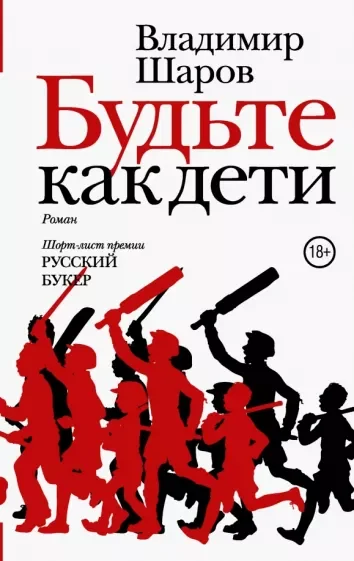
The last scene is especially remembered in the novel “Be like Children”: where the heroes turn out to be part of the metaphysical procession of the martyrs of Russian history, and the fate of each dissolves in this terrible folk movement after time. Ilya Glazunov tried to write similar processions at one time, but he always turned out to be kitchev. From Sharovsky - there is a completely different, acute and tragic impression. In a sense, such a procession is in almost every book. The characters appear, deceive, pretending to be the main characters, and then disappear without a trace, giving way to new ones. Choir of votes incomparable in a stream of history. Persons snatched from the grounds of general movement and for some reason remembered. Books-Books, where genuine protagonists and antagonists are ideas and perfumes that captured and lead people through centuries.
In the essay “October of the seventeenth and the end of history”, Sharov wrote: “Back in the late eighties, in our country there was a current that believed that the whole Soviet history could be turned as an old carpet, and send it to the closet, and then, right from the pre -war 1913, jump in the nineties and continued to live, as if not on October 1917, nor everything that was followed, of course, of course, of course, of course, of course, of course, of course, of course, of course, of course, of course, of course, of course, of course, of course. Any person has the right not to love the October Revolution, but to persuade himself and others that it was not absurd. To reassure that all of it arrived in us in a sealed wagon imposed on payment, and we have the right to send it back without even removing the filling, without even removing the seal. ”
This thought seems especially important if you recall the processions from its novels and the fact that pre -revolutionary and Soviet events are often mixed in them. In the twentieth century, Russia experienced at least two painful internal gaps. The 1917th tried to throw out the whole of the entire national past from the ship of modernity. 1991 desperately wanted to crank a similar operation with Soviet experience, which, as it seemed at that moment, was more important than to comprehend. Each decisive gap with history naturally turns into a public split, and, therefore, the prospects of a foggy future, in which every side will strive to affirm their picture of the world and avoid dialogue with opponents. Ultimately, the power will certainly take advantage of the turmoil and fragmentation. From this angle, perhaps, it is clearer shows what exactly Sharov was doing.
With his books and essays, he tried to dug up the breaks of Russian history, to combine the islands of the epochs torn, picked up and carried away by different trends.
Now, maybe, the importance and lack of such work is especially acutely felt.
The historiosophy of Sharov begins with the time of the Tatar-Mongol invasion. This motive sounds in the thoughts of Professor Suvorin from Rehearsals. The Russian lands, united primarily by the Orthodox faith, over the years of the yoke are used to their own loneliness and the ring of foreign enemies around. Later, the Florentine union of 1439 on the unification of the Western and Eastern Christian churches was fixed. Patriarch Constantinople hoped to get support from European countries in the growing confrontation of Byzantium with the Ottoman Empire. The Russian Orthodox Church rejected and condemned the union. And the fall of Constantinople in 1453, in which they saw a punishment for the betrayal of God, as if confirmed her innocence. From that moment on, Russia "realized himself the only, last guardian of true faith." Perhaps in those days such a familiar model of the besieged fortress was born.
The next nodal stage is the formation of the ideology “Moscow - the Third Rome” at the beginning of the XVI century. Sharov devotes this to the large essay "Between the two revolutions." The concept of the monk Filofei made Moscow a successor to the dead Rome and Constantinople (partly Jerusalem), and the Russian people declared the God -elected ones. Ideas about the approach of the Apocalypse and the second coming at that time were very common in Europe and in the Moscow kingdom (which is why “the fourth Rome cannot be”). According to the ideologist, the Russian kings, God's governors on earth, in future events were to play a decisive role: to expand the territory of the Holy Land for the Lord and bring to Him new peoples that have actually saved them from themselves. Over time, when the Apocalypse did not happen, the idea arose that Jesus would come to Earth only when the God -chosen people will unite all the rest. At this point, Sharov sees the beginning of several interconnected trends in Russian history. Firstly, of course, the Imper. The accession of the territories is justified by their growth to the Holy Land and the God -chosen people. That is why, maybe we are “not conquering”, and by military, “we save” other countries from their “suicidal errors”. In this sense, frankly speaking, the current Russian autocrat and his heralds-propagandists left Filofei not far from.
Secondly, here Sharov finds the idea of "revolution from above." God's governor receives a carte blanche to mobilize the country to expand its territory, strengthen power and other charitable goals. He has absolutely no need to reckon with the victims. The life of subjects, especially taking into account the scale of the divine plan, of course, is the price of pennies; Moreover, they will go straight to paradise, freed from post -alien torment for eternity. It is stupid to cling to the local fleeting life, when there is all we are waiting for eternal and genuine, beautiful, like communism. With this gaze, perhaps, one can explain the extremely careless attitude towards a person in Russia, and generally neglect of the conditions of the material world, mired in sin and doomed to languish in the shadow of the apocalypse. It is also easy to see the origins of the Power of the Power, from the top of which the autocrat can control the toy fate of subjects of the larch, in his (and divine!) Reason. Sharov calls the “revolutionaries from above” Ivan the Terrible, Peter I and Stalin. But the list may soon have to be supplemented.
The writer considers the church schism of the 1650-1680s perhaps the main Russian revolution and, in a sense, the ancestor of October. This plot, in addition to essays, is also revealed in the titled (Russian Bouquer and the Third Prize of the Big Book) Roman Sharov “Return to Egypt”. There, preparing the “dead souls”, N. V. Gogol (the second) turns Chichikov first into the Old Believer bishop, and then into the associate of Herzen and the honorary member of the revolutionary “land and will”. The Old Believer thought considered the power of the Romanovs and the Synodal Church supporting it “shameless” - actually no right to rule the God -chosen people and its country. These ideas were probably not limited to Old Believers and, according to Sharov, eventually "went to the people." Later, the Bolsheviks, using a completely different terminology, repeated and modernized them. However, for the time being in society was dominated by a state concept. While the Russian Empire expanded and successfully waged wars, the Romanovs loyalized received confirmation of their godly. But the defeat in the Russian-Japanese war and failure in the First World War shake this faith.
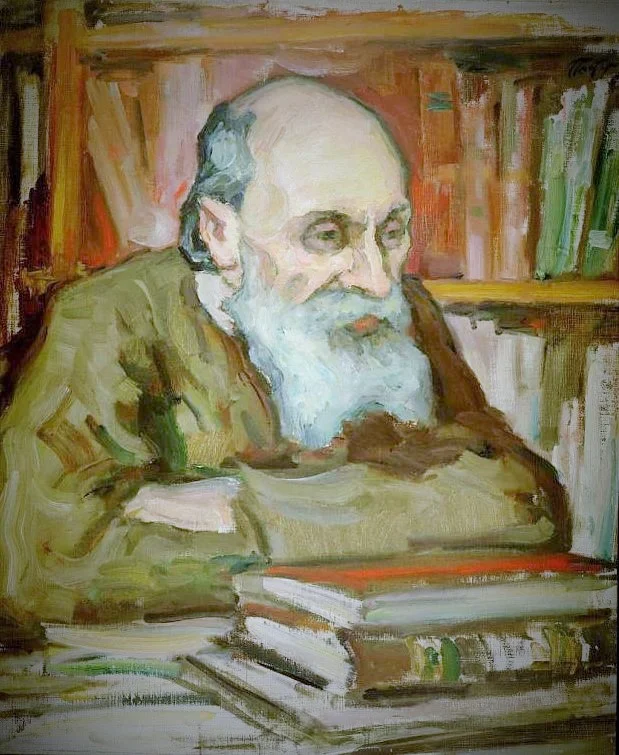
One of the forerunner of Bolshevism, Sharov, unexpectedly sees the philosopher Nikolai Fedorov. If we talk about fame, his name, of course, is inferior to both Berdyaev and Ilyin. But the influence of one of the founders of Russian cosmism and the author of the “philosophy of the common cause” should not be underestimated. As a thinker, he influenced Tolstoy, Dostoevsky, Platonov, Tsiolkovsky, Filonov, Petrov-Vodkin and others. Reflecting Christianity, Fedorov proceeded from the thesis that the true meaning of the teachings of Jesus is to build it on Earth without waiting for the afterlife, having radically transformed the planet with the help of technologies and new relationships between people, and then spread the prosperity to space. The intellectual charm and courage of Fedorov, of course, was bribed. Many thinkers and cultural figures saw communism through the prism of his teachings. In the already mentioned essay “October of the seventeenth and end of history”, Sharov emphasizes that Karl Marx himself, contrary to the declared atheism, reproduced a lot of Christian schemes in his teaching (the proletariat - as a God -chosen people, earthly life - the newcomer and sorrows, communism - the return of the fornication son and the pillowing paradise transferred to Earth).
Looking at the October Revolution through the prism of Christianity, Sharov shows a very important continuity. Bolshevik ideas lay on a soil, which seemed to be specially, for centuries have been preparing Russian history. Now the long -awaited afterlife kingdom was transferred to the earthly world. And the God -chosen people, living in a dense ring of enemies, as before, had to spread it to the entire planet. To destroy the old order to the ground, to inflate, on the mountain of the bourgeois, the world cleaning fire, so that the desired country - heavenly Jerusalem, who went down to us, appears from smoke and fog.
The dictatorship of the "proletariat" also found a suitable historical model for itself. From the last, Stalinist “revolution from above”, the country, it seems, cannot yet recover. And on the throne, another self -proclaimed “revolutionary” is already sitting. And this is not a coincidence, of course. Just models, alas, more durable than people - especially if you do not try to comprehend and get out of them. Sharov tried, but was forced to make sure of their survivability. In one of the last interviews, he said: “It seems to me that our authority believes that when people live for themselves, this state is wrong. The people should always live for the sake of high, global goals ...
Strictly speaking, we returned to imperial skiing, to how we lived in the XVII - XVIII centuries. Others no longer live like that. Secular history prevailed around the world. And we are trying to maintain a religious story. ”
And the last. In 2022, the philosopher and a long-standing acquaintance of Sharova Mikhail Epstein published an article “Satanodicia” about him. One of its heads is devoted to the hypothesis: "Alexander Dugin as the hero of the unwritten Sharovsky novel." He really really fits into the ranks of the gloomy characters of the writer. The theater director Eduard Boyakov would also look quite appropriate among them, who, in two interviews, Sobchak and Gordeeva, in fact, suggested a religious justification for the war with Ukraine. When you observe these deeply believers of the militarists, you will certainly ask yourself: how did it happen that they do not know how to make out the “sparkles of God” in the local, earthly beings and recklessly reject his creation, exchanging a large -scale and quite apocalyptic idea? Indeed, in this negligence to the living, in some fatal inability to see the secret of life in the neighbor, finally, in the inability to calmly, without tearing, to breathe in a simple “fertile” air as if the cause of Russian political misfortunes are lurking. Manipulating the “great idea”, the authorities again and again finds an excuse for crimes against its own people, and the society itself in it often finds the reason to endure.
Perhaps one of the main literary interlocutors of Sharov is Andrei Platonov, who wrote, among other things, the amazing antitotalitarian novel “Happy Moscow”. Its first half is charged with a sparkling drive of communist utopia, and the second, “Stalin”, resembles the devastating hangover and the collapse of all hopes. But there is a bright spot in this ending. Один из главных героев, выдающийся инженер Сарториус, после всех испытаний научается одной из самых сложных человеческих «вещей» — сопереживанию. Думается, таким был главный вывод жестоко разочаровавшегося в утопии Платонова. Шаров, кажется, был с ним согласен.