
Translated material
The impossibility of the second kind
Polit.ru introduces readers with books included in the long list of applicants for the Enlightener. Transportation Award of 2023. The prize for the fourth time notes the best works of editors and translators of popular science literature into Russian. In total, twenty books were included in a long list. A short list of the Enlightener. Transportation Prize will be announced until the end of September.
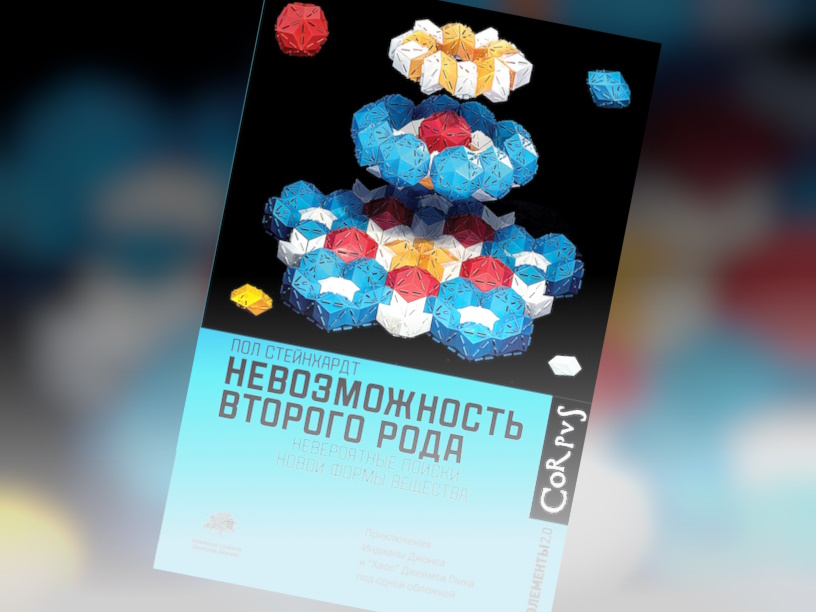
Corpus Publishing House represents a book of Princeton University of Paul Steinhardt “The impossibility of a second kind. Incredible searches for a new form of substance ”(translation by Alexander Sergeyev, editor Maxim Cherepovsky).
In this book, the story of an amazing scientific discovery is fascinating and accessible in the first person. Physicist theoretic Pol Stainhardt, professor of Princeton University, author of important cosmological theories about the early universe, in whose honor the International Mineralogical Association in 2014 called the new mineral Steinhardtt, describes how a new form of substance was found-quasicristals, with the configuration of atoms prohibited by the laws of the classical classical laws Crystallography. This is an exciting story about the origin of a new scientific direction, about the “impossibility”, which turned out to be possible, about genuine passion and desperate courage in science.
We offer to read a fragment of the book.
Lost
It is not known where, Chukotka, July 2011. In some ways, the unimaginable happened. It is difficult to find someone less suitable for participation in the expedition to remote areas of the Russian Far East, and even more so for the leadership of it. And yet I ended up here.
For the last sixteen hours I was driving in a huge caterpillar car along with a half of my team through a deserted tundra in the southeastern part of Chukotka. Finally, around midnight, we went down from a steep slope and stopped for an overnight stay near the river bank. Despite the strange and unfamiliar environment, I felt calm and balanced.
The balance was shaken at the moment when I got out of the cab and jumped from a huge all -terrain caterpillar to the ground. I suddenly began to choke. Feeling my breath, clouds of mosquitoes soared from the dirt and formed a dense cloud around my head, actually blocking oxygen to me.
I was simultaneously in despair and embarrassment. I urgently needed to breathe, but showing my vulnerability was awkward, since I was considered the head of this expedition. I tried to hide my discomfort from the rest of the team, slowly retreating to the hill behind us and continuously and unsuccessfully trying to fight off the attackers.
Desperate to restore self-control, I forced myself to focus on a series of events that somehow led to my journey for thousands of kilometers to this hellish, forgotten by God, teeming with mosquitoes.
It all started with the opening of a natural quasicristal in an unremarkable sample of the mineral, which has been dusting for years in the storage of the Italian Museum. During a first -class detective investigation, we managed to prove that the sample was part of an ancient meteorite that arose 4.5 billion years ago, before the birth of the solar system. Our alien has experienced numerous inter -star meetings and clashes, dissecting the space at a speed of more than 100,000 kilometers per hour. Finally, about 7000 years ago - about the time when people invented the wheel - he entered the atmosphere of the Earth. He declared his arrival, sintering into a skewed and drawing the sky a little south of the polar circle, and then landed in the area of the Koryak Highlands on the Chukotka, where he remained untouched for thousands of years.
In 1979, a young Soviet student named Valery Kryachko, hired to search for platinum along the channel of a stream in the middle of the Koryak Highlands, accidentally found a piece of our alien, buried in layers of mysterious blue-green clay. From that moment on, an unknown sample began its thirty -year journey, which ultimately brought it to our laboratories, where we found natural quasicristals contained in it.
And so, a few years after this opening, we returned to Chukotka with the very student who had already hit sixty -two, in search of new fragments of the meteorite.
We knew that a sample from the Florence Museum would cause disputes. The strange chemical composition of quasicristals and some crystalline metal alloys we identified contradicts the scientific principles that determine what forms of substances can exist in nature. Thus, despite all the evidence we collected, some scientists continued to doubt the natural origin of the sample.
Over the past two years, on two continents, the Florentine sample has shredded, performing all conceivable tests in order to find out the secret hidden by hitherto unheated minerals. In fact, we conducted so many tests that we destroyed the entire sample - and for further study we simply had nothing left. The only way to advance in our research was a trip to Chukotka in search of new samples.
I was so close to the proof of the existence of natural quasicrists that I had no choice. I just had to go to Chukotka! Isn't it?
Although I was still choking, fighting off the swarm of insects and swallowing air in small portions, this course of thought began to reassure me.
And then a real tsunami panic surged over me, when a truly terrifying thought appeared in my head. The second car, on which the other half of our team rode, including my youngest son Will, still did not appear.
Two cars walked together most of the day, but the all -terrain vehicle Will suffered from technical problems and disappeared from sight a few hours ago. Our driver suggested that he was just a little behind and was still riding somewhere behind us outside our field of view. But in this case, he would have already caught up with us.
I stood alone at the top of the Chukchi hill, inside me everything clenched, my head was spinning. I desperately needed at least some sign of Will's presence and the rest of my team. In me, an all -up -bearing feeling of guilt grew. Too often, I challenged the impossible, and then one day it led to the terrifying consequences: I dangerous the life of my own son and probably lost half of my team.
One by one, I ignored the clearly expressed warnings of a variety of experts. Search for new samples is hopeless. A trip to such a distant region is not worth the risk. This expedition will never receive funding. It is impossible to assemble the team in just a few months. You turned somewhere in your investigation. Such a person like you recklessly go on this journey. It is still impossible to get there.
Hopelessly. Several geologists told me that the chance to find another piece of our meteorite in the endless void of Chukotka is less than a chance to find a notorious needle in a haystack.
Have you seen the card, Paul? There is nothing to talk about here. After all, you don’t even have GPS coordinates of the initial excavation site, right? Colleagues warned me that I trust the sixty -year -old Russian scientist too much and his memories of important details of a long -standing event, which did not have much significance for him then. Even if Valery Kryachko is able to lead us to the place where he found fragments of the meteorite more than thirty years ago, that everyone considered unlikely, the chance to find additional material of the same meteorite is infinitely small, since tiny fragments are very scattered and it will be difficult to distinguish from millions of others in the area. No geologist in their right mind will spend time and resources on such a crazy enterprise.
I had to admit that our chances of success are close to zero. But at the same time, they were not zero. And while there was a non -equal chance to find more samples and reveal the secret of their origin, we had no other choice, except to stubbornly continue the search. The time of bringing the plan into action was determined by the readiness and desire of Valery, the only person in the world that can indicate to us the source, to go with us. It was a situation from the series "now or never." Or I just convinced myself of this.
There is no risk; Stop until it's too late. I received such responses from several influential physicists. Luka Bindy and I should be satisfied with what they achieved, they insisted. Our article in Science has already convinced almost the entire scientific community of the existence of natural quasicristals. Why go to Chukotka, risking to return empty -handed or, even worse, to find new data that contradicts earlier? A similar outcome can only inspire those few skeptics that still doubt our conclusions, and sow grains of doubts about our entire study.
I understood that an unsuccessful expedition was able to undermine our reputation. But for almost three decades I searched for quasicristals considered impossible and, as a result, became quite resistant to skepticism of other scientists. My Italian colleague Luke Bindy felt the same - our general perseverance has repeatedly drove us out. However, it also made it possible to make several amazing discoveries, and I was not ready to put the end to all this. It was impossible to allow the fear of failure to prevent us from doing everything possible to resolve the remaining scientific riddles.
Nefinancing. Where to get the money for such an absurd expedition? Such was a universal reaction.
Funds would never have provided funds, relying only on a confusing detective history, the memories of an unknown Russian mineralog of thirty years ago and several microscopic grains of the material. The risk of failure was too great.
As everyone predicted, I received categorically negative answers from the National Scientific Fund, the Ministry of Energy, the American Museum of Natural History, the Smithsonian Institute, the National Geographical Society and other well -known funding organizations. All of them made it clear that it makes no sense to even submit a formal application.
I did not expect that some of the usual financing agencies would consider my request, so I was ready for all these negative reactions. It was also not surprised that my employer refused to help - Princeton University. I knew that the university had many other priorities and that he, as a rule, focused on less risky projects that bring direct benefits to students on the campus.
The only thing I could hope for is to find a rich and generous philanthropist. But, before looking for such a person, it was necessary to get permission for this. Princeton, like most American universities, forbids teachers to attract private donations, as this can interfere with the efforts of the University for Collection of funds.
Knowing this, I asked if I could take the search for funds with a strict condition that I can prove: my benefactor never considered the possibility of donating to Princeton University for any goals other than supporting my expedition. The leadership considered that it was impossible to find a person who would not be interested in Princeton, but would be ready to invest in a separate project under his auspices. Perhaps that is why I was allowed to try.
They must have been amazed when three days later I called the development department and said that I had found a candidate. I had a wonderful donor who had nothing to do with Princeton and ready to provide me with 50,000 dollars necessary for the expedition. After several weeks of studying the issue, the administration agreed that, to their great surprise, I fulfilled the terms of the transaction. The donation was made to the university for my expedition.
A few months later, when our predicted expenses increased sharply due to a significant change in transportation plans, I was forced to return to my philanthropist with a request for additional support. I was struck by his reaction. Without hesitation for a second, he kindly agreed to cover the overspending, which is more than twice as much as my initial assessment.
To this day I admire the unusual modesty of my benefactor, who wished to remain anonymous. I gratefully call him “Dave” and declare a real friend of science.
Unattainable. Why are you getting involved in this? So all geologists who had experience in Russia, with whom I had to speak, reacted. All this is much more complicated than you think, Paul. Your plan is unrealistic. You can never assemble a team of qualified specialists in such a short time. In addition, Chukotka is a forbidden zone - do you know that a number of approvals and permits from the Russian government will be required to only get closer to this place? 1 It is impossible to accelerate this process. What a naive spotlight!
The criticism was fair. It was required to recruit a highly qualified team, whose members would agree to abandon all their plans in order to join the expedition. Ten months seemed not enough for negotiations with the Russian side because of the bureaucracy that reigned there, famous for its confusing. We needed permission from the Russian government in Moscow, the regional government on Chukotka, the Russian military, as well as the FSB - the Russian Security Service. Visitors to this region were thoroughly checked, since historically Russia has always emphasized the strategic significance of its Far Eastern borders.
Having passed through all this, it was also necessary to organize a Russian city closest to the place of excavations for all the excavations with a decent airport, purchase food for several weeks, assemble equipment and figure out how to deliver our team from anadyr to a remote destination on Listenitov’s stream.
Not all at once, I told myself. My first task was to find specialists who were ready to go on an expedition, which many of their colleagues considered reckless.
I immediately wrote by e -mail the Russian geologist Valery Kryachko. He was the most important member of the team, because the only one knew how to find the right point - the place of detection of the Florentine model. A strong man with a thick gray beard, Valery had many years of experience in the field and was a very active, resourceful and self -sufficient person. Fortunately, he not only agreed to go, but was also ready to do everything in his power, for the sake of the success of the expedition.
I also turned to Vadim Distler, who several decades ago was the supervisor of Valery. I knew that during this time they took together several expeditions to Chukotka in search of valuable ores and minerals. A pleasant, friendly and constantly smoking like a steam locomotive Vadim was already in eighty.
Vadim hired Marina Yudovskaya, an experienced and savvy field geologist, who recently replaced him as the head of the department at the Moscow Mining Institute. She was the daughter of two geologists from Kazakhstan. Blonde and lanching, with a slight relaxed smile, she was the only Russian -speaking composition who spoke freely in English.
These three Russians knew each other well and worked together for many years. But I had to collect the rest of the team from scratch.
Luke Bindy's participation was mandatory. More than two years have passed since he discovered an original sample lost in the storage of his museum. Luke was the only person who happened to study the desired breed in its original condition, before the sample was cut and crushed to complete unrecognizability for the study of the study. Experience with the initial model, combined with sharp vision and good motor skills, forced to lay all the hopes for the detection of new meteorite grains in a leafy stream.
Onion, to put it mildly, hesitated about participation in the expedition. He reminded me that he was not a field geologist at all. So I had to show extraordinary perseverance to convince him to go. I was glad when he eventually agreed, because he trusted his opinion, and by that time we had become big friends. This journey gave us another opportunity for a tight joint work on our already truly epic project.
My Princeton colleague and former member of the Red Team Lincoln Holter, who had a life full of geological expeditions, also had on the list of my candidates. Lincoln really wanted to go and would be an extremely valuable member of the team. He had many years of experience in difficult field conditions. However, at that time Lincoln suffered from acute, albeit temporary, health problems, and he considered it too high that he might need emergency medical care when we will be in a remote area where such help is not available. He himself was the first to admit that such an incident could jeopardize the entire expedition. Disappointed with the need for refusal, Lincoln agreed to become my adviser and help plan the expedition. He also attracted three candidates for whom he could personally vouch: Glenna MacPherson, Chris Andronikos and Mike Eddie.
Glenn was an obvious candidate. Being one of the former members of our red team, he was well acquainted with the study. It seemed ideal to take as an expert on meteorites of our former “enemy” from the red team. No one was better prepared to verify and evaluate our work than Glenn.
Chris Andronikos received a degree in Princeton under the scientific leadership of Lincoln. He was a specialist in powerful geological forces that create mountains, cause earthquakes, give rise to faults, bend and destroy the rocks. He also had an extensive experience in different parts of the world, including the coastal ridge of British Colombia, Al-Hajar Mountains in Oman and other areas with rocks and formations similar to those that we expected to find on Chukotka. Chris turned out to be thoughtful, clearly formulating his thoughts to scientists with extensive experience and a creative mind. Possessing a strong addition and rich field experience, he felt in the wild at home.
The third candidate of Lincoln was Mike Eddie, an outstanding student who finished Princeton with a degree in geological and geophysical sciences and in the fall went to graduate school of the Massachusetts Technological Institute. Mike was naturally well complicated, thinning both the musculist, and even during the bachelor's period he set several athletics records. A year earlier, he carried out field geological work in the Aleutian Islands near the Alaska Peninsula, not far from the places where we were sent. In addition to mental abilities, we could count on his physical strength, which will be needed in excavations.
Glenn MacPherson and Mike Eddie quickly accepted my invitation. However, Chris Andronikos hesitated. That summer, he carried out extensive field work in the Sultanate of Oman, and an unexpected departure to Chukotka would interrupt his research. But this was not the only reason for his doubts about participation in the expedition.
“Honestly,” Chris told me, “I am skeptical about meteorite theory. If I join, then only for the compilation of a local geological map in search of evidence of the hypothesis of earthly origin, such as super -plums and other unusual geological factors that could better explain how the Florentine model was formed. ”
1. According to the Decree of the Government of the Russian Federation No. 1641 of December 27, 1997, the entire territory of the Chukchi Autonomous Okrug was declared "a territory with a regulated visit for foreign citizens." Also, at the time of the expedition in the capital of Chukotka, the city of Anadyr acted the regime of the border zone.
Earlier, in the section “Slow Reading”, the following books were presented, included in the long list of the Enlightener. Transportation Prize:
Peter Godfri-Smit. Metazoa: The origin of the mind in the animal world / Per. from English: Galina Borodina; Scientific editors Anna Vinkelman, Mikhail Nikitin; Editor Andrey Zakharov. M.: Alpina Non-Fikshn, 2023.
Siddhartha Mukerji. Gene. Very personal story / Per. from English: Olga Volkova, Ksenia Saifulina; Editor Olga Volkova. M.: Corpus, 2023.
Sarah Manning Peskin. In the molecule from madness: stories about how the brain breaks / per. from English: Anastasia Smirnova; Scientific editor Olga Ivashkina, editor Ekaterina Ivankevich. M.: Alpina Plisher, 2023.
Marta Nussbaum. Political emotions: why love is important for justice / Per. from English: Sofya Porfiryeva; Scientific editor Dmitry Turko, episode editor Arseniy Kumankov. M.: New Literary Review, 2023.
Roland Paulsen. What if? .. Anxiety: how she controls us, and we - she/ per. from the Swede: Elena Teplyashina; Scientific editor Polina Tsygankova, editor Alexei Andreev. M.: Livibuk, 2023.
GERLLINDE PAUER-STUDER, J. David Welleman. Conrad Morgen: Conscience of the Nazi judge / Per. from English: Yuri Chizhov; Scientific editor Dmitry Gurin, editor Natalya Narcisssoa. M.: Alpina Non-Fikshn, 2023.
Anil set. Be yourself: a new theory of consciousness / Per. from English: Maria ten; Scientific editor Olga Ivashkin, editor Natalya Narcisssoa. M.: Alpina Non-Fikshn, 2023.
Nicholas Stargardt. Mobilized nation: Germany 1939–1945 / Per. from English: Alexander Colin; Scientific editor Anton Zakharov, editor Anna Zakharova. M.: Hummingbird, ABC-Atticus, 2023.
Yan Chunnyan. Millennium of imperial ceramics / Per. from Kit.: Olga Fituni, Dmitry Khudyakov, Viktor Stepanenko, Maria Sukhorukova, Anastasia Korshunova; Scientific editor Vera Belozerova, editor -in -chief Alexander Matveeva, responsible editor of Delgir Lidzhieva. M.: LLC "International Publishing Company" Chance ", 2022.
Robin George Andrews. Supervolkans. The unexpected truth about the most mysterious geological formations of the Universe / Per. from English: Valentin Frolov; Responsible editor Anna Zakharova, editor Oleg Bocharnikov. M.: Hummingbird, ABC-Atticus, 2023.
David Anthony. A horse, a wheel and a tongue: as a bronze age riders from the Eurasian steppes formed a modern world / Per. from English: Andrey Fomenko; Scientific editor Anton Ryabov, Literary Editor Konstantin Zalessky. M.: Ed. House of Higher School of Economics, 2023.