
Translated material
The utopian horizon is littered
About the book “Beyond the Secular Order”
For 30 years now, Anglican theologian John Milbank has been waging an implacable battle with the modern world, using the means of what he himself calls radical orthodoxy. Albert Sarkisyants explains why the last of his books, translated into Russian, deserves to be read despite the unreadable style.
All of us, since February 24, 2022, have found ourselves in the face of advancing barbarity, violence and lies. In this situation, it is extremely important to preserve at least the remnants of culture and support the values of humanism - including for the sake of the future of Russia. Therefore, the editors of Gorky will continue to talk about books, reminding our readers that there is still a place for thought and fiction in the world.
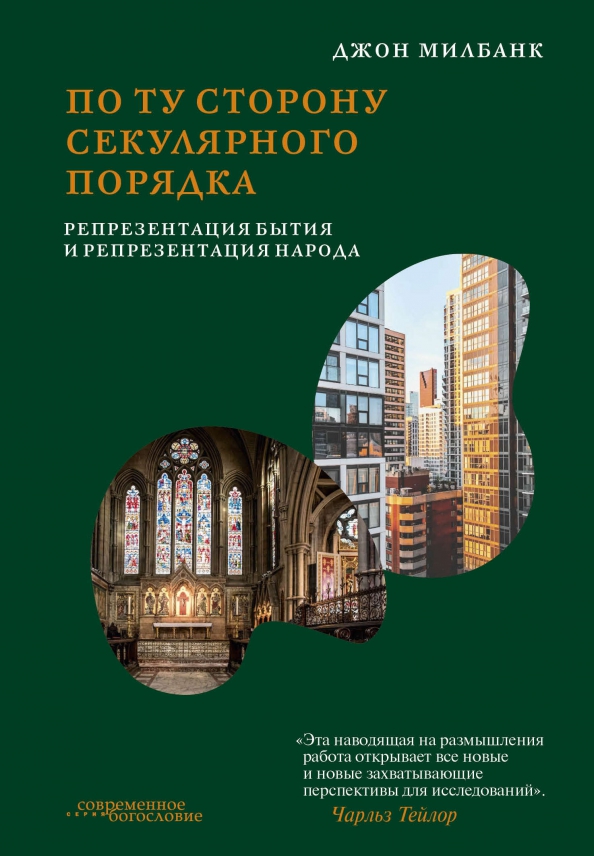
John Milbank. Beyond the secular order: representation of being and representation of the people. M.: BBI Publishing House; Theoesthetics, 2023. Translation from English by A. Kyrlezhev; edited by A. Gaginsky. Content
Beyond the Secular Order, like Milbank's other books, is almost impossible to comment on alone. In almost every text he subjects an incredible number of theologians, sociologists, philosophers, political theorists to radical orthodoxy, and it would take an army of specialists from the relevant fields to test whether his criticism is missing the mark. I do not form an army, at least an army of specialists, so I will immediately make a reservation that I will limit my commentary to the area closest to me - political philosophy.
So, we have before us a book that lends itself poorly to coherent presentation. It whirls around the political, moral, existential and other consequences of scholastic errors, as a result of which the modern world prefers “univocality” to “analogy”, “representation” to “identity”, “possibilism” to “actualism”, “coincidence” to “influence”. The consequences of these sad and disastrous preferences manifest themselves in, among other things, nihilism, fanaticism, fideism, neoliberalism, the debasement of the body and its feverish liberation, liberalism and conservatism, etc. (but not socialism, Milbank is for socialism!). So, why is such a book still worth reading? (Everyone except specialists in the scholastic tradition, since they will probably refuse now or, having already encountered the author in the past, will prefer not to repeat this experience.)
Milbank demonstrates something important about the powers and paths of modern critical thought, namely, that under its fire, after “anthropocentrism”, “subject”, “modernity”, etc., “secularity” itself, which, as a rule, is genealogically linked with the history and fate of critical reason itself, necessarily falls under its fire. The main thesis of RO, stated in the book “Theology and Social Theory” (1990, translated into Russian last year), reads: the autonomous sphere of consciousness, materiality, politics, sociality, etc. is not the fruit of a long-awaited deliverance from the dominance of theology, but a kind of aberration of the Christian theological view, which could not maintain its original height. All of them are negative creations that rest on pure nothingness not supported by God, contradictory, controlled by arbitrary power that can only discipline, subordinate and manipulate.
It is not surprising that in the new wars of all against all, where the victims of Modernity take the floor, theology, one of its very first and most tormented victims, did not want to sit idly by. At the very least, representatives of the Christian tradition, who consider themselves the most affected, are not sitting idly by. Milbank defends the exclusive right of theology to criticize Modernity, since it is theology that preserves its foundations, the consequences of which we are dealing with today. But it is how radical orthodoxy traces and records these consequences that raises the most questions. The book is divided into two parts: the first is devoted to the analysis of the products (false and unorthodox, from the author’s point of view) of theological and philosophical choices in the field of knowledge and ideas about reality and nature, the second - the field of politics and ideas about human sociality. I will only touch on the second part; I note that Milbank himself is inclined to reduce everything to the political and claims a radical re-theologization of modern societies.
One of Milbank's main targets is the concept of "sovereignty." Here he draws closer to the anti-theological left, which imagines sovereignty - in vain and due to excessive trust in Schmitt - as a product of theology (see for example ). Milbank also defends the thesis that sovereignty is an invention of theology, but an erroneous theology. It is a product of nominalistic Christianity, which has removed God from creation, leaving the world to the manipulation of an aimless disciplinary power:
“ what seems secular in modern ontology in general and in political ontology in particular, in fact stems from special trends in theology that are questionable from the point of view of the genuine Christian tradition.”
That is, according to Milbank, Modernity is infected with theology and has theological origins, and the source of this infection is false, unorthodox theology. European civilization of the last seven centuries is at its core a negativist product, since the theology that gave rise to it separated the earthly City from transcendental goals and participation in divine perfection, becoming a destructive force in relation to true Christianity, which emphasizes the participation of all creation in God.
In this respect, Milbank's narrative overlaps with the narratives of German thinkers who insisted on the "gnostic" nature of Modernity, meaning by "gnosticism" the internal disease of Christianity (see Eric Voegelin's The New Science of Politics, to which Milbank refers favorably, although not without reservations). This refers to the periodic inability inherent in Christianity to keep the Earthly City in its orbit, as a result of which it falls into the hands of godless, but dexterous forces capable of curbing human nature, which has fallen away from God. Although Milbank does not use a “gnostic narrative,” at crucial points in his presentation of his “political theology,” he speaks of Marcionism, one of the earliest and most powerful Gnostic enemies of Christianity, which supposedly always lies in wait for it as some kind of timeless entity. The special danger of Marcionism is that it denies the mediating role of political government in the cause of human salvation. Both Milbank and Voegelin, wanting to remain Christian but trying to overcome the vacuum that Christianity tends to leave in the place of political power, see the solution in a partial "bewitching" of the world, a narrowing of the gap between the divine and the worldly, the theologization of politics and secular government.
“In many ways, the main theological problem today concerns the question of how consistent with the nature of Christianity itself is the historically attested Christian tendency towards disenchanted cosmologies. Could it be that, despite Christianity’s just and beneficial break with fetishism and its suspicious attitude towards pagan metonymic-synecdochic self-closure, this religion in its liturgical and sacramental core proposed a stronger enchantment, touching even the Absolute (albeit through a cult established by itself) and therefore capable of including, summing up and perfecting all local enchantments that she must respect willy-nilly by virtue of her own incarnational logic?
Christianity, continues Milbank, offers the whole creation a “common theurgic shell” so that the world does not fall into that very secular cage where any manipulations with man and all other creatures are possible. Whatever this “theurgic sheath” means, we will add. But is it not this same “common theurgic shell” that many intellectual projects, new materialisms and “posthuman” anthropologies strive for, focusing on a more distributed participation of all the total “pulsating matter” in a certain liturgical-figurative politics? And are not attempts to bridge the gap between nature/culture, body/semiosis, the order of political power and bare life consonant with the Christian proclamation that “the word became flesh” (i.e., that same “incarnational logic” from the passage quoted above)? Is there not in this purely secular attempt to once again inscribe man into a newly sanctified world a trace of the “participatory,” “caritative” Christianity to which Milbank appeals? After all, what is the use of affectivity, physicality, participation, etc., if they are unable to lead to the trail of the One who once showed the path to salvation with his suffering flesh and was himself this path? Instead of the modern oscillation between the liberation and restraint of nature, that is, between the left-wing emancipation of the body and its right-wing suppression, Milbank proposes to connect animality and the caritative love found in grace, and then moves on to demand some kind of unity of state and church (!). Perhaps, if you try to reduce “Beyond the Secular Order” to a bunch of theses, then it will include just this connection and a semi-Byzantine symphony ( “the earthly king is truly granted a share in the divine rule” ).
What is not found in the book is a description of exactly what the institutional embodiment of the stated political ideals should look like in our post-modernity. The author confines himself to the fact that he obsessively proves: realistic ontology and positive anthropology, flavored with a craving for the supernatural, are better than nominalistic ontology and negative anthropology. Better because they more truly express the true purpose and structure of man, which Milbank, of course, drew from realist ontology and positive, flavored with a desire for the supernatural anthropology. They are also better because they are more orthodox.
The author's commitment to correct ontologies and anthropologies so dominates the Christian component of his perspective that everything in Christianity that affirms the doom and passing image of this world, as well as the “individualizing” and personalizing aspect of Christianity (see the wonderful critique of political theology) is simply ignored. This is why Milbank insists on a well-ordered Christendom, in which, it can be assumed, orthodox Christianity will be so completely embodied in the overall institutional design that nothing else will be required. The idea of Christianity without Christendom is self-deception and a superficial illusion , says Milbank, attacking the line of Christian thought represented by Kierkegaard, D. Bonhoeffer and S. Weil. Therefore, his thought often merges with the thought of conservatives and critics of Modernity, who were not seen as partial to orthodoxy (L. Strauss, E. Voegelin, H. Arendt). In other words, the author’s claim to the destruction of the secular collapses into repeatedly voiced illiberal criticism, whose ideal is the ancient polis rather than the church, although some researchers have successfully found analogies between them (see, for example ).
It seems that Milbank is fitting Christianity into his Aristotelian ideal of polity, reducing the degree of scandalousness of the Christian message and trying to present this ideal as an alternative to Modernity. At the same time, the author does not show us how his ideals allow us to solve the problems of a rebellious world - as if the world has no special problems, except that we consider it not good enough and do not want to take part in the universal cosmic liturgy. For example, the problem of “crooked timber, like the one from which man is made” (according to Kant), and violent passions, Milbank removes with the following statement: “ under the power of caritative love, we no longer strive to restrain our passions […] our passions are now correctly directed and no longer need to be suppressed, which was a Sisyphean task.” There is, of course, nothing wrong with redirecting passions through caritative love, exactly the opposite, but don’t we again come to the conclusion that true Christians do not need disciplinary power? But where can we find so many true Christians? That's why you need a stick...
As if to remove possible complaints about the lack of Christianity itself, Milbank puts forward the Church as the beginning and end of humanity:
“The Church is categorically not, from a theological point of view, some kind of additional religious organization to which some people belong; it is rather the sine qua non of the existence of human society as such and therefore of the existence of humanity as such: nulla humanitas extra ecclesiam (there is no humanity outside the Church).
That is, the church enters into the general economy of human existence, completing it in itself as a community of love.
And here, retreating from criticism, I would like to take this statement seriously. Despite the theocratic spirit, it does not seem crazy if we consider it one of the possible answers to the question : should the structure of our society embodied the desire of people to participate in all of creation and should this structure reflect their desire for salvation, grace and other things that lead them out of the state of indifferent plurality and default “humanity”? The question itself may seem provocative, but the negative answer to it is not so obvious.
We could say that such aspirations, no matter what you call them, are always aspirations for the impossible - they say, they are in a “utopian horizon”, which is also filled up. We can add that the project of “emancipation” takes on the corresponding role. And yet: should political order generally be consistent with what we as people consider in ourselves (or outside ourselves, which is more consistent with the Christian view) to be most significant? If not, what do we have against biopolitics, sovereignty, disciplinary power, capitalism, liberal democracy, nihilism, the reduction of the body to bare life, etc.? We can answer with an unequivocal “no” only if we consider the world and human society to be a space of forced stay, from which we will soon free ourselves. And again, isn’t there some (bad) theology in such a negative answer? After all, don't we ourselves know from experience that consensus around a purely negative idea of "order" and contempt for people's abilities (except the ability to obey and enrich themselves) leads to disaster - for example, in the form of mass suicide and forced death? One can reject Milbank’s decision ( “the political <...> must surpass itself through gradual full inclusion in the church ”), but it is necessary to have one’s own.
In conclusion, distorting Marx, one could say: the criticism of religion is over, the criticism of religion (genetivus subiectivus) has begun. Despite all the legitimate complaints against Milbank, of which I have identified an insignificant share, the RO project is intriguing in its attempt to rewrite the history of Modernity and secularity from the point of view of the theology they oppressed, an attempt to make theology an equal participant in the dispute about the redistribution of the modern heritage (however, theology wants to take everything, but who doesn’t?).
My comment was no less confusing than the book itself. I will conclude with words of gratitude to the translator and editor for the work done: I assure future readers of this work by Milbank that all the misfortunes that await you while reading are not from them.