
Translated material
Real life of the Creator Realpolitik
About the new biography of Bismarck
In the ZhZL series, a book about Otto von Bismarke - politics, which is not deprived of biographies, was published. Why the work of Germanist Nikolai Vlasov is not only the best biography of the Iron Chancellor in Russian, but also a labor that can interest even a German reader, says economist and political scientist Dmitry Travin.Starting from February 24, 2022, we were all in the face of the advancing barbarism, violence and lies. In this situation, it is extremely important to preserve at least the remnants of culture and support the values of humanism - including for the sake of the future of Russia. Therefore, the editorial office of Gorky will continue to talk about books, reminding our readers that the world remains in the world and fiction.
Nikolai Vlasov. Bismarck. M.: Young Guard, 2023. Content
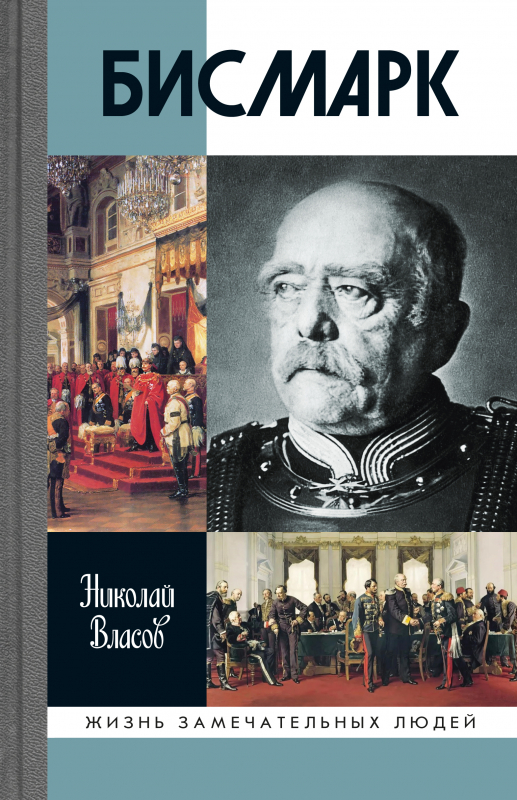 The book of Nikolai Vlasov, one of the best St. Petersburg Germanists, candidate of historical sciences, associate professor of the faculty of international relations of St. Petersburg State University, was written simply, interesting and understandable, without science boring, often found in the writings of some Russian scientists. But the book fully is the scientific biography of Bismarck, and its scientificity is determined not only and not so much a large volume of read literature in different languages, but how skillfully and interesting the author uses the material collected. For example, it would seem, a trifle: the characteristic of the Bismarck wife given in the third chapter of the study. Before forming his own judgment, Vlasov considers the assessments given to this lady in three German -speaking books. In one she appears to be a rural simpleton, in the other a smart and developed woman, in the third - an evil Megor. The author convincingly demonstrates a personal view of the problem, but at the same time makes it clear to the reader that in science there is no unity on this problem, and the one who reads in German will be able, if desired, to independently get more information about this heroine. In the same way, Vlasov throughout the book analyzes the various points of the biography of Bismarck himself, looks at his hero through the eyes of various authors, and then comes to his own conclusions. Vlasov demonstrates a deep knowledge of the works of his predecessors, but not only passively followed by them, but analyzes what they made so original that, I think, his book could be interesting to the “spoiled by Bismarck” to the German reader.
Steps of the Almighty
And here is another example. And this is definitely not a trifle. Vlasov enters into a polemic with those biographers of the “Iron Chancellor”, which “tend to consider all his actions on the political stage, like deeply thought out, rational and perfectly calculated maneuvers.” There is no reason for such idealization. Bismarck often made mistakes (for example, with cultural camps, the introduction of universal suffrage or with the control over the legislative activities of the Reichstag), and in the Book of Vlasov about them is no less details about the successes of the outstanding German politician. Moreover, the author clearly formulates an important methodological approach, the value of which, in my opinion, goes beyond the bismar of Bismarck, and indeed a biographical genre in scientific literature. Transformations in state activities are possible only when, for objective reasons, a peculiar window of political capabilities appears. This “window” cannot independently cut down at a convenient moment even the greatest figure. You can not "by order" to carry out important reforms or unite the lands. The greatness of the policy is manifested in the fact that it is able to discern the suddenly opened window of opportunities, to understand that it is quite suitable for solving important problems, and to solve these problems quickly, clearly and effectively until the window has closed. From these positions, Vlasov analyzes the activity of his hero. And from these positions, it seems that it is worth analyzing the activities of any politicians, if we want to write not Pasquvili or Panegyrics, but true scientific biographies that give the reader an understanding of real history.
Bismarck himself was well aware of the limitations of his capabilities, and Vlasov clearly shows in the tenth chapter of his book. There are several statements of the Iron Chancellor on this subject, but the most colorful is probably the following: “You can’t create anything yourself. One can only expect until the steps of the Almighty are heard, and then jump and grab the edge of his clothes - this is the whole point. ” Bismarck did not have cunning many ways that are so well -perceived when reading novels about politics, but not working in practice. But Bismarck tried to keep the most possible number of ways to achieve the goal. “Politics, he said, is not a science, but art; It depends a lot here on talent and intuition, the ability to weigh probability; Here "everything rests on assumptions and accidents." Demonstrating this throughout his book, Vlasov demonstrates to us a real Bismarck, and not the mythical, to which many readers of popular literature are accustomed to.
“Most of the major political achievements in history took place precisely due to the presence of the corresponding“ windows of opportunities, ”N. Vlasov notes, completing the fourth chapter of the book. - In the life of Bismarck, there were two such “windows”. The first - the German revolution of 1848-1849 - allowed him to rapidly begin a political and diplomatic career. The second-the international situation in Europe of the 1860s-presented an objective opportunity to create an German empire from the placers of the principalities. " Unlike many biographies built so that it seems to the reader that the hero from the diapers was preparing to fulfill the Great Mission, Bismarck’s biography under Vlasov’s pen becomes an illustration of thought about “windows of possibilities”. We see that the childhood and youth of this German junker could, in a different alignment of political forces, bring him to a completely different life, far from epoch -making achievements. The Iron Chancellor turned out to be a product of not only its own efforts, but also successfully established external circumstances.
The main such circumstance was the consequences of the Crimean war. It is clear that they were not rigidly predetermined and depended on the military luck of the rivals and on the political position of the abused states. “To a leading position,” writes Vlasov, “France advanced, Austria was almost completely isolate, and Russia weakened its foreign policy activity for some time. <...> The “window of opportunities” was formed for serious changes in the European balance, and it was these opportunities that Bismarck used it several years later. ”
Having outlined the background on which Bismarck acted, the author shows what the talents of the Iron Chancellor and its peculiarity as a politician were actually manifested. The word Realpolitik is well known to many of us, but far from always the reader of certain books understand how real politics differs from the “unreal” or any other. And far from always the reader, who is ready to extol Bismarck, understands what he, as the creator of this very Realpolitik, actually differed from his colleagues in the Midovsky “workshop”. “During foreign policy,” N. Vlasov in the fifth chapter notes, “the state does not only have the right, but is obliged to be guided primarily by quite specific interests, and not by common principles. <...> Prussian conservatives were supporters of the monarchical solidarity and the Union of Three Black Orls - Russia, Austria and Prussia - directed against the revolution and to preserve existing orders. For Bismarck, the main goal was the dominance of Prussia in Germany, which required a change in the current balance. State egoism was for him the basis of the foreign policy, the goal was above values and principles and determined the means. ”
I wanted the best, but it turned out as always
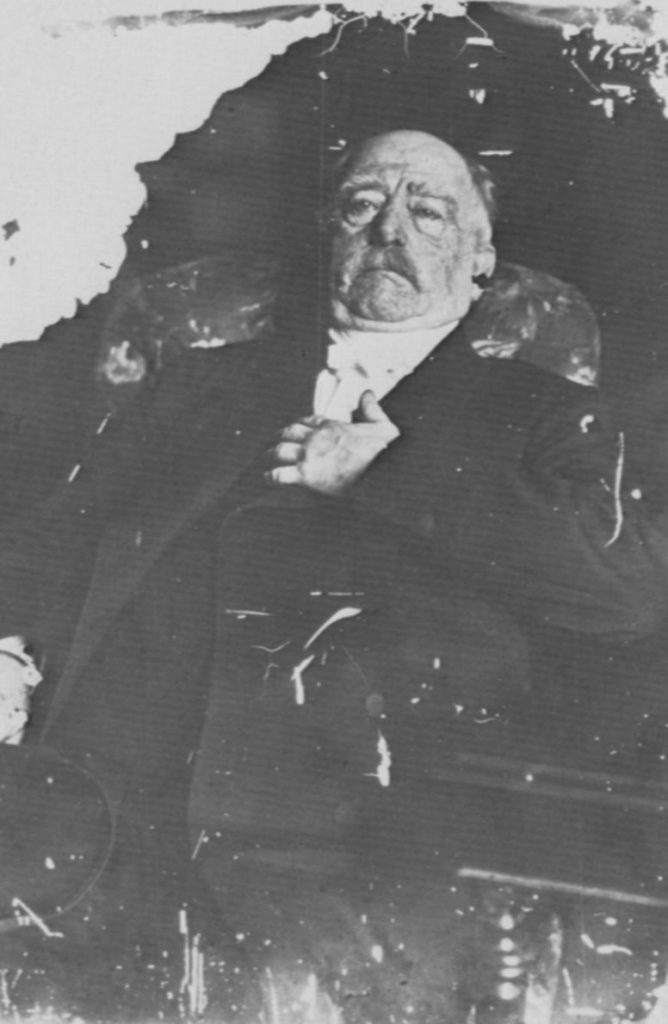 © Franz von lenbach
The book of Nikolai Vlasov is good and very useful for any reader: both for one who first gets acquainted with Bismarck’s biography, and for the one who, say, how I read the biographies written by Emile Ludwig and Vadim Chubinsky, as well as the memoirs of the Iron Chancellor himself. There are, however, places where it is difficult for me to agree with Vlasov. For example, he disputes the opinion that was widespread in the literature that Bismarck was not strong in economic matters. Vlasov notes that “Bismarck often came into contact with this sphere, and in its most diverse mortgages: from negotiations on customs issues to communication with bankers in personal financial matters. <...> If in the era of the revolution Bismarck considered modern industry an almost painful growth, then in the 1850s he began to pay due attention to new trends in the economy, the development of industry and the banking sector. Having later become the head of government, he also demonstrated a rather adequate understanding of economic factors in the life of the country. ”
All this is absolutely true. Bismarck, of course, was not a profane in economic matters. But still, interest in industry and banks is not identical to a good understanding of the essence of economic policy. It seems that the Iron Chancellor, radically changing the customs strategy and abandoning the fruit breeding in the middle of the 19th century, simply put the economy in foreign policy, not very thinking about the long-term interests of German society and about the welfare of the Germans (in Berlin, the bread was much more than in Budapest, Amsterdam or Amsterdam or Amsterdam or Amsterdam or Amsterdam or Amsterdam or Amsterdam or Amsterdama or Amsterdama or Amsterdam or Amsterdama or Amsterdama or Amsterdam or Amsterdam New York). Vlasov himself in the thirteenth chapter clearly shows that the collection of customs duties and indirect taxes was important Bismarck to strengthen the positions of central authority and gain independence from “matricular contributions” from individual German states that were part of the Second Reich. I will add to this that in the economy any measure is a stick about the two -edges. And what is beneficial to the state may be unprofitable for the country. It seems that these “system liberals” understood this (for example, Otto von Camphausen, Arthur Hobrecht, Karl Rudolf Friedenal), which, as Vlasov shows, began to leave Bismarck during a change in economic policy in the 1870s. But it was the liberals that were the creators of the policy that made the Prussian economy strong enough for the military victories of the 1860s!
Of course, we must admit that in the era of Bismarck, protectionism was rapidly entering fashion. Especially in Germany, who sought to catch up with its Western neighbors. It is possible that the head of the German government, hoping for the customs "baton", which allows to deal with too competitive neighbors, was sincerely mistaken. He wanted how to better, but it turned out, as always (if we recall the winged expression of another head of government - our Viktor Chernomyrdin). I do not presume to judge the motivation of Bismarck (Nikolai Vlasov will figure it out much better than me), but it must be noted that his successor Leo von Caprii tried to slow down Germany to sliding down to protectionism. Moreover, from the standpoint of the modern economic theory of rights, it was Kaprivi, not Bismarck. It seems that Vlasova’s book would have won if the author tried to seriously analyze these problems. I understand that the mass reader, picking up a biography of Bismarck in his hands, is more likely to entertaining foreign policy intrigues than to “boring” economic matters, but such an addition is clearly required for such a qualitatively written scientific biography.
In all specific issues related to the activities of his hero, Vlasov was extremely convincing for me as a reader. I would like to constantly return to the reviewed book (and the book of Nikolai Vlasov “Russia through the eyes of Bismarck”), even in cases where you reflect on some modern issues of the formation of large states, the accession of lands and the restoration of empires. But I cannot agree with the general conclusion contained in the afterword that Bismarck was, perhaps, the most outstanding statesman throughout the 19th century. Even if we are talking only about Germany, then rather, Baron von Stein and Prince von Gardenberg, the predecessors of Bismarck, who played a most important role in the abolition of serfdom and carry out land reform in Prussia, should be put on the first place. The role of these political figures is not too well known in Germany (as, indeed, we have wide masses prefer Peter I with his conquests to Alexander II with his liberation policy), and in Russia there is neither scientific, nor the semi -scientific, nor even the journalistic biography of these reformers. It seems that if Nikolai Vlasov, who, in addition to the biography of Bismarck, also wrote a biography of Helmut von Moltke, would have taken up Stein and Gardenberg, the result would be very good and, perhaps, would have adjusted even the conclusion from the current book that caused me doubt.