
Translated material
Tbilisi instead of Granada
Baku and Yerevan choose guarantors of future agreements and a platform for peace negotiations
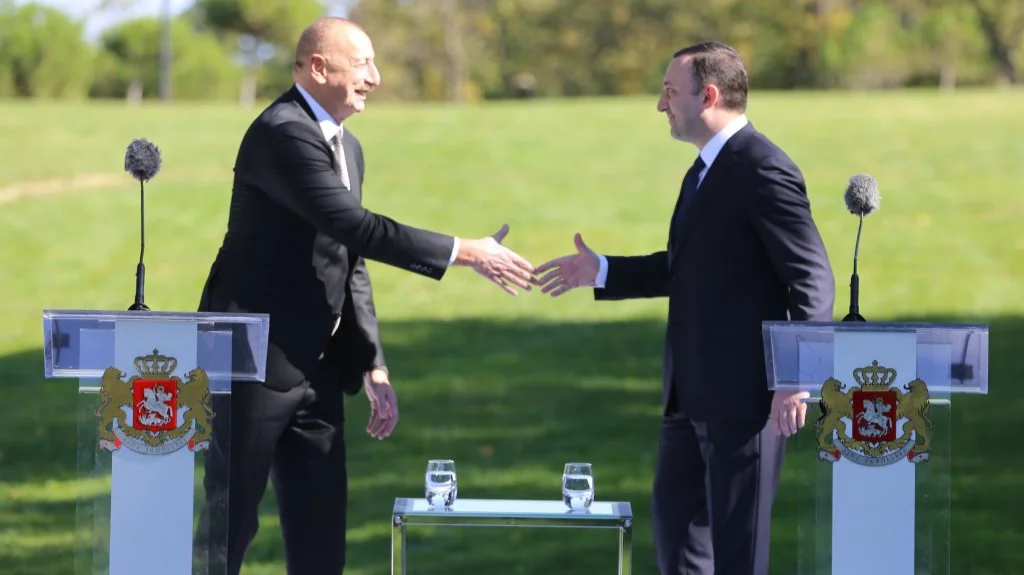
Azerbaijani President Ilham Aliyev and Georgian Prime Minister Irakli Garibashvili at a meeting in Tbilisi, October 8, 2023. Photo: Davit Kachkachishvili / Anadolu Agency - Getty Images
Will Tbilisi become a platform for peace negotiations between Baku and Yerevan? Aliyev - for, Pashinyan - so far against. After the last events in Karabakh, the alignment of forces in the South Caucasus changed, the attitude of Baku and Yerevan to the European Union changes. The President of Azerbaijan refused to go to the European summit in Granada, and the Prime Minister of Armenia to Bishkek for the CIS summit. Armenia can choose the West in the allies, and then Azerbaijan will have to react in a new way, and Georgia may not seem a pronunciation enough. A look at the situation from Tbilisi, which, as it turned out, cannot offer the neighbors nothing but a neutral attitude.
The conversation "for three"
“If Armenia expresses its consent, then bilateral and trilateral meetings will immediately begin in Georgia,” Azerbaijan President Ilham Aliyev made such an unambiguous statement on October 8, three days after almost at the last moment he refused to go to Spain for a agreed meeting with Armenian Prime Minister Nikol Pashinyan.
For the first time, Aliyev announced exactly a year ago exactly about the creation of a tripartite platform of political consultations between Baku, Yerevan and Tbilisi, in October 2022, at the Summit of the European Political Community in Prague.
A year passed, Azerbaijan regained Karabakh for himself, but Aliyev refused to go to the same summit of the European political community - this time in the Spanish Granade. Instead, he suddenly arrived in Tbilisi.
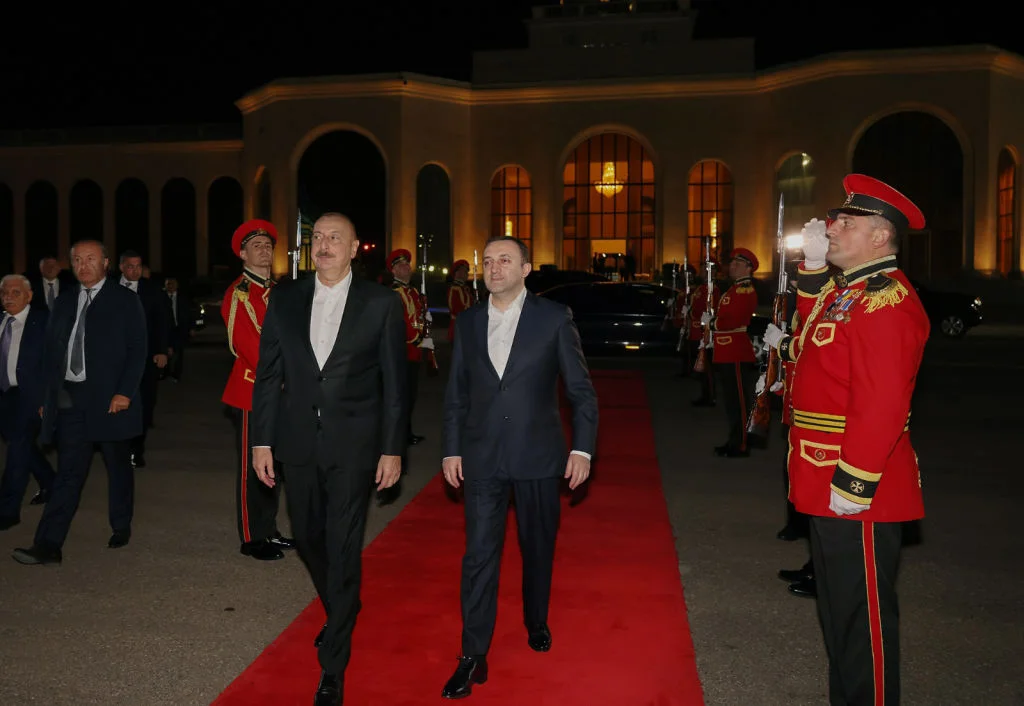
“The challenges are still remaining, the world has not yet been fully established in the South Caucasus ... Today we must actively work on a peace agreement with Armenia. I hope that we will achieve this and create a political environment and the situation in the South Caucasus, where tripartite cooperation will take place, ”Aliyev said at a joint briefing with Georgian Prime Minister Irakli Garibashvili, who thanked for his readiness to become an intermediary in negotiations with Armsia.
According to Aliyev, Georgia is the most correct choice: “Today, a number of countries and international organizations act as facilitators in the process of normalization ... We accept any help, but my idea is that the most correct choice, whether it is a historical aspect or any other, from a geographical point of view, we need Georgia to be involved in this situation.”
Garibashvili with Aliyev agreed and said that “the region’s problems must be solved in the region”: “Tbilisi is always ready to take part in this process. Our future should be peaceful, stable, and we, all three countries of the South Caucasus, must be able to solve the issues of the region and our subsequent development. ”
I must say that in the format of negotiations, which, after the Karabakh war of 2020, were proposed to resolve relations between Azerbaijan and Armenia, there are other “triples”. For example, it was proposed by Turkey and supported by Russia the 3+3 format. This is the South Caucasus (Georgia, Armenia and Azerbaijan) plus three leaders of the region: Russia, Türkiye and Iran.
However, Georgia abandoned the “two triples” due to the participation of Russia in one of them: it occupies its territory-the Tskhinvalsky region (South Ossetia) and Abkhazia. Armenia was also against Armenia, who did not want to transfer the issue of Nagorno -Karabakh to this format.
Aliyev also stated that for Baku, Aliyev also stated on October 10, at a meeting with the Secretary of the Russian Security Council Nikolai Patrushev, who arrived in Baku. There Aliyev also said that regional problems should be solved with the participation of the countries of the region.
Meanwhile, Pashinyan believes that negotiations should continue not “for three”, but with the participation of the EU.
On October 11, the Armenian prime minister responded to Aliyev’s proposal made from Tbilisi. In an interview with public television of Armenia, he said that this could be interpreted as an attempt to translate negotiations from the European platform: “We are not against any conversation, but we are against the logic that will lead us out of the framework of the already agreed principles.”
“A meeting was held in Granada, and the principles of regulating relations between Armenia and Azerbaijan were recorded on the European Union platform. It is clear that when we meet in Brussels, the conversation should be held within the framework of these principles, about which I will not say that they correspond only to the interests of Armenia. Armenia accepted them and, by the way, Azerbaijan also accepted them. ”
Baku wants without Paris
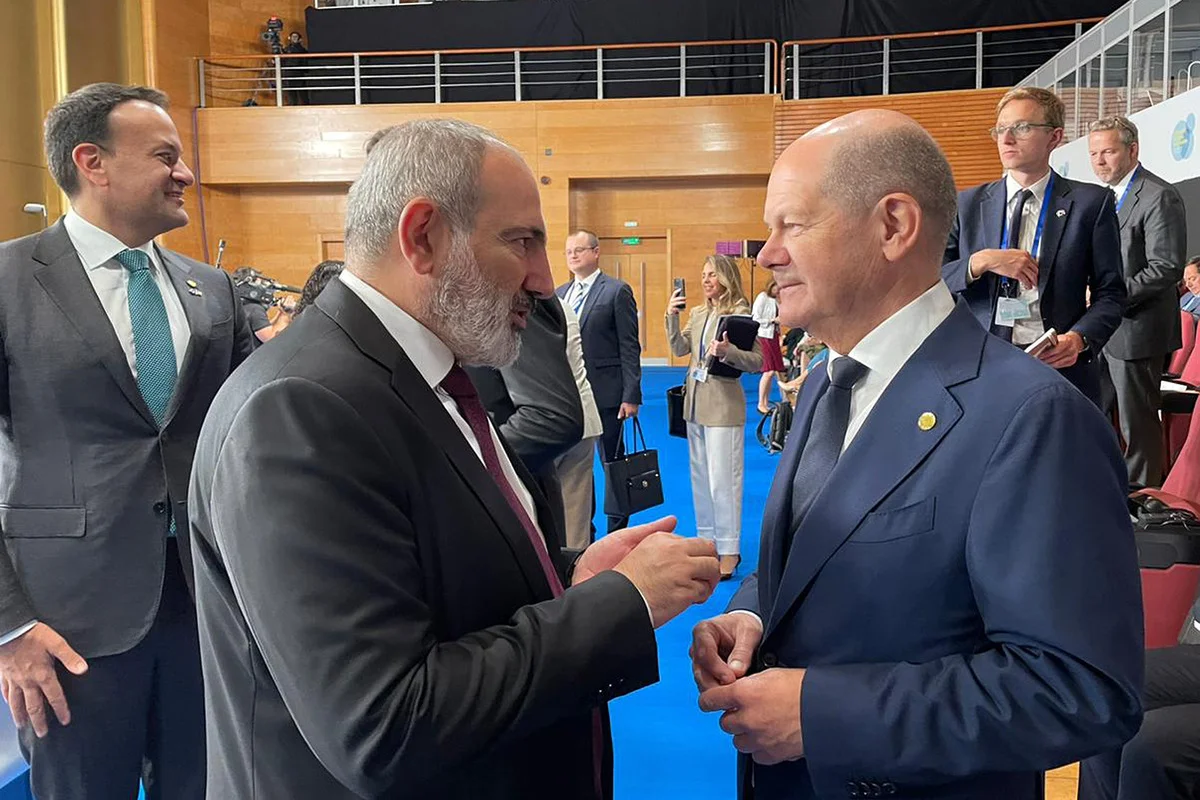
On October 5, the meeting of Aliyev and Pashinyan was supposed to take place with the participation of the European Council President Charles Michel, German Chancellor Olaf Sholts and French President Emmanuel Macron. However, not everyone is arranging Azerbaijan on this list.
The Azerbaijani media attracted diplomatic sources to explain the refusal of Aliyev: "The reason is the destructive position of France, as well as the disagreement of Paris and Berlin to participate in the meeting of Turkey."
Moreover, the source emphasized that "Azerbaijan does not intend to participate in the meetings where France is represented." But if the previous tripartite format of the Es-Azerbaijan-Armenia is returned, then Baku may agree.
On the same day, the European Parliament adopted a resolution in which the situation in Karabakh, which has already left 100 thousand Armenians, is compared with ethnic cleaning and urged to impose sanctions against Azerbaijan. And in the case of “aggression against Armenia,” European parliamentarians propose to completely stop the import of Azerbaijani oil and gas in the EU. By the way, it is interesting that in return - is it really the resumption of supplies from Russia?
Despite the fact that the resolutions of the European Parliament are exclusively advisory in nature, French President Emmanuel Macron, who was so “preventing Baku, spoke out against the negotiations in Granada:“ Now is not the time for sanctions. They would be counter -productive, ”Macron said at a summit in Spain.
The Russian Foreign Ministry noticed "betrayal"
After the surrender of Nagorno -Karabakh, Pashinyan repeatedly accused Russia of failing to fulfill obligations, the distance from the South Caucasus and that Russian peacekeepers did not control the Lachin corridor.
But Moscow has its own version about who betrayed Yerevan. According to the official representative of the Foreign Ministry of the Russian Federation, Maria Zakharova, it was the European Union.
According to her, the EU “silently looked” at how the Russian peacekeepers acted as intermediaries in agreements on the ceasefire, how they supplied humanitarian aid to the Nagoric Karabakh after unlocking the Lachinsky corridor and how they accompanied the immigrants from Karabakh to Armenia.
“Well, as silently - constituting and telling the citizens of Armenia the fables that Russia allegedly betrayed them.
It was the European Union who dissuaded Yerevan to fulfill what they agreed with the mediation of Moscow, ”Zakharova said at a briefing.
Now, in her opinion, the EU does not provide “stability and de -escalation” in Armenia, but “is engaged in intelligence monitoring in the interests of Brussels” and provoking the situation.
Nevertheless, Pashinyan will not take part in a meeting of the Council of the Heads of the CIS state on October 13, the press service of the President of Kyrgyzstan Sadyr Zhaparov said . In a telephone conversation with Zhaparov, the Armenian prime minister did not name the absence, said only that he would not come “due to a number of circumstances”.
"Full gap with Russia Yerevan is now unprofitable"
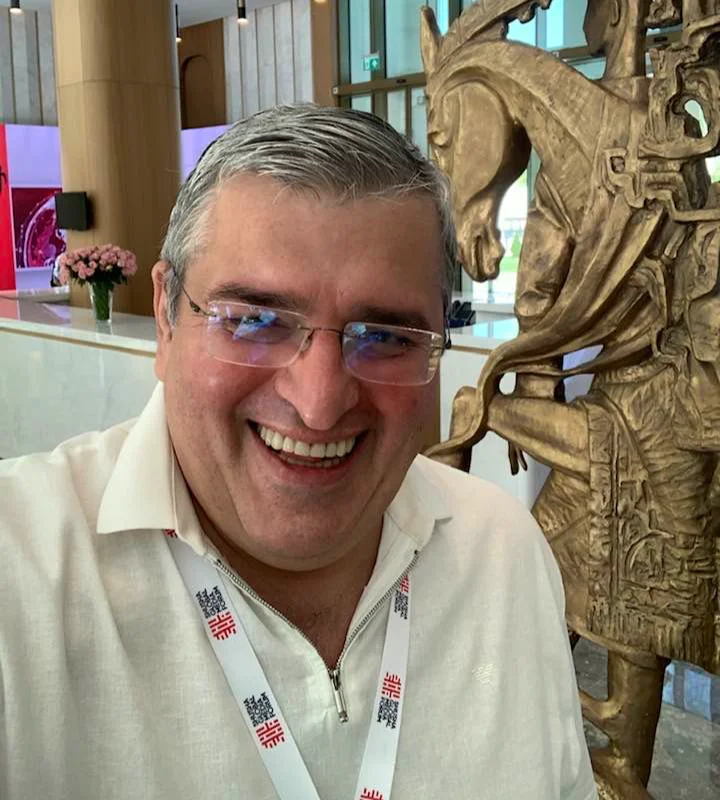
Political scientist Gela Vasadze, an expert at the Georgian Center for Strategic Analysis (GSAC), author of the Utubube Channel “News from the Caucasus” answered questions from Novaya Gazeta Europe.
- Aliyev and Pashinyan are quite common in Europe. Why did the Armenian prime minister refused to come to negotiations in Tbilisi?
- We must look at the alignment of forces. To date, Azerbaijan has a strong army and a strong ally - Türkiye. And Armenia has a weaker army and officially only one ally - Russia. This is a weak ally who is ready to concede both Azerbaijan and Turkey. In such conditions, negotiations in Tbilisi are negotiations between Baku and Yerevan one on one. And you need to understand that these are not negotiations between friends, friends or simply strangers, these are negotiations between the two countries that have been enemies for 35 years: the conflict in Karabakh began in 1988. To sit alone at the negotiating table with a stronger enemy of Armenia, of course, is unprofitable.
Here you can develop various conspiracy versions that Georgia is now not so pro -Western, so Yerevan rejects Tbilisi’s proposal ... The fact that Georgia today is just a neutral place for negotiations, it can only be an intermediary, but not a guarantor of fulfillment of agreements.
Therefore, Pashinyan does not want to meet in Tbilisi.
Not because he does not like Georgia, but because Georgia has no resources to become a guarantor. But Azerbaijan does not need guarantors, so Aliyev wants to meet one on one.
I think that Pashinyan will not agree to a meeting in Tbilisi for the same reason why he did not go to Bishkek for the CIS summit: he understands that he will be there in the minority.
Here Aliyev also did not go to Granada, because there he would be in the minority, especially near the president of France. To balance the situation, the Turkish President Erdogan was going to go there, but he was not invited in the end.
Today, the most working configuration for negotiations by Aliyev and Pashinyan is not even Washington, but Brussels, and it is with the President of the European Council Charles Michel.
The EU also has its own nuances. For example, Josep Borrel took a frankly probe position, and Azerbaijan would not talk to him. And Ursula von der Layen takes a more pro -zerbaijani position. And this is also the result of the domestic policy of the countries that they represent. Borrel is a Spanish socialist, he reflects how the question of Karabakh is updated in the domestic political discourse of Spain, and Ursula von der Lyain is a Christian democrat from Germany, for her this topic is not so relevant.
Against this background, Charles Michel managed to become such a figure that so far suits both Baku and Yerevan, although he is associated with friendly relations with Macron. But in this case it came out as in the proverb: "Friendship is friendship, and the tobacco is apart."
- Recently, they often say that Armenia has become almost more pro -Western than Georgia ...
- It is too early to say that Armenia has already become a European or changed the foreign policy ... I will say this: in the field of public policy in Armenia, the Western trend has become much more noticeable than the Russian one. This is also due to the mood in Armenian society, which believes that Russia has betrayed Armenians.
In Yerevan, they are now hoped for countries in which there is an internal political discourse on the support of Armenia: this is, for example, France, in which the strongest Armenian cocus (I emphasize that this is not a diaspora). The same picture in the USA. Do not exaggerate the factor of supporting Armenia in the domestic policy of these countries, but it is. But, for example, in Italy it is not. And Italy is a very reliable partner of Azerbaijan, based on its interests.
There is also a pan -European trend - the support of Armenians persecuted from Karabakh. Against this background, Azerbaijanis, in turn, complain of double standards in the EU.
By the way, Pashinyan said that they still do not come out of the CSTO, and this is logical and reasonable, because now it is absolutely unprofitable to go to full gap with Russia Yerevan. CSTO is a symbolic thing, because there is a big agreement between Armenia and Russia. In Armenia, the opposition has certain political forces that require to break this contract. But so far this does not happen, and I do not think what will happen in the near future. Because this is due to serious risks for Armenia, which come from Russia itself.
Armenians in public policy show their society that since Russia has betrayed us, we are going to the West. But in fact, they are not going anywhere yet. Now, if Russia falls apart, then - maybe.
- That is, Armenia is now waiting for what will happen to Russia against the backdrop of a war in Ukraine?
- Everyone is waiting for this now, not only Armenians.
- The president of Azerbaijan met with Garibashvili, then Patrushev came to Baku, after which Aliyev himself was going to meet with Putin. What does it mean?
- This is a normal policy. Aliyev leads a tricky political game with the Russians and replays them. And of course, Aliyev will use this situation. Exactly the same as Erdogan does.
Note that the President of Ukraine Vladimir Zelensky during the war met with Aliyev twice, and called him five times and thanked him. The last time - a week ago. So often he thanked Biden, Scholtsa and Macron. Because Aliyev really quietly helps Ukraine, and very seriously, but not by weapons, of course. Aliyeva just does not need to talk about this in the Russian media.