
Translated material
What are the current wars lead
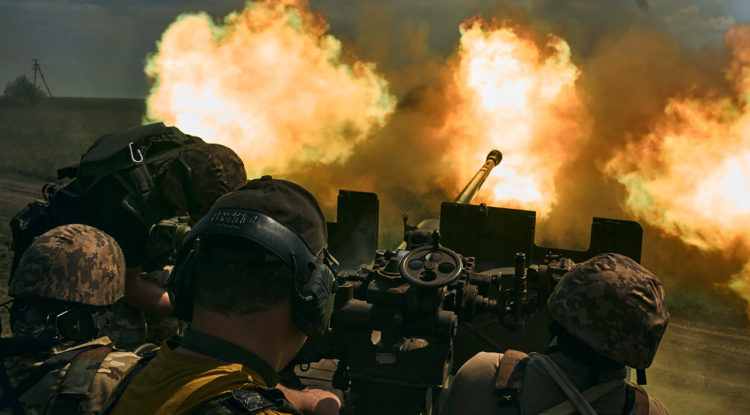
Yes, indeed, to the World War - says historian Alexander Etkind
In the fall of 2023, in the first lines of information tapes - only war. Russia continues to bomb Ukraine, Azerbaijan “took” Karabakh. Hamas has invaded Israel, Israel inflicts massive blows to the gas sector. In Niger and Gabon, there are military coups. In Taiwan, they are preparing for an armed confrontation with China. Can all these conflicts transform into a world war? Historian Alexander Etkind answers in the affirmative, and here are his arguments.
In order not to miss the main materials of the "cold", subscribe to our Instagram and telegram .
Are you tired of the word "crisis"? It has become ubiquitous, and today it is only surprising that it is not in an obvious crisis. The famous historian Adam Tuz defined our time as a “polycrysis”, which has many origins and manifestations. The equally famous historian Kuinn Slobodyan prefers the word “Permacrisis” - the constant state of the crisis. Today we see that these ideas of a multiple, but constant crisis are rather a dream than reality. The crisis no longer balances on the verge of disaster without falling into it. The crisis leads to war.
The world order is not a fiction. He retains the world. The global world is based on changing coalitions and fragile consensus. All this always hangs in the balance. All members of the community must store the world, and any of them can violate it. The crisis is replaced by a disaster.
War means a rupture of historical continuity, the collapse of the old world order and the formation of a new one. This new order usually goes beyond the understanding of those who unleashed the war, and brings benefits to completely other people. 30 years of the war between religious fanatics in the XVII century led to the Westphalian world, which recognized the variety of faith and legitimacy of opinions. The war for the Spanish inheritance at the very beginning of the 18th century weakened all the heirs, accelerating the development of new national states. Starting as a duel of European monarchs, the First World War led to the collapse of the old empires and hegemony of democratic America. Those who started the Second World War were preoccupied with the old idea of the balance of power; Those who finished her knew nuclear weapons, the Holocaust and the subtleties of the ideological struggle. The war usually carries the end of the career to those who started it, even if they managed to declare the victorious end. A big war means not only a change in the bearer of power, but also a change of generation in power.
The global war is formed as a series of local wars, in which earlier wars affect later, approximately in the movie series. Episodes at the beginning of the series serve as models, inspire, supply material, expand the horizons of the possible for those we see in the next series. War is a national disaster, but the largest conflicts are the catastrophes of a planetary scale. Already the seven -year war in the middle of the 18th century was a global war. Napoleonic wars also did not limit themselves to Europe. Together with two opium wars, between which it was no coincidence, the Crimean war was also global. Two world wars overwhelmed the twentieth century.
Global wars begin as a clash of two neighboring forces. They grow for various reasons, which are difficult to classify. The warring parties need partners in order to borrow money, purchase weapons or hire mercenaries. Almost inevitably, these partners become allies on the battlefield. No matter what happens to the payment of their efforts, one effect from the wars begun is unchanged. It can be called the effect of imitation, rutinization or expansion of horizons. What seemed impossible or unacceptable becomes an ordinary business. "What, could it be?" This effect - the strength of the example - explains many mysterious phenomena in world politics.
In the theory of international relations of the superheroes of our series, they call "revisionist forces." They are contrasted by the Angriers' countries, which protect the prevailing order-“KVO status forces”. Such a scheme was developed in his doctoral dissertation, defended in 1954 in Harvard, young Henry Kissinger . He wrote his work about the Vienna Congress, which ended the Napoleonic wars. Napoleon looked in this dissertation as the main revisionist, and Metterns - the ideal leader of the coalition, which defended the world order. Behind such Napoleon stood more recent examples - first Hitler, and then the Kremlin leaders. Whether this historical scheme was true or not, it was she who prepared Kissinger for his star career.
In today's disposition of forces, the revisionist, Russia, led by its president, is performing, and the Angengers are the countries of the Western coalition. The theoretical foundations of Putin's revisionism were laid in his 2007 Munich speech, and practice immediately began - the Georgian war and, in several stages, a war with Ukraine. The power of the example was great, and on the basis of the idea "What, it was possible?" The Armenian-Azerbaijani conflict developed. Finally, we are observing the explosive escalation of the conflict in the Gaza Strip, where Iran is headed by the dominant side - one of Putin’s few allies.
We can only guess what will happen next and what the current combination of crises will develop into. It is clear to me that the global conflict began as a war for the Soviet inheritance. The probability of transforming this war into a world war is enhanced every day. This conflict, delayed after 1991 by someone’s skill or luck, entered the hot phase 15 years ago. The United States and the European Union are trying to stop or at least limit this war, but the potential of the conflict has not been exhausted. The escalation will not stop until the overgrown issues of the regional and continental (pan -European) order will be resolved.
The trouble is that these issues were not related to all participants. The United States, which play in the current conflicts about the same role as the British empire played in the Napoleonic wars, still did not understand the meaning of the current war and did not find their interest in it. They have to do this, but the learning and awareness process was more complicated than promised in the first episodes.
The effect of routinization, however, has already been achieved. Once incredible, it is possible, it becomes ordinary and, worse, inevitable. Countries that continue to divide the Soviet inheritance, and countries that have a very indirect attitude are involved in the chain of events. The revisionist force, which challenged the world order, gains new allies. It acts in different ways: money, weapons and example. This process of escalation can be stopped only by the military defeat of the aggressor; The countries of the Anti -Napoleon coalition understood this better than the current Arenges. The latter are facing the paradox: they are for the status of a Quo, but any outcome of the conflict will mean a deep revision of the world order.
Frozen the crisis on the verge of disaster will no longer be possible. It can only be resolved by a deep alteration of the established ideas and institutions. So both world wars ended.
The analysis of the current crisis “according to Kissinger” will not beolo without China. Its role, however, is difficult to analyze in terms set by this long -standing theory. The American administration accuses China of revisionist plans, but they have not yet been implemented. China’s national interests are vast, and they were seriously infringed on by the very opium wars, and then the outcome of the Second World War. China lost external Manchuria, Hong Kong, Taiwan and many other lands. It is difficult to imagine that the double lesson of political revisionism and historical revenge, taught by close Russia, will remain without consequences for China. Due to the scale of this country and the depths of its historical injuries, the idea "What, could it be?" It can lead to new big wars. They are all the more real that the balance of forces in Northern Eurasia has moved as far over the past year as it has not happened for centuries. What seemed impossible or infinitely difficult, suddenly turned out to be a low hanging fruit, and the watchman left and is unlikely to return.
The crisis of our civilization has already resulted in a big war. Will it become world and what can interfere with this? Probably, you need a new meterny, but even better, a new kissinger. The achievement of the first was the creation of coalitions, who for decades balanced on the verge of a foul. The achievement of the second was the adoption of non -trivial and even paradoxical decisions. His secret trip to Beijing in 1971 and his shuttle diplomacy in the Middle East in 1974 effectively changed the world order in the name of its preservation. And although the fruits of his politics, good and bad, then had to disassemble several generations of his successors, the US victory in the Cold War and the followed economic globalization would not take place without those creative solutions.
The victory over those who are trying to revise the world order can take place only thanks to deep changes in the world order. This is a complex design, but the American administrations came to her one after another at the exit from both world wars. And, perhaps, the same understanding will help to avoid the Third World War.
The author’s opinion may not coincide with the opinion of the editorial office.