
Translated material
Certificate of power
What is the scandal that has unfolded around the new thousand -ruble bills
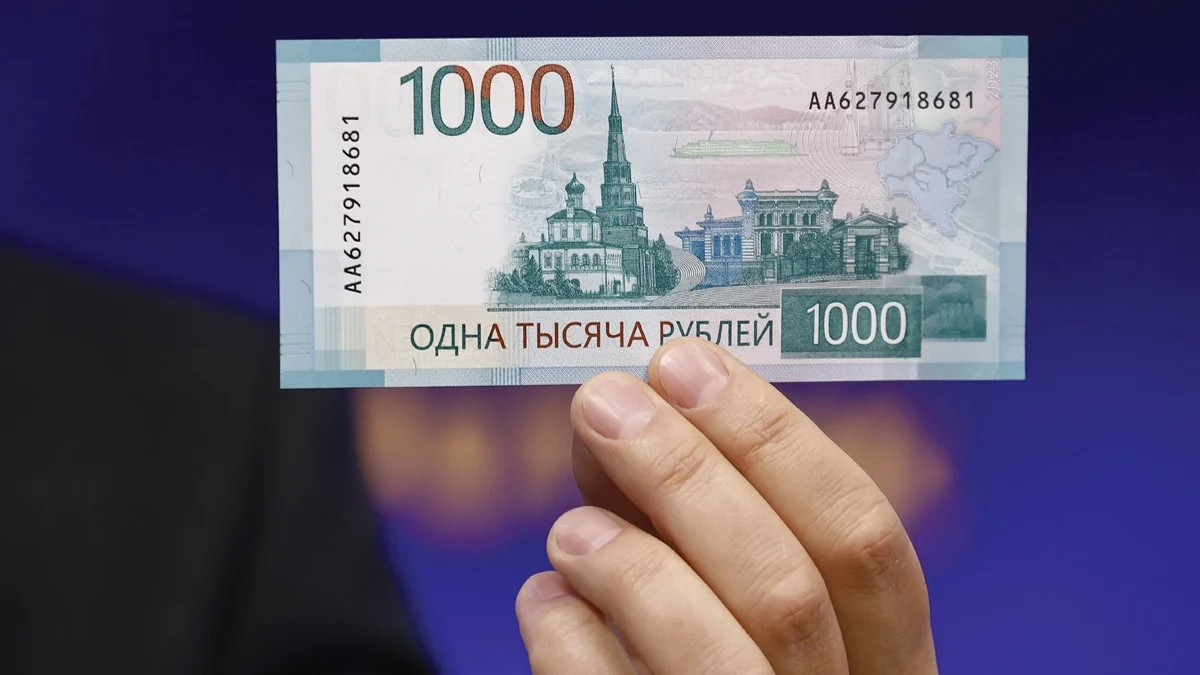
Photo: Andrey Lyubimov / RBC / TASS
Hardly one of the specialists of the Bank of Russia might have thought that the image of the canonical “open” type of Kazan on the new thousand-ruble will cause such a reaction. The keen eye of the ever -angry bloggers did not see the cross on the image of the building of the former palace church, in which the Museum of the History of the statehood of the Tatar people is located, but he noticed a crescent on a minaret. The estimated mind immediately made far -reaching conclusions, and no reminders and exhortations that the cross from the palace church was removed a hundred years ago did not cool hot heads. After the scandal reached the Federation Council, the Bank of Russia decided to “withdraw” the banknote for revision.
A mystical attitude to images on banknotes is a serious thing. Pictures on money are propaganda in the most affordable form - denoting its priorities:
A person may not listen to the radio, not to read newspapers either before or after dinner, not to watch TV, not to use the Internet, but he will take the money in his hands and immediately understand what and why the authorities in this country consider it important for himself.
The remarkable writer Mikhail Zoshchenko has the story “Thomas Nonsense”, which describes just such a clash with new money - and rather unexpected consequences. The case took place there in 1925 (just in the early 1920s, “new money” was released in the USSR, and the “old” was massively removed from circulation). The illiterate village man Thomas receives a money transfer from his son-by five rubles, and in the post office he is given a new bill on which the portrait of the proletariat is printed, such a “worker and peasants” person. And the man who remembered the “old money” with portraits of the kings, came to the conclusion that the “man” is now instead of the “king” (and in the village they said that the power is now peasant), and decides to check whether this is really ...
QUOTE
... “Tell me please,” Thomas thought, “the portrait is taken out ... Is it really a man of royal honor?” Thomas drove the horse, but suddenly turned back at the forest and went to the city.Thomas stopped at the station ... and entered the room.
It was almost empty. At the door, putting a bag under his head, some person in a soft hat slept.
Thomas bought two pennies of seeds and sat down on the window, but, sitting a minute, went to the sleeping man and suddenly shouted: “Hey, hat, sweet from the bench! I have to sit down ... "
The man in a hat opened his eyes, dumbfounded at Thomas and sat down ...
Thomas crouched nearby, pushed pushed back on the bag and began to chew the seeds with taste, spitting the husk to the floor.
“Do not lie,” Thomas thought. -The honor is still noticeable. Listen. Previously, maybe they would have slapped in the face, but they listen, scare. Look, as everything happened, it unnoticed ... Tell me to mercy ... do not lie. "
Having received confirmation that he is now the authorities, Thomas sets off to “watch the cashier” ... After the scandal with the cashier, the fight with the station guard follows. Everything ends in a police station, where “... Thomas tried to explain something, waved his hands, took out the money from the hat and invited the agent to look at them. But the agent, ... wrote the protocol on the insult by the action of the cashier in the performance of official duties. And also about the fact that Thomas, being obviously intoxicated, ate in a closed room of the seed and spat on the floor.
Thomas put a cross under the protocol and, sighing and pulling his head, left the room.
He untied the horse, sat in a cart, took out the money from the hat and looked at them. Then he waved his hand and said:
- Lie, devils ... "
The act of Thomas seems stupid, but half a century after Mikhail Zoshchenko another writer, Arkady Lviv, in the story “Briefing in Rome” shows this from the other side, but in essence - the same story.
Talking to emigrants from the USSR about the specifics of life in the United States, the instructor Mike Slom begins by showing the listeners American money:
“... He took out a few green credit cards from his pocket, slapped his palm and said:“ A piece of America, for you - an incognite terra, unfamiliar earth. I see you are surprised: why is the terra incognita?
There is a dollar dollar, the world holds on the dollar today ... You can buy everything for the dollar, you can sell everything for the dollar.
You laugh, it's good that you are laughing.
You laugh because you say to yourself: he is a nerd, this Mike, God forbid us more green of these pieces of paper - and do not care about the incognita terra!
And Mike Slom tells you: you are mistaken!
On these green stories of America: Washington, Lincoln, Hamilton, Jackson, Franklin!
Who are they, these people, what these names tell you?
These names are empty for you, because the empty phrase for you is the independence of America, the Constitution of America, the sovereign of America, the democracy of America! ”

And then Mike Slom explains why these people are depicted on the bills and what is the meaning of American institutions, emphasizing that “in your own way in Moscow you are used to exceptions, and in America they live“ according to the rules ”, and there are a lot of rules and it is not easy to observe them. You will learn to understand these rules and live by them - everything will be fine, but if you are not ready to “live according to the rules”, then it is better not to go to America.
By the way, in the Soviet Union with portraits on bills, everything was not easy: the portrait of the “man” disappeared with money already in 1926, in the late 1930s, a miner with a chipped hammer was looked at a citizen from treasury tickets-a ticket in one ruble, a Red Army soldier in a marching equipment-a ticket of three rubles-on a ticket of five rubles. On bank tickets there was a portrait of Lenin. Actually, Lenin, along with the views of the Moscow Kremlin, remained on Soviet money until 1991. It is logical: the indisputable founder of the new system of power is the center of this power (no other Soviet institutions and leaders of the images in bills were honored).
What is significant for us in today's history around the Bank of Russia ticket of a thousand rubles?
The image on money is really important, and it is no coincidence that in many countries the answer to the question of who, how and why should be drawn on money, becomes an example of a national discussion, the best artists and design bureaus are fighting for the right to “draw money”.
We have not seen anything like this (except for the Bank of Russia survey about the desired images on money), and even more so no one can say who exactly chose images and approved the design of banknotes. He already explained his principle of choosing images of the Central Bank of the Russian Federation back in 2021: “One denomination is one federal district.” Until now, Veliky Novgorod, Krasnoyarsk, St. Petersburg, Moscow, Yaroslavl, Arkhangelsk, Khabarovsk and Vladivostok appeared on paper money. On (not yet represented) 10-ruble and 500-ruble banknotes should be Novosibirsk and Pyatigorsk. At least there is logic.
But the annoyed public has its own logic - and very characteristic. After all, they do not demand to hook the cross on the building of the former (!) Palace Church, in which the museum is now located, and demand to redraw the image on money, perceiving them as a kind of certificate of power - just like a “wrong Thomas” a hundred years ago.
And if everyone was starting to look for secret signs on the new tickets of the Bank of Russia, then I will insert five kopecks: the hero with a beard on the back of the five thousandth banknote clearly “turned away” from the “steel bucket” and carefully looks at the oil rocking chair (you can, of course, add that he is also looking to the east, and then it becomes clear where he is collecting this oil).