
Translated material
Who killed Hazel Drew?
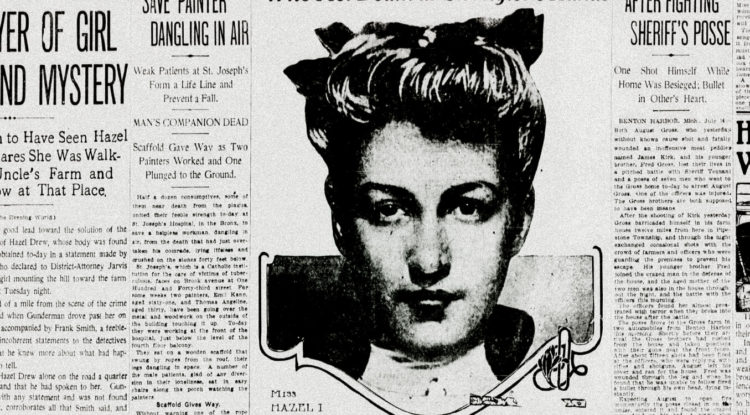
The story of an undisclosed murder that inspired the screenwriter Mark Frost to create Twin Picks
In July 1908, in a pond near the resort town of Sand-Lake, the body of a 20-year-old governess Heisel Drew was discovered. The police did not find the killers and concluded that Drew committed suicide. Many years later, her story formed the basis of the series Twin Pixes, and the series, in turn, inspired fans to investigate this matter.
In order not to miss the main materials of the "cold", subscribe to our Instagram and telegram .
On the evening of July 7, 1908, the 20-year-old governess Hazel Drew walked along the Taborno Road, the forest district of the small resort town of Sand Lake in the northern part of the state of New York. The girl carried a black straw hat in her hands, decorated with three large feathers and a pin in the form of the letter H.
On the way, Hazel met two men who rode on a wagon to the city. One of them is her acquaintance, a 17-year-old worker at Frank Smith farm, the other is the 35-year-old carrier merchant Rudolf Gandrum. Hazel and Frank exchanged greetings. These two were the last to see her alive.
Four days later, local boys found Hazel's body in a pond. Drew lay her face down with outstretched arms, the water changed her body beyond recognition: the girl's face was swollen, and her blond hair was confused. The skull was fragmented by a strong blow to the back of the head.
The decomposition was so strong that the doctors could not establish the exact cause of death. It was possible to identify it only by clothes, accessories and gold seals on the teeth. Even Father Drew was not sure that this was his daughter, until the next day he was shown her pin and brooch.
Ghost in the forest
Hazel's name became part of local folklore, and its story diverged throughout the state. In the village of Taborno near the placeof murder, the future co -author of the series Twin Pixes, the young Mark Frost, spent the summer vacation: he stayed with his grandmother Betty Kalhun. One evening, she told her grandson the story of the ghost of Hazel, who wanders in the forest nearby at night. And years later, the story of Hazel Drew formed the basis of the cult television series.
Frost recalled that while working on Twin Picks, he studied all the details of the murder known at that time. “This story struck my imagination,” he said.
Who is Hazel Drew
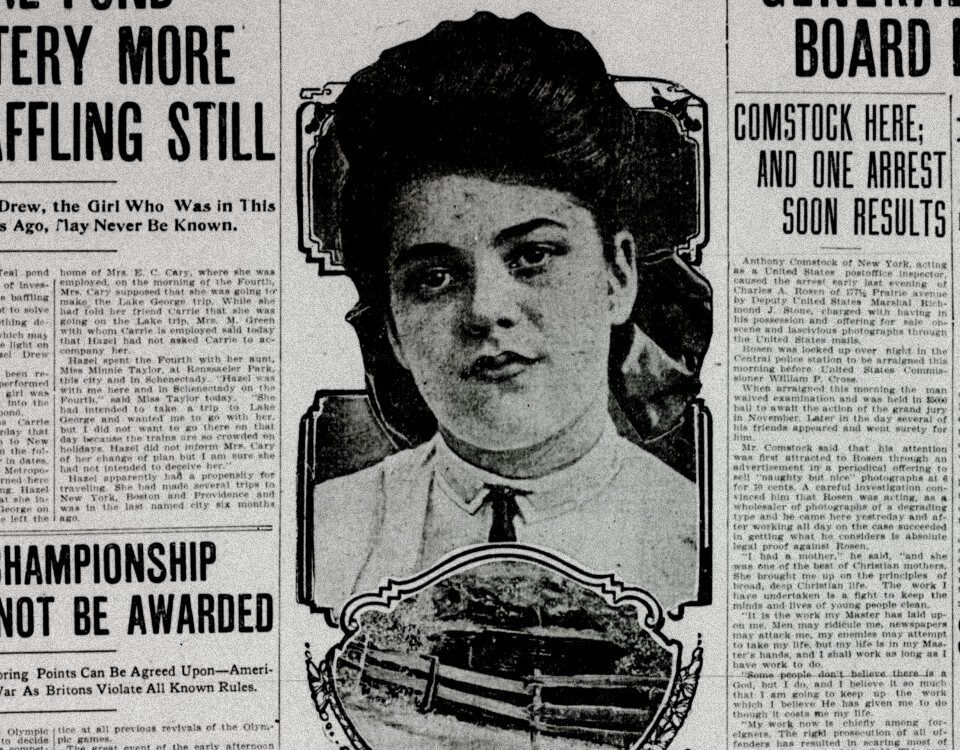
Hazel Drew was born in a poor family. At the age of 14, she left the house and began to work as a governess in the city of Troy, a large center of light industry. The girl managed to work in three influential families related to the Republican Party: she worked with Thomas Hoslop, the first treasurer of the city, and John Tapper, a member of the Coal Association. The last place of her work was the house of a city engineer, professor Edward Carey.
Hazel loved dressed dresses, dined in expensive restaurants and often went to large cities: New York, Boston and Providen. She had many fans. She met several men at once, and she accumulated many letters from the admirers. The New York World reporter, which illuminated the murder of Hazel, found out that Drew took “French tablets” for termination of pregnancy.
On the eve of death, July 6, she suddenly quit his job and left the house of her employer - Professor Kerry. According to Hazel's acquaintances, such behavior was strange for her. On the same day she was seen at the local station. The acquaintance of Hazel, Miss Mary Robinson, said that Hazel she met there never told where she was about to leave. She handed over her suitcase in the storage room at the station and sat on the train to the city of Albani. How exactly Hazel was in Taborno Road and with whom she had a meeting is unknown.
Investigation
The murder shocked the inhabitants of the sand-lake. Frightened citizens demanded that the police catch a criminal. The investigation of the death of Hazel Drew was engaged in the district prosecutor of the district Renssler Jarvis O'Brien. Two detectives helped him: William Powers and Duncan Kay.
The prosecutor interviewed local residents, secret lovers Hazel Drew and everyone who accidentally met the girl on the day of the murder. The first suspect was 54-year-old Uncle Hazel Will Taylor, who owned a farm one and a half kilometers from the place of murder, the second-17-year-old Frank Smith, who was reported , was in love with Heisel. Smith was present when extracting the body from the water, but could not identify the identity of the murdered person, and the police could not find evidence of his guilt.
Hazel Julia Drew's mother believed that "some rich guy met Heisel, hypnotized her, took it there and killed it." During the inspection of personal belongings, Hazel Police found several notes from a person with the initials of K.I.S.
It is known that he lived in Boston and worked in the company that produced fans. Investigators found out that he met with Hazel in Albani in New York, and later wrote that she "deprived him of freedom." It was not possible to establish the identity of the mysterious fan of the police.
The police also found out that Hazel participated in some orgies in the Tsatsavass camp in the Taborno forest. The camp belonged to the rich businessman Henry Kramrot and was eight kilometers from the place of death of the girl. According to a local resident Minnie Clifford, female cries were heard in the camp on the night of July 6. Kramrot denied his guilt and said that he could not hold the girls against their will.
William and Elizabeth Hoffei are the first witnesses who helped to reveal the details of the crime. They said that in the evening of July 7, they were driving in their wagon past Tils-Song. On the way they met another wagon. She looked expensive, which was unusual for the poor residents of the sand-league.
According to Hoffei, the driver behaved suspiciously and looked away so as not to look into their eyes. When William and Elizabeth looked at the pond, they saw a girl on the far shore. It was there that the Hazel body later found.
Detective Powers learned the name of the driver of the cart - he was an employee of the funeral bureau Fred Shatsl. As it turned out, Shatzl rented a carriage on the evening of July 6 for his friend, 25-year-old William Kushger, a member of the Republican Committee and the director of the beer plant. Cushing told the police that he was in the lice sand on the night of the murder and lived with Hazel in the same area.
Both suspects were Republicans, like the detectives of Powers and Kay - this, perhaps, became the reason why the murder of Hazel Drew remained unsolved. Due to insufficient evidence, the suspects quickly justified, and the case was closed. The investigation came to the conclusion that Hazel Drew committed suicide.
New version
More than 100 years after the murder, the authors of the book “Murder at Tils-Podnd”, writer David Bushman and leading Podkastov, Mark Givens, nominated their version. They are fans from Twin Pixes and decided to conduct their own investigation.
They said that William and Elizabeth Hoffei were ready to identify the people they saw on an expensive wagon. But the detectives have never been asked about this. The only newspaper that reported this was The Daily Press, which belonged to the Democrat from the city of Troy (and at that time the power in the city belonged to the Republicans).
Givens and Bushman write: “They ( cushing and Shatzl. - approx.“ Cold ” ) were connected with the Republican Party, and the disclosure of such a murder could strike a serious blow to their positions. We came to the conclusion that Hazel Drew was killed by William Kusry and Fred Shatzl. The detectives of Powers and Kay, who were also Republicans, simply removed all the charges from them. ”
According to the authors, Drew could find out a certain political secret of one of her employers. According to another version, Kushing and Shatzl fulfilled the order of the lover of Hazel or its former employer from the Republican Party. However, this is just a version of what happened, and the exact motives of the murder remained unsolved.