
Translated material
Israel will send troops to the Gaza sector for a "decisive victory." This is the name of the new doctrine, according to which Hamas should be destroyed by the entire fire power of the IDF
We figure out what can interfere with this plan
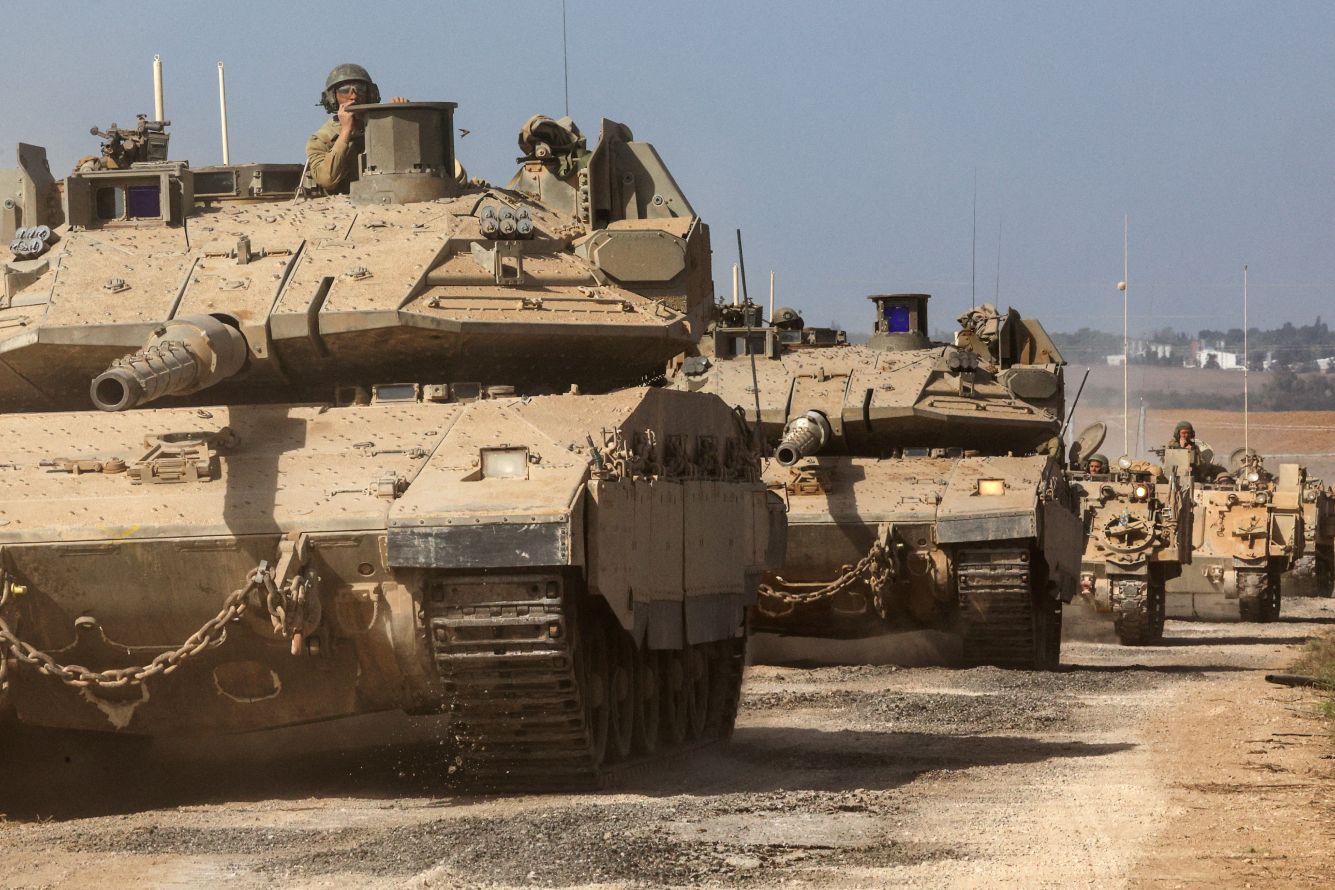
In the near future, the Israeli Defense Army (IDF) should begin a ground operation in the gas sector. With a high probability, it will become a new page in the country's military history. For several previous decades, Israel was guided by the concept of holding back its many opponents: in case of exacerbation, the IDF minimized the damage from attacks (primarily from missile strikes) and inflicted disarming blows, forcing opponents to return to the status quo. In recent years, such a strategy has been recognized as the leadership of Israel of the wrong one, and the military began to develop the concept of a “decisive victory”. The events of the current war do not leave the Benjamin to the Netanyahu Benamin to the government: there is no more talk of holding back, a “decisive victory” is simply necessary. The problem is that Israel, apparently, was not ready to implement this strategy right now. In addition, it is still unclear how the victory of Israel might look.
As a result of his operation, Israel wants to destroy Hamas and "take off his responsibility for life in the gas sector." It is incredibly difficult to achieve these goals - as the experience of previous wars showed
Israeli Minister of Defense Yoav Galant said that the operation of the IDF in the gas sector will consist of three stages:
- Destruction of the Hamas infrastructure. Probably, for this, the ground forces will enter the sector and take a significant part of its territory.
- The stage of “smaller intensity” is the elimination of resistance foci. Perhaps it will consist of military police raids in the territory not occupied by the Israeli defense army at once.
- The final stage is “the removal of responsibility from Israel for life in the gas station”. Probably, a complete blockade of the cojector will be organized and new barriers on its borders are built.
However, Israel expect complexity both in the first and last stages.
The first stage - an attempt to cause maximum damage to Hamas - is dictated by the events of the beginning of the war. The Israeli defense army will have a battle in conditions as beneficial as possible for the enemy: groups managing the gas sector have long been trying to involve the Israeli army in street battles. In such battles, the IDF risks to suffer heavy losses. In addition, the Israeli military will constantly experience a shortage of time and opportunities for applying their firepower: it is obvious that, as the losses among the peaceful population of Gaza, the leadership of Israel will be subjected to more and more pressure. In addition, as the operation develops, the probability of war on two fronts (in Gaza and in the south of Lebanon) or even three fronts will increase (plus the western bank of the Jordan River).
The next stages of the operation (they will be implemented only in case of rapid success of the first) - an attempt to get out of the war so that the safety of Israel is radically increased. It was not possible to do this for 15 years: each previous operation in Gaza (and in the south of Lebanon) politically only strengthened the opponents of the IDF - Hamas and Hizball, - because the very meaning of their existence lies in active opposition to Israel. Even the tactical loss of the militants (as it was with Hamas during operations for the IDF in Gaza in 2008 and 2014) does not give an “winning” Israel of a long -term respite.
Reuters sources in the Israeli military leadership say that there is no plan for a profitable end of the war yet. What does “removing responsibility for life in the Gaza Strip” mean is not quite clear. Israel can forever stop the supply and transit of resources - electricity, food, and other goods in gas, but this clearly will not improve the country's security. As the events of the beginning of October showed, the creation of physical barriers (building a fence on the border with gas and southern Lebanon, the destruction of tunnels in Egypt, sea blockade; air defensecapable of knocking most of the missiles that Hamas and Hizball) also does not solve the problem for a long time. Palestinian and Lebanese militants spend the time provided by them with a truce to figure out how to overcome these barriers - and attack again.
Thus, in spite of everything, the future of the gas sector remains the key problem of Israel. The long -term occupation of the sector is impossible for political reasons. Those who want to take on the “responsibility for the life of the Gaza” - that is, to change the power of Hamas to another, less radical in relation to Israel - is also not observed.
And this problem is not new:
- The IDF has long been avoiding the Ground War in the sector. The enemy is located in densely populated areas, any major operation in which will inevitably lead to big victims among the civilians. As the operation progresses, international pressure on Israel (not only from the Muslim countries, but also from the Western allies) every time forces him to stop the fighting. So it was in 2008 and 2014.
- With a similar situation, the leadership of Israel had to deal with all wars. It ended with a decisive victory those of them where the army managed to quickly defeat the enemy (however, during the 1956 war , this was not enough: the USA and the USSR forced the DSAL to leave the Sinai rapidly occupied by it). However, a series of military successes of Israel led to the fact that neighboring countries, having lost in a direct clash, decided to resort to the tactics of the proxy-war. They no longer fight with the IDF themselves - but they make it with the hands of groups that use terrorist methods in their struggle.
- With these groups, Israel has been waging wars for many years, interrupted by a truce and “peaceful processes”. The militants of Hamas and other organizations were insensitive to the methods of war, which the IDF used against the regular armies of the Arab countries. Israel eventually lost its main advantages: in firepower, high -precision weapons, maneuver, intelligence and controls. All this does not guarantee a decisive victory in the new conditions. Previously, armored blows with the support of aviation led to the collapse of the confronting IDF regular armies. In the war with groups that use terror and missile shelling in the squares, and the rest of the time sheltering in bunkers and tunnels, these traditional methods are not so effective.
- Since 2012, Israel has gradually switched to the strategy of holding back opponents. The batteries of the “Iron Dome” systems stood on duty, which were supposed to reduce the effectiveness of missile shelling to almost zero. On the borders with Lebanon and Gas, surveillance systems (including automatic) and a network of small military bases were also built. All this was supposed to prevent attacks of small groups of terrorists.
- During a short exacerbation of the war with Hamas in 2021, the IDF managed to avoid a land surgery: the Iron Dome caught a significant part of the missiles launched from the gas - the militants failed to break through the system about Israel with massive launches.
- However, even before this, the military leadership of Israel admitted that passive defense and deterrence were the path to the likely defeat. Neither aviation nor the "iron dome" allow themselves to win the war. Successful in tactical, but unsuccessful strategically , gas invasions in 2008 and 2014 showed that the Israeli defense army simply does not have a system necessary to quickly achieve a decisive victory.
- Realizing this, even before the war of 2021, Israel began to plan land operations in Gaza, Lebanon and any other places based on the new concept and deep reform of the army.
A summary of the new military concept of Israel: a lightning -fast war with the involvement of the Ground Forces, Aviation and Navy. The plan is good - but so far it is only the theory
- According to the new operational concept of the IDF (it is called a “decisive victory”), the two organizations-“Hizball” in Lebanon and Hamas in the Gaza Strip- are considered not just groups of rebel terrorists, but full-fledged “network terrorist missile armies”. In order to effectively fight them, the IDF must realize its advantages in intelligence, management and high -precision weapons.
- The Israeli Defense Army, the purchases of weapons and military-civil relations in the country should be reformed so that the military has the opportunity to quickly destroy all the hidden firing positions of Hamas or another enemy with the involvement of ground forces, aviation, and shocks of the fleet. The new units created (within the framework of the implementation of the concept) should come into contact with Hamas, forcing the militants to detect their fire means and positions - missile systems, tunnels, mobile detachments. All of them should be immediately identified using advanced means of observing the battlefield. After this, the goals should be quickly distributed between the means of damage to the ground forces, aviation and navy - and amazed.
- According to the concept, it was supposed to create, among other things, land compounds of a new type - "numbering in the battalion (less than a thousand people), but with fire power as a division (these are tactical compounds of more than 10 thousand people)."
Such a new army would be very useful to Israel in the current war. But here there are two problems:
- The implementation of the concept is at an early stage. Its existence itself does not mean that the IDF can realize it right now.
- The failure of Israeli intelligence at the beginning of the war (it turned out to be unable to reveal the plan of the raid of the Hamas militants, to reveal their accumulation and nomination) shows that the IDF leadership may be mistaken about its advantage in observation and intelligence, that is, to exaggerate it.
In addition, the attack of militants to the south of Israel showed that the reconnaissance based on automatic observation and detection systems can fail against an initiative enemy.
Operations can interfere: Hamas' high readiness for war (IDF, perhaps not all knows about the grouping), the reaction of the West - and Israeli hostages, which are still in the hands of the militants
Thus, the IDF has to begin a land surgery in very difficult conditions:
- There are no guarantees that intelligence is well represented by the hidden prepared positions of Hamas (including the Gaza Metro - a network of tunnels under its territory used by militants for maneuver, basing headquarters, weapons and reserves).
- The armament of Hamas and its ability to inflict the advancing, may be underestimated by the IDF. It is not known how many missiles the group produced and imported; It is also not known the number of drones-kikadze, as well as UAVs with systems for the discharge of ammunition and anti-tank missile systems, which can effectively fight the IDF technique. It is only obvious that the militants were preparing for this war for several years.
- Despite the fact that the cruel attack of militants in civilians in the south of the country, massacres and taking hostages - egregious and obvious acts of terrorism, Israel still has to act in international pressure. It grows, and this process will clearly continue as surgery develops. Therefore, the IDF will have to take into account the shortage of time and by all means to try to avoid the mass death of the inhabitants of the Gaza.
- A separate and very serious difficulty is due to the fact that terrorists took hostages: more than 200 people are still in the hands of militants.
From the operations of 2008 and 2014, the current one will distinguish not the increased superiority of Israel in intelligence, firepower and the accuracy of weapons, but a significantly larger scale of the forces attracted to it. Israel announced a mobilization of 300 thousand reservists. Most of them will operate in the north of the country, where the attack (including rocket) is possible significantly stronger than Hamas, the enemy - directly supported by Iran of Hizballa. According to experts, against Hamas, the Israeli defense army will be able to use 30–40% of the forces. But the group of more than 100 thousand soldiers much exceeds by the number of those that the IDF used in the wars of 2008 (about 20 thousand) and 2014 (82 thousand reservists were mobilized for all directions, and not just for gas operations).
It is not yet clear what form the operation will be worn. In 2008, the IDF occupied a significant part of the territory of the gas sector; The troops cut it into three parts and cut it off from the border with Egypt. In 2014, the Israelis limited themselves to deep raids on the sector (the purpose of the operation was then the destruction of tunnels leading to the border with Israel). Judging by the latest statements by the Minister of Defense of Yoav Galant, the current operation is likely to combine the features developed for previous conflicts: at the first stage, we should expect dissecting blows and occupation of vast areas, on the second - raids in non -accumulated settlements.
Department "Parsing"