
Translated material
Nargiz Mohammadi is the main human rights activist Iran. She was arrested 13 times and put in prison five times, but she does not stop fighting the regime even in conclusion
In 2023, the activist was awarded the Nobel Prize of the World
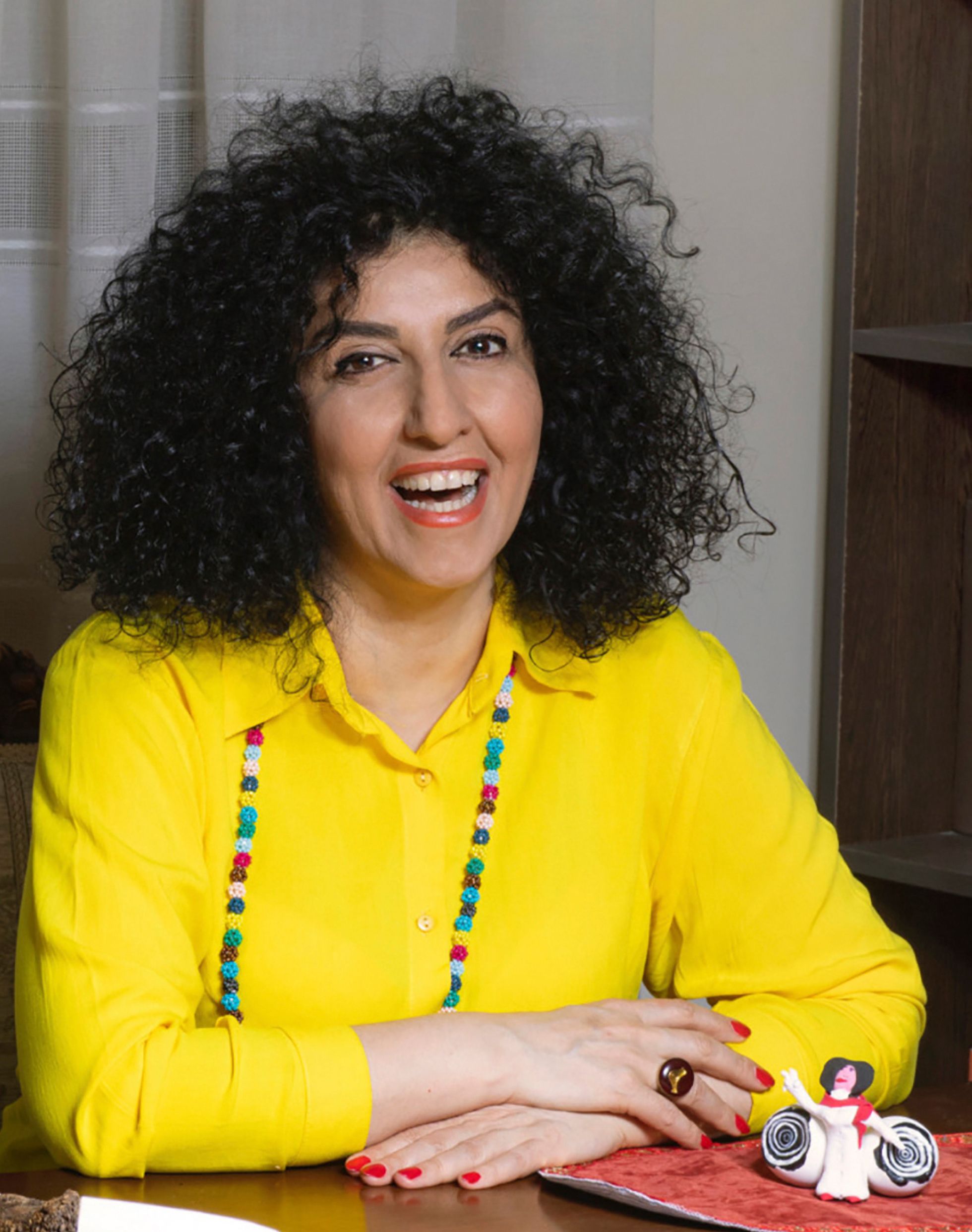
The Nobel Prize of the World 2023 became the 51-year-old Iranian human rights activist Nargiz Mohammadi. The committee connected his decision with protests that covered Iran after a year ago 22-year-old Mahsa Amini died in the hospital after interrogation to the moral police. The protest movement in totalitarian Iran would not be possible without Mohammadi. Now she is serving a term for five accusations of “civil disobedience” and the “spread of hostile propaganda” - hostile to the regime that has been operating in the country since 1979. "Medusa" tells about the life and ideas of the human rights activist, as well as how the Iranian authorities responded to the award of the world.
Nargiz Mohammadi spent more than eight years in prison. But even there she continues to fight for human rights in Iran
Since the late 1990s to our days, Nargiz Mohammadi has been advocating for the democratization of Iran, the transformation of the Totalitarian Islamic Republic into a rule of law and the rapprochement of the country with the West. As a feminist, Mohammadi is fighting for improving the position of women in the country. And also - for the rights of prisoners: it requires prohibition of death sentences, extrajudicial executions and single cameras.
Mohammadi became interested in human rights in childhood, which fell in the last years of Iran’s westernization under Shah Mohammed Pekhlevi and the Islamic Revolution of 1979. The repressions already affected her family: the uncle of the future human rights activist was arrested for participating in protests against the policy of the new authorities, and in 1981 they executed her cousin, who also opposed theocracy. Mohammadi recalls how her mother, having learned about this from the news on TV, sobbed on the floor for a long time.
Mohammadi graduated from the faculty of physics of the International University Imam Khomeini in Kazvin in northern Iran. She began to write feminist speakers during her studies, in the 1990s. Articles published Payam-E Hajar magazine, dedicated to the problems of women in Iran, and several reformist publications-all of them have long been eliminated by decision of the authorities.
Getting out of the university, Mohammadi worked as an engineer and simultaneously actively participated in a human rights movement. Later, her political essays of that time compiled a collection of “Reforms, Strategy and Tactics”, for which in 2009 the human rights activist received a prize of the Alexander Langer International Journalistic Prize.
In 1998, Mohammadi married an Iranian journalist and opposition activist Tagi Rahmani. At that time, 40-year-old Rahmani had long participated in protest against the Islamist regime. He himself considers himself a follower of Islamic modernism . Rahmani was repeatedly sentenced to conclusion - he spent more than 17 years in prison in his life. In 2011, the organization “Reporters without borders” called him “an Iranian journalist who is most often put in prison”.
In 2012, Rahmani, along with his son Ali and daughter Kiana, left for France. The mother of the children - Mohammadi - remained in Iran. She has not seen her husband since 2010, and the last time she saw her son and daughter eight years ago . Mohammadi recalls the day before their departure to France: “I made a decision: not to see my children and not even hear their voice - but to be a voice of oppressed people, women and children of my country.”
For 20 years, Mohammadi has been working at the Center for Human Rights Defenders (ZPC) - one of the main human rights organizations in Iran, which is part of the International Federation of Human Rights Protection Organizations ( FIDH ). The ZPF participated in the investigation of political murders and repressions against journalists in Iran. The founder of the center of Shirin Ebadi is also a laureate of the Nobel Prize of the World, who received the award in 2003. Mohammadi holds the post of vice president in the ZPC.
In 2005, Mahmud Akhmadinejad replaced the relatively moderate Mohammad Hatam as president of Iran - and the situation with human rights in Iran worsened sharply. According to the report from Human Rights Watch, Iran began to execute minor criminals in Iran, the number of death sentences three times increased, the pressure on the press and activists increased.
Repression was also affected by the ZPC: in 2008, the authorities officially banned his work. After the re -election of Akhmadinezhad, the president in 2009 in Iran began mass protests , of the organization of which the authorities accused several human rights activists, including Mohammadi. In 2011, she was sentenced to 11 years in prison for “anti-Islamic propaganda”. In prison, the health of Mohammadi worsened: she had several convulsive attacks, and in 2012 she was transferred from a colony to a hospital.
In 2015, Mohammadi was again detained, accusing the “threat of national security” and “anti-Islamic propaganda” due to an interview with a foreign media. The human rights activist received another sentence in 2016-16 years in prison for “hostile propaganda”, the organization of “illegal groups” and “threat to national security”. In addition, Mohammadi subjected 80 lashes to (in total, the Iranian courts sent it to 234 lashes - how much was carried out, it is unknown).
Mohammadi’s position in prison has worsened in recent years: she was banned from dates and calls to relatives and systematically refuse medical care. In 2018, she underwent surgery to remove kidney stones, and in 2019-to remove the uterus. Almost immediately after the operation, the human rights activist was returned to prison and did not provide the necessary care. Because of this, she began sepsis. And in 2020, Mohammadi transferred Koronavirus in prison.
In the same 2020, she was released in amnesty, but already in 2021 she was again arrested-once again for “hostile propaganda”. In a short period, Mohammadi received threats to be reprisal and was tortured by the police between these two conclusions. Nevertheless, she managed to prepare an interview for the publication, which Evin took from the prisoners of the political prison. Human rights organizations have repeatedly paid attention to cases of violence in this prison, especially over women. The interview with prisoners formed the basis of the book “White Torture” , published in the United States in 2022, as well as the documentary of the same name. In addition, Mohammadi in prison wrote a report on torture and sexualized violence in Evina.
In January 2022, Mohammadi sentenced to eight years in prison for “propaganda against the state” and espionage in favor of Saudi Arabia. In August 2023, she was increased for another year - for being in custody, she gave interviews by phone and by mail and made official appeals to the UN of prison violence.
In September 2023, on the anniversary of the death of Mahsa Amini, who provoked mass protests all over Iran, Mohammadi managed to send a message to The New York Times: “The more they lock us, the stronger we become.” And also contact the associates who, after a conversation with the human rights activist, published a post on her Instagram:
In the female wing [prison] we are overwhelmed with grief - and rage. We used our short phone calls to collect information. At night, we held meetings to exchange the news heard. We got stuck here inside, but we did everything we could to say that we are against the regime. Our anger reached its peak a few weeks later, when on October 15, part of the prison was covered by a fire . We chanted: "Death of the Islamic Republic!" - Against the background of shooting, explosions and flame. The Islamic Republic is responsible for everything that happens to me.
In a letter sent to the CNN editorial office in October 2023, Mohammadi said that after the shares of the 2022th, the situation of the women-conquered ones worsened:
In prison, I happened to hear the stories of three protesting women about sexualized violence. One of them is a famous activist of the student movement. She stated that after the detention on the street [police] chained her hand and handcuffs to the car door. In this position, she was raped.
Over the years of human rights work, Mohammadi was arrested 13 times and sentenced five times for a conclusion. In total, today she spent more than eight years in prison. International human rights organizations regularly advocated her protection, and Amnesty International in 2012 recognized her as a prisoner of conscience.
Tehran said that it was not Mohammadi, but the Iranian general, who helped Bashar Assad
The husband of Mohammadi Tagi Rahmani in an interview with Reuters called his wife award awarded to his wife “a reward to the whole Iranian society and human rights activists”, especially the movement “Woman - Life - Freedom” . “This award will strengthen the determination of activists to fight for human rights,” Rahmani said. The decision of the committee was also supported by the American actress with Iranian roots, representative of the Amnesty International branch in the United States Nazanin Boniadi: she expressed the hope that the award would remind the Iranian authorities, that the whole world supports the human rights movement in the country.
The official Tehran expectedly negatively reacted to the award of the Mohammadi award. “The decision of the Nobel Committee is a political action that corresponds to the interventionist and anti -Iranian policy of some European governments. It also demonstrates a disappointing deviation from its initial goals, ”the Iranian Foreign Ministry said .
The country's Foreign Minister Khosein Abdollahiyan noted that the Military Strategist and General of the Islamic Revolution Corps of the Islamic Revolution Kasem Suleimani deserved more. He was killed during the US missile strike at Baghdad airport in January 2020. It is believed that Suleimani personally helped Bashar al -Assad in the first months of the Civil War in Syria, when the Syrian regime was on the verge of collapse, and in 2019 participated in the brutal suppression of anti -Iran protests in Iraq. However, Tehran, represented by Minister Abdollahiyan, calls Suleimani a "martyr."
The founder of the Central Executive Committee and the 2003 Prize winner, Shirin Ebadi, expressed the hope that the world will again pay attention to the discrimination of women in the Islamic Republic. In a similar way, US President Joe Biden reacted to the award of the Mohammadi award:
I urge the Iran government to immediately free her and her like -minded people. <...> The United States will continue to support the desire of the Iranians to defend its own future, freedom of speech and equality, as well as put an end to violence against women.
Mohammadi became a laureate of the Nobel Prize of the World against the backdrop of another round of violence in Iran
On October 1, a 16-year-old resident of Tehran Armita Geravand fell into a coma after she, according to one of the versions, was beaten by police police : Irank was detained in the subway for walking with an uncovered head. The authorities deny that the police beat Geravand, and claim that she lost consciousness due to low pressure. On October 5, the police detained her mother Shahin Ahmadi for unknown reasons. Earlier, Ahmadi said that she doubts the official version of the incident with her daughter.
A year ago, Mahsu Amini was also detained for the "improper wearing of a hijab." Her death provoked protests throughout the country: people demanded reforms, abolition of the police of morals and revising the law on wearing hijab. The authorities responded to large -scale actions harshly: it is known about the death of more than 500 protesters, including 70 minors. Seven demonstrators were executed ; At least 12 more are waiting for a death sentence in prisons.
For a short time, the police officer was abolished. In December 2022, the Iranian authorities announced the suspension of her activities, but in July 2023 she earned again. On September 21, the Iranian parliament approved the law that tightens the punishment for improper wearing or the absence of hijab: now women are facing up to 10 years in prison and a fine of up to a billion rials (about 24 thousand dollars).
On the anniversary of the death of Mahsa, Amini, the police detained and interrogated her family members, and the family of the family of Ali Rezheisentenced the prison for an interview with a foreign media.
On October 19, 2023, the European Parliament awarded Mahsa Amini Prize "For Freedom of Thought" named after Andrei Sakharov. On the same day, more than 200 Iranian journalists, writers and activists called for the release of journalists Elae Mohammadi and Nilufar Hamedi from prison - they were the first to talk about the death of Mahsa Amini and were detained on suspicion of organizing protests.
Although the active phase of protests ended by March 2023, spontaneous shares are still continuing in different parts of the country. On September 29, the inhabitants of Zachedan, cities near the border with Afghanistan, reached a demonstration dedicated to the anniversary of the protests of 2022. Rallies with the slogans “The Death of Khamenei” and “Death to the Basijam ” at different points of the city quickly grew into clashes with the security forces, and opened fire on the protesters. The protesters set fire to the tires, blocked the movement and threw the police with stones, she actively used tear gas in response. According to the results of protests, 29 people were injured, 50 were detained. The performances also took place in other cities in the east of the country - Raske, Khasha, Taftan and Suran. But there were no demonstrations in Tehran.
Semen Grigoryev