
Translated material
Who was killed by Captain Matveev
In 1937, 300 Ukrainians - teachers, cultural figures, writers, and scientists were shot in the Karelian tract of Sandarmokh in 1937
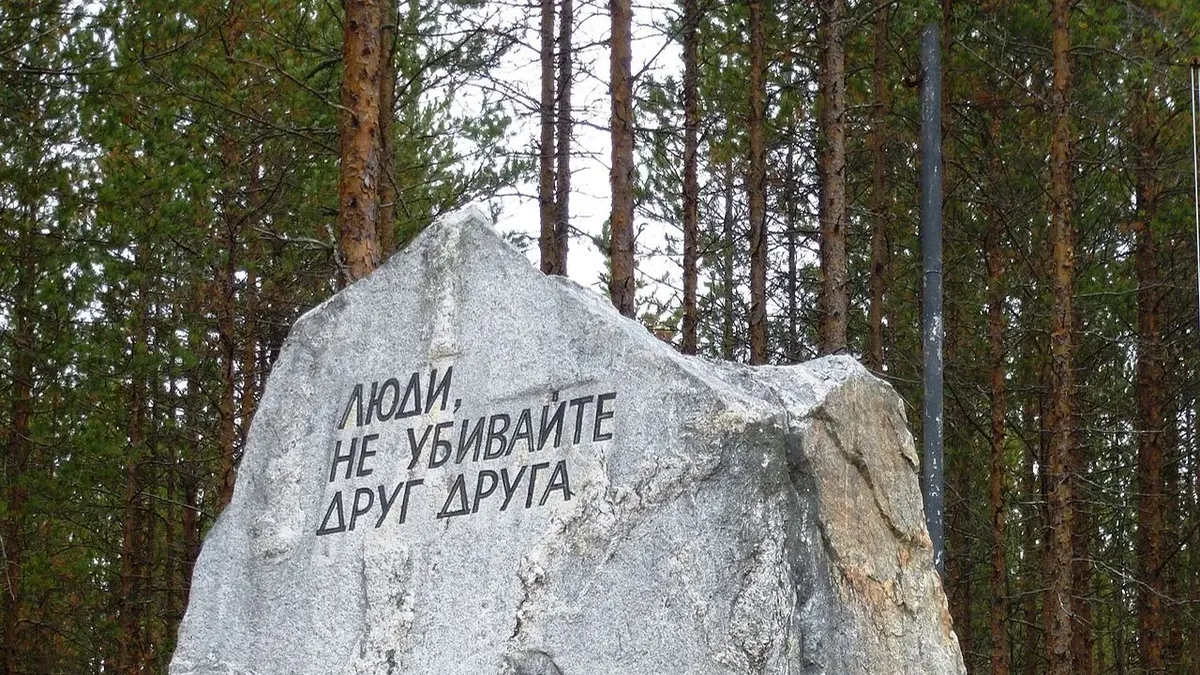
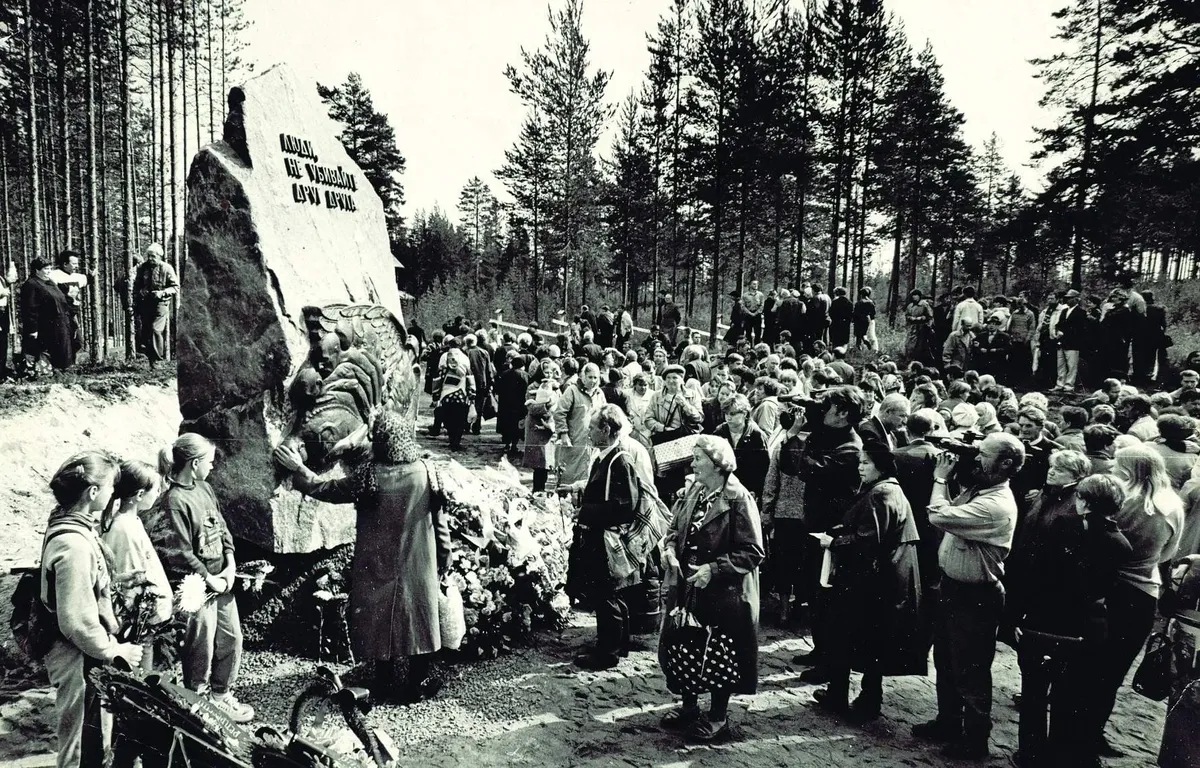
Memorial in Sandarmokh. Photo from the archive
On August 16, 1937, the People's Commissar of Internal Affairs of the USSR, the General Commissar of State Security Nikolai Yezhov signed order No. 59190 “On the completion of the operation to repress the most active counter -revolutionary elements from among the GUGB prisons”. The order was addressed to the head of the UNKVD in the Leningrad Region. In his third paragraph, the fate of those who languished in the Solovetskaya prison of special purpose was especially stipulated:
“For a Solovetsky prison, 1,200 people are approved for repression.”
The operation to exterminate prisoners was ordered to begin on August 25, 1937 and complete in two months, according to the clearly spelled out procedure.
At first, “for each repressing subject” they made a detailed certificate indicating the surname, name, patronymic, for what crimes, for what time and by whom he was convicted, criminal activity (subject to repression) in prison (“shoots, counter -revolutionary attacks and malicious violations of the regime”). Then these certificates were signed by the head of the prison and his assistant for operational work, after which the certificates, along with the case, were sent “to the corresponding republican, regional or regional“ triple ”, which, having examined the materials, passed the verdict - exclusively mortal, an extract from the protocol attached to the case, after which“ cases and protocols are returned to the chief of the prison to bring the sentence ”.
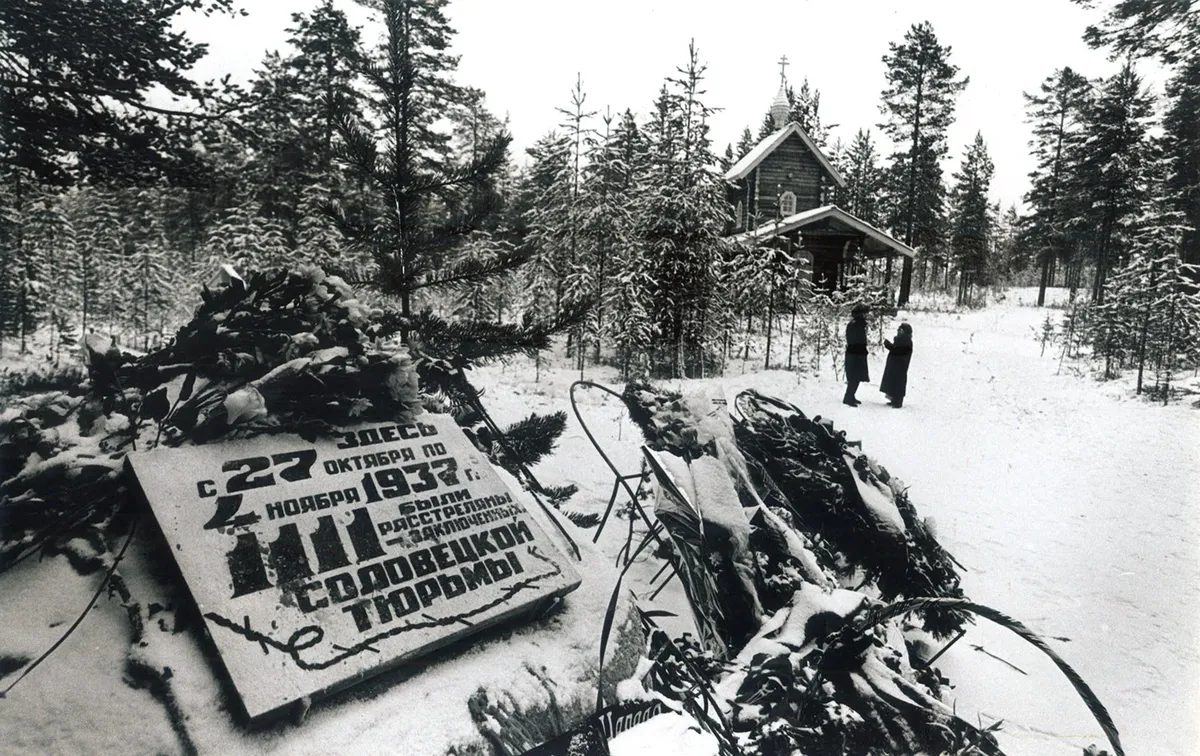
The largest shot stage, the so -called “first Solovetsky” - according to the lists of 1116 people - went from Solovkov on barges in October 1937. And then it disappeared without a trace, giving rise to a legend: the prisoners were drowned in the White Sea - along with the barges. But in the mid-1990s, researchers managed to find documents in the archives of the FSB that shed light on this matter. And in the summer of 1997, the search group with the help of the army company attached to him began the study of the Sandarmokh forest tract 16 km from the Karelian Medvezhyegorsk. Firing pits were discovered there, and in them skeletons, all have bullet holes in the back of the head. In total, the group installed 236 such pits.
According to archival documents, from August 11, 1937 to December 24, 1938, over 9,500 people were shot and buried in the Sandarmokh tract.
Including the very “missing” Solovetsky stage - 1111 prisoners, their names are known. Especially a lot in the lists of executed were cultural figures from Ukraine. As one of the researchers, Ukrainian intellectuals in Sandarmokh, was bitterly more than in the vicinity of Kyiv or Lviv noted.
A special role in revealing the secrets of Sandarmokh was played by Yuri Dmitriev. He, as you know, did not forgive this: Dmitriev in prison.
Yezhov’s instruction, as we recall, was: to shoot 1,200 Solovkov prisoners, but the Leningrad Troika, working in the sweat of her face, managed to draw up the sentences “just” for 1116 prisoners. Of these, one died, without waiting for an execution, and four, as it turned out, were already transferred to other cities.
On October 16, 1937, the head of the NKVD department for the Leningrad Region, Zakovsky sent the head of the Solovetsky prison of the GUGB of the NKVD of the USSR to the senior major of state security I. Apeter Secret disposal:
DOCUMENT
“Immediately give out all 1116 people sentenced to execution - sent to the execution of sentences of the deputy. The beginning of the AHU UNKVD LO-Captain Gos. Safety to T. Matveeva M. R. Fulfillment.
The same date, October 16, dated to Mikhail Matveeva issued by the captain of state security:
DOCUMENT
“It is proposed to be convicted by a special triple UNKVD in the amount of 1116 people contained in the Solovetsky prison of the State Unitary Enterprise of the NKVD of the USSR, to shoot. For this purpose, you must immediately leave for Kem and contacting the head of the Solovetskaya prison of the GUGB - Art. Major of state security, Comrade Apometer, who simultaneously give instructions on the issuance of convicts - to bring the verdict (so! - P.G.), according to the instructions personally given to you personally. ”
And already on November 10, the captain of state security Matveev reported:
DOCUMENT
“I am reporting that on the basis of the order of the head of the NKVD department-the commissar of state security of the 1st rank Comrade. Zakovsky of October 16, 1937 for No. 189852-a verdict against convicts to V.M.N. - According to the protocols of the special three UNKVD LO for No. 81, 82, 83, 84 and 85 of only 1.116 people - I am carried out for 1.1111 people:by prot. No. 81,
total 209 people,
Perform. 208 people.
Not comprehensive. 1 person. Rodionov F.I. He died in B-CC, Act No. 27 from 8/X-37 g.
by prot. No. 82,
- only 182 people. "
Daily Matveev “performed” from 180 to 265 sentences.
The main performer
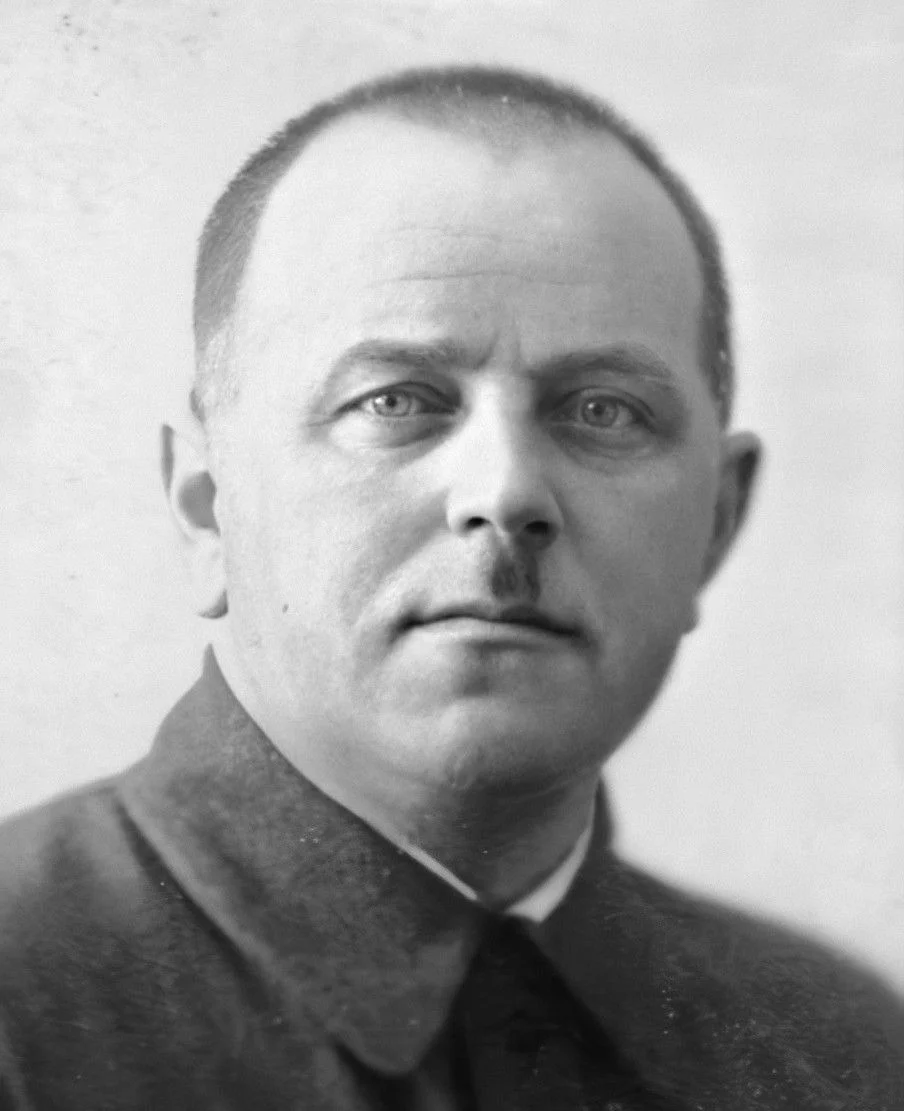
Matveev graduated from two classes of a rural school. From the age of 15, Burlak in Borovichi, since October 1908-a boy in a technical office in St. Petersburg, since February 1909-a stoker in the Larinsky gymnasium, since May 1912-a Swiss in the Ugaryumovs’s income house on Nevsky Prospekt, No. 8. In 1913-1917-a mechanic improvised at the Petrograd Mechanical and Lithuania factory. "Volcano". In 1917 he joined the Red Army, participated in the assault on the Winter Palace.
Since March 1918 - Head of the Flying detachment of the Cheka on the Petrograd side. Member of the CPSU (b) since 1918. Since 1918, he "worked" by the executor of death sentences in various departments of the OGPU/NKVD with a break in 1923-1927.
In October-November 1937, being the head of the brigade to bring the sentences in Sandarmokh, Matveev shot most of the convicts personally in the back of the head.
By order of the UNKVD LO on December 20, 1937, for “selfless work”, the State Security captain Matveev was awarded a valuable gift.
But fate, as you know, plays a man. With the change of People's Commissar Yezhov to the People’s Commissar Beria, the expected cleaning of the People's Commissariat began. In 1939, Matveev was sentenced to 10 years of camps for "excess of official powers" and "cruel treatment of prisoners." But already in 1941 he found himself at large and successfully continued to work in his main specialty: he knew how to kill people with a shot in the back of his head. For this "skill" was awarded the Order of Lenin.
The executioner-Stakhanovets Matveev, having safely lived until 79, died in Leningrad in 1971, surrounded by honor and respect-as a veteran of the Great Patriotic War.
Evidence of the historian
Irina Fliga, director of the St. Petersburg Research Center "Memorial"*:
“Matveev was sent on a business trip, he had to execute sentences against 1111 people. He arrived at Solovki, took the stage from the head of the prison and then brought it to Medvezhyegorsk. Bringing to Medvezhyegorsk, he saw that this place "categorically does not fulfill the requirements of shooting training grounds." And then gives a detailed rational explanation that he asked for four cars to be given to him, and four cars would not be given to him. Instead of cars in Leningrad, sending him on a business trip, they gave the tires so that he would take cars in place for these tires. There are different ways to analyze reliability.
But for everyone who knows Soviet realities well, it is impossible to imagine more reliability. The executioner-shooter asks the cars, they say to him: no, we won’t give you cars, we will give you tires, find it yourself.
Matveeva was to “bring” the order in conditions when all the circumstances were strongly against. And on the first day, an emergency happened. Someone from the "contingent" carried a knife with him. They cut the ropes and attacked the convoy. The work stopped for four days, and was resumed only on November 1.
The sentenced were "prepared" in three rooms of the hut located with anfilad. In the first room - “Checked the Personality”, undressed and searched. In the second - the striped were connected. In the third - stripped and tied, they stunned with the blow of a wooden "stump" on the back of the head. Then they loaded into the car, a man for forty, and covered with a tarp. Members of the "brigade" sat on top. If one of those lying below came to his senses, he was “reassured” by the blow of the “Kolotushka”.
Upon arrival at the landfill, people were dropped one at a time in the prepared pit, at the bottom of which Matveyev stood. He personally shot everyone in the back of his head. ”
Now the Sandarmokh memorial cemetery is officially registered as the “burial place of victims of political repression” in the Unified State Register of Cultural Heritage of the Peoples of the Russian Federation for No. 101510346000005 ”.
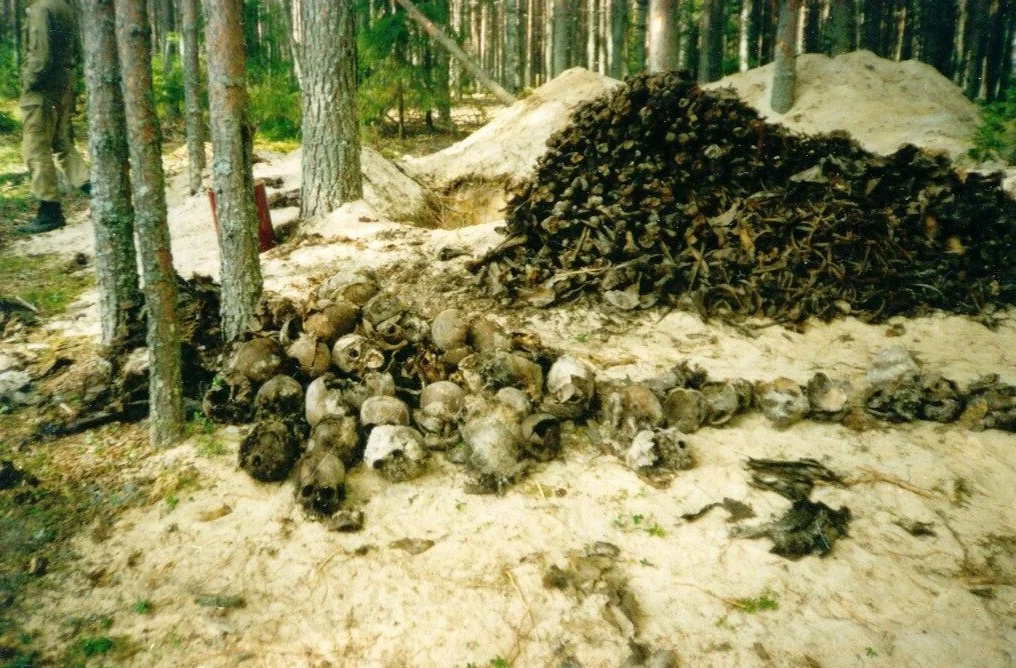
And in 2018, the Russian Military Historical Society (RVIO) suddenly decided to rewrite the history of these places. The RVIO Expedition, together with the soldiers of the 90th separate special search battalion (OSPB), organized excavations on the edge of the Sandarmokh memorial and removed the remains of several executed from the ground.
The appearance of the victims clearly reminded of the paranal work of the Chekists of 1937–1938: the hands are tied behind their backs, the legs are bent at the knees, a revolver bullet in the back of the head ...
The expedition managers, however, hastened to say that according to the “greenish residues of clothing” and “steel bullets”, it is almost confidently said that dug bones belong ... captured Red Army soldiers, executed Finns during the Second World War.
Then they unloaded the remains in the bag and sent them to the Investigative Committee for examination.
The special corner of “New” Irina Tumakova ** wrote in detail then about the research of this “expedition” and asked the relevant questions. There are still no intelligible answers.
Who did Matveev shot at?
Of the killed 1111 people, about 300 were Ukrainians.
From the publication of Dmitry Oreshkina, “Around the World” (No. 7, 2007):
“On Solovki, Troika opened a conspiracy of spies and national terrorists called the“ All-Ukrainian Central Bloc ”among the prisoners. They picked up people who had only knowledge of the Ukrainian language or relatives in Ukraine. We examined personal cases - dozens per day, pronounced a verdict, and quickly in Kem, for a bullet in the back of the head. However, the paper order was respected. In the shooting protocol of October 9, 1937, terrorist Professor Vangenheim (No. 120) is adjacent to Javorsky Matvey Ivanovich -No. 118 (“Historian-economist, speaks the languages of Russian, Polish, Czech, Belarusian, German, French, Italian, Latin and Greek, has a brother of Ivan in Prague and Galicia (Lviv) to sister. Catherine ”), with Chekhovsky Vladimir Moiseevich -No. 119 (“ Professor-Historic ”), with Grushevsky Sergey Grigoryevich -No. 121 (“ Professor-Historic ”) and so on. In total, several branched counter -revolutionary organizations were opened in the camp: conspirators, fascists, terrorists. ”
There was among the executed professor-philosopher Peter Demchuk (37 years old).
In addition to his native Ukrainian, he knew German, English, Polish, French, Czech, Italian, Russian. It is not surprising that the young scientist and the socio-political figure, who lived abroad for some time (in Western and Eastern Europe, was one of the founders of the Ukrainian Communist section under the Central Committee of the Communist Party of Austria), the Chekists charged with the so-called “UVO”-the invented “Ukrainian military organization” ... They also wrote down some kind of sucked from a finger from a finger. The "cell", in which the majority were "agents of foreign intelligence"!
When, after a quarter of a century, the Chekists of the Khrushchev time will look at the boundless “criminal” heritage fabricated by his predecessors, Major Ganenko from the KGB investigative department under the Council of Ministers of the Ukrainian SSR, constituting a review of the professor’s investigative case, write: “The testimony of Demchuk in many cases is uncleaned, there are no links to specific facts. From these testimonies, in particular, it is not clear under what circumstances and who exactly he was - Demchuk was recruited in UVO, as he ended up in “K. p. Blok ”, how does he know about this block at all, who, when organized this block; What specifically did Demchuk do on the instructions of VOV in the Soviet embassy in Vienna. ”
These are just a few questions without answers that remain after studying the materials of the linden affairs.
The bosses of the camp among the piles of others drawn up as a copy of the documents will be assembled by the signature of the certificate and about Peter Demchuk - the same obligatory piece of paper, according to which they formally decided to shoot.
DOCUMENT
“Active member of the UVO, was connected with Polish intelligence and worked in favor of Poland ... was planned to fulfill terrorist acts ... It is in the position of the fans of Ukrainian nationalists who seek to tear Ukraine from the USSR, praises German fascism, preachs the defeat and death of the owls [of the Etsk] power, accepts terror as a method of combating the owls. power. He behaves sharply counter -revolutionary. "
In the 1960s, after the first wave of rehabilitation of the victims of the Bolshevik terror, there is a place (only a few lines) in the three-volume Soviet encyclopedic dictionary and for the former “corresponding member of the Academy of Sciences of the Ukrainian SSR” Demchuk. The compilers of an ideologically designed three -volume will write that the scientist in his works exposed the reactionary essence of bourgeois philosophy, and will also indicate the false date of his death - “30.I.1943”.
And not a single word, of course, will not be in that vice versed about the place of execution of the philosopher.
Anton Vladislavovich - prose writer, literary critic, literary critic, teacher was shot by Krushelnitsky .
He studied at Lviv University. He taught in the gymnasiums of Lviv, Vienna, Kolomyia, Rogatin, Berezhan, Gorodenki.
The Minister of Education of the UNR (1919), editor of school ackname for Ukrainian literature (Vienna, 1919–1922), publisher-editor of public and literary magazines of the pro-Soviet orientation "Novi Shlyakhi" (1929–1933 in Lviv) and "Criticism" (1933, ibid.), The author of the biographical essay "Ivan Franco", etc.
In July 1932, he moved with the whole family to Soviet Ukraine, lived in Kharkov in the house "Word". On November 6, 1934, Anton Krushelnitsky was arrested by the state security authorities of the NKVD of the Ukrainian SSR in Kharkov. In the resolution of the operative II department of the ICB SPO in the Kharkov region of Bordon, it was approved:
DOCUMENT
“Krushelnitsky Anton Vladislavovich is one of the leaders of the OUN center created in Ukraine (the organization of Ukrainian nationalists, is banned in the Russian Federation. - Ed.), Which aims to overthrow the Soviet regime in the USSR and prepare terrorist acts against representatives of the party and government.”
The case of A. Krushelnitsky was considered on March 28, 1935 by the visiting session of the Military Collegium of the Supreme Court of the USSR. Sentence: Ten years of imprisonment with confiscation of property.
The elder sons of Taras and Ivan were shot with him in December 1934. Two youngest sons, Bogdan and Ostap, became ZK (“prisoners of the Canalo -Armists”) of the Belomorestroy and served his sentence on Solovki. Shot, like the father, on November 3, 1937 in the tract of Sandarmokh . Daughter, Vladimir Krushelnitskaya, a doctor, also sent to Solovki. The "Special Troika" of the UNKVD LO 11/25/1937 was additionally convicted under Art. 58-10-11 of the Criminal Code of the RSFSR to the highest degree of punishment. Shot in Leningrad (according to other sources - presumably in the Leningrad Region) 12/18/1937.
Anton Krushelnitsky is rehabilitated.
Les Kurbas - Ukrainian and Soviet actor, theater and film director. People's Artist of the Ukrainian SSR (1925).
He studied at the Ternopol Ukrainian gymnasium, participated in amateur performances. Since 1907, he studied at the Faculty of Philosophy of Vienna University, a year later he transferred to Lviv University. For the requirements of Ukrainization of the university, it was expelled. Later he recovered at the University of Vienna, which he graduated, at the same time studying at a dramatic school at the Vienna Conservatory.
In 1917, he organized a theater studio in Kyiv (later - “Young theater”).
Since December 1933-in Moscow, he worked as a director of the Maly Theater and the Jewish Theater. Arrested in Moscow on December 26, 1933 in the case of the Ukrainian Military Organization. In April 1934, the Judicial "Troika" was sentenced to five years in prison. He was at Vygozero's camp, then in Medvezhyegorsk, staged a performance at the BBK Central Theater. In October 1935 he was aimed at Solovki. The Kremlin was kept at the camp, staged performances in the camp theater.
Rehabilitated. In 2002, Kurbasa erected a monument in Kyiv.
Pidmogilny Valerian Petrovich , writer.
The author of several novels and stories. He was an organizer, editor and translator of Maupassant (10 volumes), Balzac (15 volumes) and France (25 volumes).
In 1923, the new Ukraine (Prague) magazine published novels of the fagotmogilny. This magazine appeared in the case as material evidence of his “counter -revolutionary activity”.
On December 8, 1934, he was arrested on charges of "participating in the work of a terrorist organization, which aimed at organizing terror against party leaders." In the first interrogations, he answered the investigators: “I do not admit myself guilty,” even when interrogations “became cruel”. However, on January 11, 1935, the protocol appeared “recognition” of the fagotmogiles that it belonged to the “group of nationalist writers with terrorist moods regarding the party leaders”. The so -called "group" consisted of seventeen people. Among the accusations of the fagot -mogyle in the protocol, his statement is given that "the collectivization policy led the Ukrainian village to hunger."
7–28 марта 1935 года выездная сессия Военной коллегии Верховного суда СССР без свидетелей и адвокатов осудила Пидмогильного и других арестованных по этому «делу» на «десять лет с конфискацией личного имущества». Вскоре Пидмогильный был доставлен в Соловецкий лагерь особого назначения.
Последнее произведение Пидмогильного осталось незавершенным и неозаглавленным; рукопись хранилась в спецархиве под запретом около пятидесяти лет, опубликована под условным заглавием «Повесть без названия».
Rehabilitated.
Шаль Иван Васильевич , украинский филолог, перед арестом профессор Краснодарского пединститута. Автор учебников по украинскому языку и литературе для кубанских школ. Арестован 13.01.1933 как один из организаторов и руководителей «к/р повстанческой организации «Союз Кубани и Украины». Приговорен к 10 годам ИТЛ.
Реабилитирован в 1960-м.
Яворский Матвей Иванович , академик.
Заключенный Илья Корсовецкий, сидевший вместе с ним на Соловках, говорил о нем так: «Скверно он делает, что со всяким разговаривает на эти темы и открыто говорит свои мысли, так что с ним говорить теперь опасно. Его окружили шпионами, стукачами, и он, не разбираясь в людях, болтает им все, как друзьям. Теперь 3-я часть ( чекисты . — П. Г. ) «создала» вокруг него какую-то организацию, и сейчас все избегают его. С ним опасно встречаться…»
Изучал право в Львовском и Венском университетах. Во время Первой мировой войны был старшим офицером полевой жандармерии австрийской армии. В 1918 г. вместе с оккупационной армией прибыл в Киев, где был политическим референтом-переводчиком при генерале Линзингене. В 1919 г. служил сотником в полевой жандармерии Украинской галицкой армии.
В 1919 году остался в Киеве, впоследствии переехал в Харьков, где в 1920 году вступил в КП (б) У и стал официальным историографом марксистской исторической школы. В 1920-х годах некоторое время заведовал управлением Укрнауки, впоследствии возглавлял исторический отдел Всеукраинского института марксизма-ленинизма, а некоторое время — весь институт.
Избран действительным членом Всеукраинской академии наук. С этого времени работал в Киеве.
В 1929 году отстранен от руководства историческим отделом Института марксизма за «националистический уклон», в феврале 1930-го исключен из партии, лишен звания академика ВУАН и академика АН Белорусской ССР. В 1932 г. арестован в Киеве; решением КОГПУ был приговорен к шести годам исправительно-трудовых лагерей и сослан на Соловецкие острова. В лагере был одним из лидеров украинской «внутренней эмиграции».
В 1936 году отправил удивительное (даже не верится) заявление в Центральную аттестационную комиссию ГУЛАГ НКВД СССР:
«Настоящим сообщаю, что я отказываюсь от зачетов рабочих дней не только за истекший период, но и вообще. Я считал таковой (зачет) издевательством над человеком, которого, как и многих других, сталинское «правосудие» сперва бросает в тюрьму за то, что он украинец, не поменявший любви к своей родине на русский патриотизм, подкрашенный «интернационализмом», — которого названное правосудие без суда осуждает за несуществующее дело на медленное уничтожение в лагере, в условиях тяжелого принудительного труда, на полуголодном пайке, в сетях гнусной провокации и нравственных мучений, — а после всего этого оно, это правосудие, обещает ему сократить его медленное уничтожение — моральное и физическое — при условии так называемой «перековки», т.е. безропотного самоподчинения этому уничтожению и подкупного славославия его политики.
Я лично «перековывать» себя не стараюсь, обоготворять «гениального, любимого, родного вождя всех народов» не желаю, да и вообще считаю для себя позором таким путем покупать себе волю, тем более когда десятки тысяч украинской интеллигенции погибают в тюрьмах и лагерях в условиях, означенных выше, когда их семьи осуждены на медленную голодную смерть в условиях так называемой «культурной и зажиточной жизни», в условиях сталинской «заботы о человеке», когда сотни тысяч ограбленных украинских крестьян засевают Россию своими костями на каторжных стройках, лесозаготовках и других видах принудительных работ, когда столько же погибает их у себя на родине от голода, хотя как будто и там жить стало «веселей». Я считаю, что при таком положении вещей на Украине для меня больше будет чести умереть уже вместе с ними в общей нашей каторжной жизни, чем стремиться на волю, чтобы жить жизнью хамелеона, раболепствующего перед современным Нероном и его преторианцами, хамелеона, захлебывающегося в восторге перед политикой национального гнета и крестьянского грабежа в царстве — не строящегося социализма, а всеобщего обмана провокации и произвола.
Л/п Кремль-Соловки, 30/VI-1936 года».
В 1989 году реабилитирован. В 1991 году восстановлен в звании академика АН Украины, в 1994 г. — в звании академика АН Беларуси.
***
«Расскажи, Матвеев, как ты за один день Божий погасил все большие звезды на культурном небе Украины, даже не заметив этого», —
написал уже во времена украинской независимости правозащитник Евгений Сверстюк.
Тут, если быть честным, надо обязательно напомнить, что среди тех, чей последний адрес — Сандармох, были:
адвокат россиянин А. Бобрищев-Пушкин (защитник Бейлиса и Пуришкевича),
московский литературовед сибиряк Н. Дурново ,
основатель удмуртской литературы Кузебай Герд ,
белорусский нарком Ф. Волынец ,
татарский общественный деятель И. Фирдевс ,
московский цыган Г. Станеско ,
грузинские князья Н. Эристов и Я. Андронников ,
католический администратор Грузии Ш. Батмалашвили ,
профессор истории ВКП (б) еврей Пинхус Глузман ,
черкесский писатель князь Х. Абуков ,
корейский деятель Тай До ,
православные епископы Алексий (воронежский) , Дамиан (курский) , Николай (тамбовский) , Петр (самарский) ,
лидер баптистов СССР В. Колесников ,
отец П. Вейгель , направленный Ватиканом в СССР для проверки данных о преследовании верующих…
PS
В 1937 году было вынесено 353 074 смертных приговора, в 1938 году — 328 618, в 1939 году — 2552, в 1940-м — 1649,
то есть в 1937—1938 годах было вынесено 681 692 смертных приговора (около 1000 приговоров в день!),
а вот в 1950–1957 годы — «всего» 3894 смертных приговора (около 1000 в год), с 26 марта 1947-го по 12 января 1950 года смертная казнь не применялась.