
Translated material
Landscape before the battle lost
Why society will have to resist imitations of the presidential election of 2024
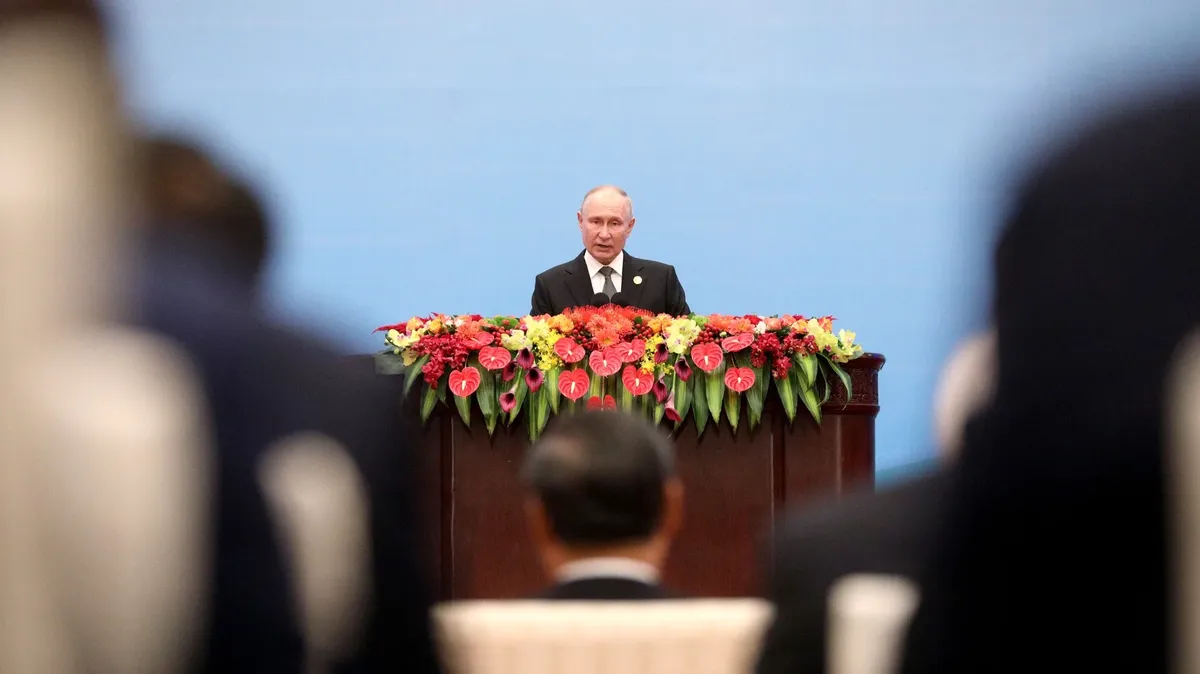
Putin at the opening ceremony of the third international forum “One belt, one path”. Photo: kremlin.ru
In the fall, workers, collective farmers and students stretched to the Kremlin: the public ordered this to worry about the fact that Vladimir Putin was again asked to run for president. A few weeks later, he will begin the election campaign, more precisely, the imitation of such a campaign in a military dictatorship.
On the eve of Putin began to change the rhetoric addressed to his supporters. The Russian dictator speaks less about the war and offers a more traditional summons for itself, in which its function is to limit the ineffective local bureaucracy, making social miracles aimed at supporting citizens. Another role played by Putin the pre -election is associated with a demonstration of his status of the leader of the global south countries fighting with American hegemony (for example, Australia is included in the global north, so there is no need to be surprised at such geography). One of Putin’s recent international trips - to Beijing was devoted to this task.
Unpopular war and arguments against participation in the show
A decrease in the public interest of the President of the Russian Federation in the war can be considered a good sign: his administration understands that the next act of folk love in the spring of 2024 should be held against another background. Putin’s war is unpopular, what the surveys are talking about, in which at the end of this summer, most citizens advocated peace negotiations. Yes, official sociology still fixes high levels of support for the dictator, but everyone would be happy if he finished. A request for normalization and return to peaceful life is the main driver of what is happening today in Russia, for example, the authorities to refuse to close the borders or announce a new big military mobilization.
The opposition and political emigration in this context are facing a difficult choice. On the one hand, there are clear arguments confirming that participation in the elections in current conditions does not make practical sense.
We list these arguments:
Real candidates who could fight for power during the presidential campaign, such as Alexei Navalny, are isolated by the Kremlin (the purpose of an unprecedented attack on Navalny’s lawyers is the isolation of the Putin’s political prisoner on the eve of the Putin’s elections);
Putin’s dictatorship is built on systematic repressions and fear, it is impossible to conduct an election campaign in conditions of complete arbitrariness;
Independent media and producing bloggers are knocked out of the legal field, declared foreign agents and undesirable organizations, so that an independent candidate cannot rely on their audience (for example, a registered presidential candidate cannot give an interview to the Rain TV channel);
The dictatorship has great opportunities for falsification of the elections - from the traditional administrative resource and coercive citizens to vote at the workplace to the actual prohibition of the Institute of Independent Observers and Novelty, such as electronic voting;
Finally, the opposition in the country is defeated, and political emigration does not have the potential in order to agree on a single candidate (more on that below).
What will the boycott lead to
Despite these considerations, the conditions in which Putin will begin a new electoral cycle are extremely important for the future of the country. In particular, for that part of our fellow citizens who are aware of the scale of the experienced catastrophe. Putin's reign has already turned into the largest political tragedy for Russian society since the Civil War and Great Terror. Military mobilization, announced for the first time since 1941, took place ten days after the next day of a single vote. The decision on this crime against his people was made by Putin in the wave of a traditional demonstration of “love”: he was convinced that his actions were formally approved by voters, and candidates in the regions supporting him are gaining non -alternatively high interest rates.
Researchers of Russian authoritarianism, such as the philosopher Grigory Yudin, explain that the elections in this system are arranged as a series of surveys, during which citizens require only regular oaths in allegiance to the president. Putin’s convincing victory in the 2024 elections in this logic will inevitably lead to a radical increase in repression and militarization of society in this logic. In the foreign policy arena, Putin is trying to collect allies to conduct an endless global war. A slight victory in the election will untie his hands for the final restructuring of Russia into a military camp. Objectively, this scenario seems almost inevitable, but the question of whether he can resist, he needs to be asked.
In Russia, even according to official figures, there are several tens of millions of people who have not accepted the war.
The anti -war movement smolders, although its public measurement was almost destroyed after the arrest of hundreds of Russian citizens who opposed aggression. These people prevent the authorities from completing the fascist of society. It was them that recently in a fit of frankness called for “destroying or somehow isolating” the deputy of the State Duma Gurulev. For our fellow citizens, participation in the elections is a safe way to express his attitude to the disaster in which Putin pushed the country. Even simulation elections can become a public platform that will record that Russian citizens who do not want war are not alone, that there are many of them.
Finally, another reason why these elections are important is that they can help the international community not put a cross on the Russians. Russia is not a country of cannibals supporting cities bombing, Russian society can and should be talked, ignoring the power of the dictator. Recently, voices urging the European Union and the United States have intensified not to recognize the results of non -alternative elections in the conditions of war and consider Putin a usurper. This is a step in the right direction: if an imitation of the 2024 presidential campaign is not easy for the Kremlin, it will be easier for the world to realize the difference between Russians and dictatorship.
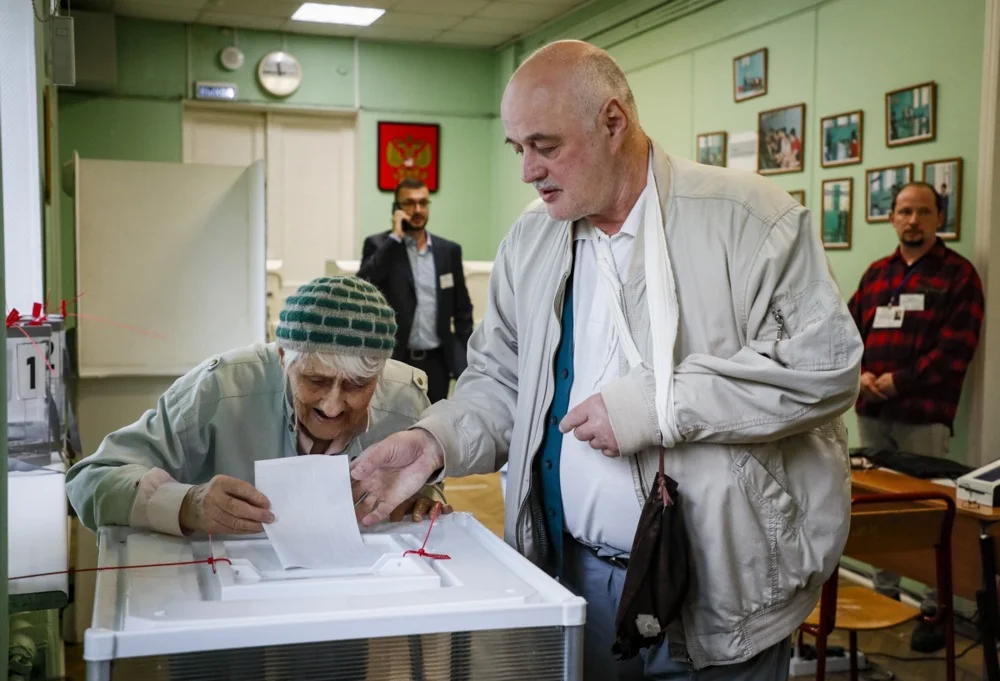
In other words, if you boycott the elections, then:
Further repressions and fascization will be easier for the Kremlin;
Anti -war movement will be strengthened in the opinion that we suffered the final defeat in the country;
People will be even more isolated and divided;
It will be easier for the West and the international community to conclude that Putin represents the interests of all Russians.
And if so, it turns out that we must participate.
However, the idea of a single opposition candidate in a military dictatorship seems to be stillborn. On the one hand, a political campaign against war and Putin cannot be conducted from emigration. Such efforts simply will not be evaluated even by critical voters, and propaganda will easily introduce any emigrant as an enemy of Russia that receives foreign financing. On the other hand, an opposition candidate who directly opposes the war and has minimal chances of a noticeable campaign, or will not be registered in the elections, or if for some reason they will allow such registration, seriously risks his freedom and life.
Everyone who offers the opposition to unite and put forward their candidate must keep in mind that such a person is actually called to sacrifice himself.
The “initiative group” of the advisers must answer the question of whether they are ready to sacrifice and themselves, going to support the anti -war candidate for Russia (also remains the question of how meaningful this victim would be, provided that the prospect of the victory of the opposition in the elections is completely illusory). The conduct of the safe and sterile campaign in the conditions of daily war crimes that are committed in Ukraine will not work. Such a campaign will resemble the Duma campaign of the New People party, which immediately turned out to be quite old.
Scoundrel and savior of the fatherland
If a candidate is impossible, does this mean that a political campaign against war is impossible? In my opinion, no. In the absence of his own candidate, the design of the opposition campaign could look like this.
The opposition refuses to find a single candidate and focuses on using the entire election period to show how Putin deprived the fellow citizens of the future (“Vladimir, who stole a generation”). This campaign is based on politicians, artists and public figures who opposed the war, and is supported by independent media. At the same time, the emphasis is on the fact that without Putin everyone will ultimately live more conveniently. The topic of war crimes of our dictatorship, which is essentially very important, will scare away the mass voter and, unfortunately, will not become an effective tool for combating dictatorship. All data of independent media show that the mass audience is protected from reality and does not want to know anything about war criminals, but they are interested in mobilization, a rebellion of Prigozhin and the ruble course - that ultimately makes their life worse directly.
Further, the public campaign admits that there are no good candidates in the elections, but in general terms use the “smart voting” already familiar to all. At a critical moment, a few days before the election, one of the registered candidates is ironically appointed by the “Savior of the Fatherland” in the spirit of the classical film “Elections Day”, and all anti -war Russia agitates its support. Perhaps the phantasmagoric, grotesque virtues of such a candidate are emphasized that it will be useful to vote, say, the traditional audience of the LDPR or the Communist Party. So that people who act in the elections against the war have additional guarantees of security by blurring the audience.
The slogans of such a campaign could be the call "Finish!" And the image of "Vladimir, who stole the future." The candidate appointed by the “Savior of the Fatherland” may be worth choosing literally by random lot on the air (the show is no worse than the last debate about the “split in the opposition”). After all, good candidates can not be expected, and attempts at rational choice may be pushed away by those anti-war voters who are unacceptable to vote, for example, for the communist candidate. The lot rarely works in modern political systems with the exception of the jury as an element of the judiciary, but was once considered the most egalitarian of all possible political practices.
We call the model of such a campaign “super -widespread voting”. It is impossible to prepare the Kremlin for the results of the lot, and it makes no sense to argue against its results, we are talking about a blind case. The campaign of this type involves the rejection of the moral assessments of the candidate chosen by the symbol of anti -war resistance. He will most likely be a villain, but for the campaign it is only important what function he will perform: opposite his last name, you can put protest marks in the ballot.
Here, the tragedy of Russian democracy acquires well -known features of the booth. But it seems that the dance of death organized by Putin can not be answered with complaints, but only with some kind of life-affirming. For example, the thesis that the Russians, despite all the patriotism, would like to live as if possible - and literally any person except Putin would give the country more chances for this.
The win -win lottery of Putin and the purpose of the opposition
It is almost impossible to disrupt an imitation organized for the sake of reassigning Putin, since the reality and mood of people almost do not affect it in principle. That is why in the headline I made the thesis that the battle will be lost. Any opposition tactics leave Putin a formal winner of the competition, the design of which is specially designed for it. But the pragmatic result, which is worth fighting, boils down to the following:
Make a falsification system to work for a refusal so that the number of cases of sabotage will grow in it;
achieve consolidation of protest votes in support of an alternative candidate;
to achieve the mass participation of public opinion leaders in an anti -war campaign aimed at mobilizing people to vote for an alternative candidate;
Make a visible position “No”, “Finish!” Both for voting participants directly at polling stations in social media, and for the world community.
Just three years ago, at a fictitious referendum on the Putin constitution, more than 20% of voters, or 16 million people, came to sites to say their “no”. If this figure manages to double during the fictitious presidential elections, what was planned as the show of one actor will become a platform for finding peace and future.
I wrote this text not as the editor-in-chief of Novy-Europe, but as a Russian citizen participating in the discussion about the 2024 elections. Publication may not be the position of the editorial office in relation to the future electoral campaign. There are arguments in favor of an alternative strategy aimed at recognizing elections by illegitimate. I do not have a complete answer to the question whether these two strategies are mutually exclusive. The illegitimacy of the elections follows from their design: falsifications, the non -removal of candidates, the ban on the work of independent media.