
Translated material
Four times longer than Navalny
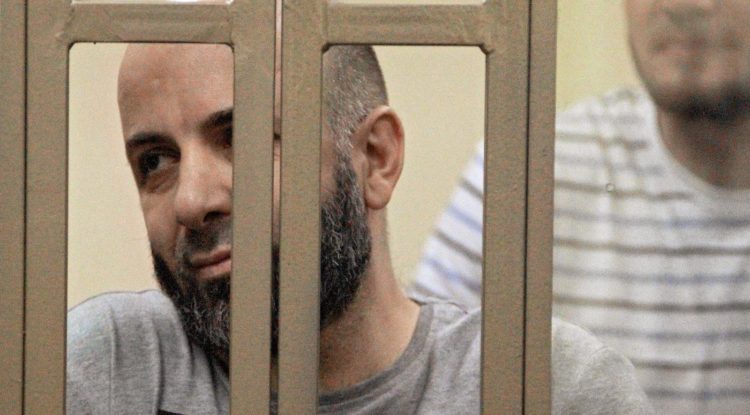
The story of Teimur Abdullaev. Of the last 1330 days in the colony, he spent almost 900 in a schizo
The security forces began to use the schizo more actively to put pressure on political prisoners, the authors of the study of the ATS-info are sure. They analyzed reports about the schizo for 2023 and compared them with data over the past 10 years. In addition, the practice of “carousel” sending to the schizo appeared - when the deadlines are extended one by one. "Cold" talks about the new Russian practice of punishment of political prisoners on the example of the Crimean Tatar Tamur Abdullaev. Over the past three and a half years in the colony, he spent almost 900 days in a schizo - this is almost two years longer than Alexei Navalny (taking into account the recent punishment , he will spend 236 days in a schizo).
In order not to miss the main materials of the "cold", subscribe to our Instagram and telegram .
On October 12, 2016, employees of the FSB broke into the house of Alim and Teimur Abdullaevs in the village of Strogonovka near Simferopol.
There are five children in the Abdullaev family. Alim, the wife of Teimur, recalls: “He had to hold a three -month -old baby in his arms, standing right in handcuffs. They checked literally everything, up to children's blankets and mattresses. The eldest son, who was nine then, was shaking. Looking in armed people turning our house, he asked: “Mom, have they come to kill us?”
That morning, special services employees came with searches at once at five addresses in settlements under Simferopol.
Teimur Abdullaev - Crimean Tatar. Together with his brother Uzeir, he held the gym, where they waged a section of Taekwondo. Teimur and his brother and three more comrades were detained and accused of terrorist activities. All of them were members of the Hizb Ut-Tairer religious community, whose participants gathered at each other, read and discussed the Qur'an and conducted political discussions. “Hizb Ut-Tahrir” in Russia recognized as a terrorist organization back in 2003, while the organization does not support violence.
What is Hizb U-Tahrir?
“Hizb Ut-Tahrir” is a political movement, the purpose of which is to spread Islam around the world. It was founded in the 1950s in East Jerusalem, after which the organization’s cells appeared in different countries. In the 1990s, the Hizb Ut-Tahrir cells also appeared in the states of the former USSR.
The Hizb Ut-Tahrir has a strict hierarchical structure, members of the organization make regular donations. The organization strives to establish a caliphate first in one country, and then spread to other countries.
At the same time, the movement advocates non -violent methods of struggle. Despite this, it is prohibited in some countries. In Russia - is included in the list of terrorist, in Kazakhstan, Kyrgyzstan and Tajikistan - recognized as extremist. In Germany, Hizb Ut-Tahrir is prohibited due to the fact that the movement opposes the existence of the Israeli state, "leads anti-Semitic propaganda and propaganda of violence to achieve political goals." At the same time, the United States and the EU countries do not include the organization to terrorist.
The human rights project "Memorial" recognizes all the pursued in the Hizb Ut-Tahrir case by political prisoners. The Memorial believes that the court did not provide evidence of their terrorist activities, and calls the persecution of activists a “instrument of suppression of civil activity”.
The last time the children of Teimur Abdullaev saw him at the court hearings, which continued until 2019. The court sentenced Abdullaev to 16.5 years in a maximum security colony, he was sent to the city of Salavat (Republic of Bashkortostan) - two and a half thousand kilometers from the house to the city. For three and a half years he has been sitting in a colony and during this time he managed to become a “record holder”: today, out of more than 1300 days, which he spent in prison, about 900 he was contained in a schizo, one of the most severe places in the entire Russian prison system.
Prison in prison
Schizo, or penalty area, is a prison prison. The colony staff can send prisoners there as a punishment - for example, for violation of the rules of the internal scene of the colony.
“This is a room two by two meters or less, there is a school on which you can only lie at night. Half an hour after lifting, the colony staff come with verification: you leave the camera, a person enters there and fasten the shkonka to the wall. It is impossible to lie on it before the end of it, ”the former political prisoner Konstantin Kotov, who was also sent to the schizo, told the“ cold ”. “There is a small table in the cell, either a stool, or a bench, a parach - a toilet in the form of a hole in the floor and a small shell nearby.”
In this special chamber, as a rule, there is practically no light, it is damp and cold in the rooms, more than 16 hours a day, the prisoner cannot be lying, only sit on a stool, stand or go from corner to corner.
Formally, they can send for refusal to work, storage, manufacture and use “forbidden” (for example, for the use of lighters, knives, playing cards), incitement to riot or conflicts with the administration . But in practice, Russian security forces are increasingly used as an occasion even minor deviations from the rules, and sometimes they themselves invent a violation themselves. They also actively use the insulator for pressure on political prisoners.
The Human Rights Project of the ATS-Info calculated that for 10 months of 2023 at least 40 political prisoners were sent to the schizo. On average, each of them spent 15 days in the insulator. At the same time, the prisoners accused in the Hizb Ut-Tahrir case were most often sent to the insulator: at least 13 such people are known. In addition to them, at least six convicted witnesses of Jehovah and four defendants in anti -war affairs were sent to Shizo. Also, women who were convicted for political reasons began to be sent to the penalty area: for example, the founder of “left -wing resistance” Daria Polyudova or journalist Maria Ponomarenko.
According to the ATS-Info, the “champion” among political prisoners in the number of days spent in 2023 in the penalty area, became Muslim Aliyev. This is another Crimean Tatar, which was sentenced to 19 years in a maximum security colony for “organizing the activities of a terrorist organization” (this refers to the same “Hizb Ut-Tahrir”) and “preparation for violent seizure of power”. For the incomplete 10 months of 2023, Aliyev spent 120 days in a schizo.
Release and plant again
The practice itself can be called carousel , by analogy with carousel arrests: the law suggests that the prisoner can be placed in a schizo for only 15 days in a row, but the security forces go on cunning and, as soon as the term ends, they immediately find a new “violation” and send a “guilty” for a new term.
“Several guards come to the cell, they greet. Teimur answers them: “Hello,” and at that moment he is announced about a violation of the routine, ”says Alime Abdullaeva. - Like, it was necessary to separately say to each employee of the colony: “Hello”, “Hello”, “Hello”, “Hello”. For such violations, it is sent for 15 days to a schizo, and then anew. ”
They can be directed to the insulator in any condition, even if the prisoner is sick - for example, Abdullaev was placed in a schizo despite the fact that he became infected with coronavirus. “Imagine, in a raw room, where, in his words, you can remove socks and squeeze from dampness, with high temperature, it should have been on your feet for 16 hours. You can neither sit down nor lie down, ”says Alime. - And if Teimur allowed himself to lie on the floor, the guards entered the schizo camera and announced that he again violated the internal regime - by laying at a wrong time. And he was appointed new day. ”
“No“ ideal ”behavior becomes a guarantee of inviolability for political prisoners in the colonies, because the very“ violation ”of the conditions of detention can be provoked by security guards,” said Eva Lovenberg, lawyer, ATS-Info. The human rights activist of the public association created by the relatives of the accused in the Hizb Ut-Tahrir case and the activists of the Crimean Solidarity, Lutfiy Zudiev, says that they want to "finally break" by constant placements in the schizo and make them "died as an individual with their political and religious views."
Alime Abdullaeva is sure that the decisions of sending to the schizo are not even made by the colonies, but someone is higher. “This may be just an order coming from other special bodies,” the human rights activist Lutfiy Zudiev agrees. “If earlier, sending to a schizo was a single character, then after 2022 it takes place systematically.”
Zudieva recalls that in 2019–2020, when Teimur Abdullaev was kept in a schizo for several months, this was an exception to the general rules. Russian and Ukrainian human rights activists wrote complaints, and journalists attracted attention to this in the media. “Now, the security forces understand that the reaction of society to violation of the rights of political prisoners will be minimal, because all the searchlights are aimed in the other direction - at military operations in Ukraine,” says Zudieva. - In the current information stream, what is happening with political prisoners in the colonies is, unfortunately, not even secondary news. Security officials and special services are well aware of this, therefore they use the moment and increase the already existing pressure on people. ”
"This year I will not pull the meeting"
During the serving of a sentence in the schizo, prisoners are losing almost all their rights: dates and gearrs are prohibited there, personal belongings are prohibited. A toothbrush, soap and one or two books are given out in time, smoking is forbidden. Written accessories and paper are issued at best for one hour a day so that the prisoner can respond to letters.
Almost the only right that is not violated is the opportunity to meet with a lawyer. As the defender of Abdullaev and Aliyeva Rustem Kamilev says, lawyers can go to the colony at least every day, but in practice this option is not available to everyone. “One working day of a lawyer costs from 10 thousand rubles,” Kamilev explains. “Not all families can pay for such services.”
According to Kamylev, lawyers usually come to the colony to each prisoner once a quarter, if there are no requests for an urgent visit. It is expensive to travel on dates to relatives: not all families of political prisoners can afford it.
“I thought that about 160 thousand were on the whole trip: this includes expenses on the road to Salavat, the purchase of products, renting an apartment,” the wife of Muslim Oblya Aliyeva tells “cold”. “I decided that this year I will not pull.”
Alim Abdulaeva last time saw her husband in August - she came to him in Bashkortostan for a three -day date . According to Alim, over seven years of conclusion and a constant stay in the schizo, Teimur's health state has radically worsened: “He now has high blood pressure, vision and hearing deteriorated, his kidneys are worried. When in August I went to a date to him, not my husband came out to me, but an old grandfather with a package of drugs, but he is only 48 years old. ”
According to lawyer Rustem Kamielev, at the time of publication, Teimur Abdullaev left for 874 days in a schizo.
When there will be their next meeting, Alime does not yet know. Basically, the Abdullaevs communicate with letters. Thamur is allowed to call the family about once every one and a half months, for a maximum of 15 minutes.
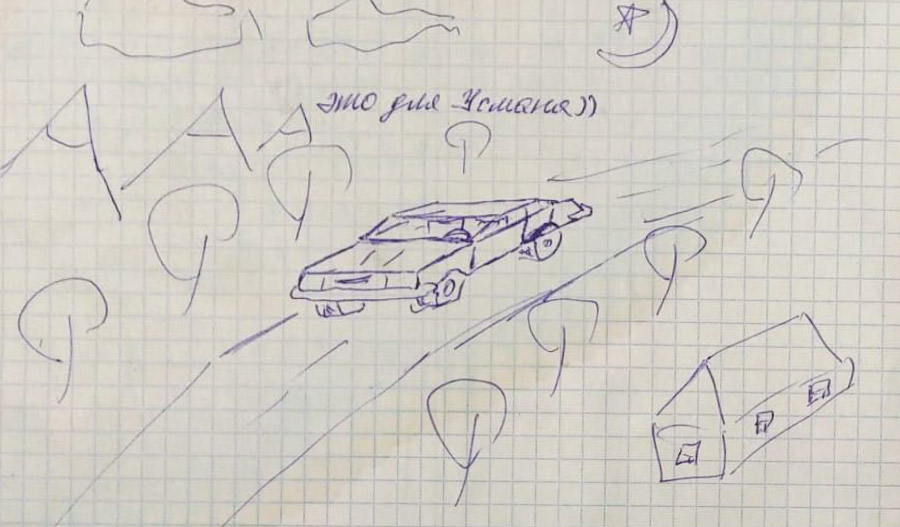
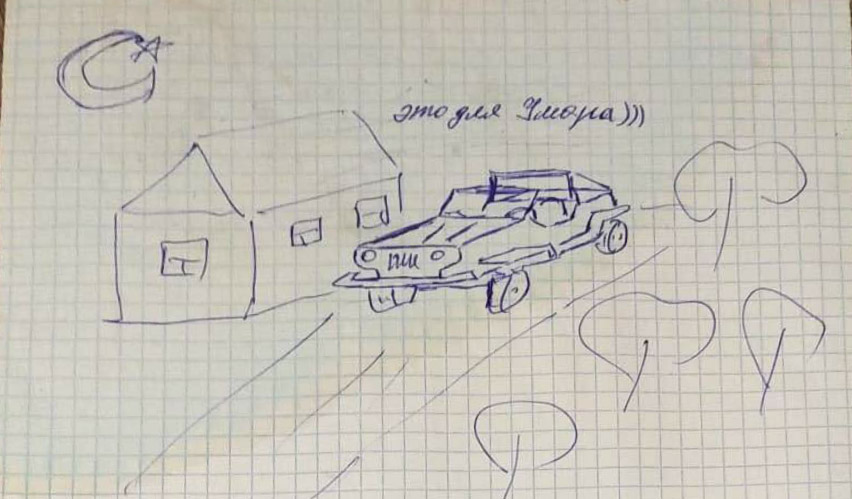
Taymur sends letters and drawings from the colony: he draws houses with trees and flowers, sons - cars and mountains. “At the same time, there is no sun in any figure of Teimur, they are all with the moon,” says Alim. “As if a person has only darkness in the subconscious.”