
Translated material
I'm not scared
Roman Dzyadko Radio Martyn. About the way to live and not die of despair
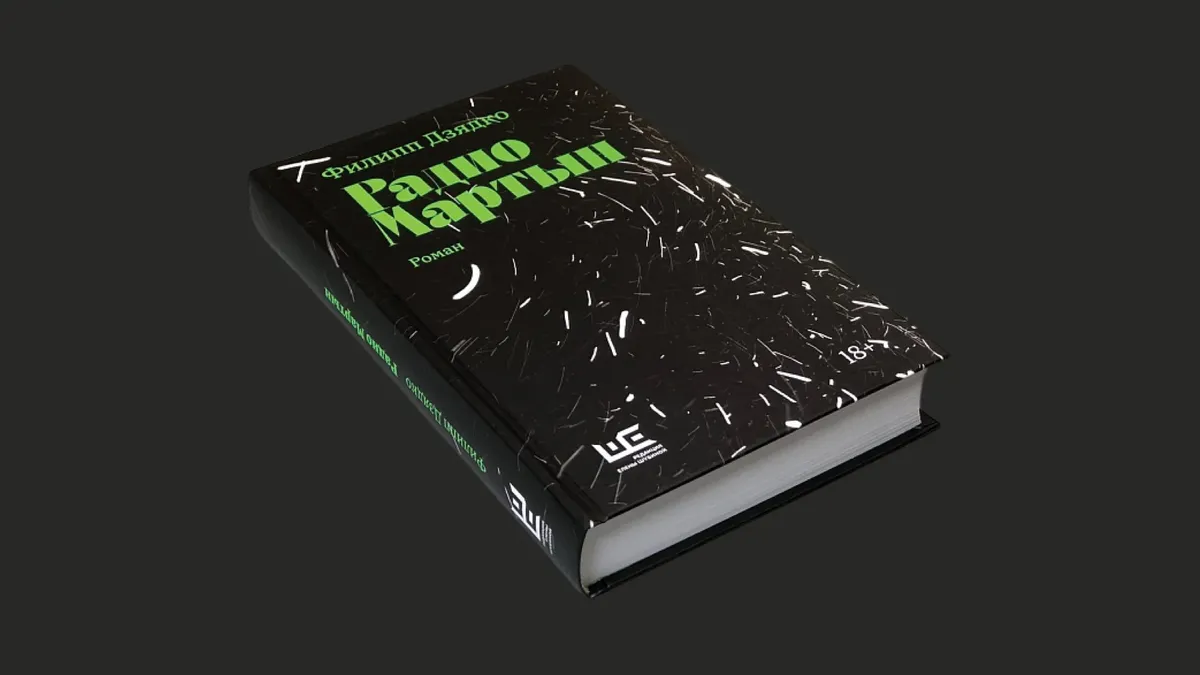
Cover of the book "Radio Martyn"
Philip Dzyadko’s novel “Radio Martyn” was not released now, but in 2022 (AST, “Elena Shubina”), but it is interesting to talk about him today, when the simple, but important thought was confirmed: good literature is a high -class seismograph that captures the earthly soil long before they come to the surface. Even the plot itself, in which shameless propaganda is a potent character, is now even more relevant than 10 years ago, when the author came up with it. Although the action of the novel takes place in the future, and the future is so totalitarian that special invitations are required to approach a friend, it is clear that he was not thinking as anti -utopia - a person remains in the focus of the writer.
The crushed by a state way, driven into a corner, suppressed by fear, clogged with lack of freedom, he is experiencing so unpainted 90s, deceptive hope of the 2010s and current cynical times.
The main character, Martyn, a puny, with a disfigured nose injury, is almost deaf (tinnitus, ringing in the ears), but with a hidden self -conceit, he lives alone - his parents died in an accident, his beloved grandfather died, teaching him difficult to think, subtly feel, talentedly fantasize. That's what it was not possible to learn - this is not to pass in front of rough power (... then I entered any room as if I was sorry for this forgiveness). He is almost forty, but there can be no question of any career, although he works as a sound engineer on the main radio of the country of Russia Always. He got there only because the leader was owed something to his grandfather, and he lingered, because he had the perfect hearing (in specially mounted headphones) and could clean any record and mount the subcases about the construction of new objects, more and more often others. Radio is a favorite tool of state propaganda: “It is forbidden to turn off the radio station, and it is impossible - only to damage, and this is already an article: once a week, the district police officer checks their condition.”
Around the radio and the plot of the novel is twisted. This plot is whimsical from different pieces, and each piece is a separate fate, character and a segment of time. Only complicated together they give a picture of life, especially distinguished generation, born in the early 80s. These are special people, they still found the Soviet Union, but they grew up in a new country, so their gaze is more voluminous than those who are younger, and more sober than those who are older. The manner of communication, jargon, cults, words, quotes - all this gives a clear feeling of their circle, its time, its values, its ideas - about good, evil, codes of behavior, read books, favorite bars, etc. etc.
Real letters of real people of the beginning of the twentieth century are woven into this modernity. Gathered by the author in antique shops and Bukinistic stores, these letters make up one of the main messages of the novel.
If now our past is interpreted by propaganda as a chain of great achievements and deafening victories, then in the novel it is poked from the fate of ordinary people. Each of them has its own injury, its own faith, its own hope. A look into the past through these fates changes the angle of the perception of this past, returns a human dimension to him, an understanding that the main thing in history is people. People do not really know great history, so they are easy to “envelop” them. "We are a country of factories for the production of illusions!" - says one of the characters, and ancient letters from 1913, 1917, 1937, sent from the camp for prisoners of war, the Gulag, links, the dugout - a way to dispel them. And yet - resurrect the memory. After all, a person dies when they forget about him. “The main river of the country has become summer” - this leitmotif of the book sounds distinctly, and this must be fighting - this message of the novel is also obvious.
And Martyn does it. As a result, it would seem, unintentional meetings with various strange subjects, he enters the community of “emerald people”. These informational demolitions with Radio NN found a way to break through with murderous news through bravura summaries of achievements on “Russia always” and an impudent chanson, which raping air. Martyn, the nature of which is an explosive mixture of superiority and freedom, is not that he gets rid of his weaknesses and fears, but slowly gets out of the feeling of hopelessness, communion for people “who did a billion of strange things. And they gradually ceased to seem strange to me. Once the silent bobeobi gloomily gave me tape and a roll of paper and said: “We went to work,” and we hung yellow posters with quotes from “three fat people”, Gugolev’s poems and “Roman about the fox”, and the next day we wrote with green paint on the walls (“it would be fine, but not”).
Unimaginated words and daring characters fill the novel with a sense of freedom.
Many lyrical digressions will seem redundant, but they are an essential part of the novel. They reflect the impressions of objects, nature, living creatures, which the author gained for life and now sorts so that that faith, those dreams, those beliefs that do not trample the most filthy power appear through these configurations.
I won’t tell you how to do it, so as not to bring down the excitement with whom you follow the detective intrigue, also available in the book. But, of course, the author would have sinned before the truth, if the novel about our twisted time ended safely.
The real resistance stories, which unfolded before our eyes, the end of the predictable end - the deadlines under the article “On Fakes”. However, in the novel, the writer, like his characters, is clearly not inclined to reconcile with the feeling of hopelessness. As in life, it gives rise to resistance:
“... we are more than it seems to us. After all, it will be correct to consider those who give us information, our agents secretly informing what is happening throughout the country, about arrests, detention, and murders. And they are everywhere, even among riot police, imagine, people are everywhere, the spirit breathes everywhere. ”
And this spirit frees the best that is in a person. This is trampled by this, raking everything that is bad in it, and the “emerald people” pull compatriots from the edge of the human disaster with the word of tough truth and support.
It sounds pathetic, but in the novel this pathos is camouflaged with stylistic hooliganism, dangerous oddities, obscene vocabulary, sophisticated lyrics. Of course, Martyn meets his only love, and this spacious narrative can be interpreted as a story of fabulous love. However, the main thing in it is that no history textbooks will give the sensations of our time more precisely than the Martyn radio.