
Translated material
Chronicle of loss
Nikolai Alexandrov - about the "Diary of a desperate", a book by a German aristocrat, who met with Hitler, fiercely hated him and regretted that he did not shoot in 1932
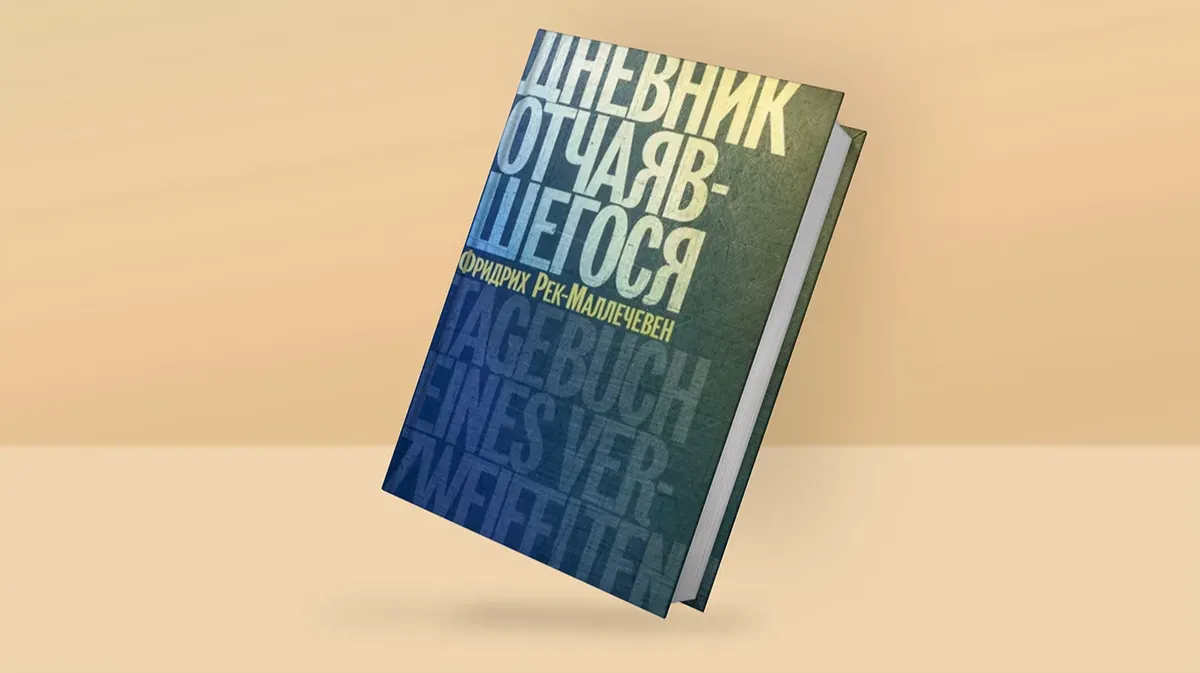
Personal time (biographical, everyday, concentrated and closed at the present moment) and historical time-are experienced in different ways. A person can dissolve in everyday concerns, and then life turns into one sorrough day.
He may not pay attention to a great historical time. It may not be interested in its family history. His personal life then grows out of historical non -being, and memory, in fact, is limited by some information about the life of fathers and grandfathers - one of the typical features of the Soviet era. This is the exact opposite of the personal historical memory of the pre -Soviet era, if you recall the Pushkin definition: history is what is transmitted from the father to the son and further - to the grandson. Unrelevant darkens the understanding of a great historical time, drowns its rhythm. But the great story itself reminds of itself with disasters and faults, shifts of temporary slabs. Modernity, fixated on an endless news stream, does not give too many tools for understanding. You have to look for food for thought in other sources. In the "Publishing House of Ivan Lumbach" came the "Diary of a desperate" Friedrich of the River Mallecheven. This is an amazing book, and you can only regret that it only now comes out in Russian. Although even today she impressed, let’s say, a limited audience, she would hardly have changed something in the past. By the way, partly this problem - a possible impact on the course of history - it is dedicated.
Awareness of disaster
Friedrich River-Mallecheven, the son of the East Prussian landowner, one of the representatives of the so-called conservative revolution, who died in Dachau under the still not understood circumstances, reckoned in Israel to the righteous of the world in 2014, kept his diary from 1936 to 1944. And this is one of the most striking evidence of the formation and development of the Nazi regime in Germany, but first of all - one of the deepest understandings of the historical meaning of events.
A convinced monarchist who knew the court life, an aristocrat, a man of impeccable taste, who received an excellent education, a traveler who visited Russia, the attentive reader of Dostoevsky, Frederick River and himself had an extraordinary fiction talent. He wrote documentary prose, historical, biographical and adventure novels. The most popular of them is “bombs over Monte Carlo” (the alteration of the novel by Pierre Sovevestra and Marseille Alena “The cut hand. Fantomas in Monaco”). And the work most significant and significant for the river itself is “Bokelson is the history of mass madness”: an artistic study of the dictatorship of the anabaptists in Münstere in 1534–1535.
The writer's talent is immediately evident in his “Diary”: an attentive and ironic look, the accuracy of descriptions and assessments, despite expressive imagery, freedom in the language and a variety of metaphors. Artistry here does not replace the analytics, and makes evidence more vivid and convincing. This is emphasized by a subjective look. The rivers do not hide emotions - it is not by chance that this is a “despair diary”, a person’s diary who was fundamentally left in the country that has turned into hell, and speaking from the depths of this hell.
“Do you understand what it means to live for so many years with hatred in your heart, go to bed with hatred, see hatred in a dream and wake up with hatred in the morning, and all this during the years of the negligence of your rights, without the slightest compromise, without a single“ Hale Hitler ”, without a mandatory visit to the meeting and with the stigma of illegality on the forehead?”
“I know well that you need to hate this Germany with all my heart, if you really love it, and it is better to die ten times than I see your triumph.”
“Is this not the height of tragedy, not a monstrous shame that the best Germans who remained here, who for twelve years have been captives of the herd of evil monkeys, should hope and pray for the defeat of their Fatherland for the sake of this fatherland?”
Conservatism and more than a skeptical attitude to bourgeois democracies does not interfere with the river with disgust to relate to national socialism and give it merciless definitions:
“Nationalism: the state of mind, in which a person does not so much love his country as he burns from hatred of a stranger, so much so that he is ready to wet his pants.”
The rapid formation of Hitlerism for him is not a special case that is not suddenly arising, an unexpected phenomenon, but a logical result of the development of European civilization, starting from the Renaissance. Therefore, appeal to the past helps to understand the present. The pages of the "Diary" are full of references to the events in Münstere of 400 years ago described by the river in the novel, and parallels with today.
“Like Germany today, the city-state Munster for many years completely separates itself from the civilized world, like Nazi Germany, it has been successful for success and seems invincible ... Like ours, there is a loser, a way, so to speak, in the wastewater, becomes a great prophet, like ours, all resistance is inexplicable for him, inexplicably for him, inexplicably for him. The amazed environment ... Like ours, hysterical women, stigmatized teachers of folk schools, fugitive priests, successful architects and outsiders of all stripes - the support of this regime. "
The Nazism flourishing in Germany is a sign of the death of the entire previous order, the characteristic features of which were finally formed after 1789 (the beginning of the French Revolution. - Ed. ).
“What happens to the system of views of 1789, which surrounds you and is still a condition for life and the image of thought ... Didn’t Saint-Just proclaim the state of the state crazy? .. The Hitler state, with its plutocratic axis, with a systematic murder of the spiritual and perfect intoxication of the masses is only the last desperate attempt to extend the XIX century ...”
The rivers quotes Dostoevsky’s prophetic words “The end of the world is close” and says: what is happening in Germany is an unconditional symptom of the deepest disharmony of the world and a sign that the apocalypse is already being completed here and now. The wake -up evil, the torn demons of Hell ( “The most infernal rabble in the world lives in Germany today” ) will shake the entire globe and will not leave anyone aloof. The inevitability of the Second World War with the millions of victims for the river cannot be doubtful (“ I have no doubt that the approaching Second World War will lead to the death of the masses”) , especially since the ethnic evil was not rebuked when he only raised his head, neither in Germany, nor beyond its borders.
“Allowing the first major violation of the world to remain unpunished, we make the offender even stronger than it is, and making it even stronger, we simultaneously make ourselves, its last opponents within Germany, even more defenseless and powerless.”
The old order is doomed to death, and it is not only about space and state borders, redistribution or redistribution of forces and influences, not only about law, economics or politics. There is another time, another eon, some global entities, the worldview foundations that determined the direction of civilizational development should change. According to the river, the essence of the previous one, suffering from the world order, was in rationalism, in faith in progress and science, in the rate on economic well -being, in the approval of the cult of consumption. The former social structure was collapsed, society became more amorphous. Individual, unique was replaced by impersonal and universal, a massive person, a bearer of mass consciousness, stated itself louder:
“... a product of radio, mass stupefying, a product of all these technical apparatuses that lead to the emergence of social quarters, to the mania of the masses, to the complete termitization of mankind and, as a result, this fact cannot be lost sight of - to humiliation and incapacity of this intelligentsia.”
“Real intelligentsia”, everything that is not massive, “others,” is under the blow. "Massity" as the main characteristic of our time - for Frederick the river symbol of wildness, degradation, loss of human proper in man:
"A massive person depends in his spiritual and physical conditions of life on a fluid of wildness and troglodytism."
"I am suffocating from the realization that I am captured by the Horde of Evil Monkeys."
“It is unbearable that this is the flood of the world by Neanderthals. It is unbearable that this herd of Neanderthals requires a few still full -fledged people to become Neanderthals, and for refusal threatens physical destruction. ”
The vulgarity, bad taste, aesthetic disgrace - signs of dividing, transitioning on the other side of good and evil, when a person is not angry and not kind, "but deeply and with certain enthusiasm at all nothing." The horror lurks in mediocrity, which hated complex, high, otherwise, and receives complete embodiment in the leaders of Nazi Germany, primarily in Hitler. In the stories of the river about several meetings with Hitler (at different times, at different moments of the political career of the Nazi leader), the impression that he made is dominated by angry disgust. The rivers writes that Hitler is not even a villain, “not an antichrist from the life of the saints, physically beautiful and spiritually burning, but rather a miserable scarecrow, each cage something like a mid-hand shopkeeper ...”
“... He represented the policy of future Germany as a chain of political robberies, and the work of a leading statesman - as a chain of fraud, falsifications of documents and violations of contracts that were typical for teachers of folk schools, super -standard tax inspectors, engineers ... in a word, all those who, during this time, really became the support of his power, who responded to the call of a wonderful guy, political Chingiskhan. With oilseed strands, falling on his face during such sermons, he resembled a marriage swindler who, before the crime, tells how he was going to deceive the mocketing of the cooks. ”
The first impression of the river from Hitler is increasingly strengthening in the future. The only thing the author regrets: he did not see in this miserable man, “frozen, outplapping, with a pasty round moon -like face” , grain and the basis of future upheavals, and did not kill him when there was such an opportunity.
“Friedrich von Mucke dinner in the Munich“ Osteria Bavaria ”, when he entered the restaurant, one, without ordinary bodyguards, and took a place at the next table ... I arrived in the city by car; At that time, in September 1932, the streets were already unsafe, so I had a gun ready and I could easily shoot it in an almost deserted restaurant. I would have done this if I realized the role of this insolent and foresaw our many years of suffering. At that time, I took it only for the hero of the humorous newspaper and did not shoot. ”
“Diary of a desperate” - of course, a work of art, deliberately written aesthetically carefully. And this artistry is emphasized by the fate of the author himself. He leads the narrative, bringing the reader closer to the tragic finale, more precisely, to his foresight: the ending itself remains behind the scenes, but his inevitability cannot be felt.
The Diary opens the news of the death of Oswald Spengler and a brilliant portrait outline of the author of the Sunset of Europe. In the image of Friedrich, the Spengler river in personality, in its appearance, seemed to combine the two main and opposite concepts of one’s own historiosophical concept - culture and civilization (high spirit and “combination”). “It was the most strange, in my opinion, a mixture of real human greatness and small and at the same time great weaknesses,” writes rivers. He describes in detail these weaknesses, manifested in everyday life, in behavior, to keep himself in the manner. That, the forerunner of which was Spengler, Friedrich of the rivers is experiencing from his own experience. His “diary” begins when the author lives in his own dump, and ends, in essence, in a prison cell (one could say “in the camp hut”, if we keep in mind the fate of the river). Chronicle of loss, essential list of ruin, destruction of culture. Final pages: a description of the bombing, a story about the invasion of Nazi officials to the estate, the confiscation of the library - signs of the current apocalypse, hellish fire, burning culture.
It is hardly worth saying that Friedrich’s “Diary” of the river, read in the context of today's events, cannot but surprise with coincidences or begging parallels. And it is difficult to resist the fact that, like the author of the "Diary", do not look back, looking for a forerunner in the past of a future catastrophe.
Of course, the point here is not only in socio-political ups and downs. I remember how - now, now, far, antediluvian times - my good acquaintance and one of our wisest and most witty contemporaries tried to convince the managers of the newspaper "Today", who decided to close the "Art" department. He said: “You do not understand. What seems boring and unnecessary to you than you sacrifice allegedly in favor of the fighting for the freedom of politics and the economy is actually a guarantor of freedom at all. ”