
Translated material
Alibi for the conformist
About the essay of Vaclav Gavel "The power of the powerless"
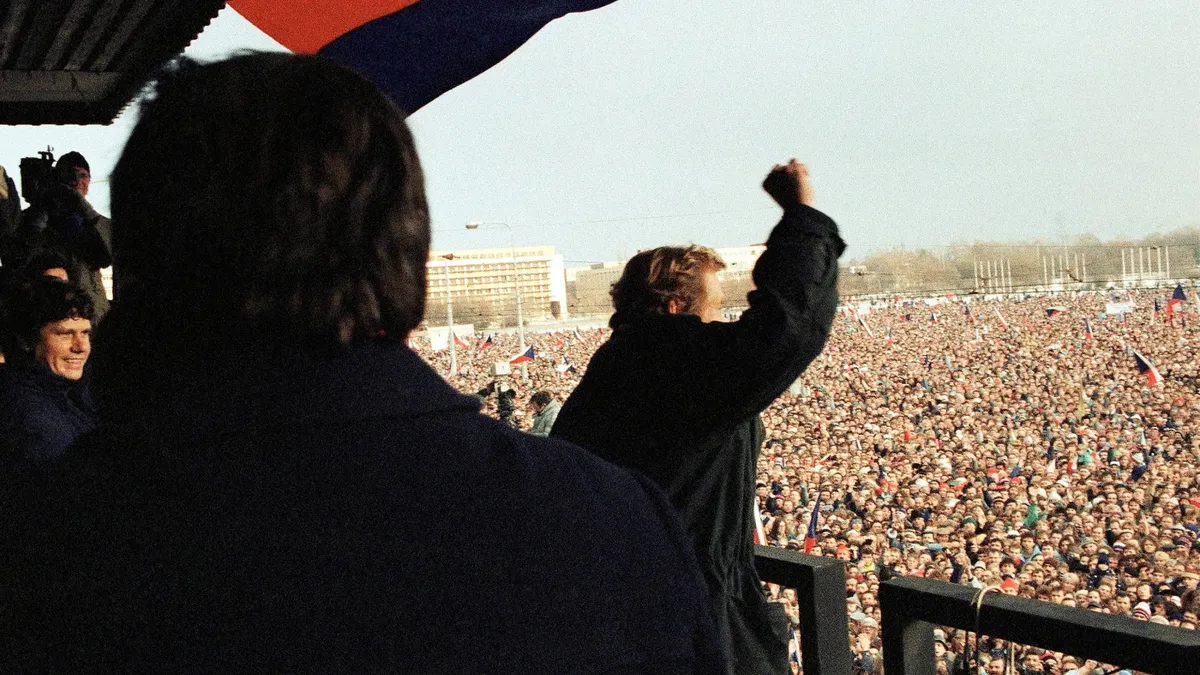
Vaclav Gavel performs at a rally. Photo: AP / TASS
As always on Saturdays, we continue to study the device of the dictatorship using literature. Last time, we agreed to leave artistic prose for a short time and consider closer the philosophy of dictatorship, the philosophy of freedom, the sociology of propaganda, the anthropology of protest and other "non -artistic" things. Today we read the famous Essay Vaclav Gavel “The power of the powerless” - reflection immediately about all of the above.
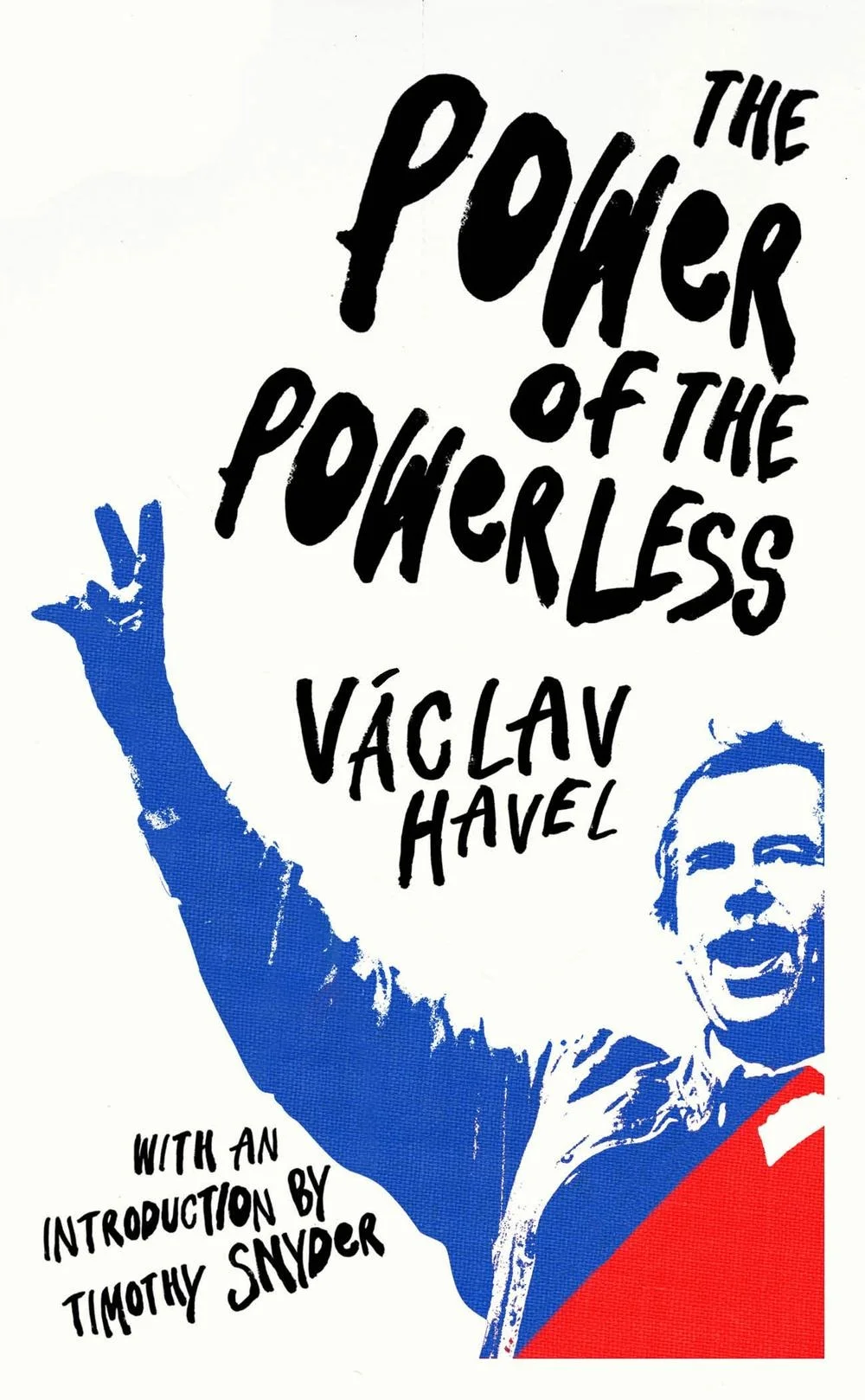
Gavel, with all the inconsistency of his policy at the presidential post, is still a monument to successful dissident-“power of powerless”, according to his own definition. In fact, such successes, as it is easy to guess, is very rare: at best, non-conformist in a totalitarian country, having served several terms, lives to the collapse of the regime (and this regime, of course, is not obligated to his personal non-conformism). In the worst, of course, he does not live. It is also easy to guess that the statistics of good and bad outcomes are disappointing. And here is one of the main issues that the Sensor Gavel is asked in his essay: what is the meaning of dissidentity then?
The answer to this question Gavel gives a paradoxical, almost literally - freely or involuntarily - quoting the second message to the Corinthians: "My strength is committed in weakness."
A protest against a deaf totalitarian system, according to Gavel, is a matter of course, hopeless, but the power of protest activity is just in this visible impotence.
The dissident does not protest for the sake of achieving the result - he may not even suspect for a long time that he is a dissident. He protests simply because he does not like lies and does not want to lie himself. At the same time, he risks a lot, but also wins a lot: in particular, his gain is a calm conscience and self -esteem. In other words, he risks the external freedom, but wins the internal freedom.
The conformist lives in this sense harder. Gavel cites an example of a greenhouse who hung in the window of his store the poster "Proletarians of all countries, connect!" (We remembered him last time when we read Snyder). Naturally, the greenhouse does not care whether the proletarians will connect or not, -
He hung this poster for the only purpose: to be left alone. And it seems that the logic is understandable, but one greenhouse hangs a poster, the second, the third, but the janitor tie the red ribbon on the broom - and on the general plan everything is unanimously “for”,
And the protest is impossible, since the entire public space is engaged in pro -government agitation.
So the slogan is directly associated with the existence of the greenhouse and reflects his higher spiritual values. But let's say that the authorities will force him to hang another poster in his window: "I'm afraid, and therefore is unquestioningly obedient." Will the greenhouse hang these words as calmly? Maybe ashamed. But after all, the second poster is just a voiced and indicated subtext of the first, then what's the difference? Here is Havel about the same thing.
There is no difference, but the conformist is also vital to experience a sense of self -esteem. But only unlike the dissident who does not require external incentives (his logic: I live in accordance with my beliefs, I don’t lie to myself, which means that I have nothing to worry about), the conformist needs such incentives-he realizes that he is lying. For such cases, a very effective reception is in power - ideology.
QUOTE
“It is enough to accept this ideology - and everything again becomes clear, life is filled with meaning, obscure issues, anxiety and loneliness are retreating. However, for this cheap "shelter" a person has to pay dearly: renouncing his own mind, conscience and responsibility; The inevitable consequence of the adoption of this ideology is the delegation of the mind and conscience by higher, and thereby identifying the Center for Power with the Center of Truth.<...> Ideology as an artificial form of relations with the world, inspiring a person with the illusion that he is a whole, worthy and moral person, gives him the opportunity not to be such in reality; As an Erzatz of something “superfluous” and abstract allows him to deceive his conscience and hide his true position and his inglorious Modus Vivendi from the world and himself. ”
In other words, ideology gives the conformist the main thing he needs is Alibi.
To desire the compounds of the proletarians of all countries is a matter, in general, quite elevated and quite good. According to this logic, a poster in a window (a sign of loyalty) becomes a sign of noble thoughts and love for the homeland. At the same time, the “signifier” may change: the slogan can call for the unification, or prophesy a heroic victory in the heroic war, or call to vote for the Savior of the Fatherland - the essence will remain the same: ideology is unshakable. Moreover, those who replicate such slogans in their windows find themselves not only in the role of subordinates to this ideology, but also in the role of its instruments. So totalitarianism turns into "self -totalitarism":
QUOTE
“The slogans that the whole city and which no one read is closed is, therefore, on the one hand, it is simply the personal report of the district secretary to the secretary to the regional, but at the same time they contain something else: the private embodiment of the principle of public“ self -motralitarianism ”. It is a fundamental for the posttotalitarian system, because it helps to involve each person into the state structure of each person, of course, not so that he realizes his human essence in it, but so that he refuses it for the prosperity of the "essence of the system" ...Thus involving everyone in their structures of the authorities, the posttotalitarian system turns them into an instrument of the mutual totalness of this “self -totalitarian“ society ”.
Havel’s post -tetotalitarian system called the structure of modern Czechoslovakia. The term is quite specific and has a strict binding to the then socio-political features, therefore, with ours today it has much in common-in contrast to “self-totalitarianism”.
In a “self -totalitarian” society, there is no need even in the special activity of the authorities: it itself stucks state symbols - from fear, conveys to itself - from fear, plugs its mouth - also from fear.
The matter of power is simple: do not tire of praising this society for its nobility and invent all new evidence that the vile non-conformers dissident of the collective West.
In this total falsification of the past, present and future, the truth begins to play the role of a factor in power. Society begins to share in two: those who can afford this truth, and those who do not. The former contrast self -control and self -discipline “self -totalitarianism” - that is, personal responsibility. On the principle of personal responsibility, another society begins to be built inside the system, self -forming and self -regulatory - that “parallel structure”, from which democracy will then grow. “ Only with this,” writes Gavel, “the complete existential relationship between each member of the community,“ apparently, can create a reliable barrier of “stealing totalitarianization”.
It is in this - in the formation of the basis for a new society - and apparently the meaning of dissident activity lies: each single picket, each article, each word. Each poster not posted in the window with state symbols. Gavel honestly speaks on behalf of all dissidents:
“We do not know the way out of the world of the world, and it would be a manifestation of unforgivable arrogance, if we regarded that the small that we do, as a certain fundamental way out, and if, finally, ourselves, our communities and their solutions to life problems began to offer someone as an example of what it makes sense to do.”
But the main thing is that it makes sense to do exactly is to remember the importance of any action. Hopelessness and apathy are the basis of any “self -totalitarianism”. It always makes sense to remember that the force of protest is performed in weakness.
QUOTE
“What is the way to choose: whether to focus on the reform of official structures, on their differentiation or to replace the structures with new ones; Whether to intend, as they say, to improve or, conversely, destroy - these and some other questions (lowering pure pseudo -problems) “dissident movements” can, in my opinion, put only in relation to a specific situation, at the moment when they faced specific tasks, that is, as they say, AD HOC based on a specific reflection of the pressing needs of life.To abstractly answer such questions and from the point of view of a hypothetical future to outline some relevant political lines would mean, in my opinion (in the spirit of a return to the methods of traditional policy), only limit their activities and deprive it of a true and true promising orientation. I already had to note for a different reason that the essence of the activities of these movements, as well as their potential political power, is not in constructing changes in the system, but in the real and everyday struggle for the best life “here and now”.
Political and systemic structural forms of expression of life that will arise will obviously remain forever, or at least for the long time limited, half-hearted, inferior and impaired insan tactics, it cannot be otherwise; It is necessary to take this into account and confront this.
Indeed, it is very important that this is the most important, this daily, ungrateful and endless struggle for a worthy, free and honest life never limited itself, has never been half, inconsistent and did not fall into trap of political fraud, speculation and fantasies. The purity of this struggle is the best guarantee of optimal results and at the level of actual interaction with posttotalitarian structures. ”