
Translated material
The last days of Stalin
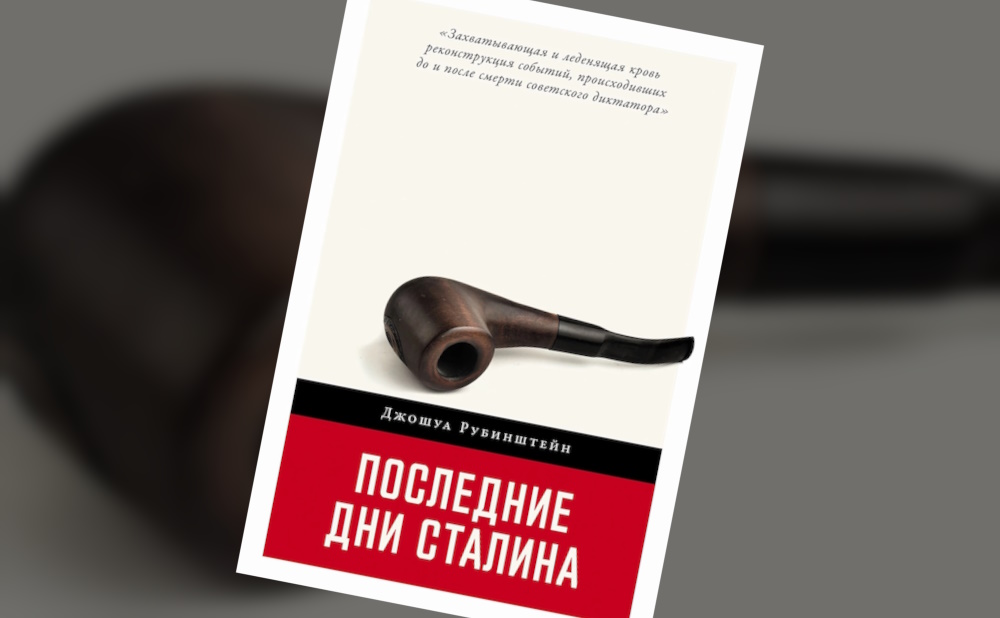
The Alpina Non-Fixes Publishing House represents the book by Joshua Rubinstein “The Last Days of Stalin” (translation of Maxim Korobov).
The book of Joshua Rubinstein, an outstanding American specialist in Russian and Eurasian research, is an exciting story about the months before and after the death of Stalin and how they changed the course of history of the 20th century.
The sudden illness and death of Stalin in March 1953 were a complete surprise for many. The tyrant was full of grandiose plans, he was preparing to challenge the armed challenge to the newly elected US President Dwight Eisenhower, and in his country he initiated a brutal campaign against Soviet Jews, after which he intended to clean in the ranks of the highest leadership of the Communist Party. Now, the long -standing “associates” of Stalin was waiting for many difficult dilemmas, including in the countries of the socialist bloc, where protest moods made themselves felt. Bright pages of the book are devoted to the confrontation of Beria, Malenkov, Khrushchev, a comparison of evidence of eyewitnesses of events with official published versions. Of particular interest are documents related to international relations, in particular with the reaction of the Eisenhower administration and his closest assistants to the Kremlin initiatives after the death of Stalin.
We offer to read a fragment of the book.
Stalin Paranoia and Jews
With the beginning of the Processing process in Prague on November 20, 1952, Soviet politics acquired a frankly anti -Semitic character. Stalin personally participated in the organization of the process, sending in 1949 to Moscow specialists in interrogations who were to control the course of the investigation and make the accused more flexible. One of the Soviet investigators, Vladimir Komarov, had special torture skills of Jewish prisoners. At the top of his career, Komarov was the deputy head of the investigative part for particularly important cases at the Ministry of State Security (MGB) of the USSR. In July 1951, during the state security authorities, he himself was arrested. Being in the camera of the MGB internal prison and fearing for his life, Komarov wrote a disgusting letter to Stalin in February 1953, in which he boasted of his cruelty and special hatred of Jewish nationalists. He must have hoped that this was the best way to return Stalin's location.
The arrested literally trembled before me, they were afraid of me like fire ... I especially hated and was merciless with Jewish nationalists, in whom I saw the most dangerous and vicious enemies. For my hatred of them, not only the arrested, but also former employees of the Ministry of State Security of the USSR of Jewish nationality considered me an anti -Semite.
Based on the words of Komarov himself, it is easy to understand why Stalin decided that he would be useful in Prague.
Rudolf Slain and thirteen more arrested in the same case, each of which was charged with treason, espionage and economic sabotage, pleaded guilty and asked the court to appoint the most severe punishment to them. Giving testimony within a whole week, the accused confirmed that, “being Trotsky-Titov, Zionist bourgeois-nationalist traitors and enemies of the Czechoslovak people,” participated in a fictitious conspiracy. By a court decision, eleven people were sentenced to death. The fact that the three defendants saved their lives was the only surprise in the process. The judges noted that these three played secondary roles in the conspiracy and carried out orders of Slansky, which removes part of the responsibility from them. But this gesture could have another, unobvious reason. The fact is that all three were Jews. The leader of Czechoslovakia, Clement Gotvald, who belonged to the last word, probably wanted to slightly smooth out the impression that the process smacks of anti -Semitism. As for the convicts to death, they were hanged at dawn on December 3. Their corpses were cremated, and the ashes were scattered along the icy highway so that the driver, who was a secret official of the organs, would not slip there on his tires.
It was the largest post -war process in Eastern Europe, in which the Stalin repressive apparatus for the last time showed its real person. Pravda published messages from the courtroom daily, emphasizing the guilt of the defendants and paying special attention to their connection with the Zionist and “bourgeois-nationalist Jewish” underground organizations. Radio Bucharest made such a typical statement: “Among us there are also criminals, Zionist agents and agents of international Jewish capital. We have to expose them, and our duty is to eliminate them. ” By mid -December, the Government of Czechoslovakia and Poland demanded that Israel withdraw his ambassador, Arya Kubovi, who represented the Jewish state in both of these countries; He was accused of abuse his diplomatic status. A similar step, which entailed the escalation of tension with Israel and the West as a whole, could not be undertaken without Stalin's approval.
It is difficult to answer the question why Rudolf Slainsky became the main accused. He was not like other major figures who fell victims of cleaning in Eastern Europe. He was not a veteran of the Civil War in Spain or the hero of anti -fascist resistance. He was in Moscow the whole war and firmly followed the party lines, not only the “national communists” who caused the Kremlin’s special irritation after Tito openly ceased to obey him. As for the leading Jewish and non -Jewish communists, Stalin enjoyed their blind devotion, naive idealism, cynical thirst for power - anything, which associated them with business. And when it was time to use them in another quality - as the defendants in the process - Stalin could poke a finger at anyone who seemed to him the most suitable role for him without the slightest hesitation. Accused of economic sabotage, branded as traitors, Slansky and other defendants in the case were present in the courtroom as a living embodiment of Western and Jewish treachery. But “the Prague process was only a prelude to the drama, which will be announced soon,” as London The Times noted. 1952 came to an end, and there were every reason to expect the coming of the next year.
The XIX Congress of the Party in Moscow and the Slansky process in Prague prepared the ground for the next series of Stalinist events. Taking advantage of the congress to reform the Politburo and the Slansky affair to incite anti -Semitic repressions in Eastern Europe, Stalin was preparing to conduct a wider cleaning of leading party personnel in his country. The Jews were perfectly suitable for the role of a scapegoat and a screen. He could arouse public indignation against Jews in the framework of a strategy that combined the Jews of non -rejection with the reorganization of security services and the leadership of the country as a whole. At some stage, he was to publicly announce his intentions. A series of imaginary crimes in Ukraine designated a new vector of his madness.
In the last week of November 1952, the Izvestia newspaper announced severe sentences against persons convicted of economic crimes, including the production of low -quality goods, a waste of funds, bribery and theft of state property. On December 1, a special military tribunal in Kyiv sentenced three people to the death penalty for the “counter -revolutionary sabotage”. All three - K. A. Kan, Yaroshetsky and Herzon - were undoubtedly Jews. They were accused of criminal conspiracy in the field of trade and brought to justice for the loss of "hundreds of thousands of rubles." For the first time, a war court gathered for the first time to consider the case related to an economic crime. Just a few weeks before, at the party congress, Screbyshev warned that "a thief that puts out folk good and digging under the interests of the national economy, there is the same spy and a traitor, if not worse." Now his threat brought fruit. The target chosen by Stalin was obvious to everyone who knew how to read.
But not only individual Jews became victims. On December 22, the party magazine published once every two weeks published a remarkable article directed against Zionism. In it, in unusually sharp expressions, Zionism was characterized as the “reactionary course of the Jewish bourgeoisie”, which serves as a faithful agent of American imperialism. The Communist Party has always opposed Zionism, and now, as reported in The New York Times, Jews as the Zionists were accused of "espionage and subversive activities of the United States." Almost five years ago, the Kremlin was the first to officially recognize the new Jewish state proclaimed in May 1948 and gave the good to the communist authorities of Czechoslovakia to sell weapons to Israel. Stalin had his own reasons. He supported the creation of Israel not least because he saw in this prospect of the departure of the British from the Middle East. But as the anti -Semitic atmosphere was pumped up inside the country, the foreign policy of the Soviet Union became more and more anti -Israeli. Now she “[identified] Zionism with American imperialism and imaginary subversive activities of the United States,” and Salisbury notified his New York edition of this. The agitator's notebook was not a magazine for ordinary readers. It was published for party workers - the number of which only in the Moscow region was 45 thousand - in order to clarify the position of the party on important issues. After reading the article, Salisbury assured his editors that she was inspired by the Slansky process in Prague.
In fact, Stalin began to repent in the fact that he supported Israel five years ago. In September 1948, after the first diplomatic representative of Israel, Golda Meyerson arrived in Moscow (soon she will change the surname for the Jewish - Meir) in the Soviet press widely covered the ceremony of presenting her charity letters, which inspired the Jews of the USSR by the Jews of the Jews of the False Hope to support Israel with the Kremlin. In September and October, on Shabbat and during the Jewish holidays, Rosh Ha-Shaan and Yom Kipur, Meyerson visited the impressive building of the Moscow Choral Synagogue. Jews who lived in the capital could not restrain their enthusiastic feelings. Thousands of people greeted her on the streets, and huge crowds gathered in front of the synagogue.
Such passionate support of the new Jewish state did not suit Stalin at all. Of conducting demonstrations, he accused the Jewish Anti -Fascist Committee (EAC) - an organization created by the Kremlin during the war in order to ensure its union with democracies additional support in the West. In November, the authorities announced the liquidation of the committee, saying that he "is the center of anti -Soviet propaganda and regularly provides anti -Soviet information to foreign intelligence authorities." For several months, idi -speaking newspapers and publishers were closed, professional theaters with production theaters were dissolved, and hundreds of Jewish culture figures, including fifteen people associated with the Jewish Anti -Fascist Committee, were arrested. Yiddish was the main means of exposing the Jews in the country, and now its state institutions have been liquidated.
This whole situation posed to Stalin the question of the reliability of his Jewish subjects. After three decades of Soviet power, putting pressure on people, so that they assimilate, abandon religious rituals and accept Russian culture as the main means of expressing spiritual and cultural identity, thousands of Jews took to the streets, demonstrating that they remain Jews with desires and dreams that go beyond the physical and spiritual borders of the Soviet state. It was time to remind them where they live: the support of Israel by the Kremlin did not mean that Soviet Jews would be allowed to emigrate or become volunteers in the army of a new Jewish state.
However, the attack on the EAC and the idi -speaking organizations did not affect the Jews who held leading posts in the Russian -speaking institutions of culture of the USSR. Their turn will come in 1949, when the authorities deploy a campaign against the West and the “Cosmopolitans” and all the carriers of Jewish surnames will fall under the sight. (The accusation of Cosmopolitanism was the easiest way to question the devotion of Soviet culture). On January 28, the newspaper truth attracted public attention to the "antipatriotic group of theatrical critics." It included Jews with such surnames as Yuzovsky, Gurvich and Kron. The article launched a wide campaign in the press, whose targets were Jews, suspected of a lack of devotion to their state and sympathies to America, Europe and the West. In the atmosphere of intimidation, the Jews turned out to be outcasts in their workplaces, and they were threatened with dismissal. The consequences extended from reprimands and withdrawal from posts to an exception from art unions. Some, in addition, were expelled from the Communist Party and even arrested.
Olga Freidenberg was a professor of classical philology in Leningrad. For many years, she led a thorough and sincere correspondence with her cousin, poet Boris Pasternak. In 1949, she shared with him an endurance from her diary.
For all cities of long -flowed Russia, moral and mental pogroms passed the pestilence. <...> subjected to moral linning of cultural figures who have Jewish surnames. It was necessary to see the atmosphere of the pogroms who took place at our faculty: groups of students scurry, rummage in the works of Jewish professors, eavesdrop on private conversations, whispering in the corners. Their business haste takes place before our eyes.
A similar atmosphere reigned in thousands of Soviet institutions as a result of the campaign against the "cosmopolitans."Jews are no longer given education, they are not accepted into universities or in graduate school. The university is defeated. All the main professors are dismissed. The murder of the remnants of the intelligentsia is continuously ... Scientists are hit by all sorts of means. Removing from work, resignation punishment of scientists in oblivion. Professors who have passed last year through popular pogroms die one after another. They are comprehended by hemorrhages and heart attacks.
Secretly from the public, the Kremlin continued the investigation of the activities of the Jewish anti -fascist committee, interrogation and torture of its arrested members. After conducting three years or more, in May 1952, they appeared in front of a closed tribunal. The process took place in the building on Lubyanka-the headquarters of the State Security Service in the center of Moscow-and took two months. Fifteen defendants were accused of Jewish bourgeois nationalism, espionage and state treason on the grounds that they collaborated with the EAC. Their merits of wartime and even the fact that they collected information about the atrocities of the Nazis and tried to preserve the memory of the victims, turned against them. On August 12, thirteen of them were shot. One of the defendants lost consciousness during the process and soon died in a prison hospital. The only one who survived in this nightmare was Lina Stern, an outstanding scientist. She was sentenced to five years, but a year after the death of Stalin was allowed to return to Moscow. Only after forty years did the Kremlin unveiled the protocols of the court hearings, which opened the anti -Semitic nature of the whole case. The execution of the defendants, five of which - David Bergelson, Peretz Markish, Leib Kvitko, David Gofstein and ICIC Fefer - were famous authors who wrote to Yiddish, became the apogee of Stalin’s attack on the idi -speaking culture. But since the process was carried out in closed mode, it could not serve as a wider purpose of intimidation. To do this, I needed to come up with something even more impressive.
By the fall of 1952, Stalin gathered together the elements of the alleged conspiracy of high -ranking Jewish doctors, who will soon be accused of attempting the life of the Kremlin leaders. Several people were arrested in November of the same year, among them the personal doctor of Stalin Vladimir Vinogradov and the chief therapist of the Red Army Miron Vovsi (the second cousin of the actor and director Solomon Mikhoels). They were subjected to brutal interrogations: according to Khrushchev, to Vinogradov Stalin ordered “put on shackles”. The regime needed their recognition in relations with foreign intelligence and plans for the murder of Soviet leading workers. “If you do not achieve the recognition of doctors,” Stalin admonished state security officers, “then your head will be removed.” The beatings became so ruthless that they equipped a special room in the Lefortovo prison. Such measures quickly brought the results. Holding to some time, Vovsi stipulated other doctors, accusing them of espionage in favor of the Americans and the British. By December, he had already agreed to say that the late Mikhoels was a "Jewish bourgeois nationalist." Vinogradov also broke, “confessing” to espionage and terrorism, as well as a criminal connection with existing doctors, including Miron Vovsi.
The inspirer of such court cases could only be Stalin. К тому времени он открыто выражал свою параноидальную озабоченность по поводу евреев и американцев. 1 декабря на заседании Президиума он заявил, что «любой еврей-националист — это агент американской разведки. Евреи-националисты считают, что их нацию спасли США (там можно стать богачом, буржуа и т. д.). Они считают себя обязанными американцам». Подобные заявления задавали тон, указывая сотрудникам службы безопасности, как проводить расследования и обращаться с обвиняемыми.