
Translated material
"Stirlitz pushed Bandera to proclaim the Ukrainian state"
A fragment of the book of Mikhail Zygar “War and Punishment” - about how Soviet propaganda created the myth of “Bandera”. And how Putin believed in him
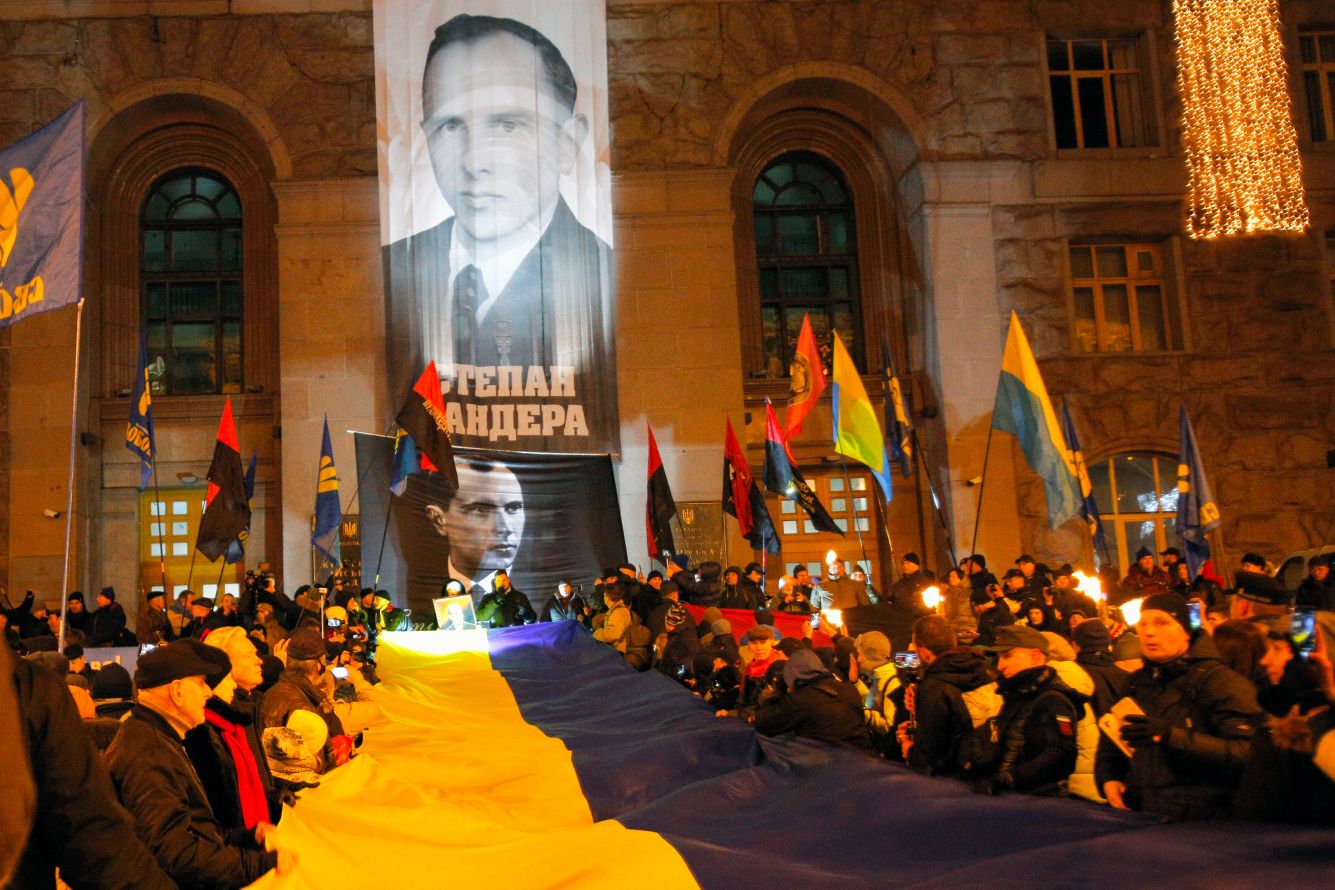
The book of Mikhail Zygar “War and Punishment”, published in the Medusa publishing house, talks about myths about Ukraine that have developed in Russia for centuries and ultimately prepared the basis for the rampant aggression of recent years. The myth of Stepan Bandera is the youngest of them. He was born in the bowels of the state security organs at the end of World War II, and gained wide popularity, including thanks to the author of the novels about Stirlitz, writer Julian Semenov, who himself collaborated with the KGB.
You can buy the book “War and Punishment” right now (keep in mind that they will buy it quickly)! Here's how to do this: order it directly from Medusa - or in the stores “Ant” and Vilki Books . There are other options, they are all described here . Unfortunately, the book cannot be ordered using a Russian bank card.
One of the fans of Stirlitz is a student Volodya from Leningrad. Having looked at the Seventeen Moments of Spring, he also decides to become a scout and begins to eagerly read all Julian Semenov’s novels about Stirlitz. And after the university, he willingly agree to go to the service in the KGB. The surname of the young man is Putin.
The plots described by Semenov are completely fictional - real people appear in all his novels, but in the foreground the Stirlitz and his adventure invented by him. However, many readers will remember historical events precisely in the presentation of Julian Semenov, and this will determine their further actions.
Putin is 25 years old, he is already working in the KGB Office for Leningrad, when a new novel of his beloved writer “Third Map” comes out. The action takes place in 1941, Stirlitz fights with Ukrainian nationalists who collaborate with Hitler. From this novel, Putin recognizes the name Stepan Bandera.
Between the two empires
On October 21, 1933, the 19-year-old Ukrainian Nikolai Lemik appeared on the threshold of the Soviet consulate in Lviv-at that moment it is the territory of Poland. He goes to the secretary Andrei Milov and shoots twice - in his heart and in the head. He does not try to escape from the scene of the crime - on the contrary, his goal is to be arrested by the Polish police.
In court, he will declare that this attack was carried out by the organization of Ukrainian nationalists (OUN) and planned by Stepan Bandera, its leader in Western Ukraine. The goal is to attract the attention of the world community to the Holodomor in Ukraine.
A year later, Bandera organizes the murder of the Minister of Internal Affairs of Poland, who is behind repression against Ukrainians in Lviv. The day before the attempt, the Bandera is arrested. In court, he performs very brightly. He describes the goals of the OUN - it strives to restore the Ukrainian state and does not relies on anyone: "From history we know that when it comes to Ukraine, Poland and Moscow have always agreed." Bandera is sentenced to death, but then they replace it with a lifelong opinion.
On August 23, 1939, German Foreign Minister Joachim von Ribbentrop came to Moscow. The Soviet Union and the Third Reich sign a non -aggression pact, and with it secret protocols on the division of Poland and the Baltic countries.
On September 1, 1939, Germany attacks Poland - the Second World War begins. The Soviet Union does not enter the war immediately. Only on September 17, the Soviet government sends a note to Warsaw, reporting that, since the Polish state has collapsed, Moscow takes the defense of Ukrainians and Belarusians living in Eastern Poland, therefore it occupies this territory.
With the advent of the Soviet troops, the protection of the prison in which Bandera is sitting is scattered, he, along with the rest of the prisoners, is at large and returns to Lviv. There, the USSR is already establishing its orders: nationalizes the land and enterprises. Repressions begin against Ukrainian nationalists. Among the others, the father of the leader of the OUN, priest Andrei Bandera, was arrested, he was soon sent to Kyiv. Stepan Bandera manages to leave the territories occupied by the USSR.
Soon, his conflict flashes with the head of the OUN Andrei Melnik - he is guessed in progerman and counts on the help of the Third Reich. Bandera quarrels with him, proves that the organization should be completely independent. And it provokes a split - young nationalists who participated in terrorist attacks in Galicia and Poland, follow the Bandera. The organization of Ukrainian nationalists is divided into "Melnikov" and "Bandera".
However, Bandera also does not refuse to cooperate with the Germans. Its part of the OUN concludes an agreement with German military intelligence on the formation of two sabotage battalions from Bandera. Two divisions are created-“Nachtigal”, in German Nightingale, they are commanded by Roman Shukhevich, and “Roland”, led by Austrian Richard Yarym. Bandera expects these battalions will become the basis for the Ukrainian army.
On June 22, 1941, Germany attacks the USSR. Bandera at that moment is in Krakow. Gestapo recommends that he not go to the captured territories. At the same time, the underground detachments of the OUN are rebelled against the Soviet regime in Western Ukraine - they capture several dozen settlements even before they were captured by the German military. After their arrival, the OUN detachments are reorganized into the national police, and the villagers help her find the Red Army soldiers, NKVD and Jews.
The Soviet authorities take about 3.5 million people from Ukraine to the east, as well as industrial enterprises - to the Urals, to Siberia and Central Asia. Food supplies are also trying to take out - or destroy.
On June 29, OUN battalions participate in the capture of the Germans of Lviv. Before the retreat of the Red Army, by order from Moscow, over 4,000 prisoners - primarily political prisons in local prisons.
When Nachtigal and Roland take the city, there is a rumor that Jews helped destroy prisoners. In Lviv, a Jewish pogrom begins.
The next day in Lviv, the deputy Stepan Bandera Yaroslav Stetsko proclaims the Ukrainian state. The fundamental act states that this is part of the future independent Ukraine with the capital in Kyiv, the state “will closely interact with the National Socialist Great Germany, which, under the leadership of its leader Adolf Hitler, creates a new order in Europe and helps the Ukrainian people get rid of the Moscow occupation”.
In Moscow at this time, panic. The day before, the Germans took the capital of Belarus Minsk, on June 29, Stalin says: “Lenin left us a great heritage, we - his heirs - all this was packed,” after which he leaves for his country house and stops in touch. The next day, members of the Politburo go to him - according to the memoirs of one of them, Stalin is scared, sitting, squeezing into a chair, as if waiting for him to be arrested now. But the close associates persuade him to continue to lead the country. By July 3, Stalin finally comes to his senses - and for the first time since the beginning of the war he acts with the radio, to the population.
And the Bandera in Krakow is called for interrogation that day - the German command is shocked by the demarche of Ukrainian nationalists. Bandera claims that this has been done on his orders and that the OUN has been fighting the Bolsheviks for more than ten years. He refuses to cancel the act of proclamation of the Ukrainian state. On July 5, Gestapo delays Bandera and sends to Berlin.
On July 10, in Kyiv, the NKVD shoots the father of Stepan Andrei Bandera.
The German command continues negotiations with Stepan Bandera, inviting him to cancel the act on the proclamation of the state. He refuses, and in September the Bandera OUN is prohibited. Bandera and his associates are sent to prison, and at the beginning of 1942 - to the concentration camp of Zasenhausen. This is in a sense an elite camp, they contain especially important prisoners. Stepan’s brothers are sent to Auschwitz, where they soon die.
It is the first weeks of the war that are described in the novel “Third Map” by Julian Semenov, however, he has a central character - this is Stirlitz, the beloved hero of Volodya Putin. And Stepan Bandera is depicted as a sadist and a criminal, a paid agent, a puppet of his German owners from the military intelligence of the Third Reich. “This figure is“ made ”pronouncing the words of learned, laid down in it by local instructors, - the Stirlitz spy in Moscow reports. - Bandera is deprived of the past - it is criminally, criminally, bloody - he will apparently fight for his “piece of the pie” especially fiercely; As for demagogic slogans, apparently, his immediate leaders, to whom he obeyed implicitly, work here in Berlin. ”
The Soviet command orders the scout to use Bandera in order to provoke a conflict inside the German elite - and it is Stirlitz that pushes the Ukrainians to proclaim their own state: Hitler is furious, the leaders of all German structures begin to be terribly enmity, smart Stirlitz rubs their hands.
The style of the novel “Third Map”, written in 1975, is amazingly similar to the propaganda programs of Russian television in 2022. The author is stepping proves that Ukrainian nationalism was invented in the Austrian Empire: the insidious Habsburgs deliberately supported the Ukrainian culture in Lviv in order to annoy Russia. All Ukrainian wrestlers for independence are entirely bought by the Nazis, all honest Ukrainians are ready to give their lives for the Soviet Union.
Against everyone
In August 1941, the German command was disbanded by the Nachtigal and Roland units. And Ukraine is divided: Galicia is part of the Polish General General, the rest of the territory is called the Reich Commissariat of Ukraine.
At the end of September, German troops approach Kyiv and surround the army of the South-Western Front, which defends Kyiv. There are more than 600 thousand people in the Kiev boiler.
Leaving the Ukrainian capital, the Red Army destroys the bridges and mines the city center. On September 24, buildings in the center begin to explode, almost the entire main street, Khreshchatyk, is on fire. To localize the fire, the Germans destroy buildings on neighboring streets. In ruins, almost the entire even side of Khreshchatyk.
In sabotage, because of which explosions and fire began, Jews are accused. On September 29, 1941, Germans and Ukrainian police officers gather all the Jews of the city in the Babi Yar area. For two days they shoot 35 thousand people. This is the first mass reprisal against Jews during the Second World War.
In October, in Kyiv, the Germans create local authorities, they rely on the Melniki, rivals of Bandera on the OUN. Those form a national rain - but already in November they prohibit it, and repressions begin against Ukrainian nationalists, several people are executed. By the end of 1941, Germany would occupy the entire territory of Ukraine. About 3 million residents are sent for forced labor in Germany. In central Ukraine, near Vinnitsa, they build a hiper bunker - often it is from there that he leads the fighting in 1942-1943.
In October 1942, in the midst of the Battle of Stalingrad, the underground congress of the Bandera part of the OUN takes place in Lviv. Its participants discuss the situation at the front and come to the conclusion that the victory of Germany, which six months ago seemed to them inevitable, is far from obvious. OUN decides to create his own army and fight again for independent Ukraine. Soon it will be called the Ukrainian rebel army.
At the same time, partisan detachments supporting the Red Army are also fighting against the Germans - for example, under the command of Sidor Kovpak. It is interesting that the communist Kovpak fights partially contrary to - while he is fighting with the Germans, NKVD employees come behind him and try to arrest him, but the partisans are hiding from them in the forest. And then again enters the battle on the side of the Soviet Army.
After the Battle of Stalingrad-it lasts from July 1942 to February 1943-the Red Army is transferred to the counterattack. And Ukrainian nationalists decide to activate their own war in Western Ukraine. However, there are Ukrainians who are fighting on the side of the Third Reich. In the spring of 1943, the Germans create the 14th division of the SS "Galicia"-only Ukrainians take it into it.
In April 1943, the OUN has a new leader Roman Shukhevich. He holds the Congress of the OUN, the participants of which claim that they are fighting against empires, against the exploitation of the nation by the nation and are equally opposed to both communism and Nazism.
The Ukrainian rebel army (UPA), created by the OUN, begins the struggle with the Poles, which make up the ethnic minority on Volyn, parts of Western Ukraine. The calculation is this: so that after the end of the war this territory does not depart, it is necessary to exterminate the Polish population. In July - August 1943, the UPA destroyed the Poles - this will go down in history as a Volyn massacre. Ukrainian historians, however, insist that these events should be perceived as part of the fighting - and the Poles killed Ukrainians in the same way as Ukrainians of the Poles. And the UPA fighters also kill Ukrainians from other camps and organizations, whether they are the National Melniki Nationalists or the partisans of Sidor Kovpak.
After the battle on the Kursk arc, which lasted from July 5 to August 23, 1943, the Red Army gradually supplants the Germans from the territory of Ukraine and in November 1943 takes Kyiv.
In February 1944, the commander of the 1st Ukrainian Front of the Red Army, General Vatutin, was ambushed, organized by the UPA. He is seriously wounded and soon dies. He is buried in the center of Kyiv, in the Mariinsky Park. And the NKVD is taking a powerful operation to destroy the detachments who killed the general.
In May 1944, Crimea was released from the Germans - and immediately after that, 200 thousand Crimean Tatars and 37 thousand representatives of other nationalities deport from the peninsula - Stalin accuses local residents of collaboration.
In July 1944, the Red Army took Lviv. But this does not mean that the war ends here - the battles continue, but already against the UPA. In August - September, about 11 thousand Ukrainian nationalists are killed, as much as he is captured.
In the same month, under the fords, Soviet troops surround eight German divisions, including 6,700 fighters of the SS division of Galicia. About 3,000 people from the "Galicia" break out of the environment, and part of the remaining in the boiler join the UPA.
In September 1944, the German authorities change their approach-they decide to unite everyone who can be used to fight the USSR. Bandera is transported from the concentration camp of Zasenhausen to Berlin. There he is offered cooperation with the Russian General Vlasov, who crossed the side of Germany, but nothing happens: according to the report of the SS General, who was talking with Bandera, he "equally hates both the Great Russians and the Germans."
In February 1945, the word “Bandera” first appeared in the newspaper Izvestia - in an open letter to the congress of teachers of Western Ukraine to Stalin. The authors of the text curse "Ukrainian-German nationalists and lack of alien from the camp of Bandera, Ounovites."
In the same February 1945, Stalin, Roosevelt and Churchill were found in Crimea - they discuss the post -war world order, agree on the creation of the UN. On the initiative of Stalin, individual places along with the USSR in this organization receive Ukraine and Belarus. The Yalta Conference becomes the basis of the entire system of post -war world order - and the idea of Putin's fix. All the time of his reign, he will dream of holding a new Yalta, which would confirm that he is respected and considered a key world player. This will never happen, which will push him to military adventures.
In February 1945, a bander on fake documents moved from Berlin to Austria. And in Western Ukraine, the leadership of the UPA meets with representatives of the KGB of the USSR, trying to agree on a truce. Negotiations have no success.
With the end of the war in May 1945, Roman Shukhevich urges Ukrainians to continue the armed struggle against the USSR. For their part, the Soviet authorities on May 19, 1945 offer the UPA fighters to lay down their weapons and come with a guesses - until July 20. During 1945, more than 10 thousand people are handed over.
But regular clashes with the UPA fighters in Western Ukraine continue all 1946, then they decline and completely stop in 1949. All this time, the key method for the struggle of Soviet power with Ukrainian nationalists is the deportation of all potential supporters to Siberia. In February 1946, at a session of the UN General Assembly in London, the USSR demands to give out all Ukrainian nationalists hiding in Europe. The West is refused, and then the KGB begins to hunt the leaders of the OUN around the world.
In 1947, Bandera was again elected the head of the OUN, and he continues to defend his former principle-to rely only on his own forces, and not on any state. In 1948, attempts on the life of Stepan Bandera, organized by agents of Soviet special services, began.
Only in September 1949, the commander Roman Shukhevich gives an order to disband the last military detachments and the headquarters of the UPA: the fighters are invited to move to the west or go underground. And on March 5, 1950, Shukhevich was killed in the Lviv region while trying to arrest.
15 октября 1959 года агентом КГБ в Мюнхене убит Степан Бандера.
Фамилия Бандеры станет нарицательной в Советском Союзе. До Первой мировой войны сторонников украинской независимости обзывали «мазепинцами» , между мировыми войнами — «петлюровцами» , а начиная с 1945 года любые украинские националисты в СССР именуются «бандеровцами». Это понятный психологический прием: они не за Украину, а за Бандеру, как бы говорят пропагандисты. С конца 1940-х «бандеровцы» регулярно упоминаются в советских газетах в одном ряду с фашистами. Про самого Бандеру обычно не пишут (впрочем, советская пресса никогда не вспоминает и про пакт Молотова — Риббентропа), как и про то, что, по сути, Бандера был союзником нацистов в то же самое время, что и Сталин. Но поклонникам Юлиана Семенова вроде Володи Путина и так все ясно.
Герой Юлиана Семенова Штирлиц сохранит популярность даже после распада Советского Союза. В 1998 году, когда президентом России еще будет Борис Ельцин, авторитетный еженедельный журнал «Коммерсантъ-Власть» закажет социологический опрос, кого из киногероев россияне хотели бы видеть президентом. В лидерах с большим отрывом окажется Штирлиц. В тот момент широкая публика еще будет в полном неведении, кто такой Владимир Путин.
Mikhail Zygar