
Translated material
See Marx and Enlighten
In China, the series “When Marx met Confucius” was released - about how the onset of communism will solve everything. We looked at him - and here is his main conclusions
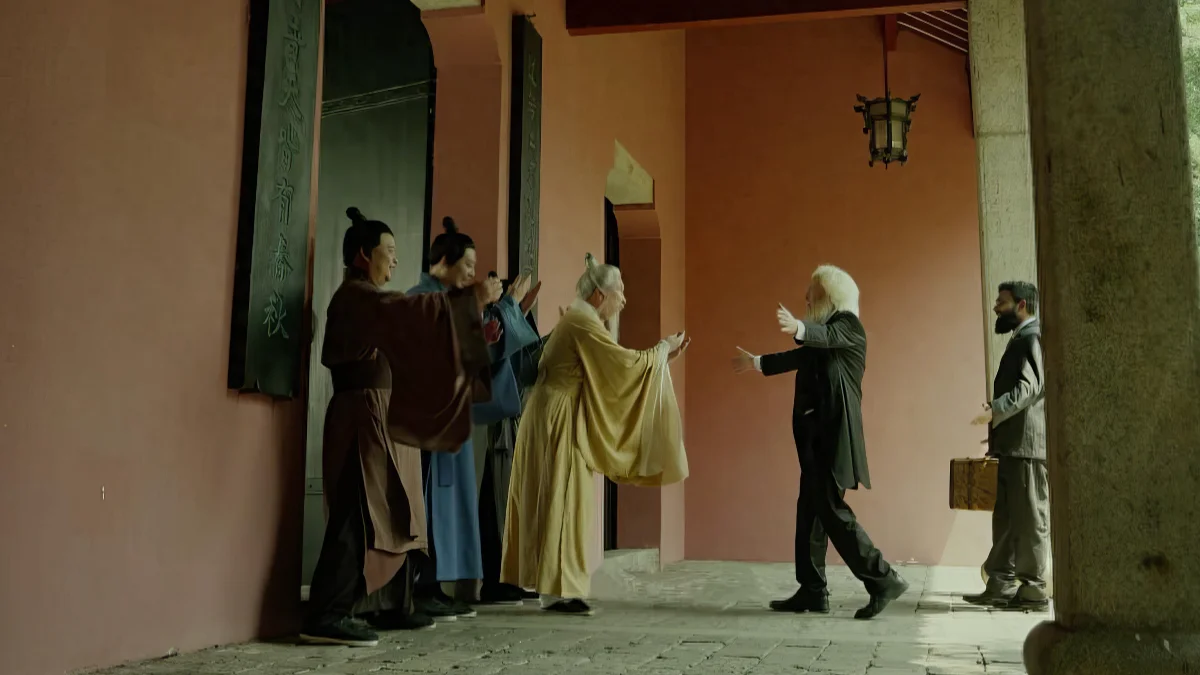
The episode of “Sutra Study”, Marx and Confucius met at the Yuela Academy. Screenshot: GMW.cn
In October 2023, the second on views in China Hunan TV (湖南卫视), inferior only to CCTV-1, released the series “When Marx met Confucius” (当马克思遇见孔夫子). For five episodes of 30 minutes, the authors are trying to answer the question of what would happen if Karl Marx and the ancient sage Confucius met in China of the 21st century and talked with students and professors of history. Is Confucius of Marxism interesting? And what does Marx think about socialism with Chinese specifics?
Against historical nihilism?
The most important topic that excites the chairman of Xi Jinping is the rise and fall of the Communist Party of the Soviet Union (CPSU). In detail this in his essay “Lessons of the Disconnection of the USSR” in 2022 was written by the political analyst of the Commission for the Office of Economic Regulation and Security between the USA and China Jonaton P. Sine). The essay was dedicated to the release of the documentary “Historical Nigalism and the Goyage of the Soviet Union” on the 30th anniversary of the fall of the CPSU.
The legitimacy of Xi Jinping is experienced not only by the pandemic of coronavirus, a slowdown in the pace of economic development and an unprecedented violation of the unspoken rule to leave the post of chairman of the PRC after two terms. Globalization comes to everyone and checks the resistance of the political regime in each country. And if you have not completely cut off your country from the outside world, then the political elite, civil society, students, workers, scientists will continuously compare the picture within the country and beyond.
The sudden collapse of the USSR instilled existential horror in the generation of SI and its predecessors. Undoubtedly, the class of bureaucracy is gradually being formed, which is more reformist and is ready to flirt more with market reforms, but you should not downplay the meaning of personnel that see their historical significance in reating the party, its mission and ideology. This is a grandiose plan of ideological repairs, where one wrong movement can lead to the collapse of the entire political skyscraper - to repaint here, to stick around the wallpaper, here to install a new plumbing. Xi Jinping is forced to make repairs in the dark, not imagining which of the beams bearing.
In his speech of 2018, Xi Jinping noted: “The Marxist political parties are organized by common ideals and beliefs, and not formed by interests. To build a strong Marxist ruling party, you must first start with ideals and beliefs. Faith in Marxism, socialism and communism are the political soul of the Communists, a spiritual support, thanks to which the Communists withstand any trials. We often say that if the foundation is not strong, then the earth and mountains will shudder.
And if faith is not strong, then the earth and the mountains will shudder. Is this not the logic of the collapse of the Soviet Union, the CPSU and radical changes in Eastern Europe?
The Soviet Communist Party seized power when there were 200 thousand members in it, Hitler defeated when there were 2 million members in it, and lost power when there were almost 20 million members in it. As I said, in this turmoil, no one showed the courage to get to the fight. For what reason? [The reason] is that ideals and faith (beliefs) have disappeared ... "
As often happens in Chinese history, it is necessary to deal with historical nihilism-in reality it is any interpretation of history that, for some reason, does not meet the needs of the current leadership of the CPC. China is not the only country with an unpredictable past. Historical nihilism refers to facts that can undermine the faith of party personnel in the PDA and, as a result, the stability of the PRC in difficult times. In a situation in which new progressive steps can cause catastrophic consequences, it is always better to turn to the classics and try to find an answer there.
When did Confucius meet Marx?
The Hunan TV channel makes excellent content - from entertaining television shows to historical dramas. This is a truly popular channel that knows his viewer, carefully monitors his requests and buys rating formats abroad to embody them in China. But even a popular television channel should not forget that it is primarily a state channel, so sometimes it should be released stories that would meet the tastes of the political leadership of the PRC. The decision to turn to the classics was not accidental. An article with a similar name “Marx is included in the Confucian Temple” (马克思进文庙) was written almost 100 years ago.
The great Chinese poet, playwright, historian and public figure Go Mojo (1892–1978) in 1914, immediately after school, left for Japan, where he received a medical education, but did not become a doctor, and five years later he went into literature. He became famous as the author of one of the first books of new poetry, and also published several short plays of anti -feudal orientation. In 1924, Mojo returned to China with a convinced Marxist and in December 1925 published in the magazine the Great Flood (or also “Pawn Waters”) the article “Marx enters the Confucian Temple” (reprinted on January 1, 1926), in which, with a share of humor, he described the meeting of Marx and Confucius. The story is quite short, written in modern Chinese, without discussions about ideological filling, but with a clear message that Confucianism and Marxism can coexist. Discussions in the beginning and middle of the 20th century in China were quite revolutionary and did not differ from the Soviet ones, and their main content can be put into a slender “all the world of violence we will destroy to the foundation, and then we are ours, we will build a new world - who was nothing.”
For intellectuals of movement for a new culture, Confucianism has become the embodiment of a regressive, patriarchal worldview. The very fact of the need for all this classic nonsense, which slowed down the creation of the new great China, is posed into question - who needs confusion in the new world?
In many opposition to China, the media try to present the film as a stupid bike that does not make any sense. This is a deep misconception: it is these five episodes that are a system of values that the CPC broadcasts and explains. And if a party leader wants to successfully build a career in the party, then the series is only the first step to understand the direction in which you need to move.
What did Confucius and Marx talk about?
Confucius meets Karl Marx at the Yuela Academy (岳麓书院) - one of the most prestigious Academies of China for thousands of years. The Academy of Juel was formed in 976 during the Northern Dynasty Song, the famous Confucians Zhu Si and Zhang Shi taught in it. In 1903, the Academy was reorganized at the university, and in 1926 it was called the University of Hunan. After an awkward handshake, gentlemen proceed to discuss history. Their dialogue is commented on by professors of the most important intellectual centers of China-director of the Chinese Research Center for Cultural Soft Strength, employees of the University of Beijing, the Chinese University of Political Sciences and Law, the Hunan Academy of Social Sciences and the Shenian Research Institute of Education, as well as the dean of the Faculty of Marxism of the Chinese Oil University and the Secretary of the Party Committee of the Academy of Academy Yuela. Sitting with straight backs, exemplary students periodically ask questions with a request to comment on one or another position of the conversation.
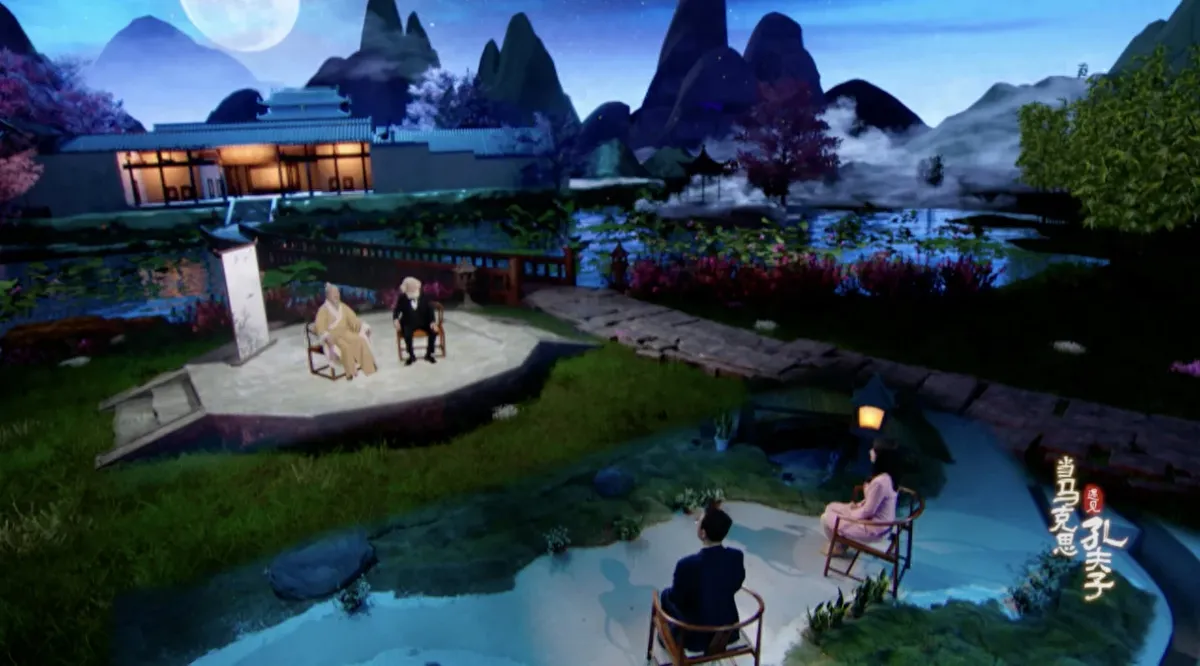
Owing to the historical references and the game of words, we will try to adequately translate the names of the series, from which the design of the television show will become clear:
执经叩问: Holding canonical texts in their hands, seek clarification to the teacher.
高山流水: “Tall mountains and current waters” (one of the famous melodies of antiquity, according to legend created by the great master of the game on Qin's battle); understand each other; Sincere friends. (When the battle, playing Qin, was carried away by thoughts to the high mountains, his friend Zhong Zzii said: “Oh how beautiful the sounds of Qiny are, majestic, like Mount Taishan.” He did not play, because there was no one to understand his music).
结合之路: Road to unity.
别开生面: Put the new.
固本开新: Strengthen the foundation and create a new one.
Confucius and Karl Marx consistently introduce viewers with the basic positions of their doctrines. And here the main advantage of any written text, from the Bible to the philosophy textbook, is the opportunity to interpret in their favor. Unknown topics either bypass, or emphasize that coexistence is possible.
For example, at first some disagreements arise, since Marx makes several sharp comments about the need for a class struggle, and also mentions his goal to become a “grave of the capitalist class”. Marx accuses Confucian philosophy of aiming at stability based on the patriarchal system of tribal relations. But none of this is discussed, since both agree that the onset of communism will decide everything. In this design, the Confucian tradition softens the extremes of Marxism, provides an ethical and spiritual basis for new authoritarianism.
No one also recalls that after the founding of the PRC in 1949, the Red Army successfully exploded the graves of the descendants of Confucius. By the beginning of the 21st century, the academic interest in Confucius resumed, but there were no signs of official revival.
In one of the series, Marx and Confucius are Vladimir Lenin, who reminds them that everything is old and feudal in culture should be discarded. But can he confuse old friends!
If the first two episodes refresh the basic positions of the two sages in the memory of people, then the next part of the program should work on Xi Jinping and its ideological construct “Two Combines , 两个结合). The expression was fixed after its use in Chinese, but it was translated into Russian by a more lengthy statement from Xi Jinping from the speech of the ceremonial meeting on the occasion of the 100th anniversary of the CPC in July 2021: “In a new campaign, we must, unshakably adhering to Marxism-Leninism, the ideas of the Deng Xiaopin, important ideas of the three Representations and scientific concept of development, comprehensively implement the ideas of socialism with the Chinese specifics of the new era, continue to combine the basic provisions of Marxism with the specific reality of China, with excellent traditional Chinese culture , to observe the era, understand its characteristic features and direct tendencies of its development, continue to develop modern Chinese Marxism and Marxism of Marxism. XXI century! "
Xi Jinping mentioned this earlier, in 2014 at the opening ceremony of the International Academic Symposium on the 2565th anniversary of the birth of Confucius, and, ironically, in August 2018 at a conference in honor of the 200th anniversary of Marx's birth. Then Xi Jinping said : “Only by close integration of the basic principles of scientific socialism with the specific reality of the country, historical and cultural traditions, the needs of time and constantly exploring and generalizing in practice, we can turn plans into excellent reality.”

Marxism and Confucianism can and should be redone in order to strengthen the party and the state. There is no reason for them to reject each other or challenging the poison philosophy of the CPC.
Marxism is a soul, excellent traditional Chinese culture is the root.
And on the basis of this, you need to re -make the ideology of the CCP.
What conclusions can be drawn from this?
It is curious that there is a discussion in society. In Chinese social networks, due to existing censorship restrictions, it is quite sluggish, but nevertheless exists. Who is still cooler-our native patriarchal statesman of Confucius or the radical revolutionary Karl Marx?
The Russian political leadership offers its bureaucracy a set of theses that are not related to each other: “hate gays”, “soulless West”, “parent 1 and parent 2”, as well as “traditional values”, which cannot be clearly formulated. The Chinese ideological construct is voluminous, understandable and has its own language and methodological apparatus. This is a unique intra -Chinese history that cannot be exported, unlike the ideological construct of democracy and human rights, but this is not necessary. Its main task is the political stability of the PPC power, a bright future is only a side factor.
It is curious that Mao Zedong appears in the series only episodically - his ideological views excite the authors much less than the concept of Xi Jinping. It seems that even dead competitors are not needed today.
Although this could be an excellent base for the second season! In the biography of Mao, we found an excellent passage , which can be the basis for the first series. From September 18 to October 20, 1965, the CPC Central Committee held a work conference. On October 10, Mao Zedong said that if the Central Committee turns to revisionism, then it is necessary to rebel, because both the English revolution and the Paris commune began with actions in the center. The Chinese are good at rebelling! During the report of one of the party members, Mao Zedong intervened: “I will soon see Marx ( “ see Marx ” - an expression synonymous to the word“ die. ” - Approx. Aut. ). How will I explain it to him? If you leave me with the tail of revisionism, I will not accept it! ”
Interestingly interesting what Mao would say when he saw modern China!