
Translated material
Catch the moment, ilse!
Susan Monso finds out in the book “Schrödinger Opissum” whether the animals understand what death is
The idea of death is only with us, people. Is this one of many differences that make us unique animals - or not even animals? Special beings, which the farther, the more confidently they are freed from natural bonds. But is this thought of one of many illusions that accompanied humanity throughout its history? Are we very different from other inhabitants of the planet?
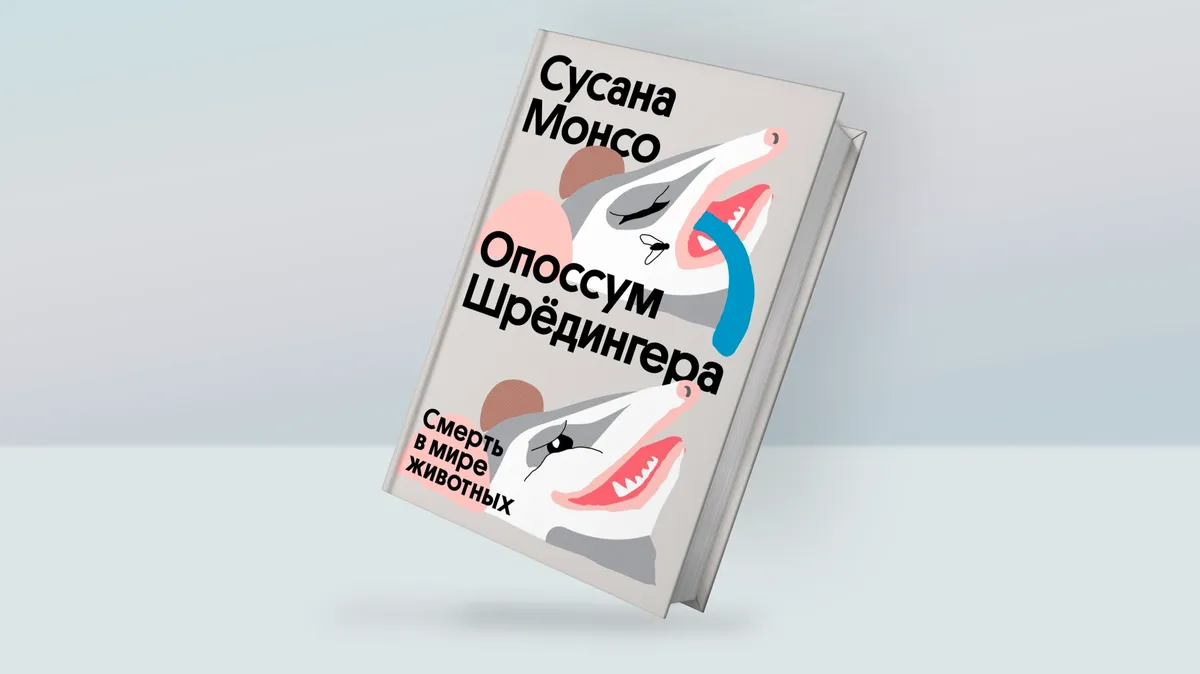
In the publishing house Individuum was published by the book Opossum Schrödinger. In it, a Spanish philosopher and specialist in cognitive abilities and social behavior of animals Susan Monsan tries to figure out if our neighbors on the planet have an idea of death. This, of course, is not the only question. Talking about animals, Monso thinks about people - about their own attitude to death and mistakes that prevent them from understanding other creatures.
The playing cover of the Schrödinger Opeksum promises easy reading. But the unusual angle of Montso's gaze suggests that the book will not leave you without worthwhile thoughts. Both are true. The philosopher writes an outrageously simple language for the philosopher, which heats the soul. And also jokes a lot, reducing the degree of tension, almost always arising next to the theme of death. But the ideas expressed in the book have a happy and rare property in today's times: they look simpler than they really are. "Opissum ..." sways slowly. Only 206 pages. You involuntarily wait for the philosopher he will let him go to the quarry. But you can cope with the first quarter and catch yourself thinking: the phenomenon unravels did not come a single step.
First, the author explains the difference between the stereotypical and cognitive reactions of the animal. The former are inherited genetically and are formed through natural selection. The latter are associated with the individual characteristics of the creature - "mental and emotional mechanisms, as well as the properties of their personalities or their past experience." When ants together take the deceased counterpart from the anthill, they act according to the inherited scheme (stereotypically). But the chimpanzees can demonstrate a whole range of cognitive reactions to the deceased: “Some gave the alarms, others reacted aggressively, demonstrating dominance and even attacking the rest. When the group members were finally tired and left, two females remained next to the corpse - mother and daughter. The mother, whose connection with the deceased was especially close, carefully examined his face, then took a twig and began to carefully brush his teeth. ” Monso is interested in cognitive reactions.
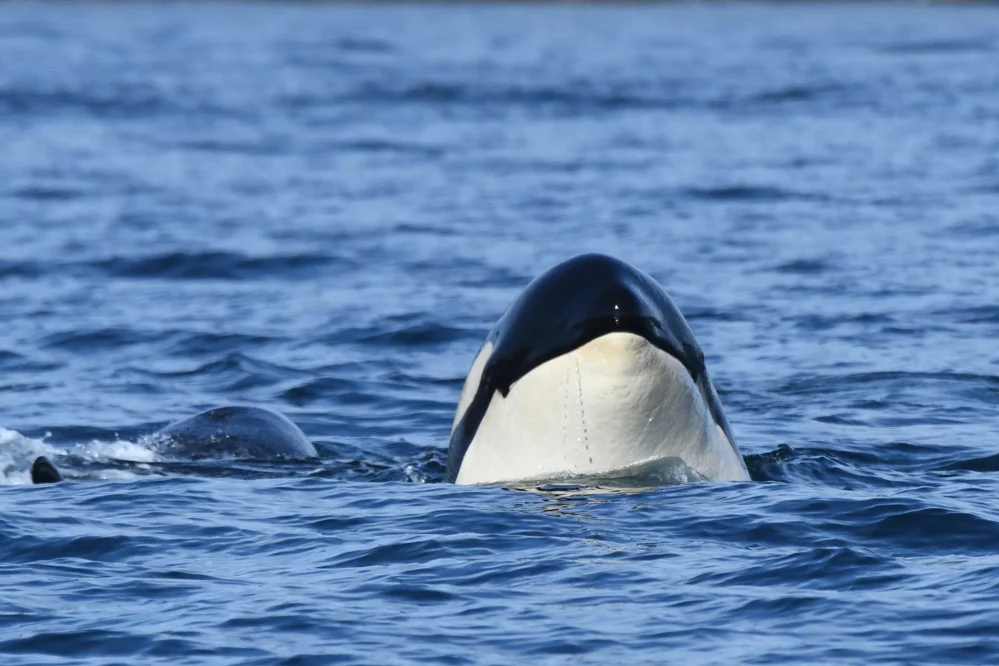
In 2018, the history of the Kosatka Talelua, who lost the cub, thundered in the media and carried his corpse behind his family for 17 days, overcoming more than a thousand miles during this time. Then the tragedy of Tallekua was unambiguously interpreted: she could not come to terms with the loss and mourned. Journalists, scientists and ordinary spectators interpreted her feelings as very human. In fact, none of the “support or empathy group” could know the true causes of the witch's behavior. This plot is for Montso the reason to analyze the main mistakes of perception associated with our anthropocentric optics. The simplest philosopher calls anthropomorphism. We are talking about the false "attributing something or to someone human qualities." Another misconception has the exact opposite reason. It is associated with erroneous denial in the animal of the "human" features (anthropectomy). In other words, in the analysis, extremes should be avoided. The third distortion of perception is determined by anthropocentrism - the arrogance of the “crown of creation”, who believes that he belongs to the only true way to understand and feel death (and not only her, of course).
Whale Research
Following Monso is trying to define the "minimum concept of death." According to her thoughts, only two necessary components are non -functionality and irreversibility . The “dead” is a creature that led itself as living if it stops doing this and cannot resume. But what does the animal need in order to have the concept of death? The philosopher offers three elements that he easily calls the "Holy Trinity." We are already familiar with cognition . This is the ability to experience not only stereotypical (like ants), but also cognitive (like chimpanzees) reaction to death. In addition, the creature should have the direct experience of observing the death of other individuals and experience emotions . Moreover, they can be very different - not necessarily mournful. Montso suggests that it is precisely a relatively small number of animals that the deceased can grieve over the deceased, but gives several stories from the life of primates, elephants and giraffes that describe such an attitude.
One of them, connected with the Schimpanzees from the Gombus National Park, wrote Jane Guddlle: “Flint (son) ... It was eight and a half years old when Flo (mother) died, and he should have already been able to take care of himself. However, he was addicted to his mother, and it seemed to not want to live without her ... Flint became apathetic, ignored almost all the food and fell ill due to the weakening of the immune system. The last time I saw him alive, he had fallen eyes, he was emaciated and looked completely depressed, curled up with a kalachik in the thicket next to the place where Flo died. Of course, we tried to help him ... But nothing could make up for the loss of Flo. During his last short walk, he stopped on vacation every few feet, stuck to the place where the Flo body once lay. He stayed there for several hours ... he walked a little more, then lay down to the ground - and did not move anymore. "
In several other subjects, the child is “mourning” by the mother. Here, Montso speaks of the importance of K-strategy of reproduction, inherent, for example, primates, elephants and whaling. These animals give birth to few cubs. Therefore, to preserve the offspring, they developed a special mechanism: the mother firmly takes care of the offspring, and this turns into a sorrow (inability to let go) in case of loss. The author admits that in animals with K-strategia emotions caused by the death of the cub (and in nature these are the most common deaths) can be extrapolated to the situations of adults. A number of scientists believe that the understanding of death in animals is associated with sociality. Monso partially agree with this. Firstly, such animals often follow K-strategies (emotions). Secondly, "sociality usually encourages the receipt and accumulation of experience." Cognitive is a little more complicated, but the philosopher believes that she is also available to many.
In the final quarter of the "Oposum ..." we are talking mainly about violence, which, according to Montso, is "an ideal nutrient medium for the formation of the concept of death in animals." Briefly, although with a mass of examples, having examined the coalition murders (a group of individuals attacks one) and infanticides (an adult straightens with a cub), the author proceeds to the lifestyle of predators. The latter "get from hunting so much pleasure that sometimes they are engaged in it as an end in itself." When playing, the wands are killed by narvals, and the dolphins have fun in the same way with naval pigs. Since hunting for predators is associated with high risks, its successful completion (murder) cannot be unemotional. Although their feelings, of course, are exactly the opposite of sorrow. Predators need a cognitive understanding, because the inability to recognize death can cost expensive. The gaping hunter at best will pay hunger, and at the worst will suffer from the desperate self -defense of his “booty”. Needless to say that an adult predator has the rich experience of seeing someone else's death?
Just here, in the finish line of a direct book, a charming hero appears from the cover and the real crown of creation - Opeksum. Montso considers his protective strategy “Tanatosis” as the main evidence that animals have the concept of death.
If the Opissum encounters a predator and does not have the opportunity to escape, he is very believably "staging his own death."
“In the OPSSUM, the indicators of life and temperature are reduced to a minimum, the position of the body and the expression of the muzzle imitate cadaveric wind, the animal urinates, defecates, its tongue turns blue, and the anal glands produce the smell of decay.”
Probably, tanatosis helps the animal to look not the most tidbit. But there is a version that this mechanism is rather designed to weaken the attention of the aggressor so that the Opesum has more chances to slip away. It is important to note that such "simulators" exist not only among mammals, but also among amphibians, reptiles and birds. In other words, "such behavior arose independently of each other in different living beings." According to Montso, the prevalence of tanatosis in the animal world should be proportional to the prevalence of the idea of death. The “imitator” itself, of course, may not understand what death depicts. However, the evolutionary success of the mechanism implies that the “play” is accepted by the beliefs of the Benefit, from which it serves as protection.
Although “we are the only animals that have developed complex rituals and acquired symbolic ideas about death”,
“There are very good reasons to believe that we are far from the only species of animals that have an understanding of death.”
“At the same time, we are definitely the only animals that consider the death of inevitable and unpredictable.” But it is unlikely to make it that people are lonely crowns of creations, proudly rising above the rest of nature and therefore “the right to have”. Montso explains that animals in their everyday life face death much more often than us and can not obscure from it. Humanity, on the other hand, was conveniently hidden from it in the cocoon of modern civilization, but still did not stop being afraid. Indeed, in society, the theme of death remains in many ways taboo. It is inconvenient for the majority to talk about her, as well as about abortion, incurable diseases, even about old age and other people's funerals. We avoid thoughts about our own predation, eating by "corpses that are supplied to us in hygienic containers, without a single drop of blood, cut into pieces."
And if you think about it, then many of the “expensive illusions” that accompanied humanity throughout history are only attempts to obscure from mortality. Whatever forms the unknown paradise took, where everything will finally become good and “forever”: who was closer to communism, to whom-the “American dream”, which now has become global, to whom-the utopia of transgumanism with a dream about the eternal life of consciousness. Reality without “forever”, the world without “stable tomorrow”, where it is impossible to preserve anything, and even more so to return, but you can only constantly dry up the crumbling cubes-it is not so easy to reconcile with this. But, it seems, the human flight from the adoption of death (and hence the adoption of life) will not help - only lubricates the impressions of the last warm days. The question is how to learn this acceptance. Even if you know that the finale of both the Opeksum and the Supreme Commander will be the same.