
Translated material
Russians were left without Apple and Alibabs
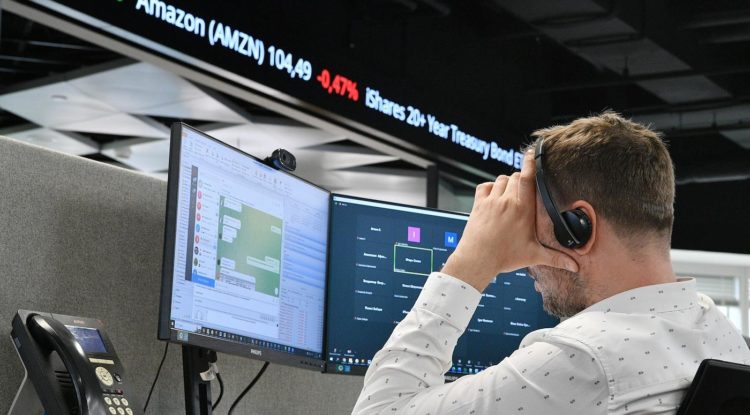
The sanctions were the only exchange selling foreign shares. What to do if you still want to invest in Russia?
Under American sanctions, St. Petersburg Exchange fell. Through it, most of the foreign papers in Russia was conducted. Now the exchange has suspended tenders with foreign actions and has several times transferred the date of their renewal. What does this mean for investors?
In order not to miss the main materials of the "cold", subscribe to our Instagram and telegram .
The US Department of Foreign Asset (OFAC) of the US Treasury included SPb Exchange in the SDN list-a list of people and organizations with which the US citizens cannot be carried out.
These sanctions do not instantly come into effect. OFAC allowed to complete the relationship with the St. Petersburg Exchange until January 31, 2024. Therefore, so far there are no technical reasons to stop the trade in American actions.
However, immediately after the announcement of the sanctions, St. Petersburg Exchange itself suspended all the auction. Trading Russian shares became available the next day, and the turnover of foreign papers decided to restart on November 6 (on weekends the exchange usually does not work). But then the pause was again extended for at least another week. The St. Petersburg Exchange explained that they "interact with counterparties in order to establish the procedure in the current conditions."
What is important "St. Petersburg Exchange"
There are two main exchanges in Russia on which you can buy securities-Moscow and St. Petersburg (there is still a St. Petersburg currency exchange, but there is a list of traded securities very small). For a long time, access to foreign papers was provided by SPb Exchange for a long time. Since 2014, she has had access to several dozens of American promotions popular among investors , and after that they regularly added new securities. In 2020, the exchange launched trade in European shares.
In 2020, the Mosbirzha also launched the trade in foreign shares, but most investors in Russia continued to use the St. Petersburg Exchange. After February 24, 2022, trading by foreign papers on the Moscow Birgat were stopped : at first the exchange itself did not work, and then the shares of Western companies purchased through the Moscow Biru were frozen.
More about freezing
The fact is that information about securities and their owners was stored in the national settlement depository (NRD), and through it was transmitted to European EuroClear and Clearstream. Since March 2022, foreign companies temporarily froze calculations with NRA, since some of the operations could be performed under the sanctions by Russian investors and companies. And in the summer, NRA himself fell under one of the packets of European sanctions, which slowed down attempts to agree with EuroClear and Clearstream and separate the propyscancies from the assets of the rest of the Russians.
Since then, foreign shares purchased through the MoscowBirge have remained frozen. The accounting chain of most of the foreign shares traded on the St. Petersburg Exchange was different - it led to the main American depository of DTC. He did not stop all the calculations with the St. Petersburg Exchange, so the last year and a half trade in American shares has lasted.
For the past year and a half in Russia, foreign actions have traded only through the St. Petersburg Exchange. The volume of bidding by American and European actions during this period fell three times - mainly due to the restrictions of the Central Bank prohibiting the shares of “unfriendly countries” to unskilled investors ( 98% of all investors in Russia). But the St. Petersburg Exchange tried to open access to new markets: in 2022, shares trading from the Hong Kong Exchange launched (mainly shares of Chinese companies) - and new tools were gradually added.
In the context of restrictions from the Central Bank and external sanctions, Russian investors had fewer opportunities to invest in some market, except for the Russian one. Thanks to the St. Petersburg Exchange in October 2023, there were still such options, but now they can disappear completely.
What will happen to the assets of investors
Representatives of the exchange immediately stated that the sanctions would not affect customer assets. But this does not mean that they can be freely disposed of. Analysts believe that the scenario that happened with Western securities on the Moscow Exchange is quite likely: technically, assets are still belonging to investors, but neither to sell them or to get a dividend profit from them for a year and a half.
By the way, the profit from these assets may never go to Russian investors
Profit can take the restoration of Ukraine. Such conversations have long been going on for frozen assets of the Russian Central Bank, and recently they began to discuss the possibility of transferring income from personal assets of Russian investors frozen in EuroClear and Clearstream. EUROCLEAR recently reported that in nine months I earned almost three billion euros on frozen Russian assets. 700 million of them have already gone to Belgium taxes (there is EuroClear there), and for other income they can create a fund and transfer it to Ukraine.
In total, according to the Central Bank, at the end of 2022, 5.7 trillion rubles of Russian assets were frozen, of which 1.1 trillion belong to private investors. Some of these assets tried to redeem brokers. For example, in 2022, Tinkoff bought a blocked share in one of its funds and resumed trade without severe loss in price. And in the fall of 2023, over-time trading launched by several Finex ETF funds, but you can sell them about five to six times cheaper than the real market value of the assets included in them. In general, after freezing assets, the way out of them has so far become possible only in rare cases and often with a huge non -and -yield discount. On November 8, Putin signed a decree according to which the exchange of foreign investors frozen in Russia will become possible for frozen assets of Russians - perhaps this will change the situation.
Nevertheless, the "SPb Exchange" and Russian investors have a chance to avoid the same papa situation. Western counterparties have almost three months to complete relations with the exchange. During this time, the exchange may agree to transfer assets to another jurisdiction. And Russian investors will be able to get out of American and European assets - provided that the SPb Exchange will resume trading in the near future. Promotions are unlikely to lose price - the share of Russian investors in them is quite low.
When the sanctions come into force, it will become impossible to trade in American actions through the St. Petersburg Exchange. Most likely, European ones also - usually companies in the USA and the EU observe each other's sanctions against Russia. But the fate of the Hong Kong actions remains in question.
In conditions of loss of its main foreign market, St. Petersburg Exchange can strive to strengthen and expand cooperation with Asian partners. But there are also risks: companies from Asia can be afraid of secondary American sanctions for contact with Russia and refuse to cooperate with the SPb Exchange. Many Chinese companies that are now represented on the exchange are closely connected with the USA of trade relations. For Russian investors, the purchase of Asian shares will become more risky, but at the same time it will remain the only way of exchange investments not in the Russian economy.
What will happen to the exchange
The full termination of the trade in American shares will cause a serious blow to business: in September, 2.42 billion dollars of 2.11 billion were made from a total of foreign papers from the United States.
This news has already been reflected in the expectations of investors: the shares of the St. Petersburg Exchange itself fell by about 24% after the news about sanctions. And on November 7 it became known that the company general of the company Roman Goryunov leaves his post. The position will be occupied by the First Deputy Evgeny Serdyukov, who has already identified the new strategy of the company. Judging by his words, the St. Petersburg Exchange is not very counted on expanding trade with the Asian markets: after solving problems with potential locks, the exchange “focuses on tenders with investment tools with calculations in rubles, retain and will develop projects in the Russian financial market”.
To be afraid that the exchange will close at all until it seems to be worth it. She survived after the start of the war, although the market value fell from 700 to 100 rubles per share. Against this background, a fall of 24% no longer seems so significant.
Are there any other options to buy foreign promotions?
There is, although recently it was formally prohibited.
Since March 2023, a presidential decree has been in force in Russia, which actually prohibits the residents of the securities transaction residents with “persons of unfriendly foreign states” in foreign brokerage and bank accounts. “Persons of unfriendly foreign states” are recognized by all citizens and companies of “unfriendly countries” - that is, almost all states, widely represented in the global stock market, except for continental China. But in practice it was not known about any case of persecution. On November 8, Putin signed a new decree that canceled the previous restrictions.
There is also a bill establishing a fine for such transactions in 20–40% of the amount of the transaction, but it has not yet been adopted. So, such transactions are no longer considered a violation.
Investors from Russia are looking for ways to trade in world markets bypassing Russian laws and external sanctions. To do this, they usually try to open an account with a foreign broker. Such an account almost eliminates the risk of sanctions, but other risks appear - for example, that the broker himself will decide to stop cooperation with investors from Russia and close their accounts. Or that due to sanctions, customers from Russia have no way to replenish or withdraw funds.
The most famous option is Interactive Brokers. The broker continues to work with the Russians and allows you to replenish the score from non -conquest Russian banks. But since the summer of last year, he withdrew the ruble out of circulation, which made the replenishment of the account for Russians difficult due to internal Russian prohibitions on the purchase and storage of currency. And SWIFT translators from Russian banks have a very large minimum commission, which makes small replenishment disadvantageous. But even for the amount of 10 thousand dollars, you can lose about 3-4% at all commissions and conversion courses.
Two other popular options are Freedom Finance Global (part of the Kazakhstan Freedom Holding, which had a popular broker in Russia until 2022 ) and Just2trade (Cyprus company from the founders of one of the largest Russian Finamas brokers). The commissions of these brokers may differ depending on which of which legal entities will trade, but replenishing an account from Russia will be cheaper than in the case of a currency SWIFT transmission. Since these companies investing Russians are one of the main audiences, the risks of closing an account for the Russian passport are lower than in the American brokers. But the threat of sanctions can hang over the broker himself - for example, Freedom Holding has recently been accused of bypassing sanctions for working with clients from Russia.
Updated: Information about Putin’s decree of November 8, 2023, which cancels restrictions on securities transactions with “persons of unfriendly foreign states” in foreign brokerage and banking accounts, has been added to the material.