
Translated material
"Theater for one viewer"
The Kazakhstani authorities accept Putin in their country for the fifth time in a year. For what
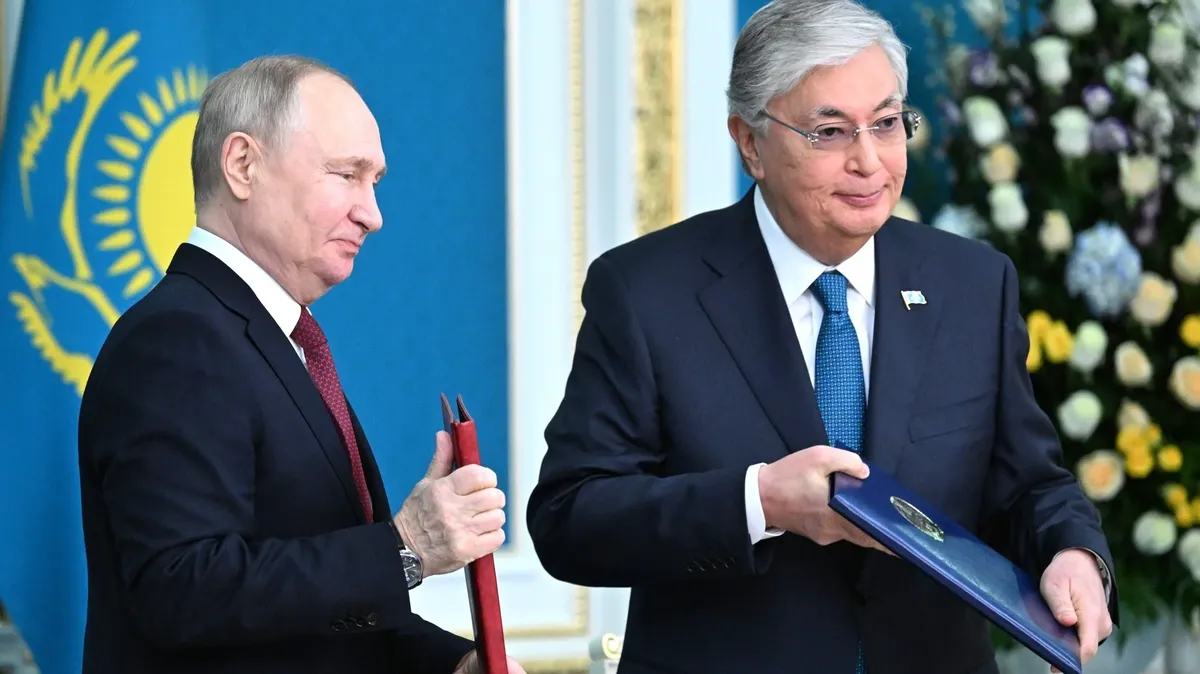
Photo: kremlin.ru
Russian President Vladimir Putin came to Kazakhstan and met with the head of state Kasim-Zhomart Tokayev. They held negotiations, signed several documents, and also participated in the Forum of Interregional Cooperation. This is the fifth visit of the Russian president to Kazakhstan over the past year. Is this an important event, and what it means to both sides, the expert explains to the Novaya Gazeta Europe.
Context
Putin’s trip was widely announced. In anticipation of it, the presidents of Russia and Kazakhstan gave cross interviews: Putin-the newspaper Kazakhstan Pravda , and Kasim-Zhomart Tokaev- Izvestia .
During the visit, Putin held negotiations with Tokayev in narrow and expanded compositions and took part in the plenary meeting of the XIX Forum of Interregional Cooperation of Russia and Kazakhstan.
During the negotiations in a wide format, Tokaev said that “there are no fundamental problems in the relations of Kazakhstan and Russia,” and they will remain unshakable. Putin emphasized that Russia and Kazakhstan are the closest allies.
At the forum, Russian and Kazakhstan presidents reported on cooperation between states in various fields, including in the military. Putin noted that Russia provides Kazakhstan "great assistance in training military personnel."
Not without incidents. Putin made a reservation again and incorrectly said the name and patronymic of Kasym-Zhomart Tokayev, and he “in return” was disconnected for a short time during a performance on the forum.
According to the results of the negotiations, a package of documents was signed . Among them is a joint statement to the decade of the Russian-Kazakhstan Treaty on Good-Settlement and Allied in the 21st century, a plan for joint actions of Russia and Kazakhstan for 2024–2026, a memorandum of cooperation on the construction of three TSPs and others.
Read more about the causes and significance of this visit “New Gazeta Europe” with Temur Umarov, a researcher at the Berlin Center of Carnegie on the study of Russia and Eurasia.
Temur Umarov
Researcher at the Carnegie Berlin Center for the Study of Russia and Eurasia
- What is the importance of today's visit by Putin?
- It is important that he actually took place. And on this its importance ends. The Forum of Regional Cooperation is a format that has existed for several decades. There is nothing particularly new there. This is not the case when Putin arrives unplanned and for some separately allocated reason.
- Putin has been visiting Kazakhstan for the fifth time in a year. Why does he go there so often and why?
- The fact is that, before Russia's invasion of Ukraine and before the pandemic, Vladimir Putin, in principle, quite often traveled around the world. But given that now he is on the international wanted list, the number of countries in which he can come calmly and safely decreased greatly. Kazakhstan is one of those few countries. Therefore, in this way it compensates for other potential directions.
- Has the role of Kazakhstan as a partner of Russia changed this year?
- Partly changed. The role of Kazakhstan and other countries of Central Asia, which, roughly speaking, did not turn to Russia with their backs after it started the war, grew up in the priorities of Russian foreign policy. The importance of Kazakhstan for the stability of the Russian economy has also increased. And, of course, for the Russian audience, Kazakhstan turns into a stable, reliable partner of Russia, which you can rely on. And it sticks out in every possible way, in particular in the official rhetoric of the Kremlin.
- And how did the rhetoric of Kazakhstan change in relation to Russia for this year? And did it change in principle?
- Kazakhstan, in principle, has several variations of rhetoric for different audiences - for Russia and Europe. In the case of rhetoric for Russia, this is a theater for one viewer, for Vladimir Putin.
Tokaev in every possible way demonstrates to him that Kazakhstan does not turn into the next “anti-Russia”, Kazakhstan is still an ally, he does not take any radical measures to turn from Russia.
And for this, at meetings with Vladimir Putin and other Russian officials, Kazakhstani leaders emphasize what the Kremlin pays attention to. This primarily concerns the position of the Russian -speaking population. Tokaev almost every time says that Kazakhstan is a multinational country where there is no place for discrimination on the principle of language; About the support of the Russian language. He even somehow proposed to declare the year of the Russian language as part of the CIS of 2023.
But there is another rhetoric. When Tokaev, for example, goes with visits to the west, there he says a little about other things. There he says that Kazakhstan will not turn into a country with which Russia will bypass sanctions, and that war is always bad, and the world is good.
- Why did Kazakhstan visit Putin's visits?
- It is important to understand that Kazakhstan is in a rather difficult situation. Purely geographically, this is the only country in the Central Asian region, which has a huge border with Russia. I would like this border to be calm and somehow contribute to the development of Kazakhstan. Therefore, it is impossible to imagine a situation in which Kazakhstan will completely turn away from Russia, because it will mean increasing the risks of Russian aggression. And as a result of the fact that Russian foreign policy turns into something very unpredictable, Kazakhstan, of course, does not want to take risks and risk its national security.
But besides this, Kazakhstan understands that all this bouquet of dependence on Russia that he has will not go anywhere. It is impossible to get rid of it in a few years. This is a long process that requires a lot of effort and time. And now is not the time in order to do this forced and to expose yourself to risk.
- There were many cases when in Kazakhstan the concerts of Russian artists supporting the war were canceled, because local residents expressed irritation on this subject. And how does the population of Kazakhstan feel about Putin's visits?
-Judging by social surveys, for 20% -30% of Kazakhstani society it is absolutely obvious that there are many problems from Russia. They believe that contacts need to be minimized with Russia. Only one thing is when we are talking about the visits of government officials, and quite another when it comes to artists. Society may affect artists because Kazakhstan does not have any clear protocols, duties against them. Kazakhstan is not obliged to provide the site for all Russian artists. And if there is no demand for them, the organizers are not going to forcibly force Kazakhstanis to watch their concerts.
And when it comes to government officials, Kazakhstan cannot refuse to Vladimir Putin on a visit. It will be a diplomatic scandal.
- Putin again incorrectly said the name Tokaev. Is the Kazakhstan side once reacting to this or not?
- Officially does not react. Why and how officially it could be answered so that it did not look like some kind of offense? The official line on this occasion is such that in Kazakhstan they are simply silent and pretend that nothing happened. They perfectly understand that Vladimir Putin is already an elderly politician, and the number of names that revolves around him does not fit in his head, he has difficulties with pronunciation and so on. Why will Kazakhstani officials laugh at the elderly?
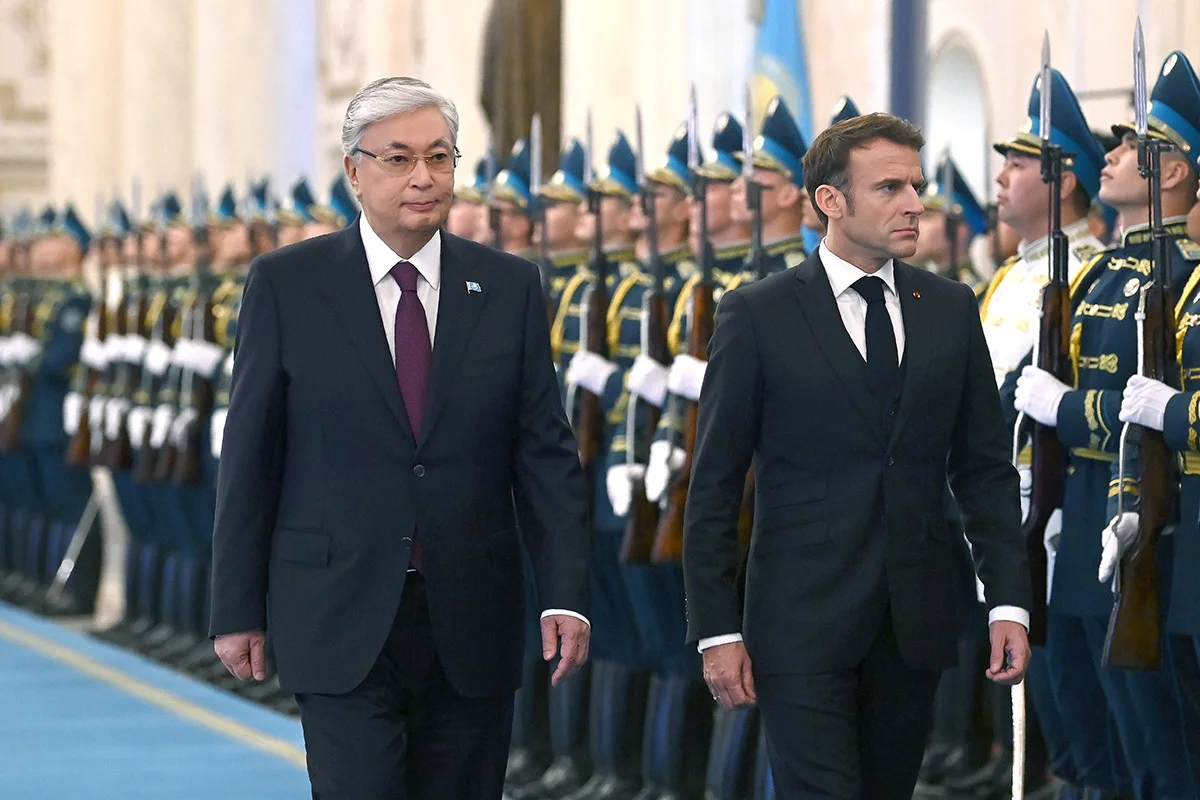
- Last week, Kazakhstan was visited by French President Emmanuel Macron. What is the difference between the visits of the French president to Kazakhstan and the Russian?
- The main difference is the frequency. The last visit of the French president was nine years ago, that is, this is a rather unique event. It suggests that Western countries are more and more of interest in Central Asia, they have their own pragmatic goals. If we talk specifically about Macron, he is interested in uranium deposits and an increase in the import of Uranus from Kazakhstan.
Before the war, before Russia has become a toxic country with which it is impossible to have any connections, Europe quite often communicated with Central Asia through Moscow. Many European countries did not open the diplomatic mission in Central Asia, and decided their affairs there through embassies in Moscow, and did the same business. But now it seems that this is impossible. In addition, a similar impetus was from the countries of Central Asia themselves. It did not arise today and not even with the outbreak of war, but even earlier. And now this cumulative effect gives some fruit.
-Do Kazakhstani authorities accept Putin and Macron differently?
- No. In the diplomatic protocol, everything is described in such detail that any step to the left or right raises many questions. But, of course, there are differences. Putin will not be transported in conditional Astana or introduce to Kazakhstan culture, as was the case with Macron. Just because Putin’s visits are much more workers and less extraordinary. And when the president of the country arrives every ten years, it is important to demonstrate that this is an important event, and because of this, the number of events in which representatives of the two countries take part together and increase.
-Can we talk about some struggle between Russia and Europe for Kazakhstan and, in principle, for Central Asia as an ally?
- Such a comparison can only be used in part. Because it is obvious that there are intersecting interests, and this creates potential for competition. But we must understand that, firstly, Central Asia is not such an important region for which countries are really ready to fight, invest resources and so on. Secondly, this is not in the interests of Central Asia itself. Kazakhstan, for example, is doing everything possible so that countries that do not get along with each other coexist peacefully and without any conflicts in Kazakhstan. Therefore, based on the fact that Central Asia is not just an object in the hands of Russia or anyone else, there can be no conflict, because the Central Asia itself is not profitable.