
Translated material
Where the waters of the Ob and the Yenisei flow
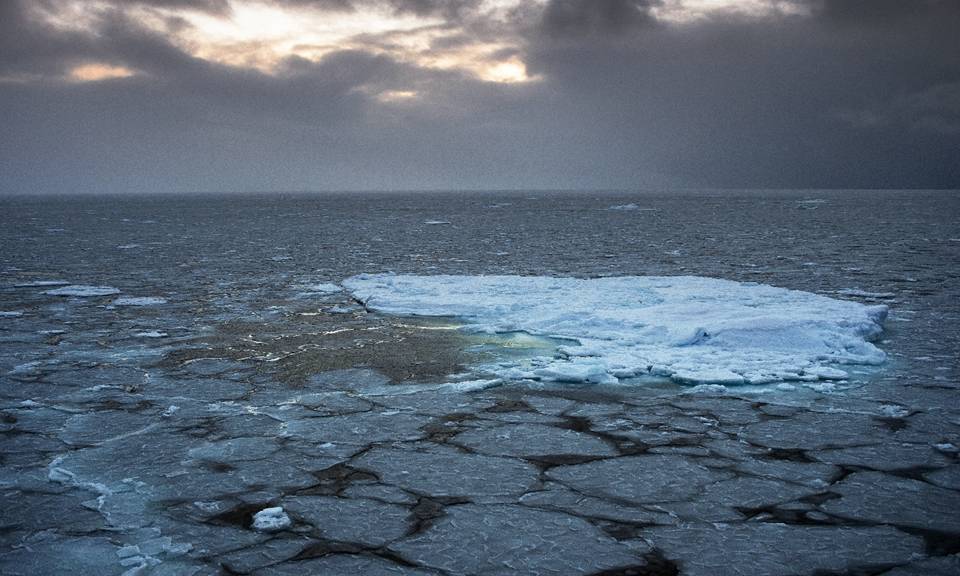
Scientists have found that fresh water entering the Kara Sea from rivers is transferred to the Laptev Sea in the autumn-winter period. As a result, by January, the previously desalinated central part of the Kara Sea restores its salinity. Since the salinity of water greatly affects the intensity of ice formation, this discovery will be useful when predicting the thickness of the ice cover in the shipyard areas of the Arctic. In the Arctic, there are practically no sea research in the cold season, when most of the Arctic Ocean is covered with ice. Because of this, there is a lot of unknown about what is happening in the Arctic seas in winter and spring, even in the relatively studied coastal and shelf areas of the Kara Sea, where active economic activities are conducted and icebreakers regularly go.
Two large rivers - Ob and Yenisei flow into the Kara Sea - and form in it a huge area of desalination with an area of up to 250 thousand square kilometers. In a recent work, scientists from the Institute of Oceanology named after P.P. Shirshov RAS (Moscow) showed that all this is the desalination at the end of autumn and the beginning of winter disappears, but so far it remained unclear what was happening with such a huge massive of fresh water.
To resolve this issue, the authors conducted large-scale studies of water parameters in the Arctic: flow speed, temperature, salinity-in the winter-spring seasons from 2021 to 2023 using measuring probes. Scientists worked on icebreaker ships and a floating station, in the Strait of Vilkitsky, connecting the Kara Sea and the Laptev Sea. It was at this station that the researchers recorded an intense stream of desalinated waters at the end of autumn and early winter from west to east.
“Thanks to the rotation of the Earth, desalinated waters of low density under the ice form a powerful flow along the coast and are carried away to the east - in the Laptev sea. Because of this process, already in January, the surface layer in the central part of the Kara Sea becomes salty again , ”explains the leading researcher at the P. P. Shirshov Oceanology Institute and the main researcher at the Moscow Institute of Physics and Technology, Alexander Osadchiev.
“The discovery of this ice flow that carries the desalinated waters from the Kara Sea to the Laptev sea is fundamentally important in order to more accurately predict the strength of ice on the Northern Sea Route highway - after all, ice, formed and increasing from desalinated waters, is 10-15 % stronger than ice formed from salty sea waters ,” says Roman Sedakov, a senior employee , a senior employee Institute of Oceanology named after P.P. Shirshov RAS. In addition, the study will help to better understand how climatic changes affect the Arctic ecosystems.
The study was also attended by scientists from the Moscow Physics and Technical Institute, the Center for Marine Studies of the Moscow State University named after M.V. Lomonosov and the Pacific Oceanology Institute named after V.I. Ilyichev RAS (Vladivostok). The results of the study supported by Grant of the Russian Scientific Fund are published in the journal Scientific Reports.