
Translated material
Light target
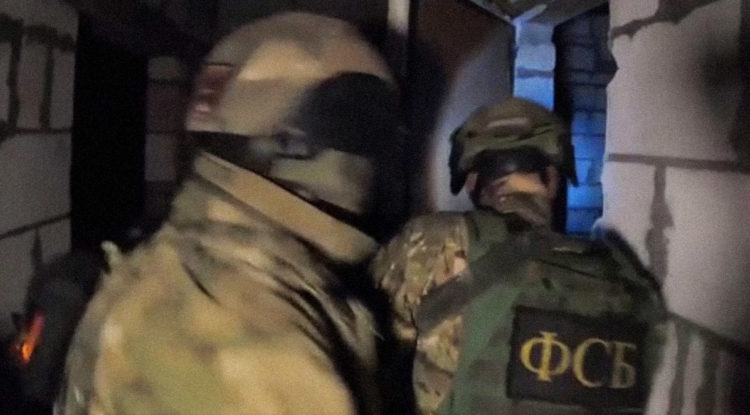
The FSB catches migrants for petty hooliganism, and then starts things about terrorism on them. Almost no one has noticed this year
Migrants in Russia are in constant danger, not only because of xenophobia: at any moment they risk becoming defendants in new affairs about “terrorism”, who for many years according to one scenario is fabricated by the FSB. "Cold" tells how this happens.
In order not to miss the main materials of the "cold", subscribe to our Instagram and telegram .
On the morning of September 8, 2021, FSB officers broke into an apartment in Yekaterinburg, where 15 migrants from Tajikistan lived. The men were thrown to the ground, twisted their hands, put bags on their heads, beat and took them to different police branches. It turned out that the Russian security forces consider them members of the “terrorist community”. During the detention, about three kilograms of explosive were allegedly seized from them.
10 out of 15 detainees were deported to Tajikistan. And five - Sanginmurod Musofirov, Shakhromjon Musofirov, Nurali Dustov, Anvarsokha Avezov and Abubakara Sangcharov - were put in jail. According to investigators, mucophils and sangers created a cell of the Taliban banned in Russia (nevertheless coming to Russia with official visits), and the rest in it participated and prepared a terrorist attack.
The investigation in the criminal case lasts more than two years. The meetings are constantly transferred, the consulate of Tajikistan is also in no hurry to help its citizens. All this time, only a distant relative of the Musofirovs is fighting for fellow countrymen - Azismurus of Mosofirs, who himself works at a construction site.
“They say that they wanted to blow up the Ural metro, but these guys cannot connect two wires,” Azismurur tells the “cold”. -These are young guys, someone has minor children. How can you blame them for what they did not do? There should be justice? "
To Yekaterinburg to work to help families at home
All detainees arrived at ekaterinburg not from a good life: the average salary in Tajikistan is less than $ 200, and in Russia at a construction site you can earn medicines for sick parents, accumulate money for a new home and financially help wives raise children at home.
The brother of Azismurod, 35-year-old Sanguinmurod of Mosofirov began to fly to work in Russia as a student-he worked three months a year to pay something to study. Having graduated from the university, Sanginmurur married and started children. There was not enough money again, and he again began to fly to Russia once a season. September 30, Sanginmurod planned to return home: the wife was preparing for childbirth. “I wanted to be present there,” says Azismurur. “But he could not, he was detained and put him.” Sanginmurod has four children, the oldest studying in the second grade.
Another delayed - the nephew of Azismurod, Shahrromjon Musofirov - also has a young child. He had never seen him, since he did not have enough money to visit his family in his homeland.
Shakhromjon - 29 years old. Immediately after graduating from school, he began to fly to seasonal work in Yekaterinburg. At first it was necessary to financially help a sick mother with disabilities, and then he had his own family and money was also required for her.
In 2019, Shakhromjon once again went to seasonal work. However, they dragged on - he decided to build a new house to his mother and lingered in Russia.
Almost all detainees from one little village of Marzich and knew each other in Tajikistan, went to visit, weddings and funerals. One of them - Anvarsokh Avezov - worked in the police department of the Zafarabadsky district of the Sogdian region of Tajikistan. He lacked salaries in the civil service, and in 2021 he decided to fly to Yekaterinburg for three months to accumulate medicines for his mother.
Avezov also wanted to make money for a medical examination in Russia - he and his wife could not have a child for a long time. Another accused, Nural Dustov, flew to Russia to work to feed his four young children at home. “His father had a pressure when he found out that Dustov was put in a pre -trial detention center on charges of terrorism,” says Azismurur. “It's a shame in our village, do you understand?” He died because of this. God forbid, still to lose their mothers. "
Worked at a construction site, but became "terrorists"
A few weeks before the all of the FSB, Nural Dustov lost his passport. According to Azismurod, the state bodies refused to help Dustov and he was angry and worried, because without a personality certificate he could be detained.
“He came home one evening and half in Tajik, half in Russian said to the guys:“ Here, they need to be killed, exploded, look, no one helps me, ”says Azismurur.“ Where to go, I have no documents! ” Somehow, the court of this conversation was at the court. Probably, it was a wiretap, which is unknown who, where, when and how it installed. ”
Azismurod believes that Nurali spoke emotions, and is sure that he would never have committed such a crime. But, according to him, the examination found that speakers do not joke.
Who made the record and how she fell into the hands of the FSB officers is unknown. Its existence by the “cold” was confirmed by one of the lawyers - Sergey Suslov, who defends Shakhromjon Musofirov. However, he refused to confirm the contents of the conversation and details of the examination.
Azismurur suggests that the security forces could persuade the mistress of the apartment in which the accused lived. Now she is taking a witness in the case and refuses to communicate with reporters.
All 14 fellow villagers who came to seasonal work settled in the apartment, which was found by Shahrromjon. It was cheaper, and men could save money, says Azismurom.
Abubakr Sangcharov was familiar with Sanginmurod and often came to visit him. In the morning, on the day of the detention, all 15 people were in the apartment.
They were taken away in an unknown direction. One of the defendants in the case named Hovar, who was later deported to Tajikistan, said in an interview with Radio Ozodi that after the detention everyone was taken to the department, where they kept two days in a cold room with blindfolded eyes, beaten and not allowed to ask questions.
Hovar told reporters that the security forces forced him to sign some papers. Only after deportation to Tajikistan did he learn that he became one of 10 witnesses in the case “On the preparation of the attack”. According to Khovar, under torture, they signed under false testimonies against five compatriots.
Not the only thing
Migrants from Central Asia have become accused of terrorism for several years. In 2021, Novaya Gazeta journalists revealed a whole scheme according to which security officials work. First, police officers catch migrants supposedly for violation of public order. Administrative affairs about “petty hooliganism” and “disobedience to the legal order of a police officer” are being brought on them, then they are placed in a special receiver for 10-15 days. And then they endlessly extend the detention and start criminal articles.
Such a practice in a conversation with the Cold is confirmed by a human rights activist, who has been working with migrant problems for many years, Alexander Kim. “They can detain the cigarette butt allegedly thrown by the urn. And after two days it is planted for another 15 days, ”says Kim. - Then the migrant is released and immediately detained at the gate of the pre -trial detention center. This shows that law enforcement officers do not have real evidence against a person. They can not even justify the detention of a person with regulatory legal acts. ”
It was such a chain of constant detentions that occurred with the 34-year-old native of Kyrgyzstan by Talent of Onurov, who has a disability in a fourth degree. In September 2019, Onurov informed his mother that he was going to look for a job in Bishkek. But he never left Russia. He was detained for “petty hooliganism” and kept in the isolator for 10 days, and when he was released, he was immediately detained again.
After carousel arrests against him, a case was opened under a terrorist article. The court sentenced him to seven years in prison, accusing him of "attempted a terrorist attack" and "public calls to carry out terrorist activities on the Internet."
The case of a citizen of Tajikistan, Umarjon Saidov, also developed. The first time he was detained on September 6, 2018 for “petty hooliganism”, and on the same day the court arrested it for 13 days. On the day of release, he was appointed a second administrative arrest. And immediately after the release, the Meshchansky District Court accused Saidov of “recruiting in a terrorist organization” and put in a pre -trial detention center. A year later, Saidov was sentenced.
“The problem is that those cases that become public are the very top of the iceberg,” says human rights activist Alexander Kim. “Even if it becomes clear that there are more such public cases, there are doubts that on this basis we can judge the whole problem of falsification of cases and illegal claims of the FSB in relation to migrants.”
All papers are signed in fear
Migrants are a light target, Kim explains. With regard to them, it is very easy to falsify things, because they do not always know the Russian language well and sign what they say.
“They sign all the papers in fear. Then the investigator identifies them a state department who persuades everything to sign and admit a crime that they did not commit, ”confirms the Tajik lawyer protecting the rights of migrants in Russia. Because of the threat, he himself fell under the pressure of the security forces, with the "cold" he agreed to speak only anonymously.
So the migrant detained for “petty hooliganism” becomes the accused of “terrorism” and falls into the pre -trial detention center. And getting out of there is almost impossible. “In the pre -trial detention center, the accused comes to his senses and begins to call relatives, look for a lawyer. But at this stage it is already difficult to prove his innocence, ”says the Tajik lawyer. “He signed all the documents, testified - that is, all investigative actions have already been carried out.”
Consulates are in no hurry to help their own citizens, and the security forces use it. “They know that no one will almost protect these migrants, no one will stand up for them,” the Tajik lawyer is sure.
Another reason for the raids on migrants, the interlocutors of the "cold" call anti -Islamic sentiments and xenophobia. According to Azismurod, the FSB could be interested in his relatives because the employees did not like their beard and religion.
“The guys do not shave for two or three months, just cut off. A beard does not mean that he is a terrorist, ”says Azismurur.
“Campaigns in“ illegal mosques ”also arouse suspicions of the police,” says human rights activist Alexander Kim. - Such prayer houses seem to them a rod of Wahhabism and extremist ideologies. <...> The state and residents are becoming more xenophobic, and there should now become more fabricated affairs. ”
Among other things, starting cases on migrants, the FSB officers increase the level of disclosure of crimes in terrorist articles, lawyers and human rights activists are sure.
According to lawyer Timofei Shirokov, who defends migrants and those who help them, over the past five years in Russia, not a single terrorist attack was committed by citizens of Central Asia, while many innocent people are sitting behind bars on charges of “terrorism”.
In order to show the results of the disclosure of particularly serious crimes, the FSB uses another method: special services artificially form terrorist cells and recruit migrants there.
“For example, an illiterate native of Uzbekistan sits in chats in Telegram,” says Shirokov. - And here are strangers begin to write to him, to promote on Muslim topics. They say that they say, you should not stand aside, you need to help the brothers, and thus draw it, and then they valiantly reveal the “crime”. They find explosives in him, of course, then he says that he testified under torture. Standard scheme. "
The situation of migrants is hopeless, human rights activists are sure. Even if they try to defend their rights, it may become even worse “if the migrant behaves so that the FSB officers do not like it, then this situation can become very dangerous for a person,” says human rights activist Alexander Kim.
Not only migrants themselves are exposed to dangers, but also those who protect their rights. Most human rights activists who remain in Russia quite often receive threats from the FSB, unknown people attack them, and sometimes they become involved in serious criminal cases.
This happened with the human rights activist born in the Uzbek SSR, Bakhrom Khamroev. For more than 20 years he lived in Moscow and helped refugees and migrants from Central Asia. Khamroev was often persecuted for his human rights activities: he was attacked, the operatives were beaten in civilian clothes and unknown , searches were often carried out in his apartment.
The last time Khamroev was detained on February 24, 2022. Since then, he has been in the Lefortovo pre -trial detention center. In May 2023, the court found him guilty of “public calls for terrorism on the Internet” and “organizing the activities of a terrorist organization” and condemned 14 years in prison. The lawyer Khamroev Timofei Shirokov believes that the FSB thus "set accounts with the human rights activist." Due to such risks, human rights activists are trying to move from Russia and help the victims remotely.
Pray that a fair judge is caught
Sanginmurom of Musofirov, Shahromjon of Musofirs, Nurali Dustov, Anvarsokh Avezov and Abubakr Sangcharov have been sitting in a pre -trial detention center for two years, and the case is not moving.
The last six months of the defendants are defended by state lawyers. Their loved ones can no longer pay for private services, and Azismurod believes that this makes no sense.
“They also need to pay every time before the processes in court, and the children will transfer and extend the arrests all the time. In three months they ask for 250 thousand; The hearing took place, and they ask for money and will conduct the case until the next meeting. And there is no result on the process. How many complaints and petitions were written, there are no results, ”says Azismurur. “I had to terminate the contract and pray, so that a fair judge who will decide their life will come across.”
According to him, he repeatedly turned to the Consulate General of Tajikistan in Yekaterinburg, but did not receive help. “I tell them:“ You are the embassy, you must protect our rights. Go to the pre -trial detention center, talk with the accused, you have never gone there in two years. At least for a date, at least half an hour go to talk, ”recalls Azismurur. “But they say that they are not allowed to go to the pre -trial detention center, that permission should be taken from the court.” However, the last time the diplomatic officers promised that they would visit the next court hearing. It is scheduled for November 22.
So far, Azismurod has to be in touch with the families of the accused all the time and gradually help them financially. Because of this, he takes up any construction work, because he also needs to buy medicines and feed his family and family family in Tajikistan.
“Women in the village cry every day,” says Azismurur. “We have to lie to them and say every time:“ In the next month they will definitely let them go. ” So two years have passed. They call all the time, we have to ask them to endure - we say: “They will let them go, let them go.”