
Translated material
How to make a person from a pig
Beads Gilbert Chesterton, a detective as a confessor and detective as a sermon
There are writers so complex that life is not enough to figure out their work.
There are simple, like three kopecks. And sometimes Gilbert Kit Chesteron.
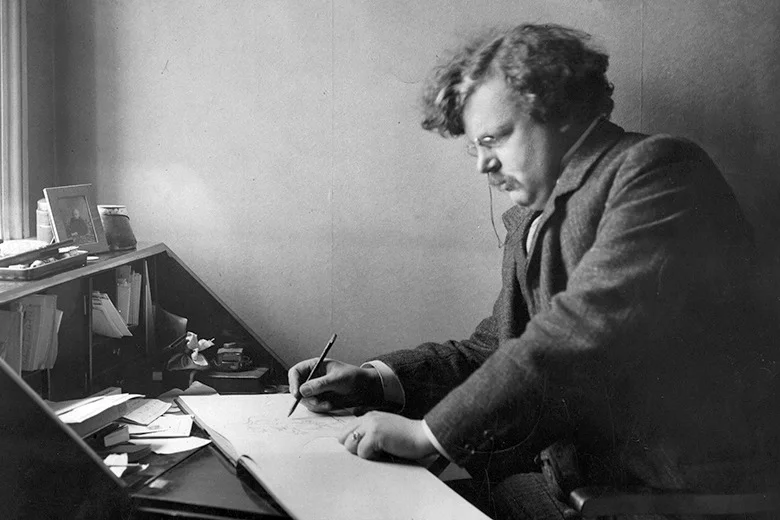
Chesterton is at the same time Chatsky and Hitchcock. Kozma Prutkov and Dmitry Bykov. Big (this is poorly said - big; say, huge) modernist, who spent his whole life to convince the world of his rightness. Scattered to such an extent that it was perpetuated in jokes. Enjoyed enormous folk love and snobbery contempt in literary circles.
This is a paradox: the most English writer, what you can imagine, zealously defends Catholicism (Pope Pius XI after the death of Chesterton will call him the defender of faith). The absurdist, who built a career on the game in a game of words, repeats that he is a journalist, not a writer.
But the question, of course, is not how these opposites are combined.
Anemones live in the same place as white bears.
The question is what it gives.
Chesterton is a detective writer. The stories about Brown's father is the indicative example, but far from the only one: the whole plot of the “man who was Thursday”, the best novel of the writer, is detective through and through. And what is the detective? A detective is genre literature, the pampering of romantics who occupied the authors, starting with Edgar software, when they were not seriously “not written”. Is it possible to put an author of such trinkets on a par with his brilliant contemporaries - say, Joyce or Virginia Wolf?
Or is it not trinkets?
Genre literature always speaks of time: Gothic novel - about the past, fantastic - about the future. And the detective - about the present. There is something very characteristic of the fact that Chesterton, this journalist writer, is fixed (unlike most brothers-modernists) on urgent problems, wrote detectives.
The twentieth century shook confidence in rationality, erected by the detective genre in the apogee; Rationality, scientific thinking led humanity to world wars, revolutions and weapons of mass defeat.
The rational failure states, for example, Rex Stout, another outstanding author of detectives.
Chesterton does not ignore this problem, but finds her a paradoxical solution. Yes, the whole world is in darkness, yes, the evil is unknown, and the hero-rayer, Sherlock Holmes of the New Age, turned from a knight of reason into a little man, Andrei Gorchakov, the hero of the “nostalgia” of Tarkovsky, which carries his candle-a candle of reason-and covering it with it. Chesterton says: Yes, yes, yes, all this is so, but look at the very darkness. Take a look at the anarchism (“The man who was Thursday”), the thinking of the criminal (Flambo from the books about Pater Brown) - and you will understand that the human soul is hidden there.
The detective should not catch criminals, but let them go sins. He must be a priest. His task (and after him the task of any respectable Christian) is to look for light, dazzling ray of sofits, hidden behind multilayer darkness.
In such a paradoxical optimism, all Chesterton.
This, for example, is very reminiscent of the Alfred Hitchcock method. And he also has genre art, but not a detective, but a gloomy Freudian thriller; And as Chesterton filled his detectives with a truly philosophical content, so Hitchcock did not just shoot horror films - he made a movie about fears of time. He did as a “serious” cinema could not imagine, talked on equal terms with the audience-and in this relevance, the adaptability of the language to the consciousness of the mass audience was a truly democratic artist.
The main claim to this approach (Tomas Eliot expressed it among others) - in pigs. Why adapt to the reader, compose popular detectives, argue with everyone in a row on the fields of a weekly column, which Chesterton, by the way, led more than 30 years? Why convince those who cannot be convinced?
Why did Chesterton mosques beads in front of pigs?
This is Chatsky’s conflict. The controversy of Chesterton with Eliot is convincingly read as part of Pushkin’s dispute with Griboedov, the famous commentary of the first to “grief from the mind”: “Now the question. In the comedy “Woe from Wit”, who is a smart acting face? Answer: Griboedov. " And from there: "The first sign of a smart person is at first glance to know who you are dealing with."
Indeed, Chesterton is primarily a dispute, and the dispute is not only with Bernard Show or Bertrand Russell, outstanding minds of his time, but with everyone, not only on the fields of newspapers, but also in detectives, not only in detectives, but also in essays, biographies, philosophical novels. The very style of his letter, built on paradoxes, is the style of a rhetorical, the style of a professional debate.
Chesterton really did not care with whom he was dealing with - he had the belief that his position needed to be defended before any opponent.
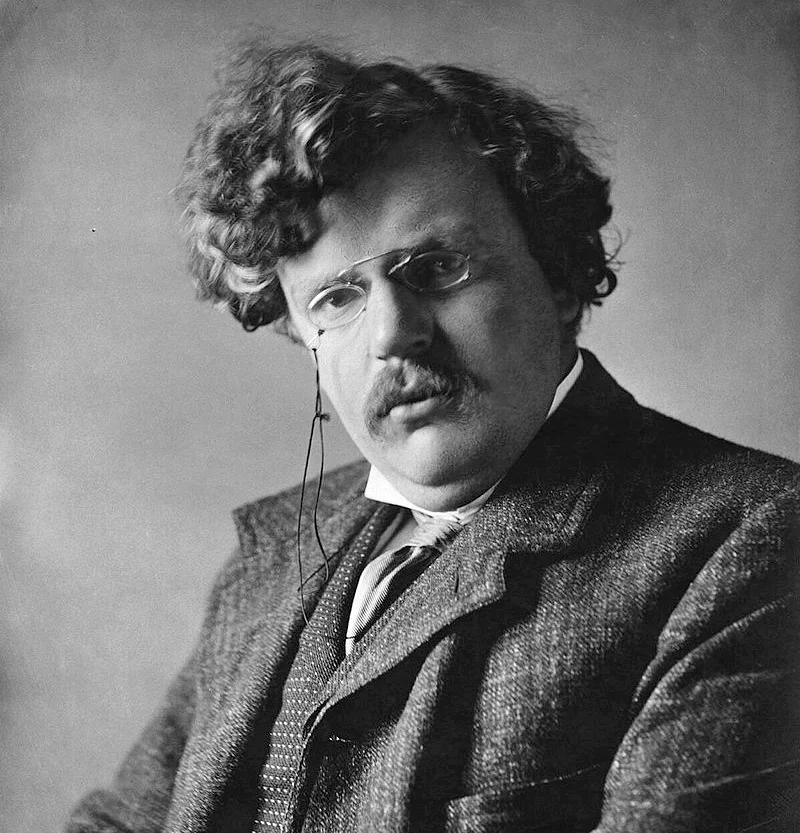
How to answer Pushkin’s claim - Eliot? Is it possible to convince the skeptic of the need to argue, enlighten, no matter what? Even if the audience is immune, the circumstances are constrained, and the times are difficult?
Chesterton would have replied that it was possible. That's why he and Chesterton.
He would argue, polemicize, as well as his numerous followers, as, for example, argues and polemizes Dmitry Bykov, a literary heir to Chesterton, who is a genetic resemblance to everything: starting from appearance, endless educational activities and ending with love for the biographies genre.
However, the skeptics of this will be not enough. I'll try to answer differently.
Through love.
There is something very national in the love of Chesterton of the British. Which country loves its artists more? Not only in England there is still the title of the poet-laureate, the court poet, who at different times wore Wordsworth, tennyson, Hughes; England to this day, in our, frankly, not particularly literary central age, is infinitely devoted to his writers: it is worth recalling how compatriots reacted to the death of Terry Pratchett.
In all English writers, regardless of their individual qualities, there is something very English. Fauls debunks a Victorian myth in the “French Lieutenant’s mistress” and nevertheless cannot resist devoting a dozen pages to a detailed, tender and devilishly serious description of the hats, as the condoing Victorian would devote them to their hats. There is nothing more English than the absurdity of Carroll and Lira - the norms of etiquette and morality, which are blocked from the inside, only consolidate the Status Quo established in the society. Why is this happening?
The culture of England is dialogical. Even in the most explosive class era, English society strove for a conversation, a gentleman's dispute. And thereby preparing the country for democratic times, when the communication skill helps you hear another and be heard by yourself.
This property of English identity is the answer of Chesterton to Eliot.
Whether Russian society is not so monologue, not so focused on enlightenment, let it allow itself a little more irony - Chatsky Pushkin would be the same.
However, it is never too late to start a dialogue. Even if you are surrounded by pigs.
If you don’t talk to them at all-at some point we, with all our knowledge, will remain in proud loneliness. This is at best. And at worst - we ourselves begin to grunt.
If for a long, consistently to throw beads in front of pigs, they can become people.
Or it turns out that the pigs were only in your head.