
Translated material
"Disabled people are going, very old people"
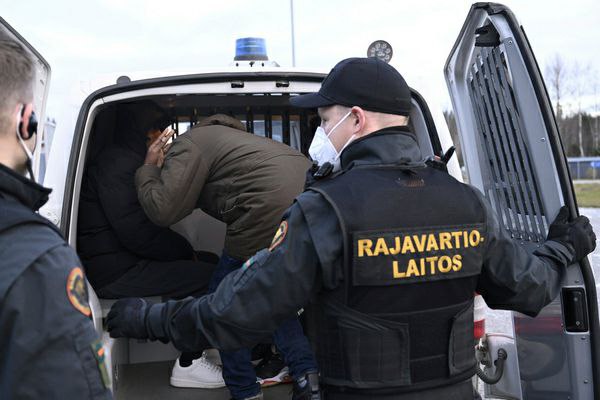
Since November 18, Finland closes four border posts on the border with Russia. Estonia authorities also allow the possibility of closing their checkpoints - if this happens, then there will be no open border posts in the Leningrad region.
Now, through these checkpoints, refugees from Russia from the occupied territories of Ukraine are going to Europe - mainly the elderly relatives of those who were evacuated earlier.
“Paper” found out from the coordinator of the Center for Assistance to refugees in St. Petersburg Ekaterina Evchenko whether Ukrainians remained ways to leave Russia and who would suffer the most from the closure of the borders.
- Do I understand correctly that now, after the closing of the border posts with Russia, the departure of Ukrainian refugees from St. Petersburg is very complicated?
- I want to note that we are not only about those refugees who are now in St. Petersburg. They leave from afar, with the so -called liberated territories. They overcome a long way, and those who follow in one of the European countries through Finland or Estonia come to St. Petersburg. Accordingly, now you can drive only through Estonia, through Ivangorod.
There is still a border with Latvia in the Pskov region and the Republic of Belarus. You can go through them. But, in any case, it all becomes more complicated and more expensive.
- What is the difficulty of traveling through Estonia?
- In Ivangorod, only a border crossing is possible - there is a bridge one and a half kilometer. Not everyone can go through it, because there are little people who are in wheelchairs, there are those who just walk badly and they have no support. In addition, refugees go with bags, with suitcases, sometimes with young children.
Logistics will also be complicated. Further refugees will have to follow in Tallinn, sit on steam, arrive in Helsinki on a ferry, where there is a temporary shelter and where they are distributed at the points of temporary accommodation.
“But still there are ways to leave the refugees so far?”
- Not everyone. The most difficult question now: how to transport people on reanimobiles. Those who are very sick or can only move in a lying state. Previously, this issue was resolved very simply: the brigade [ambulance], which has a Schengen visa, passed the Finnish checkpoint, gave the Finnish authorities a person and they called an ambulance. How to do this now is not clear at all, because not to get into Finland directly, and in Estonia a walk.
Even if the automobile travel to Estonia is not closed, it is still not clear so far, how to do it. For example, an ambulance brought a person in a lying state, which all the time should be under the supervision of medical personnel, to the Estonian border. How will he get into Helsinki now? It turns out that we still need a reanimobile on the Estonian border, which will take it on a ferry and somehow it will be necessary to build logistics. I have no ideas yet on this score.
- Are there any refugees who need such transportation right now?
- Specifically, there are no such applications in our center of assistance to refugees. But our center is not the only one, in St. Petersburg there are other volunteers and what applications and what methods of solving the problem do they have, I do not know.
But you need to understand that this is a window of opportunities that is constantly compressed. Now it has become even smaller. As soon as an application for the removal of a seriously ill person appears, this will become a problem.
What do volunteers say from another help group ↓
Petersburg volunteer
Wanted to stay anonymous
- Now the stream of moving towards Europe has decreased significantly, but at the same time the export has become more “heavy”. Often, people with mobility, people with health problems, disabled people, very old people go. This was a problem before the closure of the border guards, but now it will worsen.
There is a border post “Kolotilovka” through which refugees can immediately get to Ukraine, bypassing Europe. Perhaps this stream will go there. But not everyone wants to immediately in Ukraine, some want children who are in the European Union.
- Why is it difficult to get to Finland through a checkpoint in Karelia and the Murmansk region?
- This is very far away. If I do not confuse, you need to go by train to these gearbox. This complicates everything. Suppose even an auto -volunteer will agree to go to Karelia or the Murmansk region, but these are large expenses for gasoline, this is perhaps an overnight stay. And if you send a reanimobile there, then the cost of one trip becomes “gold”.
- Do you have ideas how to get out of the situation?
- We will try to talk with the Finnish authorities. Perhaps they will agree to skip reanimobiles, perhaps make an exception for Ukrainians. But I would not hope for it too much, because if the checkpoint closes, then it closes for everyone.
Yesterday I heard that the points in Karelia in the Murmansk region can also be covered. Therefore, we can now develop long routes, discuss with our auto -volunteers whether they are ready to spend on the trip for no half a day, but for a day, and the next day all this will also become pointless. The same with Estonia.
What else to read:
- Why Finland closes the border with the Leningrad region and whether it is still possible to enter the country
- How Russians have been helping refugees from Ukraine for a year and a half and what pressure faces
Photo of the cover: Finland. Lappeenranta. Migrants from Russia sit in a van, following the Youtseno center at the Nuyamaa border station. Vesa Moilanen / AP / TASS