
Translated material
Closed in 2022, Hydra was the world's largest marketplace for the sale of drugs. For six years, its turnover amounted to five billion dollars
"Medusa" talks about the first scientific study of this site

The main problem of business is trust. Are you sure when buying bread in the supermarket that the seller did not put rat poison there? Or that he, taking the money, will not drive you out of the store? The mechanism for ensuring such trust and the guarantor of compliance with the rules are usually the state and public institutions. You know who to contact if someone violates the existing order. But what if the state does not regulate the market in any way? The appearance of the Internet, satellite navigation, TOR technologies and cryptocurrencies led to the creation of darkmarkets-underground Internet platforms in drug trafficking. For researchers, each of these sites is a unique social experiment.
Over the seven years of the existence of the world's largest marketplace for the sale of Hydra drugs, scientists were able to trace how the environment is literally formed where trust is possible, the rules and institutions arise. In other words, the second state arises - with its "laws" and sanctions for their violation. Researcher at the Boston College Criminologist Alexei Knorre, as well as graduate students of the University of Pennsylvania Artem Kuriksha and Poyanka Hunnetlek, conducted the first detailed quantitative study of Hydra, published in the English -language reviewed journal Criminology & Public Policy. Medusa talks about the results of a study published in October 2023 - and that allowed Hydra to become a monopolist with an annual profit is 10 times higher than that of the most profitable Western sites.
What is Hydra?
This is an online market for the sale of drugs in a darknet , which arose in 2015 after the merger of the other two sites-Way Away and Legal RC (they also sold synthetic cannabinoids and designer drugs , which were not available at the largest Russian Anonymous MarketPlace, abbreviated RAMP at that moment). In 2017, after the closure of the RAMP, the number of hydra users began to grow sharply, it, in fact, became a monopolist in the field of drug sale in Russia.
"Hydra" participated in the destruction of its main competitor
Read more
In 2019, the journalists of the Lenta.ru publication managed to establish that at the end of 2016, RAMP tried to lure the suppliers of precursors (that is, the substances by which they produce drugs) from the Far East near the sites-the founders of the "Hydra" Legal RC and WayAway. In response, Hydra organized large-scale DDOS attacks on RAMP, paralyzing the work of its main sources of income-instant stores with ready-made drugs of drugs. In parallel, Hydra began to lure with RAMP wholesalers of narcotic substances and retail sellers, promising them the best conditions for trade.
However, the final blow to the RAMP was the collapse of the HTS Crypto-Railway, where about 60 million dollars of RAMP dealers and the safety budget of the site administration were stored, Lenta claims in its investigation.
In April 2022, as a result of the joint operation of the German and American police, Hydra was closed . There is no data on the participation of Russian security forces in this operation.
What is the uniqueness of this site?
“Hydra” still holds a record for drug trafficking: according to the US authorities, from January 2016 to March 2022, its turnover amounted to five billion dollars. According to various estimates, the annual income of the site was from 1.3 billion to 1.7 billion dollars, which is 10 times higher than the most profitable western sites (the gap will be slightly smaller, if you take into account inflation). For example, Dream earned about 170-190 million dollars per year, and Silk Road - from 90 to 105 million.
The key point that allowed the Hydra to become a unique marketplace: the site was the most long -lived among the existing in the world. She worked as long as seven years, while the average life of the majority of the most famous Western marketplaces did not exceed 220 days. Such a situation does not allow Western marketplaces to occupy a monopoly market share, the co -author of the study Alexei Knorre: Medusa explains to Medusa:
This is associated both with strong competition (including aggressive-power) between marketplaces, and with the fact that governments and law enforcement agencies are actively closing such sites there. At the same time, new new ones quickly arise at the site of a closed marketplace. The general level of trust - let's say, willing to pay - is unlikely to grow. In this sense, “Hydra” in its last years is an example of what will happen if the narcomarkets are not destroyed.
Thanks to working with onion routing and using Tor, “Hydra” ensured anonymity of both sellers and buyers. The use of cryptocurrencies and QIWI systems as a payment method, as well as bookmarks as a delivery means, made it possible to exclude personal contact of sellers and customers. Bookmarks - that is, caches, the location of which, together with the photo, was received by the buyer after payment - the main difference between the "hydra" from the western markets in the darknet, which mainly use postal delivery. In addition, the site acts as a guarantor of the transaction: the money transferred by the buyer is frozen on the escrow account , and the seller does not receive them until the buyer receives the goods.
“Bookmarks are a rather unique post -Soviet invention, since mail is used in Western countries for delivery: it is more reliable and at the same time brings legal risks lower than in the Russian Federation,” says Medusa Alexei Knorre.
Buyers could purchase drugs already ready to pick them up - it was only necessary to pay and get a photo and coordinates of the place where the “treasure” was hidden from the seller. However, there was another option: place an order for some unusual substance or for a relatively large amount of drug-in this case it was necessary to wait until the bookmark was made.
"Hydra" had a developed system of rules that regulate all aspects of trade. In particular, these rules forbade selling weapons, poisons, explosives, state secrets and pornography on the site, making orders for murders. There were also some particularly dangerous drugs - Fentanil and its derivatives. If something went wrong-for example, there were no bookmarks in the right place-the buyer could “open a dispute” on the platform and send a complaint to the moderator “hydra”, after the consideration of which he could return the money.
The Hydra rules strictly forbade sellers and customers to try to make personal contact outside the platform chats. In the case of such attempts, sellers had to pay large fines (up to two bitcoins) , and customers were supposed to be a bonus if they informed the platform about the seller’s attempts to contact the messengers. In addition, Knorra assumes that the marketplace administration could read correspondence between buyers and sellers - and thus monitor unwanted contacts.
Within the framework of the site, there was a mechanism for advertising and marketing for sellers and a feedback system, which included sellers and customer reviews. In addition, Hydra has developed the rules for resolving conflicts between sellers and buyers, created its own recruiting and training couriers training service, as well as a system of selective product quality verification .
“Hydra” also offered something similar to professional education-an online school for “nuclear” (people who place bookmarks), consultations for drug producers, as well as assistance in resolving disputes between employers and employees. Finally, the absolute innovation among such platforms was free online consultations of health workers for drug users. "Hydra" hired professional doctors for such consultations-they had to answer questions in chat bots in Telegram.
Alexey Knorre told Medusa that, in his opinion, the main prerequisite that made it possible to create such a project as Hydra, was an explosive Internet distribution in Russia. According to him, individual technological elements, such as a decentralized TOR network and cryptocurrencies, are also important, but they are only part of the process. In addition, Knorra explains, Hydra was so advanced in terms of mechanisms and infrastructure, including due to borrowing various practices from other marketplaces (for example, reviews and escrow accounts ). But there were other reasons, the researcher continues:
The economy of scale worked. Imagine that you have a small company for 10 employees. If the business goes well, it will grow, and you can afford more expensive and qualified specialists, the best equipment, the office is larger - simply because this will make more profits by increasing the number and quality of customers.
What did the owners of the marketplace earned?
"Hydra" earned this way: each seller bought a trading place on the marketplace (it cost $ 300), and then paid $ 100 for renting this place monthly. From each transaction, the site received interest (from five to 10, depending on the amount of the transaction, such as the goods and the status of the seller). That is why Hydra forbade contacting market participants outside the site: if the buyer and seller agreed on transactions outside the marketplace, this led to lost profits for the platform, explains Knorra.
In addition, merchants could buy a place on the main page (it could cost up to tens of thousands of dollars a month) and pay for special statuses (“Trusted Seller”, “Certified Manufacturer”). In case of violation of the rules of the marketplace, the seller paid fines - from 25 thousand to several hundred thousand rubles.
What data have scientists collected?
A group of researchers analyzed the data on the Hydra, collected in the period from April 1 to May 2, 2020 by an independent “data collector” who wished to remain anonymous - the same data was used for their investigations by journalists from the Knife and Project . They are daily “cast” of the “hydra” pages, they contain more than 31 million positions - that is, specific trading offers where there is the name of the substance, its number, price, as well as information about where and how the goods could be obtained after the purchase.
Scientists also analyzed the information from the American project to collect data from drug maiden lines - this made it possible to get a collection of customer reviews on the Hydra website. In total, after cleaning from duplicate reviews, there were about 326 thousand for the period from January 2019 to February 2020. The authors of the study emphasize that these are far from all reviews for the selected period, so they cannot be used to assess the volume of trade. Another source of data about the marketplace is files with a description of the Hydra Rules.
In addition, the authors conducted a series of interviews with journalists-investigators who studied Hydra, as well as with activists of non-governmental organizations related to drug addicts.
Who is Alexey Knorre and what does he say about his profession?
To know
Here's what the scientist told Medusa:
I work as a researcher (post -house) in Boston College : I work with data, write articles, discuss work with colleagues. This is an interesting profession: for example, right now I have projects about spatio-temporal modeling of crime, modeling traces of screwdrivers, scenarios of murders in Russia and crimes on the basis of hatred in the United States. For each of the projects, I have separate colleagues-submarines, so there are no permanent group-I work on my own.
Some results of criminological studies can be useful to law enforcement agencies, and sometimes they are used. For example, in criminology, Pattern is well known that half of all crimes are committed in about 5% of places in the city, known as “Hotspot” . And although the police on Earth probably already know where these places, studies allow us to say how exactly the police resources can be optimally directed there. Many police departments and city administrations have positions and departments on criminal analytics.
In general, criminology is a science that studies criminal behavior and everything related to it. Somewhere in the middle of the 20th century, it stood out from sociology, in the USA and other countries there are criminological magazines, conferences, magistrates and graduate schools, as well as a large related area of applied research that Think Tanks engaged in. Criminology has very clear applied issues. For example, how to make people trust the police more? Does it make sense to increase the term of imprisonment for some crimes? What to do to make crimes - murders, attacks, robberies, domestic violence - was there less? What approaches, interventions and programs work for this? Under what social and personal conditions do people commit more or less crimes?
What did the researchers find out?
Scientists have analyzed the screenshots received and identified from them only non-duplicate offers of an instant purchase-that is, offers to buy a drug that is already packed and hidden somewhere in the city.
Volumes
Over April 2020, more than 417 thousand were on the Hydra, which makes Marketplais a record for a large online market for drugs-at least among those that have data about trade volumes. According to 2019 data, Western marketplaces, such as Silk Road, Silk Road 2.0, Evolution and Agora, even at the peak of their popularity placed no more than 25 thousand trading offers per month.
Breaking by type
Most of the sales fell on different types of stimulants - 72.8%. Of these, 31% of the proposals occurred in Mephedron, 13% on amphetamine, 12% on alpha-rowp , 4.9% for cocaine. 18% accounted for different types of cannabis, marijuana and hash. Psychedelics amounted to 3.9% of sales, opiates - 2.3%.
The authors note that heroin accounts for only 0.8% of the sentences. A larger number of sentences - 0.9% - even represented prescription drugs, which could also be bought on a "hydra". However, the informants with whom the scientists said, suggest that the main volumes of heroin come true through channels in Telegram and with the help of traditional street sale.
Most of the sentences are packages of 0.5, 1, 2, 3 or 5 grams. Prescription drugs could be sold in more volumes.
Geography
Scientists have found out exactly where potential buyers could take the treasure - in other words, analyzed the geographical distribution of trade offers. In total, 1130 Russian cities and villages were on the list. In the settlements, where in April 2020 there was at least one “treasure” sold on the “Hydra”, more than 100 million people lived - that is, 69% of Russia’s residents could buy drugs on the site and get them in their city.
Moscow and St. Petersburg, as expected, were leader in terms of proposals. For every hundred inhabitants of these cities, there were three and nine bookings, respectively, but the record density was in Sochi - 16 bookmarks per hundred inhabitants. The authors of the study explain this demand by resort status of the city. Even higher values were demonstrated by the cities of Aprelevka and Solnechnogorsk. However, scientists explain such numbers “made” by Moscow demand - it is easy to get from the capital by car to these cities, but they have fewer police.
Relatively high values were recorded in the neighboring Kaluga, Tula and Yaroslavl regions. In general, the researchers write, the density of the “hydra” proposals corresponds to the distribution of the population and the level of urbanization - that is, it concentrates in the European part of Russia and in the south of Siberia.
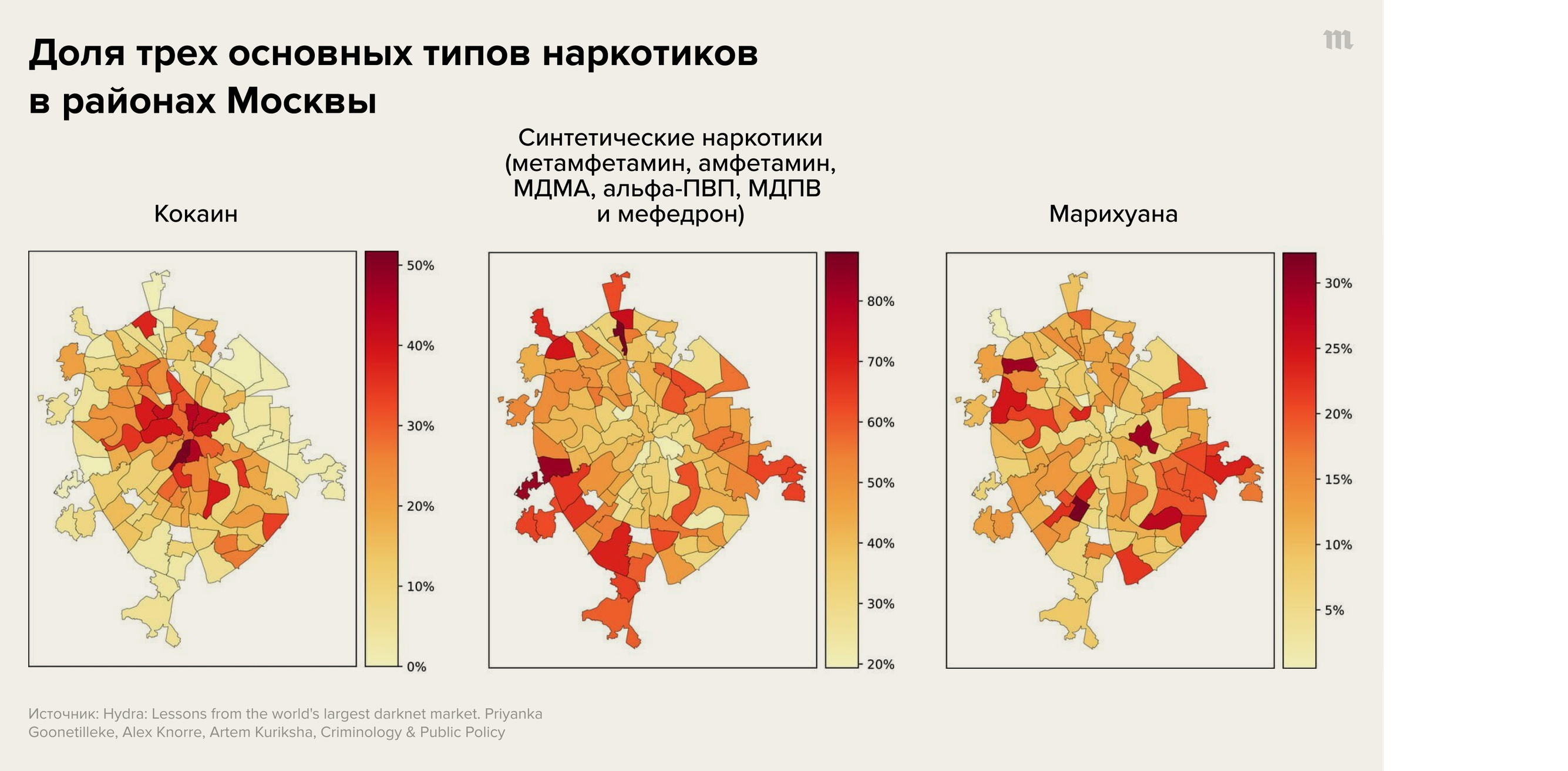
The amount of data in Moscow made it possible to build the distribution of the “hydra” proposals in the metropolitan areas. It turned out, in particular, that the proposal of cocaine is concentrated in the business center of the city, and cheap synthetic drugs-methamphetamine, alfa-PVP and Mephedron on the outskirts.
What can be considered the main result of the study? And what surprised scientists?
Answers Alexey Knorre:
For me, this is a descriptive study, the main task of which is to show and describe an important but inconspicuous part of social reality. Probably, for me, therefore, the main result is meaningfully that it turned out that it turned out to describe this huge, difficultly arranged and technologically advanced platform that exists in an illegal environment, in terms of mechanisms and descriptive statistics. Of the specific facts, it seems to me the most important assessment of the coating: 69% of the Russian population had access to the Hydra bookmarks in their village.
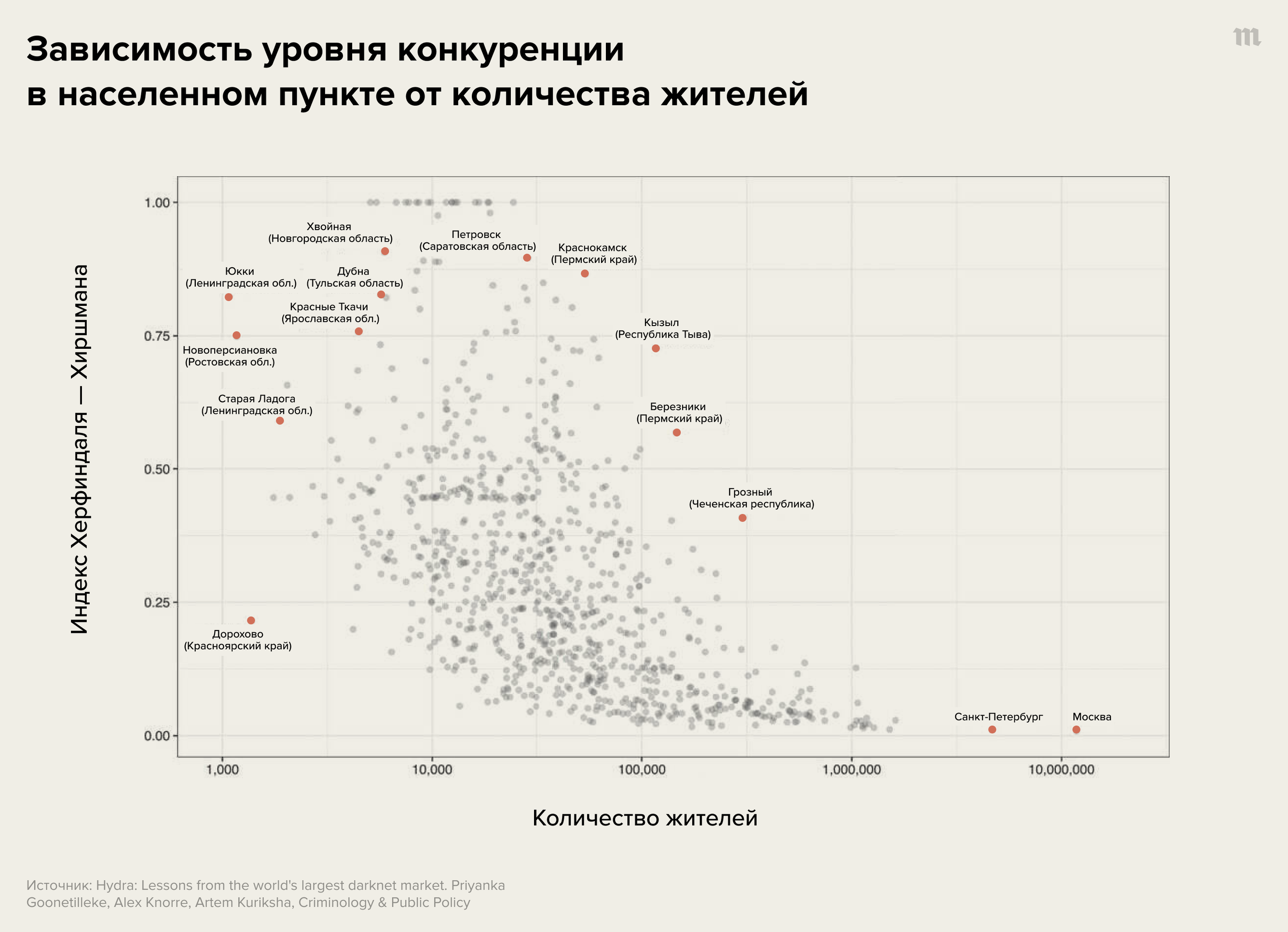
It seemed amazing how much this market is competitive, I expected that the stores would be smaller. To assess the level of competition, we used such an indicator as Hhi-this is Herfindahl-Hirschman Index, Herfindal-Hirschmann-the number from 0 to 1 showing how concentrated or fragmented some kind of market is. If the index is close to 1, then the market is monopolized by one company. If the index is close to 0 - the market is competitive, with a large number of companies, each of which is not a very large share. Мы рассчитывали этот индекс для «Гидры» в целом, для отдельных типов наркотиков и для отдельных городов. Для «Гидры» в целом индекс близок к нулю — 0,004. Рынок кокаина более сконцентрирован, чем другие, но все равно конкурентен (0,027). В статье есть график, показывающий интересное: чем меньше город, тем менее конкурентен там рынок.
Новые вопросы, которые перед нами встали: что стало с онлайн-рынком наркотиков после «Гидры»? Произойдет ли новая монополизация рынка? Есть и старый вопрос, который требует полноценного опросного исследования: какая доля людей рекреационно употребляет наркотики, какие наркотики, сколько из них приобретаются с помощью онлайн-маркетплейсов и онлайн-магазинов.
Я могу сказать, что это первое детальное количественное исследование «Гидры», опубликованное в англоязычном рецензируемом журнале. При этом, конечно, есть большое количество опубликованных исследований, которые исследуют другие онлайн-наркомаркетплейсы мира.
Можно ли сказать, что с точки зрения снижения вреда «Гидра» — лучший вариант, чем уличный рынок или множество мелких маркетплейсов?
«В целом кажется, что это так, хотя у нас нет жестких данных, чтобы это доказать или обосновать», — отвечает на этот вопрос Алексей Кнорре. По словам исследователя, подобными данными могло бы стать сравнение двух стран или регионов, если бы в одном из них аналог «Гидры» был, а в другом — нет. В таком случае можно было бы сопоставить смертность от наркотиков. Если бы она была ниже в одном из регионов — это было бы убедительное эмпирическое свидетельство предпочтительности одного из вариантов.
На вопрос о рекомендациях, которые ученые дают правоохранительным органам по итогам исследования, Кнорре отвечает так:
На мой взгляд, суть рекомендаций примерно такая: у решения активно закрывать нелегальные онлайн-маркетплейсы есть как плюсы, так и минусы. Мы в заключительной части статьи их рассматриваем детально. Какой именно баланс по совокупности между плюсами и минусами — сказать сложно, нужны дополнительные исследования. Однако со всеми минусами существования такого наркорынка, как «Гидра», в подобном формате определенно есть и свои плюсы.
"Jellyfish"