
Translated material
Pontus and the truth
What is the secret of the Russian soul and the Russian "sea"
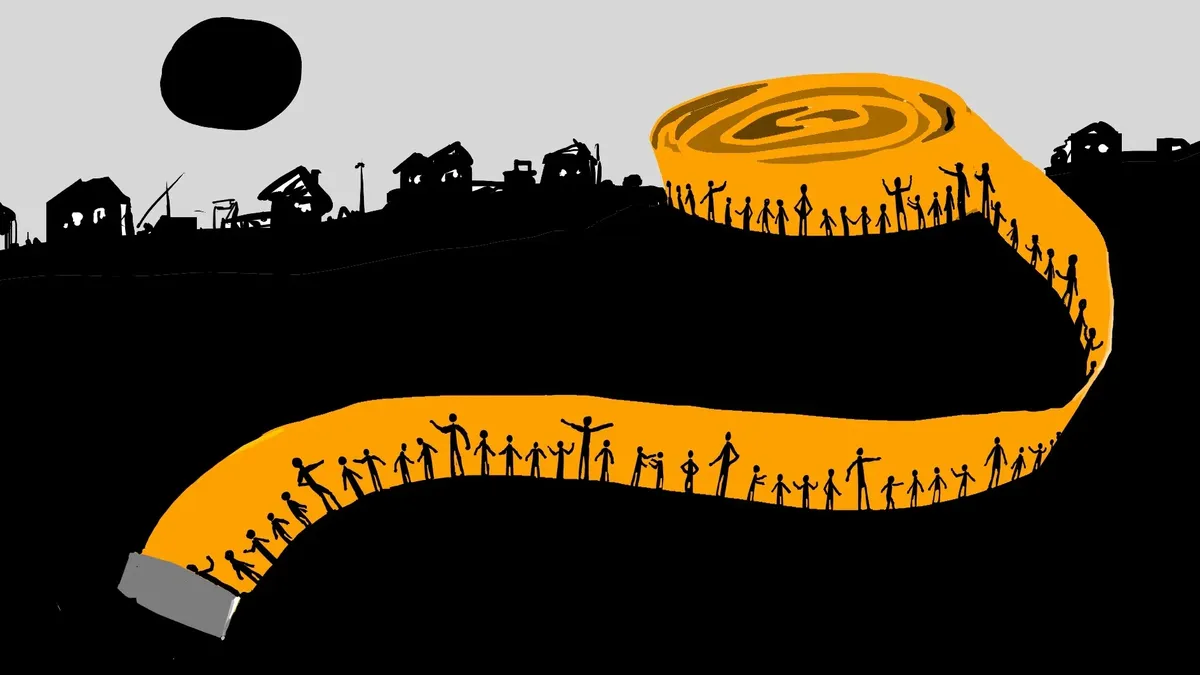
Peter Sarukhanov / "New Gazeta"
Nothing defines a Russian person as much as love for two things: for Pontus and the truth. They are an almost inextricable ligament. Perhaps this ligament is that very main secret of the feverish Russian soul, in an attempt to unravel that all countries and peoples of the Earth suffer for so long.
... what is the Pont of the Russian person? This is a social action (including a statement), the purpose of which is a public demonstration of obvious and unconditional superiority.
What is true for a Russian person? This is a thought (or a stable emotion), which should convince its carrier that social justice and spiritual perfection in this world are absent. In other words, the truth is for a Russian person there is an appeal to what is not.
The mentioned inextricable connection between show -off and truth is built on the principle of absolute compensatoryness. The stronger the Russian person feels the truth, i.e. The lack of justice and perfection, the more it needs Ponte. For without turning to the latter, as a kind of existential therapy, though for him it acts as an unbearably painful fact of recognizing himself that very “trembling creature”.
Remembering the literary classics of the century before last: the actions of the famous protagonist, chopping the old woman and her niece, cutting the head of the head and her niece, there is one of the most indicative and unknown examples of what Russian Pontus is cultivated in Russian Truth.
... In the event that the feeling of truth accumulates to a certain critical, i.e. an unbearable state - and this can happen quite unconsciously, without any reflection (which, in fact, is supported by both the official and folk Russian tradition) - then the compensatory need for Pon also reaches a critical mark. Pont begins to persistently demand an increase in its scale exponentially, and the will to public superiority wants to achieve the final, last, undeniable limit. In the sense that there is no one left who could refute this.
The way of an existential achievement of superiority is mentioned above: one way or another it rotates around the story with the Division. It is modified from century to century, the ax is replaced, for example, with a shotgun. Recall at least a cinematic “brother” close to the Russian heart, in which - although more than a hundred years have passed - but the dreams of poor St. Petersburg student Rodion Romanovich were still fulfilled. The essence of this story remains the same: to destroy in order to rise. Modifications only emphasize substantial immutability.
... However, so far all the stories of the Russian Pontus, even brought to a critical point, ended relatively good for the world around him. After a rapid increase and pathos baptism, collapse, collapsing energy and space, came up - and everything returned to the basic Russian truth, to the basic thought that there was no truth in this world. Broken dreams.
It is impossible again not to be surprised at the prophetic mission of great Russian literature, where all this has long been seen.
Who is unknown about the story of the poor fisherman and his unfortunate old wife, deeply injured by the injustice of the world? And what ended with their attempt to radically change the state of things. A broken trough.
... Yes, the Russian truth is determined primarily negatively, through its shortage. But if you still talk about some kind of ontologically positive formula for her, then it may sound something like this: expansion, increment of matter. And since from ancient times, matter for humans is primarily the Earth, then we are talking about the growth of the Earth.
And the truth, and strength - in the ground. Famous protagonists of Russian myths only draw their supernatural power from the Earth. Or as Mikhailo Lomonosov said there: "Russian power will grow Siberia!" But, of course, they did not limit Siberia.
The whole historical dynamics of the Russian world is built on this truth: the truth of land increasing. Not speculative ideas, not messianism, and not even ambitious ambitions moved the Russian world into all directions of its immense space, but this one is a realized truth in Russian. There was not even a question, what to do with the Earth, how to arrange a life on it, how to transform. The main thing is to master and hold. Actually, the device and transformation have always been very poorly given to a Russian person. Perhaps all his forces ended at the level of simple retention: what is, that is, the main thing is that it was. Or the very thought of the structure and transformation of space did not seem too important to him: the main thing is that it is already. As Nikolai Berdyaev writes: the gift of the form of Russian people is small.
“Earth collectors” - as the princes of the Great Muscovy, and then the first Russian kings were traditionally called. This word itself - “collectors” - points to the oldest, perhaps the most ancient way of human being. At the time of renovations, who have not yet known a developed hunt, even more so agriculture, but wandering around the earth with their clans-steers and selecting everything that can extend their life from its surface. The "era of collectors" is called those times. Here are the Russian princes and kings - not conquerors, not conquerors, but collectors. Find and select lands like berries or mushrooms in the forest.
Collection, but differently to say-"acquisition." It is very symbolic that exactly in those days when the growth of lands began to go to the global level - in the 15th century under Sovereign John III - one of those famous disputes, of which in the Russian world had happened, took place. But they then determined everything for a long time. And they argued precisely “composers” with “non -possessors”. From the first was Joseph Volotsky, from the latter - Nile Sorsky. The former said that it was not shameful for spiritual people to possess the land with slaves and that for slaves it is as a result and the good, because the essence is the progress to the righteous fragmentation of their cold souls. And the second - that the kingdom of the Lord is not from this world. In general, two truths came together. The top was taken by the “money -grubbers”, and with them the truth was established and got stronger in the Russian world that it costs for increasing and expanding these visible lands and everything that is on them. The same truth about the "other", eyes of invisible lands - did not take root. As in that dispute they decided, then they went to do such a story. And to complicate, philosophize and “inflated” began to read for the empty. Later, only unmarried young ladies, poets, and myizantrop students visited invisible lands with their thoughts.
…All in all,
There is little for a Russian person to compare with how if he comes to an inappropriate expanse, he looks around the surroundings and says slowly: “Here is our earth!”
If they object to this and say: “You say“ ours ”, but only one Russian sovereign is disposed of with the whole earth. He and his servants! " However, the Russian person will not be embarrassed from such a question, he will only grin slyly and will answer: “So the sovereign is ours!” And happy will go.
It turns out that not only in the ground, but also in the sovereign is Russian truth. Is this enough for a Russian person for a full -fledged picture of the world? Apparently, yes - if at the same time working without lingering hands, but then drink the same way. And so that leisure on the thought of the “other” does not appear at all. And in order to support himself in this picture, from time to time a Russian man from his Russian Russian is created by a huge, immense pont. As immense as the earth, which he has grown for as many centuries and intends to grow further. Apparently, he did not recognize for his stay in the world of other excuses.
... So it turns out that a Russian person lives with two times. With the one that is in the earth in the sovereign, and with the one that there is no good on Earth, and our sovereign is an insatiable wolf. And some also recall: what is the use of a person, if he will gain the whole world, and damage his soul? However, the Russian man seemed to live like that: he blocked one truth, but in order not to notice this himself, he tries to think less, but to work more. And more care of health. But for a long time, is it still enough?