
Translated material
Who gives gas
What should be expected from the main conference of the UN in climate, to which the world approaches global failures, and Russia with a "pale" position

Peter Sarukhanov
Today, in Dubai in the United Arab Emirates, an international climate conference under the auspices of the UN COP 28 starts. It will last until December 12 - then the first results of the efforts of countries to reduce the emissions of greenhouse gases will be summed up. However, on the eve of almost the only international negotiations at a high level where Russia is involved, silence is in the domestic information field. The “new newspaper Europe” found out from the experts what they expect from negotiations and what will be the position of Russia in Dubai.
The contradictory goals of Russia
In 2015, in Paris, an international climate agreement was signed under the stormy applause of delegates. It replaced the Kyoto protocol, the active phase of which ended in 2012. The adoption of obligations after 2012 was waited back in 2009 at negotiations in Copenhagen, but then the countries failed to agree, so so many hopes were held for six years later in Paris.
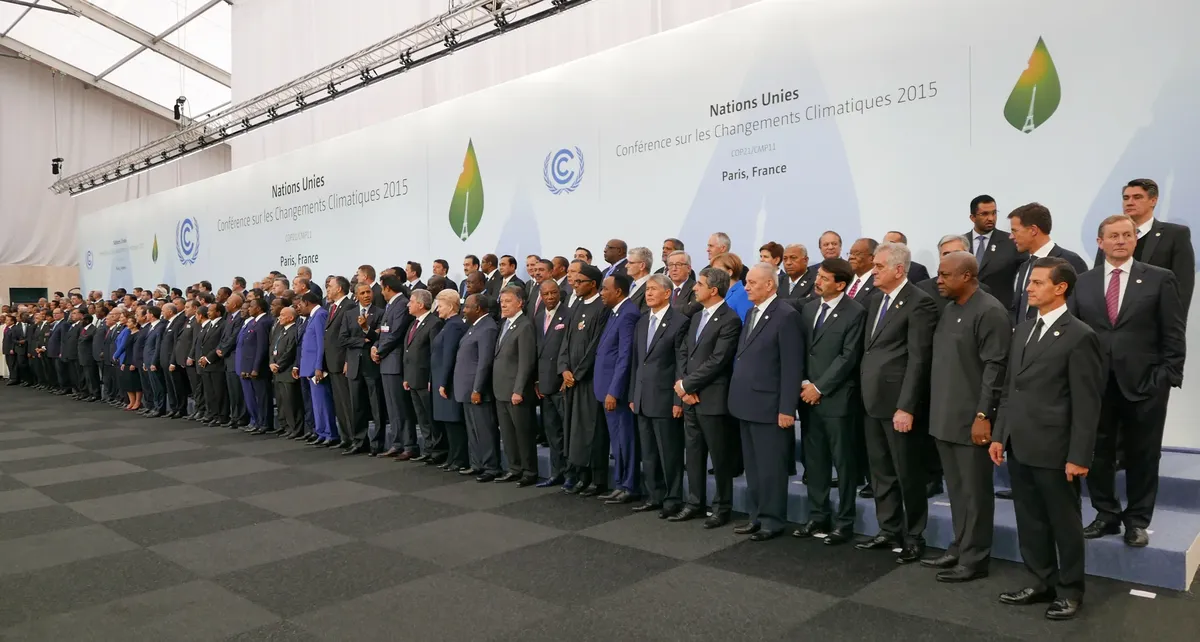
When it became clear that the participants in the delegations managed to develop the text of the document, Russian President Vladimir Putin flew to Paris, but was late and was not among the main-states in traditional photography on the occasion of the conference. Nevertheless, Putin acted and made statements that he still repeats, and after him - Russian officials.
Eight years ago in Paris, the president said that by modernization by 2012, Russia reduced greenhouse gas emissions regarding the level of 1990. “Thanks to this [Russia's actions], about 40 billion tons of carbon dioxide equivalent did not fall into the atmosphere,” Putin said, but kept silent that this was mainly due to the collapse of the USSR economy and production falling.
Further, the President outlined the goal of Russia to reduce greenhouse gas emissions. “By 2030, we expect to reduce greenhouse gas emissions to 70 percent of the 1990 basic level,” Putin said . Commenting on this statement, experts repeatedly said that the goal of Russia was fulfilled before its announcement. The level of greenhouse gas emissions of Russia in 2017 amounted to 2.35 billion tons of CO2, that is, 52% of the 1990 level.
Now experts are noteworthy that the obviously underestimated goal of Russia, where the year of the landslide fall of economic indicators has been taken over the base, allows the country not to reduce emissions, but to increase if counted from the current level. “That is, in the spirit of the Paris Agreement it would be to reduce emissions from the current moment in order to save the climate, and Russia states that it has already historically reduced it much, so it can also increase percent by 40 emissions by 2030,” the expert explains ( all experts spoke from Novo-Europe on the terms of anonymity.- approx. Ed. ).
On October 26 of this year, President Putin approved the updated climatic doctrine of the Russian Federation, which changed a similar document of 2009. There was a goal in reducing emissions voiced in Paris. But then it turned out to be a formalized intention to become a climatically neutral country by 2060. Putin said this two years ago on the eve of the Cop 26 conference in Glasgow, but since then the goal has remained not documented. Climatic neutrality means that the volume of emissions of greenhouse gases in Russia will be equal to the volume of their absorption.
“These two goals look somewhat inconsistent. On the one hand, Russia wants to become climatically neutral, on the other, based on the goals to reduce emissions, it is going to increase them, ”,
- the expert is surprised.
Also, by 2060, Kazakhstan, Saudi Arabia, China and other countries are going to reach climatic neutrality; India wants to achieve a balance between emissions and absorption by 2070, the USA and the EU have more ambitious goals-by 2050, and Finland in 2035.
In anticipation of the global failure
But at a conference in Dubai, they will not summarize in relation to climatic neutrality, but regarding the obligations taken to reduce the countries of greenhouse gases in the current decade. And they will watch how countries have strengthened their obligations to reduce emissions.
Representatives of countries who gather in Dubai most likely state fiasco in such a decisive decrease in emissions. Despite the voluntary obligations taken under the Paris Agreement, the successes in preventing climate change are very modest.
The largest issuers of greenhouse gases in the atmosphere: China, USA, India, EU, Japan, Russia, Indonesia and Brazil. Closes a group of leaders in emissions of international transport. It traditionally stands out from national reporting. These issuers account for more than 55% of emissions.
According to the intergovernmental group of experts on climate change (MGEIK), to fulfill the goals of the Paris Agreement by 2030, greenhouse gas emissions should be reduced by 43%. In this case, an increase in the temperature of the planet can be kept within 1.5 degrees. However, such a reduction is incredible. Even if countries fulfill the obligations, emissions will be reduced by a maximum of 10-15%, but for now their number is growing.
During the action of the Climate Convention of the UN (and this is thirty years), the only thing that countries managed to achieve was to reduce the growth rate of emissions. In the current century, a decrease in global emissions by 4.7% was observed only in 2020 in relation to 2019 (due to pandemia), in 2021 the emission returned to the dopandemic level, in 2022-increased. In 2023, the concentration of carbon dioxide in the atmosphere due to human actions reached 412 PPM and became a record high over the past 23 million years.
But Russia never sprinkles with ashes and does not blame in its significant contribution to global warming and associated damage. Representatives of the country indicate that the country has fulfilled its goal to reduce, and it is underestimated or not - it does not matter. The rest of the countries cannot even boast of this.
“We [Russia] now have less emissions than we were in 1990, and other countries themselves did not do this. We took an ambitious obligation until 2060, and do not stick to us. This provides the opportunity to do nothing ",
- The expert explains the position of the Russian Federation.
In addition, Russia, when Putin signed an updated climatic doctrine, formally updated the obligations to reduce emissions on the eve of negotiations. “Updated - in the Russian sense. Once again I rewrote the old [obligations], but in the new doctrine. It was refreshed, one might say, paper, ”the source emphasizes.
Alliances of countries or companies?
Starting from the conference in Glasgow in 2021, the approach to the negotiation process has changed. Earlier, countries tried to develop a general solution, but this turned out to be a difficult and ineffective occupation. Negotiations were inhibited due to political contradictions and endless trade in negotiation positions between countries. In the end, it was decided to move to preserve the climate by creating various alliances, and not wait for the final coordination of general decisions.
For example, in 2021, on the initiative of the EU and the USA, an alliance was created to reduce the emissions of another greenhouse gas, methane - Global Methane Pledge . 152 countries, including the United States, Australia, Canada, France and Germany, joined the antimetan community. In Glasgow, even Russia considered the possibility of participating in this initiative, but now there is no talk of this. “But the President of Kazakhstan Tokaev, on the contrary, is going to negotiate. He can also support the alliance, and it will be a very beautiful move, ”says an expert familiar with the situation.
Another specialist notes that on COP 28 the United States and China can come out with the initiative of the alliance, whose goal is to contribute to a significant increase in the share of renewable energy (VEI) in the global electrogeneration, which, with a very high probability, will join many countries. The expert’s assumptions are based on an agreement concluded in November between China and the USA, in which countries agreed to strive for the triple of renewable revenue in the world by 2030. “The USA and China are going to increase the power of renequal on a global scale, and what does Russia offer? Do not touch us with our gas and coal. There is no element of the transformation of the world into the ideas of the Russian Federation, ”the expert believes.
Nevertheless, there is a climatic initiative to which Russia joined. This happened in 2021 in Glasgow. Russia signed under the declaration of forests and land use. In addition to the Russian Federation, among the signing are Brazil, Great Britain, Indonesia, China, USA, Türkiye, Sri Lanka, Japan, Africa, EU and Oceania. In the territories of these countries - 75% of the forests of the planet. “Russia even involves at the expense of forests to double the absorption of CO2 by 2030, but as it is still unclear. It is unclear how the country is going to fulfill its own goals, ”the expert notes.
Meanwhile, other experts believe that Russia is able, in the end, to offer the BRICS and SCO to the countries (and maybe some other countries of the first row) climatic initiatives and alliances.
For the Eurasian Economic Community, a single market of carbon units can be created, but so far it is a very distant prospect.
It is also possible that the observant position of Russia can play a role in negotiations. “The intention to enter the alliance, the risk of going out, the risk of blocking some kind of decision-this all plays a role in the negotiation process. Even remaining the most observer, Russia can affect the processes that are taking place, albeit to a small extent, ”the expert explains the possibilities of the Russian Federation in negotiations.
It is possible that it is not a country, but Russian companies will join alliances, an expert who is familiar with the situation believes. Presumably, the UAE will be offered to sign the charter in Dubai, which will contain points related to the energy transfer, that is, the rejection of fossil fuel and the transformation of oil and gas companies into energy with a reduction in emissions (mainly methane). “Such an initiative for“ oil ”UAE is quite predictable. It is better to offer oilmen who have money, a key role in the energy transition than to endlessly shame their climate change. A number of Russian industry companies expressed interest in joining the initiative, ”the expert says.
Indirectly, the expert’s assumption confirms the leak of the preparation documents COP 28, which refers to measures on oil and gas production.
Weak position
According to the economist, a specialist in the low -carbon development of Igor Bashmakov, which he expressed at the seminar “financial and social aspects of the global climate agenda on the eve of the UN conference - 2023” at the Institute of International Economics and International Relations (IMEMO), Russia has a “very weak and pale” position in the negotiations in Dubai. The country is not going to offer any serious initiatives and alliances.

Economist Igor Makarov, who performed at the same event , adds that Russia's weakness in negotiations may also be associated with the lack of a powerful pool of experts in the country. The number of Russian experts in reducing emissions and adaptation is different from developed countries, as well as from India, China and the UAE. He also notes that the strategy for international negotiations is formed on the basis of domestic policy, and in Russia there is no country's vision by 2035–2050 in the context of climatic changes.
“What will Russia be specialized in, what will be its competitive advantages, what will be replaced by oil, gas and coal? The latter, of course, will remain. They will buy Russian oil in 10 years, but this cannot be a driver.
New economic industries come, and Russia still has not formulated which of them it will develop. This is a question not to the delegation, but to the general goal -setting within the country, ”Makarov believes.
Bashmakov believes that with such a position in negotiations it is hardly worth expecting success in the promotion of a climate agenda in BRICS.
Leave us alone
Meanwhile, one of the experts believes that the lack of an active climatic position is the position of Russia.
“We promise once in the distant future to do something, but in the near future we do not plan to throw more than 70% of the 1990 level. With this position, according to most players within the Russian Federation. The extension of emissions does not entail any sanctions within the country, and external regulation is unclear when it will act. The Kremlin does not want to declare an ambitious position. You can revise the climatic doctrine, change the commas in it and still do nothing or do nothing formally, ”the expert says.
The specialist notes that in 2020, Russia discussed the introduction of relatively hard carbon regulation, which would stimulate the company to reduce emissions. In fact, in 2022, only a system of reporting on emissions and a modest version of the payment for emissions in a single region in the Sakhalin Region were introduced.
Russia also managed to develop project criteria that can be recognized as climatic. “But the country lagged behind in this year by 10 years, and the criteria do not meet the current realities. Projects of the transition to gas in Russia are recognized as climatic, but in the world - no; Designing projects for solar stations instead of diesel generators in Russia recognize, in the world - no. World practice involves innovation in the preservation of climate, and not economically feasible solutions based on long -known technologies. The same is with the preservation of forests: Russia does not offer any original projects, ”the expert notes.
The only thing that Russia is really promoting in climatic negotiations is the construction of new nuclear power plants as a way of preserving climate. However, the atom has quite weak prospects for implementation in the world. Now the share of nuclear power plants in global electricity production is less than 10%. You can increase this figure by several percent, but they build one station for more than ten years in tens of billions of dollars, and then the country receives complex technology with the problem of waste disposal and high environmental risks. For example, almost all foreign projects of Russia are nuclear stations that build on loans of the Russian Federation. Instead of nuclear power plants, it is more convenient to invest in sunny and wind generations, they are many times cheaper, easier, and you can build them in 1-2 years, the expert explains.
“To promote the nuclear agenda, but at the same time, to leave a place for the fuel fuel, Russia is bad. The Paris Agreement refers to sustainable decarbonization, and coal, oil and gas are technologies destroying climate.
In Russia, they prefer to “not notice” this indication in the agreement, ”the expert says.
Another analyst believes that Rosatom and individual powers that promote nuclear power plants in the world “inflate” the meaning of this source of energy in the issue of preserving climate. At the negotiations themselves, nuclear energy is not discussed, all the noise around it is focused on events taking place at the stands of the participating countries, and in an interview with nuclear workers.
Together with Rosatom, Russia will represent Cop 28 “Sber”, “Nornickel”, “Siber”, Russian Railways, RusHydro, Alrosa, Pole, Severstal and the Andrei Melnichenko fund, the coal tycoon of Russia. All these companies will be represented at the Russian stand on Cop 28.
According to the specialist, no one expects global, iconic decisions from the forum in Dubai. “Now there is a technical, methodological work. The emphasis has shifted from the political part to the development of mechanisms that allow you to attract money to climatic projects and make the projects themselves. Investors began to be of great importance in negotiations. The Russian delegation will play at the main climatic event of 2023 a very modest role, ”the expert summed up.