
Translated material
From the horror of empty shelves ...
Why can the government still go for price regulation
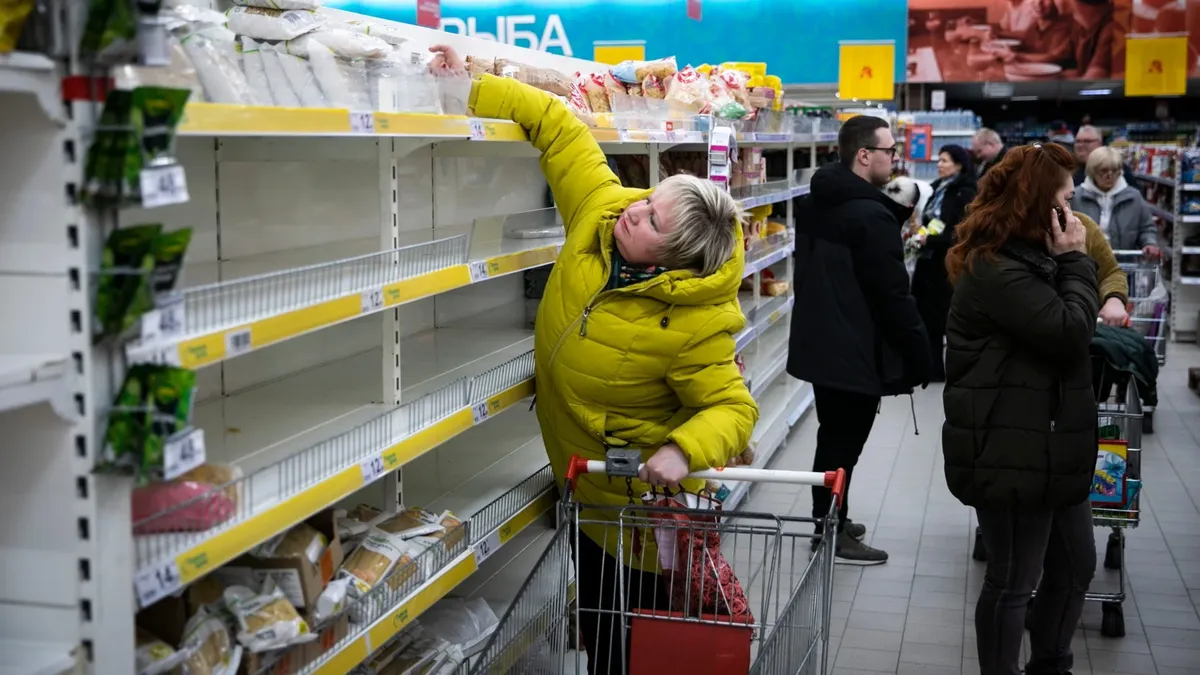
Photo: Vlad Dokshin / "New Gazeta"
The government is discussing a new stabilization tool: the FAS proposes to prohibit large companies to establish economically unreasonable prices for goods-this follows from the draft amendments to the Federal Law “On Protection of Competition”, developed on behalf of the first deputy prime minister Andrei Belousov.
We are talking about a fairly sharp increase in the cost of goods - up to 30% for no more than 60 days - provided that it cannot be explained in any way with economic factors.
What are these economic factors? These FAS calls a significant change in demand or offer of goods, fluctuations in adjustable tariffs, raw materials and components, seasonal factors and more.
The list of goods that the regulator will track will be established by the government.
Well, in fact, everything went to this.
For the past year and a half, the government has made titanic efforts without exaggeration aimed at maintaining a “consumer picture” - shelves full of goods at affordable prices.
It is no coincidence that one of the first “anti -crisis” government measures was the resolution of “parallel imports” - we’ll take what you want, just do not allow empty shelves (though there was a taboo on “imports from Europe” - a natural symbol of import substitution since 2014, but also to bypass these restrictions began to look through the fingers).
I must say that demagogy about “consumer goods made in Russia and occupying“ empty niches ”, which sounded quite loudly last spring in the spring of last year, the authorities also muffled quite quickly, and the Russians continued to see either familiar or new imported brands (for the most part, however, rise in price, but partly quite affordable in price).
Why so?
Because for the Russian consumer there are three key markers showing him that something bad is happening to the economy.
Firstly, it is a price increase that over the past 30 years is called the main factor that irritates people. Even when prices, by today's standards, almost did not grow, people continued to “see inflation” literally on every corner - or rather, on every price tag.
Secondly, it is an increase in the dollar.
And thirdly-yes, this is a shortage. It would seem, long-forgotten, but the authorities remember the finally empty shelves at the turn of the 1990s and categorically does not want to repeat this experience.
And here the economic policy chosen by the government literally brought it into three pines, between which it went in a circle.
Punishment by budgetary money of industry pulls up the demand for resources, their deficit turns into an increase in prices for these resources. The increase in prices for resources turns into an increase in prices for goods and - attention! - An increase in demand for currency, which is necessary both for the purchase of consumer imports and to ensure the release of “as if Russian goods”. The increase in demand for currency is an increase in prices for it, which the government also does not want to allow. At the same time, in conditions when the “shadow fleet” seems to “bring“ currency in exchange for oil ”to the economy, for some reason there are not enough dollars, importers do not want to accumulate rubles in their accounts, they change ruble revenues for foreign exchange in Russia. This means that the rate is still growing, and if the dollar rate is growing, then prices are rising, and for their deterrence it is necessary ... Yes, to increase imports or increase production again, but the growth of the “production of consumer goods” will remove resources from the “production paid by the government”, you yourself understand what.
In the summer, the Central Bank of the Russian Federation said that the production capacities of enterprises are loaded by 80.9%, and enterprises work in three shifts . This means that there are no reserves for building a proposal in the economy. Accordingly, any increase in demand from consumers will pour into prices. Inflation has already exceeded 7% and by the end of the year, most likely, it will even officially overcome the upper boundary of the Central Bank forecast (7.5%). Such a price dynamics forces the Central Bank of the Russian Federation to increase the rate (now 15%) and promise to keep it two -digit for a long time. At the same time, according to a survey conducted by the Central Bank of the Russian Federation, vacation prices in 2024 plan to increase 82% of enterprises . True, most of them lay down prices by no more than 10%, the financial regulator reports, but 10% there, 10% here - how do you keep track of the price on the counter?
The government has to choose:
or full shelves, but high prices and a rising currency course,
or "stable prices", but the lack of goods,
Or ... stable prices and even the availability of goods, but “restriction of consumption” - but this is not at all what people would like to offer.
Therefore, the government is ahead of the advance, creating for itself the opportunity to take up prices. It is characteristic, of course, that the artificial restriction of prices for goods has been talking right now - apparently, the government understands that structural imbalances in the economy that provoke deficiency accumulate too quickly, and the market mechanisms of their compensation (due to prices), of course, work, but destroy the picture of consumer stability at affordable prices, which is carefully drawn. government.
The farther, the more difficult it is to make the government to make a choice between “full shelves and high prices” and “stable prices and limited consumption”.
Well, as the consequences of regulation, they may look “in practice”, it is brightly described by Alexander Solzhenitsyn in the novel “October Sixteenth”.
“The dachshund appeared on the village bazaar in a quiet: glued a table on the fence around a latrine and that's it.
Who needs it, they already knew her by heart.
The Cossack-Khutoryanin is not aware of why the buyer was bargaining before exhaustion, and now he chooses without unnecessary conversations:
- Karasi, what? Is there a carp?
- Yes, your degree. If you please, the pounds will pull the heels. Or here ...
- All!
- Do you take both?
- Both!
The Cossack weighed on the Bezmen, the buyer, unable to cope about the price, put it in the basket, counted 74 kopecks and silently handed over to the Cossack.
- Mr.! What will it be? -the Cossack was amazed, holding in a brown wide palm stooped modern marsh coins.
“By a dachshund, my darling,” the buyer answers meekly, putting a finger to the fence, “if it is competent, he must read it himself.”
- Come on fish here! - cried the Cossack, throwing his brand into the basket of the buyer. - No matter how your stomach is sick, eat on a dachshund!
- And the policeman is noisy?
- Noise, and give the fish here!
And four hands clung to the basket ... "