
Translated material
"A joke is an act of pressed against the wall"
The eighth-grader from Bryansk arranged shooting, probably because of persecution at school. The psychologist tells the "New Europe" how to protect the child from bullying
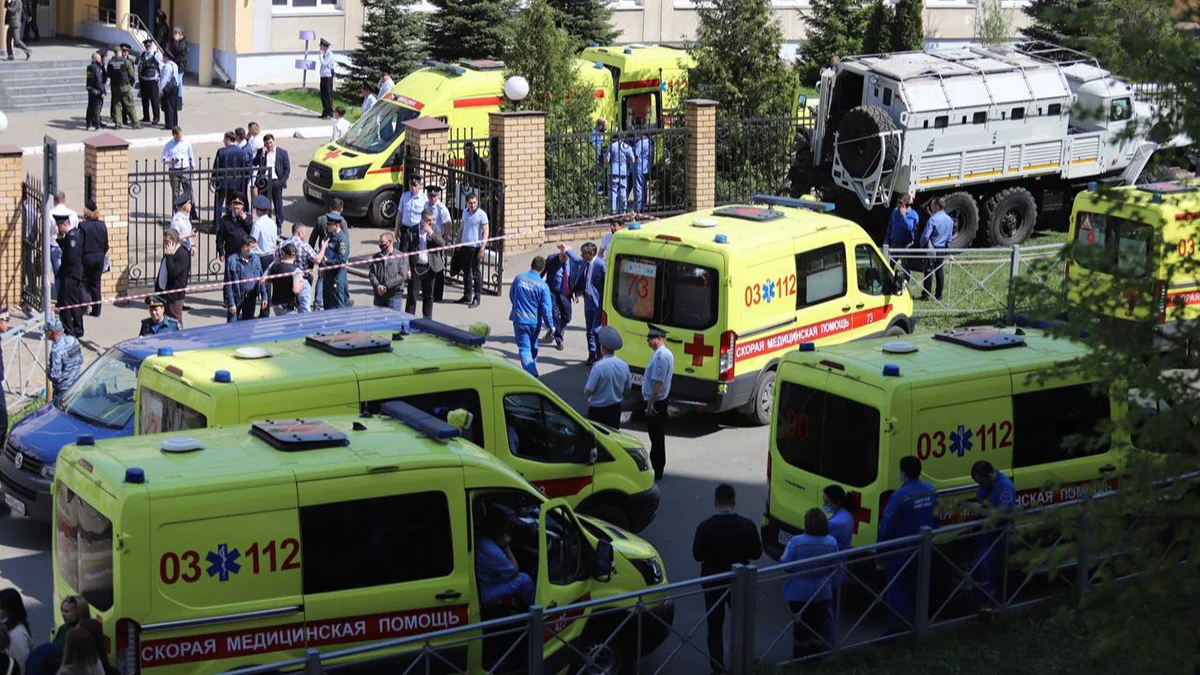
Employees of special forces gather at the school after shooting in Kazan, Russia, May 11, 2021. Anton Reichstat / EPA-EFE
On December 7, in Bryansk, a 14-year-old student of the eighth grade brought a hunting rifle taken by her father to the gymnasium and began to shoot in classmates: one schoolboy died, five were injured. After that, the girl shot himself.
According to Shot and Mash , she was subjected to persecution at school. In addition, among the possible versions of the incident, telegram channels are also called a conflict of firing with a dead classmate because of the boy.
The tragedy was the first case of an attack by a schoolgirl in Russia to result in the death of people. On the same day, the State Duma speaker Vyacheslav Volodin and deputy Valery Gartung proposed to record the concept of “persecution” in the law. The Deputy Committee of the State Duma on Enlightenment, Jan Lantratov, said that a bill on persecution of persecution in educational institutions has already been prepared.
The New European Europe, together with a psychologist (he preferred to remain anonymous for security reasons.-Approx. Ed.) Skiden how to distinguish injuries from the conflict, what reasons could make a 14-year-old girl joke and how to protect the child from a school at school.
-Why could a 14-year-old girl decide on a joke?
- Not every person who is poisoned reaches such a state. Here we can talk about the totality of the alleged factors: how long was the systematic persecution? The longer, the more severe consequences will be for the psyche. Was there any society where a person who is exposed to persecution could get relief, support and acceptance? What was the environment in the family? What personal characteristics did this child have?
A joke is an act of pressed against a wall driven into a corner of a person who collects his last forces from a point of despair and thus repulses. There are no longer any thoughts about the consequences for yourself, for society. This is a pure splash of rage and a complete absence of empathy and sympathy.
- What could the girl really want?
- The reasons for the violent act may be different. This can be sudden captivity with affect, when a person does not control his actions, does not evaluate the consequences and does not give a report to his motives. But in Bryansk another story happened. A joke is a fairly thoughtful action: you need to find and take weapons somewhere, you need to hide it from relatives, think over a plan. And then there is definitely a motive, but everyone can have a different one. Perhaps this is revenge, an act of despair, the desire to restore justice.
- What is persecution and how to distinguish it from a simple conflict?
- Traveling has clear criteria that help distinguish it from conflict or situational rudeness. Half is systematic, regular, repeated actions that are made against a particular person with certain intentions. This is a persecution or provision of pressure using force. A person who has become a target of bullying suffers and cannot independently interrupt violent actions, since the parties are not equilibrium.
Unlike the conflict, persecution has no reason. Initially, persecution could get out of the conflict: the parties had disagreements, but at some point the focus of one side did not shift to resolve the conflict, but to pursue the second side.
And then the second side has no tools to stop it.
She can either be silent and ignore, or to rebuff and resist. But nothing works, because the purpose of the one who demonstrates aggressive behavior is simply to pursue.
If the conflict can be resolved and the parties can make peace and agree, then in the situation of bullying this possibility. It can only be stopped by influence from above. Or the aggressive side can independently decide to switch to something else.
- Why do people "poison"?
- For example, there are studies showing that children who are subjected to cruel or excessively authoritarian circulation within the family or live in a family with a very rigid hierarchy, where there is no way to show and protect themselves are more likely to act at school by authors of violent acts. Thus, they either compensate for what happens to them in the family, or simply reproduce this and build relationships with other peers from a position from above.
Children who were once exposed to persecution themselves in other teams can act as authors of violent acts if they did not work out this experience and did not help them integrate into society.
Children who seek to take leadership positions in the team, but do not have the necessary communication skills for this, are also inclined to become “starters” in a situation of persecution, because this method of managing the group becomes the only understandable and acquaintance for them.
In a children's team without a leading adult, the situation of bullying occurs more often, since it is the adult who teaches children to regulate the relationship between themselves.
But nothing from the behavior of the pre -suffering side can be the cause of persecution. The actions of the injured side can be wrong, but how to react to this is always a choice: to respond by a violent way or others, more complicated and long.
- How can persecution affect the psyche of the child?
- A person who has survived the grass may encounter different negative consequences.
The former are somatic: headaches, abdominal pain, eating disorders as a reaction to the inability to resist violence. The latter are psychological: a decrease in self -esteem, self -confidence, difficulties in adaptation in the team, close, search for the causes of bullying in yourself. Such a child, perhaps, will constantly look for a person or team, where they will also treat him as well. After all, it is precisely these schemes of behavior to him that he will disturb such a person if they behave differently with him.
And he understands the violent form of behavior, and he knows how to resist. With the worst scenarios, the child can subsequently diagnose personality disorder, depression, he may have suicidal thoughts or even he can make suicide attempts as an extreme form of aggression aimed at himself.
In a person who shows aggression, inability to control himself, inability to control, to recognize his feelings, emotions, as well as a decrease in empathy and emotional intelligence, may develop. It will also be difficult for him to build relationships in adulthood.
- Why is such an atmosphere in school dangerous for children?
- Do not forget about the trauma of the witness. Everyone who observes the bullying from the side experiences similar consequences, like the injured party. Observers who do not allow themselves to respond to what they see and express their position, often assimilate the belief that it is better to “not stick out” and not manifest themselves.
In addition, children in such a team are in constant stress. In this case, knowledge is absorbed much worse.
- Why can adults not notice the injury?
- Half, like any prolonged violence, begins with small things. Gradually, there are more and more of them, but since everything develops gradually, children and teachers, as well as parents perceive it as a norm and get used to it.
Children understand that they do something wrong, and therefore often the persecution does not happen before the teachers' eyes, but behind the door or in the corridor. And the teacher really may not notice this. Therefore, it is very important for him to be able to recognize that in the team something is not so emotionally. But teachers are often busy with another work and reporting and pushing psychological problems into the background.
- Why does society ignore the grass?
- Society does not teach children more complex and long ways to resolve the conflict. We do not have separate courses where children would learn communication skills in the team and conflict resolution.
Most often, a culture of violence is broadcast, where there is a lot of suppression and where you are in winning, if you are stronger and faster.
So it happened historically. In part, this is also an echo of patriarchal culture, because just in it everything rests on the hierarchy, demonstrations of strength, power and the ability to take its position in society due to this.
- How, in this case, reduce the negative consequences of persecution or get rid of them? How to protect a child at school?
- It is necessary to teach children communication skills and the ability to resolve conflicts. It is also important to be able to identify the grass and immediately declare it. In addition, it is necessary to carry out educational events with teachers and parents, work out the skills of behavior in the attack situation and in the threat of an attack. This is carried out in schools, but these classes are deeply formal and children do not receive enough knowledge. In addition, we need a bill on the prevention of bullying in schools, and the very concept of bullying should be enshrined.
- What to do to the families of those children who were firing?
- The help of a specialist is sure to minimize the risks of post -traumatic stress disorder (PTSD). What is happening absolutely exceeds all the abilities of the psyche is to survive.