
Translated material
Cornflows in the snow
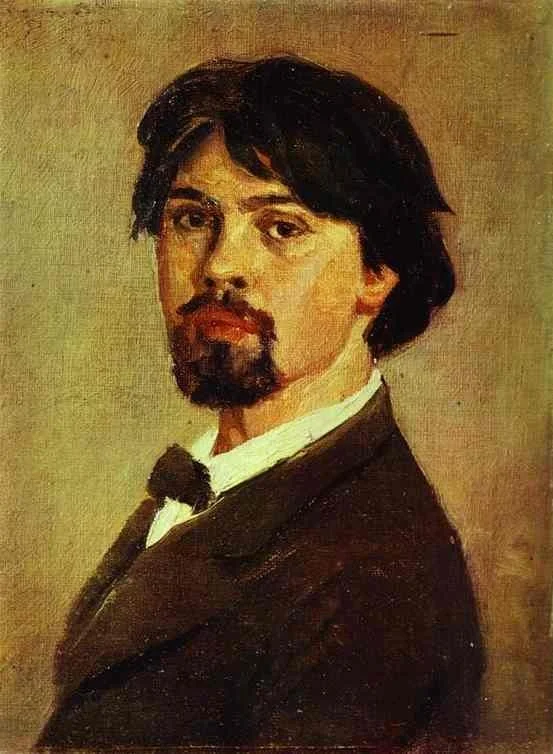
Vasily Surikov, who is missing. From a personal diary
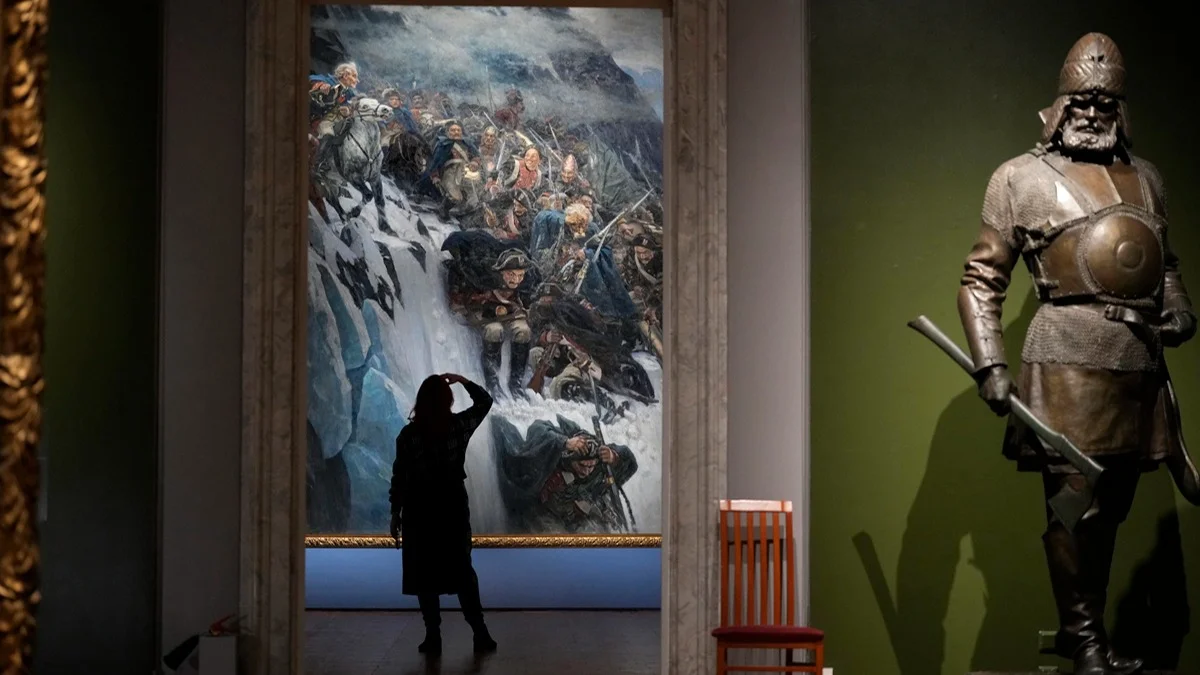
Exhibition "Vasily Surikov. By the 175th birthday. " The painting "Suvorov's transition through the Alps." Photo: AP / TASS
At the finish of the year, at a short temporary segment, there were three significant dates for Russia.
On November 30, in St. Petersburg, in the Russian Museum, an exhibition of Surikov opened. According to experts, the most representative over the past 90 years. In my amateurish look, and generally unprecedented hitherto in the wholeness of the creative heritage of the brilliant tragic of Russian art. Or maybe the world. The occasion is 175 years since the artist’s birth. December 3 - the day of an unknown soldier. On this day in 1966, the ashes of an unknown soldier was transferred from a mass grave at the 41st kilometer of the Leningrad highway and buried near the Kremlin wall. Now here state post No. 1. Since 2014, the day of an unknown soldier is celebrated with us throughout the country. December 6 is the 82nd anniversary of the start of the defeat of the Nazi troops near Moscow. It would seem what the connection between the first and two dates can be? In fact, there is such a connection. Straight. "Significant, rough, visible."
24 January 2008. Thursday
"History is not a house, not a pier, not a shore, but a path ..."
Surikov-160. And he still, in the words of Pushkin, “with a century along with the age”, although the century is completely different. At his road with the past century, the Publishing House "Trilist" released a three -volume on the history of Russian fine art and architecture. And there is such a characteristic and content of the "boyars of Morozova", and in general - the deep modern subtexts of Surikovsky historicism:
“The split for Surikov is not only a historical incident that has gone into the past, but the repeating event of Russian history is an event in which every new era can recognize itself. The turning point is not a moment, but a constant property of Russian history. Surikov does not embody crises in history, but the crisis nature of history in general. History is not a house, not a pier, not a shore, but a way ... History is what is pushing a person out of everyday life ... - On the street, to the square, to the crowd ... "
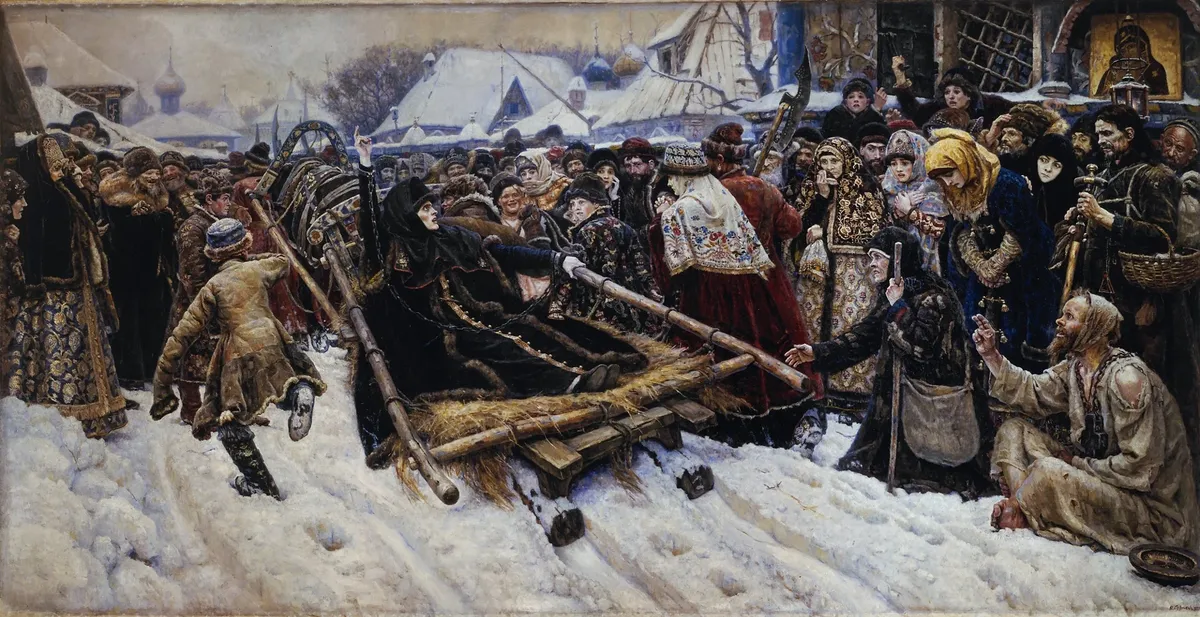
Gloomyly said. However, the inner drama of Surikov’s work is conveyed. And indeed: according to the concentration of unbending spiritual power, little can be compared in world painting with the Surikov’s “hawthorn of Morozova”. But there are few analogues in this picture and in picturesque expressiveness. About every image of it, about every smeast you can write a poem. Some cornflowers in the snow are worth it! Indeed, the blue flowers on the white board of one of the women and the cornflower-blue color of the robes of the other, adjacent to her, next to the frenzied from the frost, snow-capped by the holy fool are perceived precisely as a cornfield in the snow.
Proportional inconsistencies are clearly striking. But there is no question of "inability". Surikov goes on inconsistencies boldly and consciously, precisely where he needs it , hacking the usual shape for the sake of a more acute and ultimately more accurate expression of his plan.
He already knows that the cubists later discovered: if there is not enough real form to express the content, it is necessary to hack the form, transgress the laws of the linear perspective, go into “nonlinear” painting.
Kramskoy told him about Menshikov in Berezovo: either your picture is brilliant, or it is monstrously illiterate; If Menshikov rises, he will cut his head with his head. But Surikov wanted this! It is this feeling that he dictates to the viewer, intentionally “hacking” the form, its balance, deliberately distorting the proportions. The poet of another, already our time, Yuri Apenchenko will express the same thought with the words: "I would prefer this wing of a deaf blow to a low ceiling."
The same - in the "Boyar Morozova". And as soon as these sledges can go, the mind is incomprehensible. But they go! The schismatic bipart of the right hand of the frost, overcoming the weight of a heavy chain closed on her wrist, is depicted as if icy. And this gesture, repeated by a gesture of the holy fool, and this icyness is the key to the character, adamant, petrified, rye in its faith. This Morozov character cannot be thawed. He is forever soldered into the eternal permafrost of Russian life.
The strongest and deeper in the picture is the cycle of views.
First, Morozova, whose gaze is on top of the crowd, directed to the Virgin, collects in his gaze, addressed to the icon, fright, prayer, mockery of people and mirrored them in the eyes of the Mother of God. And the mournful gaze of the Virgin comes back to people who do not look at her , they do not see her.
24 January 2013. Thursday
"Death death is corrected"
With Surikov’s assessment of public opinion and critics-arts, a strange thing is happening. He is confidently called the "morning of the Strelets execution", "Menshikov in Berezovo" and "Boyaryny Morozov". Some add the “conquest of the Ermak of Siberia” and the “capture of the snowy town”. And then everything seems to be more insignificant. Although after that he rose to such peaks as “Suvorov’s transition through the Alps” and “Stepan Razin”.
For medals in honor of the victory of the young Russian fleet over the invincible by the Swedish fleet, Peter the Great commanded to knock out the inscription: "The unprecedented happens." These words later overshadowed the whole history of Russia. But the one who correlates them only with this and other military Victorias will be deeply wrong.
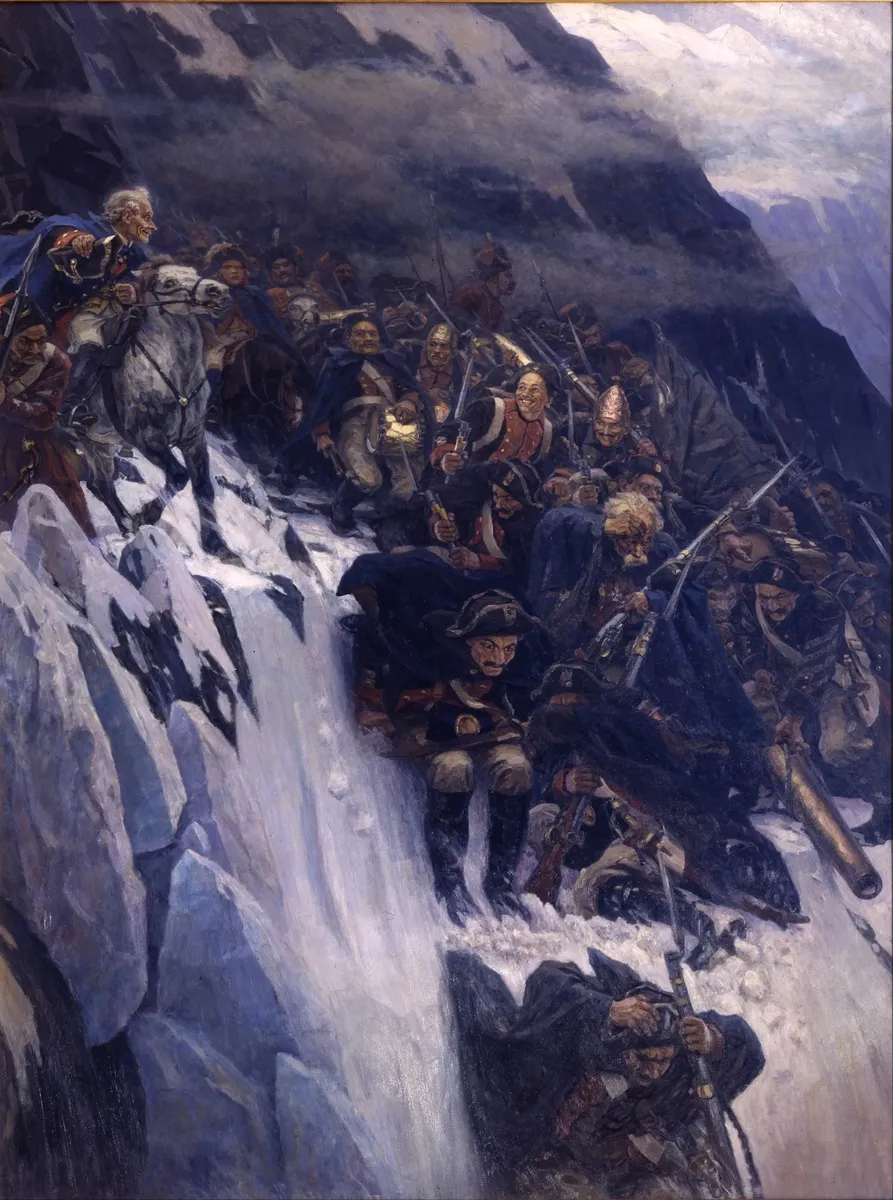
Surikovsky “Suvorov’s transition through the Alps” - about overcoming an insurmountable vertical of death and fate. Yes, Surikov depicts a road leading right to death and only to death. And if you want, this is him, Surikova, the “apotheosis of the war”, no less strong in effect on the consciousness and subconscious of a person than the same anti -war manifesto of Vereshchagin. But - the watershed. Here, the final impression largely depends on the properties of the depicted human stream, materializing and the biblical “death of death is correct”, and the Peter's “unprecedented can”, and Blokov’s “and the impossible is possible”.
I have with the Surikovsky “Suvorov’s transition through the Alps” another association, very subjective mine. It seems to me that there is a certain deep connection between the soldiers of the “horizontal” country, storming the alpine verticals that they saw them in their imagination and depicted Surikov, and those who, in the “horizontal” fields of this country itself, standing across fate and death, did not let the enemy into their capital. I'm talking about thousands of those who fell on the approaches to Moscow in the fall of 1941. Different eras, different wars, different people. But there and there - everything at the stake.
*Conflagrations in the half -nebosvod
And the reality of defenseless roads.
October of the forty -first year,
The earth leaves from under the legs.
And the terrible outcome is terrible
Moscow in Vladimir ...
Somewhere
Again goes to the bayonet
Rush platoon. Until dawn
Victory fighters do not live
Names cannot be left in the annals.
It is bequeathed to us to cherish
Their eternal glory. Start
Immortal Russian miracle
In their death, to the pain of a simple one.
Already on the centuries everywhere
The graves stand on a simple
Where, by irrigation with blood,
The boys saved Russia.
I would all bring them to the saints.
But ... how many saints in Rus'!*
(10/16/1996 from a personal diary.)
The line “ and the reality of defenseless roads ” has one long -standing full conversation in the Minsk -Moscow train car. In perestroika times, we, three Izvestins, returned from a “signature” trip in Belarus and ended up in the same car with Vasily Bykov. He entered our compartment, where the fourth place was unoccupied. And far after midnight, an interesting, frank conversation lasted.
It was not in our personalities. And definitely in the personality of Nikolai Yegorovich Matukovsky, our Belarusian Sobster, who in the most difficult times for Bykov, when he was poisoned in his homeland, fearlessly stood up to his defense. Hence the writer's respect for the "Izvestia" of those years.
By the way, Bykov told one story (and Simonov told him, and Marshal Zhukov during the famous conversation, which partially entered the film “If your house is dear to you” - about the battle for Moscow, in more full of Simonov himself in print publications, but not completely published to this day).
So, according to Zhukov’s testimony, during the Moscow battle there was a moment when German intelligence had data that three roads to Moscow were completely free.
We simply had no parts to protect these directions. One of them moved German tanks. But they were detained by the 316th Infantry Division that had arrived from Central Asia. A blow was struck along the second road. But this gap was closed by the Podolsk cadets raised in alarm.
And then on the third road, the Germans did not dare to advance on the move, considering that the information of their front -line intelligence is inaccurate and require additional verification. Zhukov said that, along with those who fought, surrounded by Vyazma by our troops, it allowed to win and pull up reserves.
I heard this from Bykov personally. But then nowhere, neither in any printed publication, nor with Zhukov, nor at Simonov, nor by Bykov himself, nor in historical research and memoirs about the Moscow battle, he still has not met this fact.
In May 2010, two TV channels-the first and “Culture”-showed allegedly a complete record of the very interview of Simonov with Zhukov. He looked - and did not find this episode. In a general form, the thought of several days in October, when there was nothing to close the road to Moscow, sounded. But ... it is in the general form.
It turned out along the way: the record released by two television channels is also incomplete. “LG” (May 12–18, 2010), referring to the critic of Vladimir Ognev, wrote:
QUOTE
“... The interview with Marshal lasted 2 hours, and indeed in it were very sharp statements at that time <...>. Most likely, this is why the head of the Glavpur Epishev, who oversee all documentary projects about the war, demanded everything that was not included in the film to destroy <...>. The leaders of the ETC ( experimental creative film studio under the Council of Ministers of the USSR. - K. S. ) <...> signed the corresponding act “On the destruction”, but did not wash away anything, but simply from two boxes with a film, the inscription “Conversation with Marshal of the USSR Zhukov” was erased and it was written: “Soldiers' memoirs”. <...> The preserved film was sent to the archive, and after a while Konstantin Simonov <...> was mounted by exactly the one that lasted less than an hour <...> the film that we saw on Channel One and the Culture. Moreover, the first (closed) show of this interview, on which Ognev was present, took place in 1969 in the Small Hall of the CDL. "
And-who knows, maybe somewhere in the archives that very, more, more, unknown to us, is a truly historical interview, and is there really a story about three defenseless roads? Or not?..
But is it so important to know how everything was actually, with an accuracy to the details, if it is known how it ended? Important, very importantly
Of course, although in many cases, in connection with the departure of the latter from the great front -line generation, this is already physically impossible.
They argue about 28 Panfilovtsy. How many were there really? Did the village have a legendary battle and was it at all? Did Politruk Klochkov become winged words? Etc. Is it important? Important. Nevertheless, it is necessary to all this rise in the terrible and holy vertical of the highest truth of the tragedy and feat: on a completely open, defenseless road to Moscow, the Germans moved their tank armades. The 316th Infantry Division, which went down as Panfilovskaya, was in the history of 11,700 human souls, just formed in the Central Asian rear. And in fierce, bloody battles in these deadly days for the capital, the division stopped the enemy, did not miss him to Moscow. At the cost of 3620 dead fighters and commanders (including the commander) and 6300 wounded ...
Yes, I am for every real point on the map of the Great War - where it is only possible - a true picture of how everything really was here was established. However, another thing is important: so that the highest, Hamburg account of history does not turn off in the subconscious, and in our minds!
Is it not too far that the events of the Moscow battle brought me away from the real Surikov picture, where is still a different time, other people, a different war? However, there is something that connects this artist, his picture of both these events both among himself and with heaven.
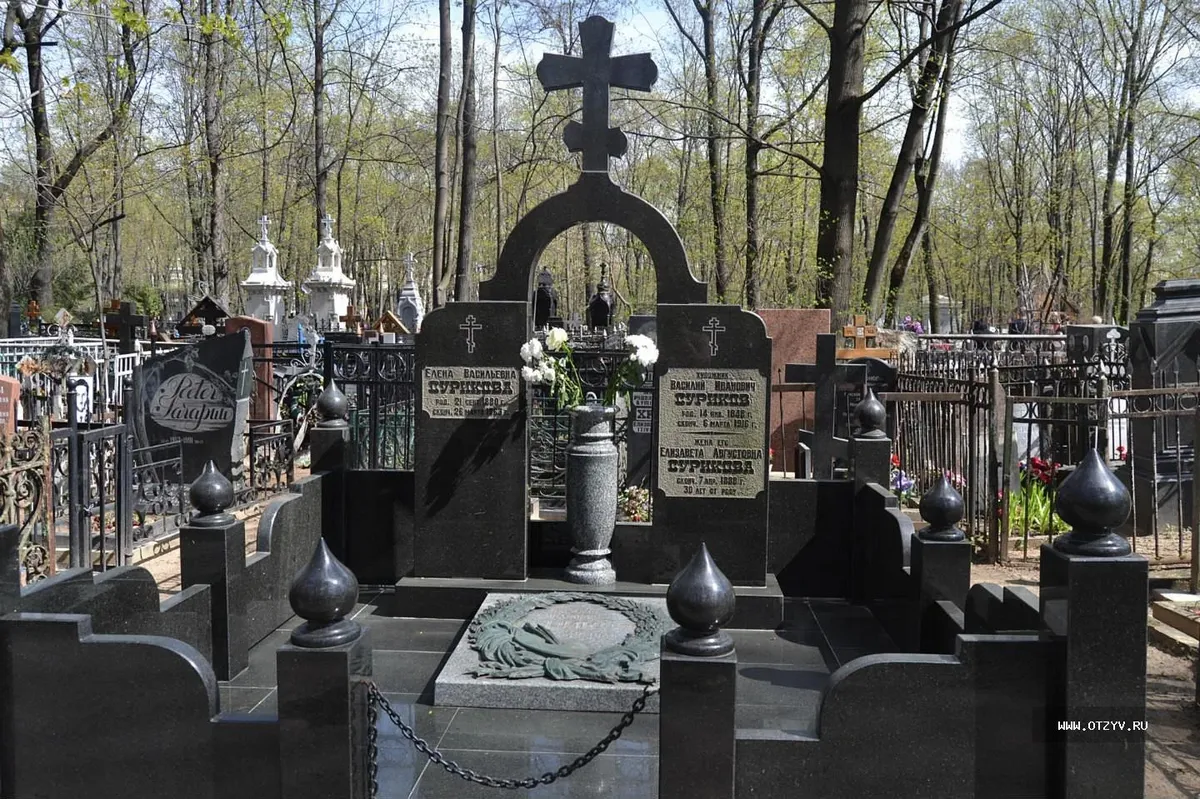
Inside the Big Vagankovsky cemetery, there is another cemetery. When on May 9 we head from our native burials to him to lay flowers, our path passes along the Surikovsky alley. And at the end of her almost close to the army system, the pyramidal obelisks over the fallen in the 41st in the battle for Moscow are adjacent to the grave of Surikov.
*Forest by November spent all the foliage,
Becoming the music of the graphic sonata
And the silence in which the soldiers sleep,
Who died in the battle for Moscow.
They dream of that snowfall and the parade,
Where does the road lead to battle only.
And only to death. And there is no way back
And on the rostrum Stalin instead of God.
Eternal lights are burning over them,
Granites of obelisks freeze.
And mourning branches of November
Above them, adamant, include
The miraculous canopy of silence
And memory. And non -conjunction,
But for immortality we need
In the graves of brotherly their holy dreams.*
(11/07/1996 from a personal diary.)
March 19, 2016. Saturday
How many steps from the "morning of the Streletsky execution" to the "Germniki" Picasso?
100 years without Surikov. And - with Surikov. He was surprisingly in the court of the past twentieth century. And the current, XXI, too.
In the second edition of the BSE, Surikov was called "a brilliant representative of realism in historical painting." In this definition, undoubtedly, I can only agree with the very first adjective. For, in my opinion,
In the manner of his Surikov, this is an inseparable alloy of strong realism and ... impressionism. The boyars of Morozova and the people around her are the first. And snow is the purest impressionism.
The point is not only that he erected work in the open air to the “Symbol of Faith”. There is something from the essence of his talent. Or, if you dig deeper, from God.
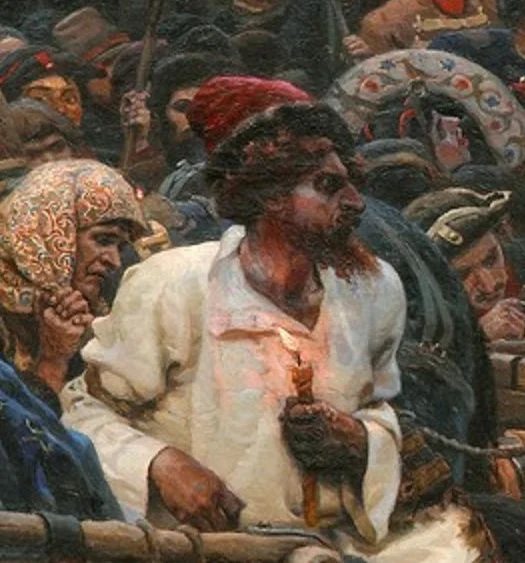
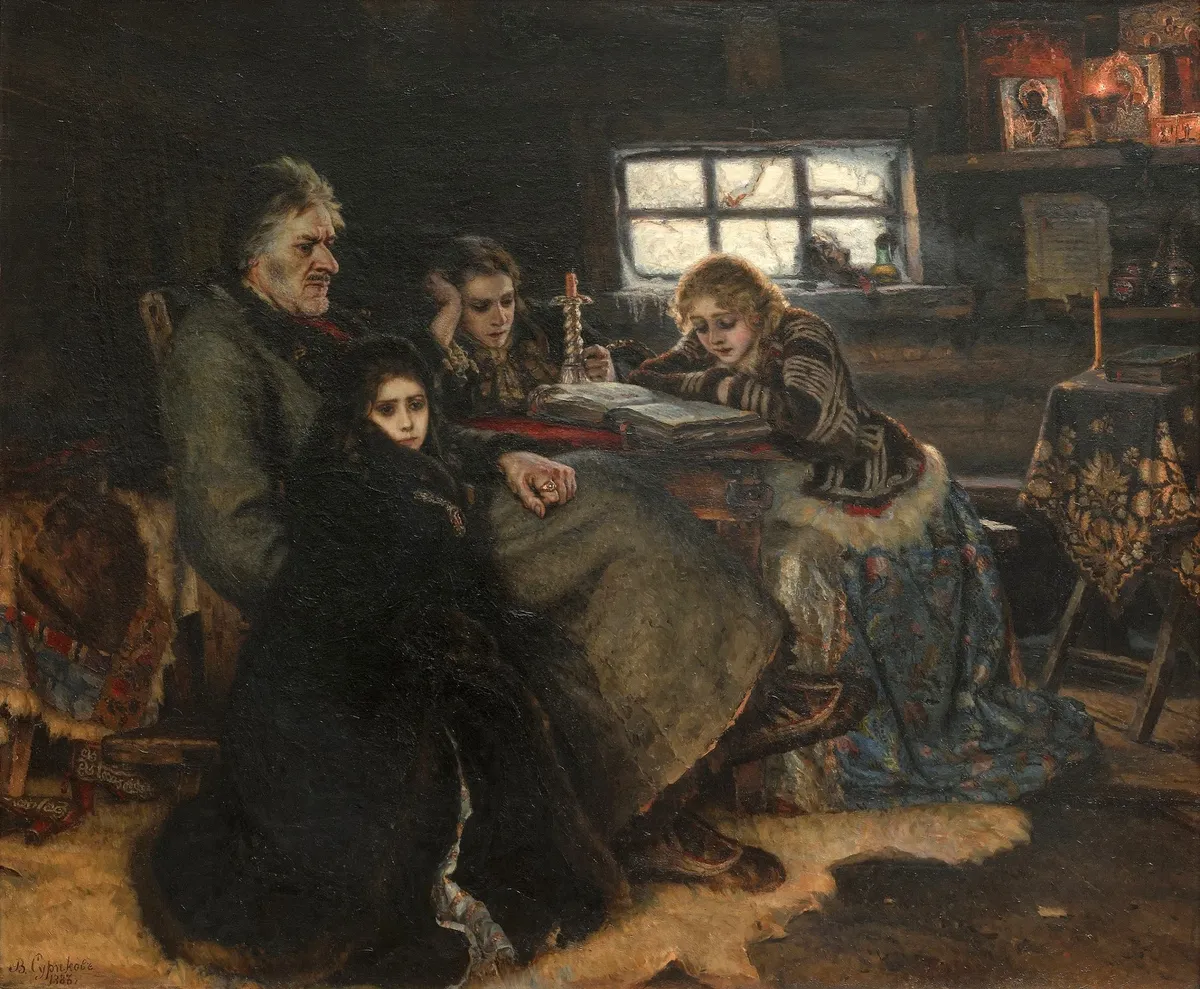
And really. How often his great canvases began each with a colorful-light first impression ... Just like Claude Monet in his canvas, a signature under which gave a name to a new direction in painting: L'Mprepration. Only this was no longer a “impression. Sunrise of the Sun ”, and“ Impression ... ”and further:“ Raven in the snow ”,“ glare of flames of candles on a white shirt ”,“ hut with a low ceiling, and outside the window hopeless weather ” - emotional keys to the“ hawthorn of Morozova ”,“ in the morning of the Streletsa execution ”,“ Menshikov in Birch ”. Surikov himself told Voloshin about this (by the way, he considered Voloshin the assessment of his work as the most consonant with his own self -assessment):
“... I lived near Moscow in the country, in the hut of a peasant. Summer was rainy. The hut is cramped, the ceiling is low. The rain is going on and you can’t work. And I began to remember who was sitting in the same way in a hut. And suddenly ... Menshikov ... Everything came at once - I immediately saw the whole composition at once. <...>
And then once I saw a crow in the snow. The raven sits in the snow and put one wing, sitting with a black spot in the snow. So I could not forget this spot for many years. Then he wrote to the boyar Morozov. Yes, and the “execution of the archers” went the same way: since he saw a candle on a white shirt, with reflexes. ”
Voloshin saw in all this the pronounced nature of Surikov’s talent :
“You have a huge force of observation: even what you saw briefly, you have a clearly in your eyes. Your mind is clear and sharp, but it does not illuminate the areas deeper and represents complete space to the unconscious. The idea, barely appearing, is immediately clothed in the visual form, ahead of your consciousness. ”
In other words, the perception of the world with Surikov was crystal fresh, non -stranded, not distorted by any ideologized “hazards”, open towards and everything truly eternal in life and in art, and everything new, non -trivial, unusual.
The ridiculous, two -core, adamant Siberian character - and (right according to Dostoevsky - about the universal responsiveness of the Russian person!) Such a sincere susceptibility not only to all the native, “oven”, but also to new trends in European art, to the paintings of those who will become the idols of the new, twentieth century, but for now, abroad of academic and salon calm.
Voloshin testifies:
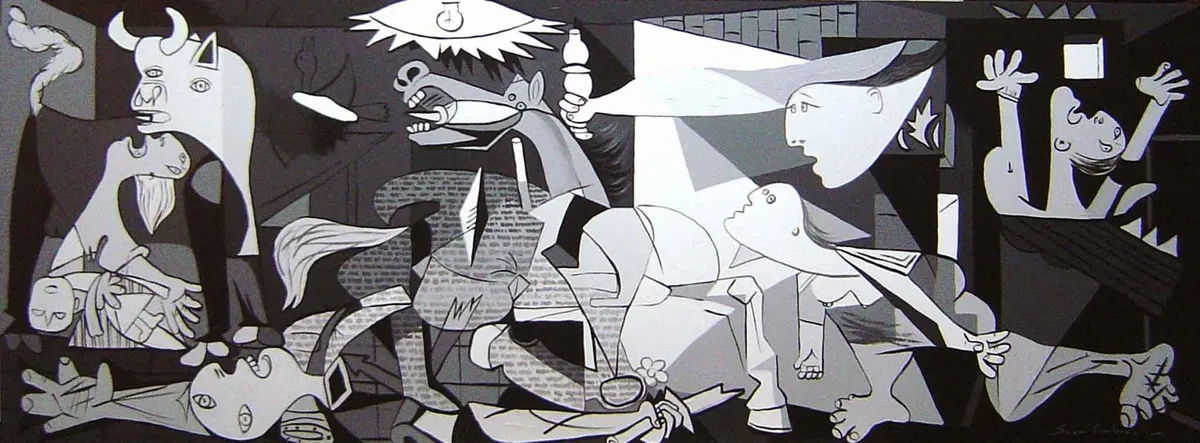
“Once we were together with Vasily Ivanovich in the gallery of Sergey Ivanovich Schukin and watched Picasso. At the same time, there was another company with us. One of the ladies was indignant at Picasso. Vasily Ivanovich spoke to his defense: “This is not so scary at all. This is the real artist that should begin any composition: straight angles and common masses. And Picasso only wants to stop there to be stronger than the power of expression. This is scary for the big audience. And the artist is very clear. "
So, in the everyday, everyday environment, the authors of two, perhaps the most tragic picturesque canvases (“most” - each in their century) - already written “in the morning of the Streltskaya execution” and no nostradams of the “Germanic” already written. Meet - and understood each other.
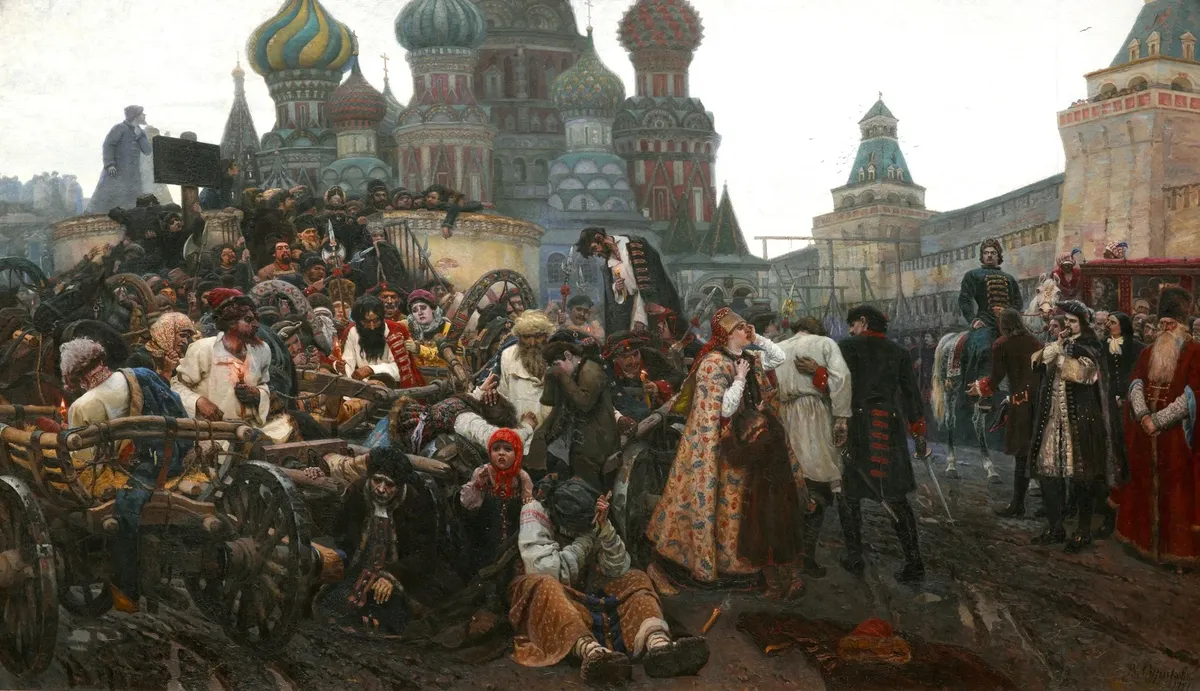
December 1, 2023 Friday.
Two epilogue to information on the opening of the Surikov exhibition.
My favorite domestic painters - Rublev, Serov, Levitan, Vrubel, Surikov. And it so happened that in recent years the first four were devoted to the impressive in fullness, which enjoyed the deafening success of the exhibition (remember how Muscovites and guests of the capital literally burst for the exhibition of Serov). And then the turn of Surikov came.
His exhibition has just opened. Not in the Tretyakov Gallery this time, but in the Russian Museum. But the same all -looking. It presents more than 120 works from the GTG, the Russian Museum, museums and art galleries of Moscow, St. Petersburg, Krasnoyarsk, Novosibirsk, other cities, from private collections. But even in the Tretyakov Gallery this exhibition was preceded by the implementation of a special program dedicated to Surikov. She included thematic evenings, excursions, film screenings.
Maximilian Voloshin:
“The blood of the old rebels who conquered Siberia along with Ermak, defended in the peaceful life of Old Rus', is an exceptionally healthy childhood, furnished with harsh, tragic and bloody impressions of nature and human life, deeply amazing the childish soul, but not complicated by any personal catastrophes, formed a concentrated and powerful charge in it huge creative power. "
(Maximilian Voloshin. From an article by Surikov’s memory, published shortly after his death, in the journal Apollo more than 100 years ago.)
Vasily Livanov:
“Do I love Surikov? Well, what's the point of saying: I love oxygen, the air that I breathe? And if I do not like, then I just do not exist. It seems that Surikov is the same era in Russian painting as Pushkin in literature or Chaliapin in the theater. And obviously, no person brought up in Russian culture is beyond the connection with the work of these brilliant inspirers. ”
(“The Word of Surikov” by the People's Artist of the RSFSR Vasily Livanov in his book “Remember the White Vorone. Notes of Sherlock Holmes.”)