
Translated material
There is no government. It left us
On January 25, 2024, Doxa was recognized as an “unwanted organization”.
If you are in Russia or plan to return to it, you can not replace our materials on social networks, refer to them and publish quotes.
Read more about what is possible and impossible, read in the cards .
Almost two weeks have passed since the attack of Hamas on Israel on October 7. During this time, citizens of Israel showed an incredible level of self -organization and mutual assistance. In a column for DOXA, Jerusalem Jerusalem Jerusalem Jerus City tells how the society reacts, why the state cannot cope and how citizens of Israel of different origin are united with each other (spoiler: not only Jews).
Cover: Reuters/Ammar Awad
Editor
Editor
Dasha ManzhuraPublication
October 20, 2023
The beginning of the self -organization of the Israeli society immediately after the attack on October 7
In an interview with the journalist OR-L. Barlev, a 19-year-old girl, who survived the terrorists on Kibutz Beeri, says: “[From the state] we did not receive enough help, [...] Citizens came to our aid, citizens! The government is missing! ”
Despite all the tests of the last days, ordinary citizens of Israel behaved in the most worthy way. People began to help each other without waiting for help from the state. They organize the supply of food, essential items not only for the victims of the attack, but also for soldiers and reservist, who were called in the last days for the operation.
Assistance to the victims of the southern Israeli.
- Beeri's printing house in Beeri kibbutz, which suffered a heavy blow as a result of the attack, works a printing house, which, among other things, is engaged in the release of digital albums. Can be supported by kibbutz by ordering albums from the printing house
- The organization " Haveim Lerefua " ("Friends of Medicine") The organization helps evacuated residents of the south of Israel, delivering the missing medical equipment and medicines
- “ Bonot Alternative ” (“Build an alternative”) another organization engaged in the collection of assistance
Help of peaceful people of the Gaza
- Medical Aid for Palestinians, the organization is engaged in the collection and delivery of the missing medical equipment, disposable materials to hospitals that will experience the influx of wounded patients.
- Palestine Children's Relief Fund PCRF is a humanitarian organization that provides medical and humanitarian assistance to the victims of the conflict in the gas sector, providing medical assistance and essential items to children affected by air strikes.
- Doctors Without Borders is an independent charitable organization that provides medical care and materials to the victims of conflicts, outbreaks of diseases and natural disasters. “Doctors without borders” called on all parties to ensure the safety of the civilian population.
On October 9, in an interview with the Israeli newspaper Maariv, a reservist, who was deployed to the border with the gas sector for the operation “Iron Swords”, shared: “Our situation is bad. There is not enough basic equipment for battle. Ceramic vests No one has an ultra -resistant body armor , and we simply do not have the opportunity to protect ourselves during the battle. Our weapons have no sights, and there are not enough basic combat equipment. ” After that, tens of thousands of residents throughout the country mobilized and organized the collection of equipment and food for soldiers.
The Israeli edition Ynet quotes a soldier of one of the backup companies: “We are now getting ready to enter the combat zones in Gaza Envelope The territory of Israel on the border with the gas sector . [And we are not enough] tax lanterns, drilling rooms, it would be good if there was a combat vest. ”
Another soldier notes: “Yesterday we were brought up [in Gaza Envelope] one of the first, and many soldiers did not come from their home. [We have] an endless list of things that are not enough: shoes, underwear, socks, towels, toothbrushes and elementary hygiene products. ” At the same time, the representative of the IDF, the brigade General Daniel Hagari on the same day gave another assessment of the events: “Thousands of reservists will arrive. We will give them tasks and make sure that everyone gets equipment. ”
The Israeli edition of Globus notes that the lack of a reserve equipment in the warehouses of the IDF is not news and does not happen for the first time, and gives an example the second Lebanese War The Second Lebanese War is an armed conflict between Israel and Hezbollah, which actually controlled the southern territories of Lebanon. , although such a amount of reserve_k on one day - 300 thousand - Israel has never called. At the same time, the publication continues, the army is not always positively looking at civilian donations at military uniforms, and in some departments they even prohibit taking combat vests due to the fact that they may not fit under the standards of the army and expose the danger soldiers. But in those parts where combat vests are necessary, there is no other way out.
The unpreparedness of the army to attack was taken by society by surprise. Military experts still find it difficult to answer the question why, during the first critical hours of a terrorist attack to the south of the country, the army was completely absent. Among the possible reasons, they bring:
1) a large focus of Israel on the air forces and modern surveillance technologies, which is why preparations for low-tech ground attacks fall out of attention;
2) the deployment of most fighting companies for the IFAL on the western shore to protect Israeli settlements The settlements created after 1967 in the territories occupied by Israel during the six -day war. .
Beeri surviving in the massacre in the kibbuces noted that from the first minutes of the attack they informed the relatives, the police and the authorities about the attack. There are records of telephone conversations of the victims during the attack on the festival in the south of Israel, with their relatives.
In an interview with the Israeli channel "Kan", a resident of Kibutz Beeri Omri, Evens, who survived in a terrorist attack, is perplexed :
OE: An hour passes, another, third ... I do not know when the army arrived ... [We were waiting for many] hours ...
Journalist Kan Moaw Vardi: You called me at 10:30 in the morning and said, whispered: “Moaw, no one comes [to the rescue] ... Tell people from the army to come ...”.
OE: That's right, I thought: I’ll call people who know who is not from the kibbutz who has some kind of influence. You see in all groups of [social networks] kibbutz people shout: “Save! Save! They shoot at us, they set us settled! ”... And you think: where is the army? ... it was already deep in noon ... You think: “Well [let] at least [military] helicopter arrive?” ... Nothing! There are no aircraft, there are no helicopters ... Nothing ... a feeling of complete abandonment, as if someone said: "We do not care, [what will happen to you]."
In an interview with Times of ISRAEL, 36-year-old Mikhael Shamai, a pilot of a medical rescue helicopter in the south of the country, said that he had to engage in not only the evacuation of the victims of a resident, but to do this in military conditions for which his helicopter is not adapted. When he tried to find out at what time the military helicopter would arrive at the aid, they answered: “There are no [military helicopters], you are alone.”
Israeli government reaction after an attack on October 7
According to several sources, including the Chairman of the Committee on Foreign Affairs of the House of US RepresentativesMichael McColus and the representative of Egypt , Netanyahu received a warning about the attack from the Gaza sector a few days before the attack, but did not start preparation.
Sociological surveys of the Israeli editions of Jerusalem Post and Maariv also testify to the crisis in the relations of the Netanyahu society and the government. Most JP surveyed, among which there are third administrations, believe that a sudden attack from the gas sector is a consequence of the failure of the country's leadership, and call for the resignation of the government.
The increasing distrust is also affected by the slowness of the Prime Minister in communication with the survivors and relatives of the dead. He visited the settlements, which were attacked on October 7, he visited only a week later and met with the military, but not with peaceful people. Netanyahu consulted nine days with his relatives_ts, although, for example, US President Joe Biden did this two days earlier.
The Government and the Co -Tannya Netanyahu use the language of hatred, which can contribute to inciting conflicts. On the first day of the attack, Netanyahu declared Gaza the “city of evil” and promised to turn “all the places where Hamas is hiding into ruins”, and a resident of the Gaza_nitsa threatened: “Come from there now. We will act in all places and with all force. ” At the same time, he did not offer options where to go to the population under the air, marine and ground blockade of Israel.
Co -Tannya Netanyahu was not at all embarrassed in the description of the details of an acceptable punishment for terrorists. So, the head of the office of the wife of Prime Minister Sarah Ntanyahu Tsipi Navon described in her social networks what measures she considers necessary against the militants Hamas when the government caught them. Among them - torture, having coated them with pork fat, to tear off the nails and skin and feed the severed genitals by the terrorists themselves. Israeli President Yitzhak Duke said that “the whole [Palestinian] nation is responsible [for the attack]. <...> This rhetoric that civilians do not know, do not participate - this is an absolute untruth. "
In this round of conflict, tragic and painful for Israeli society and almost hopeless for Gaza, a split between the resident of Israel is felt sharply, and any careless word can lead to a outbreak of violence and within the country. So, on the night of October 15, a crowd of ultra -right activist_k gathered around the house of journalist Israel Frey, who, threatening the journalist, launched fireworks towards his windows, but fell out the neighbor's window. After that, Frey moved and hides in a secret apartment.
My Israeli friends and colleagues in mourning and shock. My Palestinian friends living in cities with a mixed Palestinian-Jewish population (Jaffa, Jerusalem, Haifa), equally incredibly injured by the last disaster-and they have friends who died not only with Hamas, but also in gas and in the western bank, they are afraid to talk in Arabic in public places.
Sally Abed, Palestinian activist and a resident of Haifa, said Doxa:
“Many are blind to the pain of the other side. I am not allowed to publicly experience pain. My partner works in the hospital, they are asked not to speak Arabic ... [We hear] a lot of racist statements, completely inhuman ones, directed both against the Israeli Arabs and against those who are in Gaza ... I’m scared, scary ... If this is not "to" kill everyone as cattle, in gas! "[The situation is very] stuffy."
כתב ואתו wood ω ction @alarabytv @ahdaarawsha הפרואיום באמצ ° ️וד ω ω ction בוטalta במשטרת ישראmp. השוטר אמר לו ״ מקוה מאוail.Ru אומרים טובי״ וואחר כך מ TH ״כי א μ# µ לא ising Maybe או אוי unt ואבו yourself! Urbיין מה תגובת βivity ─ ─ @10elilevi שהיה באותו מaged du כאיתeption במern μ.twitter.com/heecz1fd9a
- Yanal Jabarin | Isingال جlf (@jbareenyanal) October 15, 2023
Palestine on the western bank is afraid of Israeli soldiers_ok, as well as well -organized and armed groups of settlement_ok, who attack the Palestinian villages. In the last week, almost 50 people were killed in such attacks.
On the western coast there are groups of armed Jewish ultra -right, attackers not only on local Palestine_ok, but also on the Israeli soldiers and Israeli activist.
On October 19, it became known about cases of violence in relation to Palestine_s living on the West Coast, and the Israeli activist from the Jewish settlement_ok and the soldier_ok DSAL. According to the witness, the soldier and the settlement_ki detained and tied the arms and legs of the three Palestinians from the village of Vadi As-Sik on the west coast, for several hours they were brutally beaten, divided naked and photographed naked and underwear. For two of them they urged, put out burning cigarettes on their bodies and even tried to insert the object into the body of one of them. Only at the end of the day they were released by employees of the civil administration, who transported the victims to the hospital in Ramalla. The victims also stated that they stole money and hijacked the car. The representative of the IDF told the Gaarets newspaper that the investigation had begun in the army and the regiment commander removed the commander of the region.
At the same time, the Minister of National Security, Itamar Ben-Gvir, announced on October 10 that the ministry will purchase ten thousand rifles for weapons of civil security groups, most of which will go to cities close to borders, as well as mixed Jewish-Arab cities and settlements on the western coast.
Negev’s Bedouin community suffered at Hamas attack on Israel: 16 killed, as well as 40 missing, some of them were recognized in the video with a hostage. But they also face the rejection of fellow citizens.
Nati Yeffet, representative of The Council for Unrecognized Bedouin Villages, said DOXA:
“People are sitting at home and afraid ... In the first days of the attack [there was] three [reasons to be afraid]. The first [reason] is a fear of Hamasniks that can come here [in the Bedouin communities]. The second is the fear that you can be mistaken for a terrorist ... It is wrong to identify. Third - afraid of [...] kahanists Cahanism is a reactionary nation in modern Zionism, founded by Rabbi Meir Kahan, who was of the opinion that the majority of Arab, living in Israel, were the enemies of the Jew and Israel itself, and believed that it was necessary to create a Jewish theocratic state in which non -Jews are not entitled to votes. . [Around] there are a lot of incitements [ultra -right Jews]. ”
All this - despite the fact that the Palestinian and Bedouin communities participated in rescue operations and continue to be part of the volunteer movement that covered the whole country.
How citizens_s of Israel continue to self -organize
From the very first day of the disaster, citizens throughout the country began to organize points of assistance and collecting the necessary products, hygiene products, and so on to fill the gaps in the logistics of the IDF, as well as support the victims of terrorist attacks and even take out pets remaining in hazardous areas.
On social networks and messengers, groups are created daily that unite people and coordinate volunteer_k, sending them to where there is a need. The clinics lined up the queues for blood donation. One of the most touching and at the same time the most terrible requests voiced in such groups is a request for milk for infants. Hundreds of people who wanted to help immediately answered him.
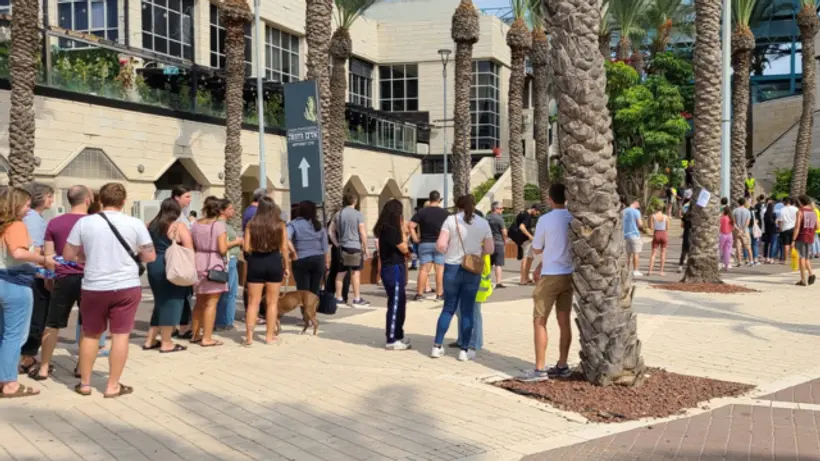
The queue for blood donation to Congress Center
Photo: GOLAN VAN MITER
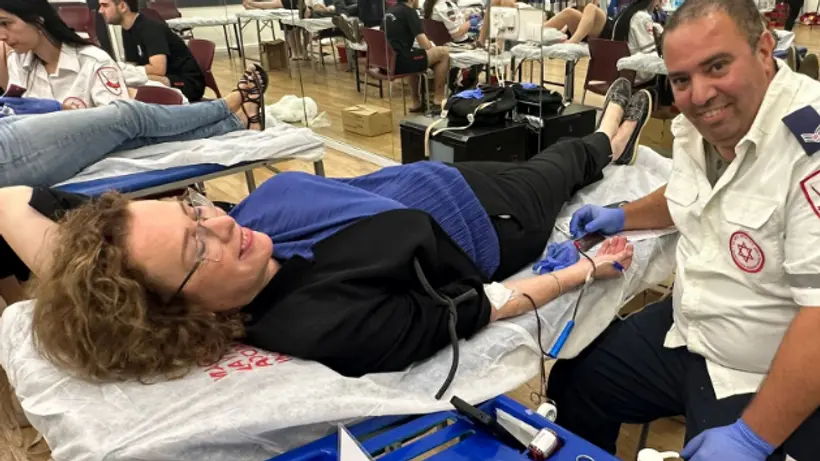
Ainat Kalish donates blood
Photo: Haifa municipality
Such self -organization and self -sufficiency of society did not arise out of the blue. Over the past few years, lower civil activity has been formed in the country, the purpose of which is a political transformation. In the past six months, the protest movement has been actively developing.
With all despair, fatigue and shock, attempts to rally the Israeli and Palestinian population do not stop - contrary to the rhetoric of the language of enmity from statesmen. One of these examples is the naked Jewish-Arab brigades “ protect each other together ” (שומרים etc. etc. βו ביחiance), arranged by Jewish and Palestinian activist in mixed cities to protect local residents of any ethnic groups from violence.
Activist of one of these brigades, as well as one of the founders, “standing together” (״ panung ביח tub)-activist organization for peaceful coexistence of the Jew and Palestine_ok-Alon-Lee Green shared with Doxa:
“We are aware that now is a very dangerous moment in society. The government calls for war and violence, to even greater deaths - and all these words are translated into [action] on the streets. Our task is to create as many cooperation spaces between Jews and Palestinians and cleanse the public space of Israel from xenophobia and violence. ”
Green said that they monitor groups on social networks belonging to the right extremist, transfer data to the police, arrange joint shares, gain volunteer_k to transfer the necessary things to everyone who became victims of Hamas attacks, and help older people.
Their goal is to show that Jewish and Palestine_ki can work with each other hand in hand and overcome this difficult time together
Some shares of activistically for the peaceful coexistence of Arak_k and Jews attract the attention of police forces who see them danger. On October 18, the activist “standing together” for hanging posters with the inscription in Arabic and Hebrews were detained in Jerusalem: “Jews and Arabs, we will overcome it together.” Posters and T -shirts activated_k were confiscated by the police. Earlier in Haifa, an action was stopped against the bombardment of Gaza. Israeli Coobi General General of the Police of Israel, said : “Who wants to sympathize with Gaza - please. I will put anyone on the buses that are now going there. ” More and more Palestine, as well as a Jew, expressing sympathy for those killed in gas, is removed from study, dismissed or arrested due to publications on social networks. Moreover, not only academics and activist, but also workers are subjected to repression. So, the Israeli Arak, who came to work on October 17, expelled inspectors sent by the municipality of the Israeli Center.
It remains only hoping that solidarity will overcome the atmosphere of hatred and mutual suspicion, and the lessons extracted from the catastrophe that occurred last week in Israel, and the tragedy on the gas will not be in vain.

We talk about Russia's military invasion of Ukraine, protests and repression. We believe that now, when dozens of media have closed or ceased to cover the war, access to independent information is more important than ever.