
Translated material
The era of Nemzer
To the death of an outstanding critic
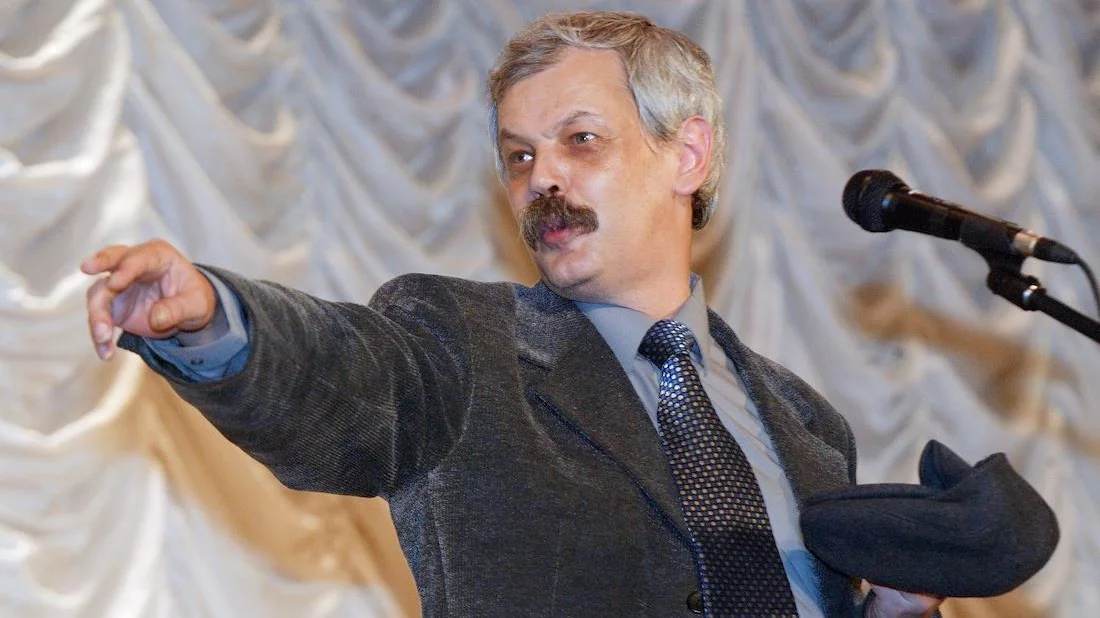
Andrey Nemzer. Photo: Valery Melnikov / Kommersant
Literary critic rarely gives his name to the era. When this happens, we are amazing and admiring. But this happens once on a 100th anniversary, if at least. There was an era of Belinsky, there was an era of Khodasevich, in the 90s there was an era of Nemzer. In order for this to happen, the critic must either guess where the time moves, or give time his vector. Andrei Nemzer did not try to guess. He designed. He was the leader of the wild literary tribe, which would have spread without him, scattered. And he led, at least hoped to lead him behind him. At the same time, he had his own clear picture, where and where the literature of the last three centuries moves. He did not close in the framework of the short literary era. He looked over the barriers, on top of the borders. And a single process at least from the eighteenth century to the day of today was obvious to him. And he could not understand why it was not obvious to everyone, and was very angry. As it happens, the teacher is angry with the incomprehensible students, to whom he already explained everything, gave his homework, and they came with empty notebooks, doing nothing.
If you get away from metaphors, and talk about specific things, then, of course, in the early youth, Nemzer and in a terrible dream could not imagine what would be a literary critic. He came to this world to build an academic history of literature.
And for him, a meeting with Yuri Mikhailovich Lotman and the Russian school was not just a meeting, as for many, it was a goal, the choice of fate. This is approximately the same as the real commander of the 19th century had to receive a mystical sign of succession from Suvorov. And Tartu for Andrei was not just a place where he went to summer schools and performed at student conferences, but a place of initiation. At first, I repeat - in historians of literature, no criticism.
He wrote, together with Andrei Zorin and Nikolai Zubkov, the outstanding book “Having performed his feat ...” about the heritage of the Russian poets of the Prepushkinsky period.
This book was a symbol of the generation. But the story is not very malleable. He was simply not taken to academic institutes because of the Jewish surname, because of a bright impudent nature, due to the fact that he did not fit into the framework of Moscow literary groups.
There was a principle when he entered the literature: please, we will let you be realized, but not where you want. Want to be critics? Stay literary scholars. Want to be literary scholars? Well, work in the field of modern literature.
And Nemzer decided that he would relate to modern - as part of the great Russian literature, that literature, in the very core of which he felt and thought. And he jumped from classics to today.
What was it in time? Mid-80s, peak of stagnation. And the material with which he had to work as criticism did not always reach him. It is clear that Zhukovsky was worthy of Nemzer to deal with him. Is this worthy of this writer NN? To write terrible articles about him? To begin with, Nemzer arranged a review of the writers of the generation of seventy -ears - and in the end he realized that they were suitable for the reserve, but were not suitable for sending them to the battlefield. And he decided: well, then I will work with the next generations. And in the shortest possible time he gathered his own - first the backup, then the main - the literary army. So Andrei Dmitriev appeared in his writing situation, so early Peter Aleshkovsky, Saratov prose writer Alexei Slapovsky appeared in his reader's everyday life. Sergey Soloukh. Khurgin. Scrofula. Kibirov’s poetry. Those to whom he gave the way as a critic, stubbornly, annoyingly and very deeply reading into their books.
And then it became clear that, as in Russian military history, there are outstanding generals, and there are the only one - Kutuzov, so there are talents in the current literature, but there is Alexander Isaevich Solzhenitsyn. Nemzer read it back at school. Of course, underground. And he was internally ready to ensure that two personal Nemzerian strategies came together in Solzhenitsyn - working with the history of literature in a scale of three centuries and work with modern literature.
Solzhenitsyn's prose allowed him without violence, without a strangle to combine three centuries of Russian literature and modernity. And finish the design to completeness.
For criticism, it is very important to experience the illusion that it is he who builds the ranks of modern literature. In this sense, he became Belinsky of the New Age. Not only because he was equally passionate about literature. But also because he saw a distant perspective, which can be seen only from the top of knowledge, from where he looked at the Borodino battle of Russian literature for the right to be herself.
And in this sense, work in the newspapers of the 1990s was the gold time for him. When it suddenly turned out that daily newspapers did not resist literary criticism, but give it an ideal site. “Independent newspaper”, “Today”, “News Time”-where he worked and where he was given carte blanche. And suddenly it turned out that criticism has a reader. And suddenly it turned out that the reputation of the newspaper is measured by literary criticism, and not political journalism.
It was the pinnacle of his literary career. He found writers who, from his point of view, are worthy of being writers of Solzhenitsyn. He had a big reader. Influence. The feeling that the process obeys his will. And then the article by Pavel of the Basinsky “man with a gun” came out. From my point of view, she was a form of negative admiration: it is clear that Nemzer is the main one, it is clear that we would never reach him, but at least we will sink. But Andrei read the article differently, decided that the era paid him brutal ingratitude. In it, it began to rush the decision to get away from the present, return to the point from which he was squeezed out in his youth. In recent years, he made many large literary discoveries. He wrote about David Samoilov, the author simultaneously both today and the equalerik of the three centuries of great Russian literature. He brilliantly wrote about the Pushkin era, about Solzhenitsyn, and about such an unobvious text as the “red wheel”, and its texts are at least not inferior to the “red wheel” in the depth of study of historical material. And thanks to the library of the Russian abroad and the Solzhenitsynsky center that sheltered it. But again, he was worthy of any academic place at any academic institute and all literary awards combined, for what he did for Russian literature for Russian writers. Everyone understood who he was, everyone understood his scale, everyone understood that he could not reach him on tiptoe. But few people told him how important he was. And he needed kind words.
He needed it. Not done. And now you have to turn to him on top of the borders that share us already outside this life.