
Translated material
Children's work, hunger and $ 75 per month
On January 25, 2024, Doxa was recognized as an “unwanted organization”.
If you are in Russia or plan to return to it, you can not replace our materials on social networks, refer to them and publish quotes.
Read more about what is possible and impossible, read in the cards .
Bangladesh is the second largest exporter of clothing in the world after China. It is there that thousands of factories work that sew products for the mass market: Levi's, Zara, Gap, H&M. Worker: TsAM is underpaid and pursued for belonging to the trade union, and the monthly salary is about 75 dollars.
Ten years ago, a sewing factory hit Bangladesh, more than a thousand workers were killed under the rubble: c. The Rana Plaza building collapsed, unable to withstand the load: four floors were built in illegally. What has changed to Bangladesh during this time? We briefly talk about why, after the tragedy at the sewing factory, many still work in dangerous conditions and who is to blame for this.
In order not to miss new DOXA texts, subscribe to our social networks:

Editor
Editor
Dasha ManzhuraPublication
November 10, 2023
How did it all begin: ten years with the largest disaster in the history of light industry
On April 24, 2013, hundreds of people came to the factory in Savara, the industrial city of Bangladesh, where clothing for international brands, such as Mango, Primark, Bonmarché and Canadian Loblaw, was produced . Of the eight floors of Rana Plaza, four were built in illegally. It was on the upper floors that cooperated: Tsy, who sewed their clothes. Ten years ago, they received about $ 37 a month - this is the lowest wage in the sewing industry industry. The cost of living in Bangladesh in 2013 was 160 euros per month.
On the eve of April 22, the inspection groups of the city discovered cracks on the Rana Plaza building, which the workers were warned about. As a result, banks and shops that were located on the lower floors immediately closed. But the seams were ordered to go to work the next day, despite the threat of security. Worker: Ts was put before the choice: either going to work in dangerous conditions, or dismissal. On April 24, the building collapsed - 1,134 people were killed that day, 2,500 suffered.
The survivors described that day as hell on earth. “I can never return to any factory. The memories of the “wound of Plaza” still cause my nightmares, ” says the survivor in Savara. At the time of the disaster, she was a little over 20 years old. Like many survivors that day, the girl cannot find a job: due to her hands and head injuries, the employer refuses the victims: they cannot carry out painstaking work on sewing). More than a half The buildings are still unemployed , Yanur, at the time of the disaster, was only 15 years old .

Consequences of the destruction Rana Plaza
Source: munir uz zaman/AFP/Getty images
Often in Bangladesh factories they work as families. So it was in the case of Akhtar, who replaced the Rana Plaza with her husband. “He worked on the fifth floor, and I am on the seventh, but we always had lunch together. After work, he was waiting for me at the gate so that we could go home together. The last time I saw him alive at this gate ... I could not imagine how my life would change that day, ”the woman recalls .
Some of the companies immediately tried to distance herself from the tragedy, saying that sewing clothes was transferred to the subcontractors without their knowledge - this was what Walmart did . As a result, brands allocated at least three million dollars for repairing factories in Bangladesh. H&M, Primark, Walmart, Inditex, which belongs to Zara, deposited $ 30 million to the Fund for the families of the dead and victims of the catastrophe in Rana Plaza. But, according to Human Rights Watch, ten years later, many clothing brands from the United States have not joined the health and safety agreement in Bangladesh and Pakistan. This agreement took shape precisely after the tragedy in Savar, it obliges clothing brands and global trade unions to conduct safety checks in factories, eliminate the consequences of fires and construction disasters . Now the document has been signed by 195 brands.
Brands never truly took responsibility for working conditions and did not apologize for numerous accidents that continue to occur in these factories
- says Sultan Uddin Ahmed from the Bangladesh Institute of Labor Studies.
The tragedy in Savara is not the only decade for this. A few months before her, a fire broke out on the outskirts of Dacca. Hundreds of workers: Ts was trapped at the Tazreen Fashion factory, from which they could not get out on their own. To be saved, some jumped out of the windows of the third and fourth floors. According to various estimates, during a fire, from 112 to 124 people died , more than 200 were injured. Families lost both children and a means of earnings: many seamstresses were the only ones who brought money to the family. The factory lasted about three years: it opened in 2009, all its workers sewed out t-shirts, polo shirts and jackets for the brands of the mass market, merch for Disney and other corporations.
As a rule, such tragedies occur due to lack of state and corporations to working conditions. People who are forced to balance on the verge of poverty and poverty agree to work in dangerous conditions, just to earn a living. Moreover, human rights activists: T in Bangladesh is simply killed. For example, this summer the activist of Shahidul Islam was beaten to death after he visited the factory in Gazipur to achieve payments of the employment of the worker: Tsam. And this is not the first case of murder for activism.
In 2012, when the employee was killed at the Tazreen Fashion factory: TSY, President of the Bangladesh Center for Working Solidarity (BCWS), Islam was abducted and killed. Traces of torture were found on his body. Human rights: TSI connect the death of an activist with his social activity. Islam reported that he was threatened by the owners of factories, in whom he with the center of working solidarity required improvement of working conditions. According to Human Rights Watch, the murder of Islam has not yet been disclosed.
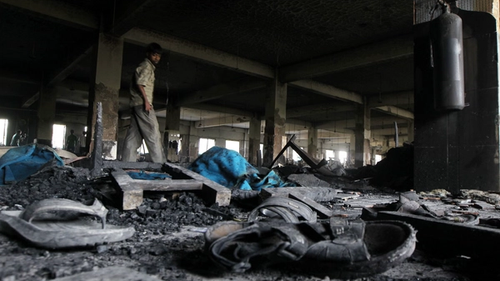
The consequences of the fire at the Tazreen Fashion factory
The work of adolescents and less than $ 80 per month
3,500 textile factories are located in Bangladesh, and about 4.4 million people work in the sewing industry, most of which are women. Minors also go to work in factories in the hope of feeding their families. Starting monthly salary of seamstresses and others cooperated: Ts factories is 8,300 taka (approximately $ 75). Every day, the position of the worker: C Witches: this is due to inflation, which in October 2023 approached ten percent. For comparison, in the year of the beginning of a full -scale invasion, inflation in Russia amounted to almost 12%. At the end of October, trade unions called to set the minimum wage of 23 thousand taka (approximately $ 209). After that, the worker: Tsy went to the strike.

Protest Works: T in Bangladesh
The protests coincided with the demonstrations of opposition parties, which demanded the resignation of the Prime Minister Sheikh Hasina on the eve of the elections in January 2024. Hasin, who came to power in 2009, was accused of authoritarianism, human rights violations, suppression of freedom of speech and repressions against dissenters. During the protests, the 26-year-old worker Razel Havlader was killed , the police were supposedly to blame for his death. On protests, the security forces used tear gas, rubber and combat cartridges in order to intimidate the demonstrato: K. Trade Union Leader: Ki call this incident one of the critical moments in the dispersal of protests.
After that, the strikes began in most industrial cities. Worker: TSI covered the roads, set fire to cars and at least four factories. About 300 sewing factories were closed, and those who took to the streets refused to pay. On November 7, the Bangladesh Ministry offered a new minimum wage - $ 12,500 ($ 113) for 4.4 million workers: Sworf industry. This is almost half as much as the amount that the trade unions requested .
Now, in order to survive and earn a little more than the minimum rate, the worker: Tsy refuse dinners, take additional shifts (in addition to their usual 48-hour work week) and loans.
If your labor rights violate, you can create a trade union or join the existing, inspired by the example of Bangladesh.

We talk about Russia's military invasion of Ukraine, protests and repression. We believe that now, when dozens of media have closed or ceased to cover the war, access to independent information is more important than ever.