
Translated material
Restoring the number of saigas
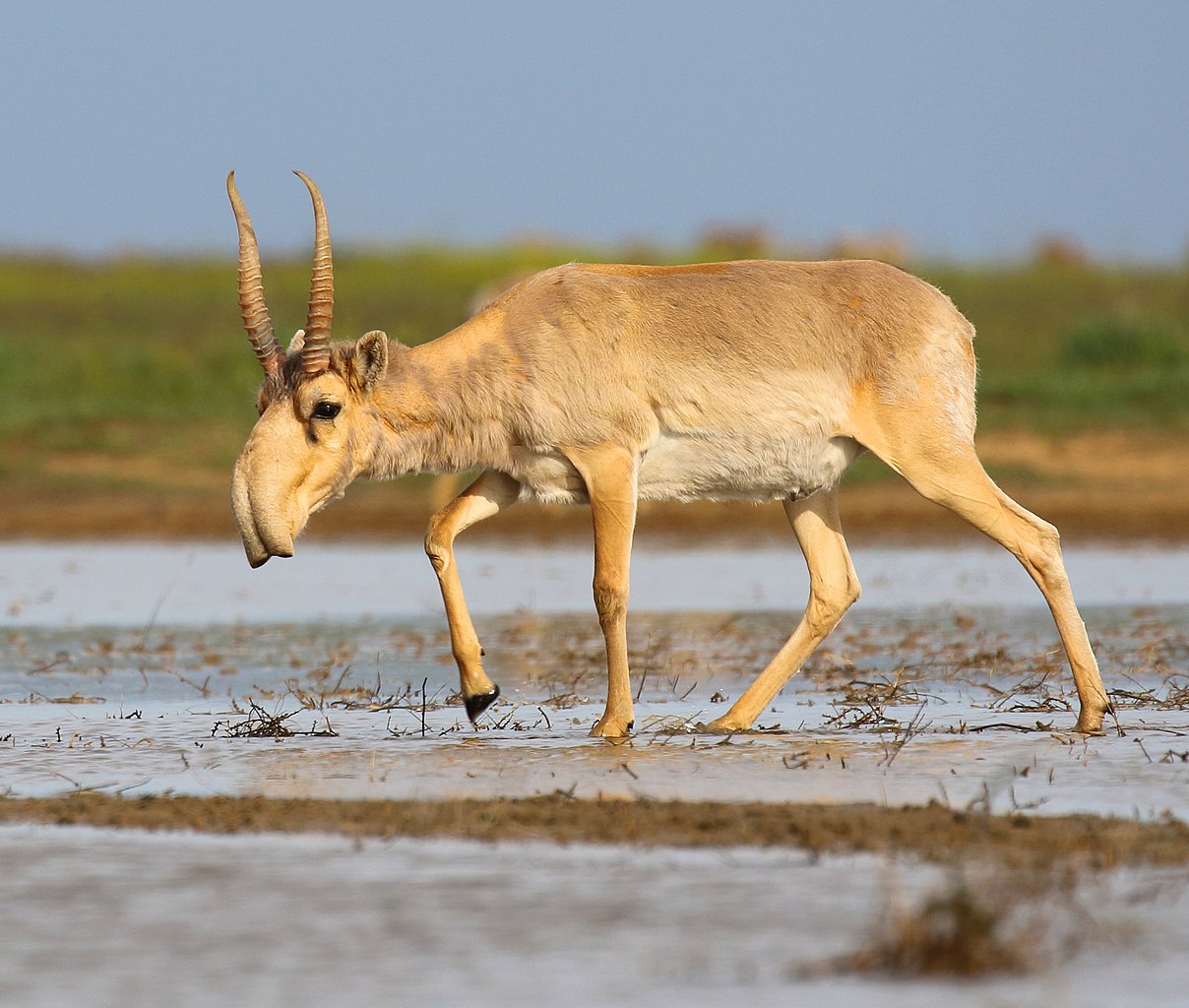
The International Union of Nature Protection changed the status of Saigak in the International Red Book. Until recently, Saigak was one of the species “on the verge of disappearance”, but now the experts admitted that his position has improved, and Saigak fell into a list of species “in a state close to the threatened”.
By the 1980s, the number of saigas has decreased significantly, but in the 1990–2000s, the extinction of Saigaks acquired a catastrophic scale. The main reasons were poaching booty (Saigakov’s horns are illegally delivered to China, where they use in traditional medicine), as well as periodically striking saigas of epizootics, during which animals die in thousands.
From May to June 2015, Kazakhstan suddenly died, according to various estimates, from 134 to 200 thousand saigas. This is more than 80 % of their number in the country and up to 60 % of the global population. Entire herds were dying of hemorrhagic septicemia, or pasteurellosis - a disease caused by the Pasteurella Multocida bacterium. Outbreaks of this disease of a slightly smaller scale were observed among Saigaks of Kazakhstan and earlier, in 2010, 2012 and 2013.
In 2018, the work of an international group of scientists was published in which it was concluded that a number of factors separately separately became the causes of such a large -scale epidemic. The authors of the study indicate that usually the bacterium of Pasteurella Multocida lives in the tonsils of saigas, without harm to animals, but in some cases penetrates the blood and causes an epidemic with a high level of mortality. Scientists include high humidity and increased air temperature a few days before the onset of mass deaths a few days before the onset of the disease. For other large mammals, such mass deadly outbreaks are not characteristic. Researchers associate the fate of Saigaks with the fact that these animals invest a lot of body resources in the development of the cub. Newborn Saigaki is larger than the children of all other ungulates, so they are able to develop rapidly and soon after birth to follow the mother, which is important for survival in a harsh continental climate. However, this causes a very strong physiological stress for the body of a given female. According to the authors of the work, it is no coincidence that the outbreaks of the disease among the saigas coincide with the edema period.
By this year, thanks to the measures for the protection of Saigak, its number increased to 1.9 million individuals. The increase is primarily associated with the fight against poaching in Kazakhstan and the establishment of new protected natural territories, primarily the state natural reserve of Bokeiord and the Aschiosek natural reserve (2022) in the West Kazakhstan region with a total area of more than 60 thousand hectares. Every year, in April, when the Saigakov’s light wool stands out well against the background of soil and young vegetation, in Kazakhstan, a aircraft training of the number of saigas is carried out. In Russia, the Saigakov reserve "Black Lands" in Kalmykia is engaged in the protection of Saigakov. According to 2020, in Kalmykia there were about 6350 saigas.