
Translated material
Another massive amendment?
The Message of Zorkin, the chairman of the Constitutional Court, will tell us more changes in the country than the president’s speech
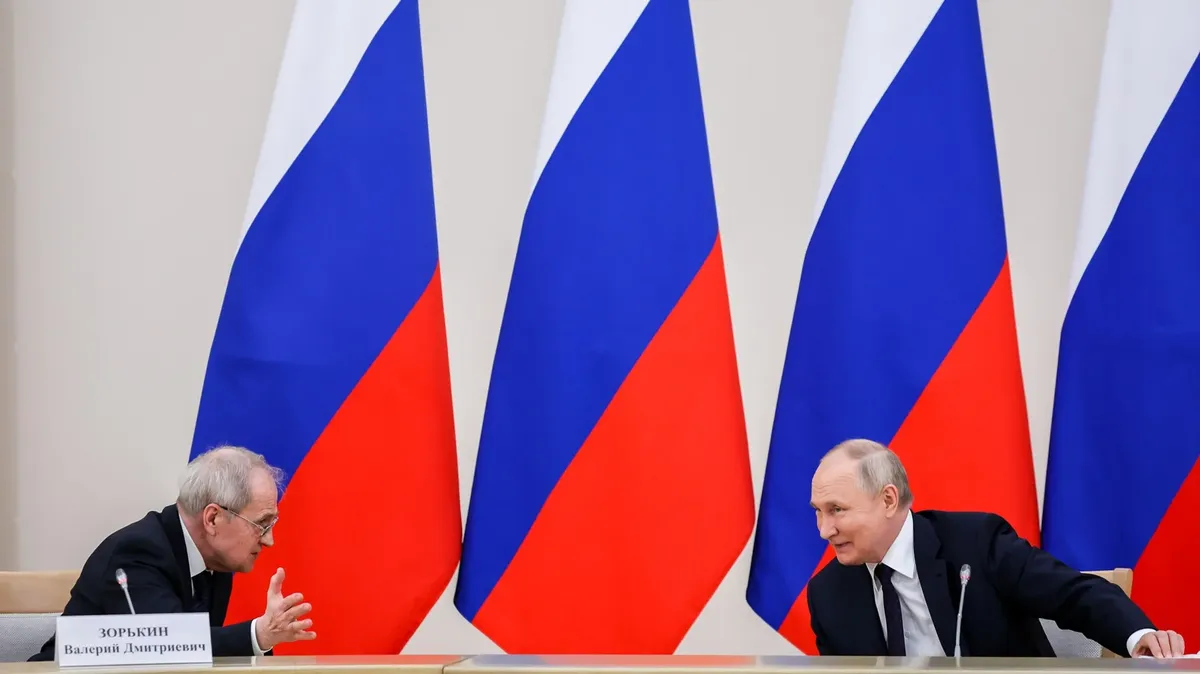
Chairman of the Constitutional Court Valery Zorkin and President Vladimir Putin during a meeting with the judges of the Constitutional Court of the Russian Federation. Photo: Mikhail Tereshchenko / TASS
With some delay caused by work on more relevant topics, we will still turn to the “annual Epistle” by Valery Zorkin, which was published in the “Rossiy newspaper” on the eve of the Constitution Day, December 11, as well as his speech at the meeting of the President with the judges of the Constitutional Court of the Russian Federation on the very day.
Zorkin traditionally twice a year, preparing for a performance at the St. Petersburg Law Forum in June and for a meeting with the president in December, creates huge political and philosophical treatises that willingly and without editing take the RG from him. This time, Zorkin did not say anything epoch -making or scandalous, and his texts were almost unnoticed, but it is necessary to read them carefully.
The Chairman of the Constitutional Court does not belong to the neighboring Circle of the President and does not affect him decisions, but participates in the creation of an ideological platform for them.
He is one of the few, if not the only one but the president who is allowed to speak in the highest level meaningfully, and the analysis of his “Epistle” will tell us more than the direct line of Putin.
Zorkin pays a lot of attention to the newspaper article to Ukraine, justifying the need for his own that in 2013 a coup d'etat occurred there: “In the West, such an atrocities would be cruel.” At the same time, without noticing double standards, he evaluates as a revolution and events in the Russian Federation in 1991 and 1993. In this logic, the terrible NATO would also have the right to “restore order” in Russia, how is it now trying to do in Ukraine of the Russian Federation?
The somewhat frightened half -turn of Zorkin towards moderate liberalism is indicative:
“We hear the irresponsible speeches of those who call for the complete coagulation of everything that has been acquired, for the sake of returning to some kind of allegedly soil utopia. But is it really unclear that the singers of lack of freedom and arbitrariness with their denial of the need to mating freedom and law and order, with their chanting order as such - are the reactionary nihilists who go hand in hand with the anarchist nihilists? ”
This is practically copy -paste that Zorkin spoke at the legal forum in June, although there he developed this thesis in more detail. However, the chairman of the Constitutional Court considered this thought to develop this idea with the president, regarding the constitutional amendments of 2020 as "an attempt to more balanced to combine the principles of freedom and the principles of solidarism, which are traditionally very important for the Russian state and Russian society."
Zorkin devotes the most significant in volume to the newspaper Zorkin, focusing on violation of its principles, admitted under Yeltsin:
“Russian society is already quite well aware of the connection between the socio-economic position and the injustice of large property spent in the country in the 90s of the last century. And this not only casts doubt on the legitimacy of the prevailing system of property with all the ensuing consequences and risks, but also leads to a demolition of public confidence in the social structure as a whole. ”
“We have to smooth out an unreasonable sharp social inequality, which, according to some leading sociologists, is perceived as unfair already in all segments of the population. This is the only way to rely on strengthening trust between power and the people, as well as the revival and development of traditional Russian spiritual and moral values ... An example of such a revival should give a Russian elite, which is now facing a historical choice: either to rise with the people to a new level of spiritual and moral development, or lose touch with the people ... "
From these leftist reasoning in the newspaper, which I have greatly reduced here, it follows that
The issue of deprivatization and review in some form of the results of privatization of the 90s at the highest level is at least discussed.
At the same time, speaking at a meeting with the president, the chairman of the Constitutional Court completely bypassed this topic: apparently, the attitude of this has not yet been formulated to deprivatization.
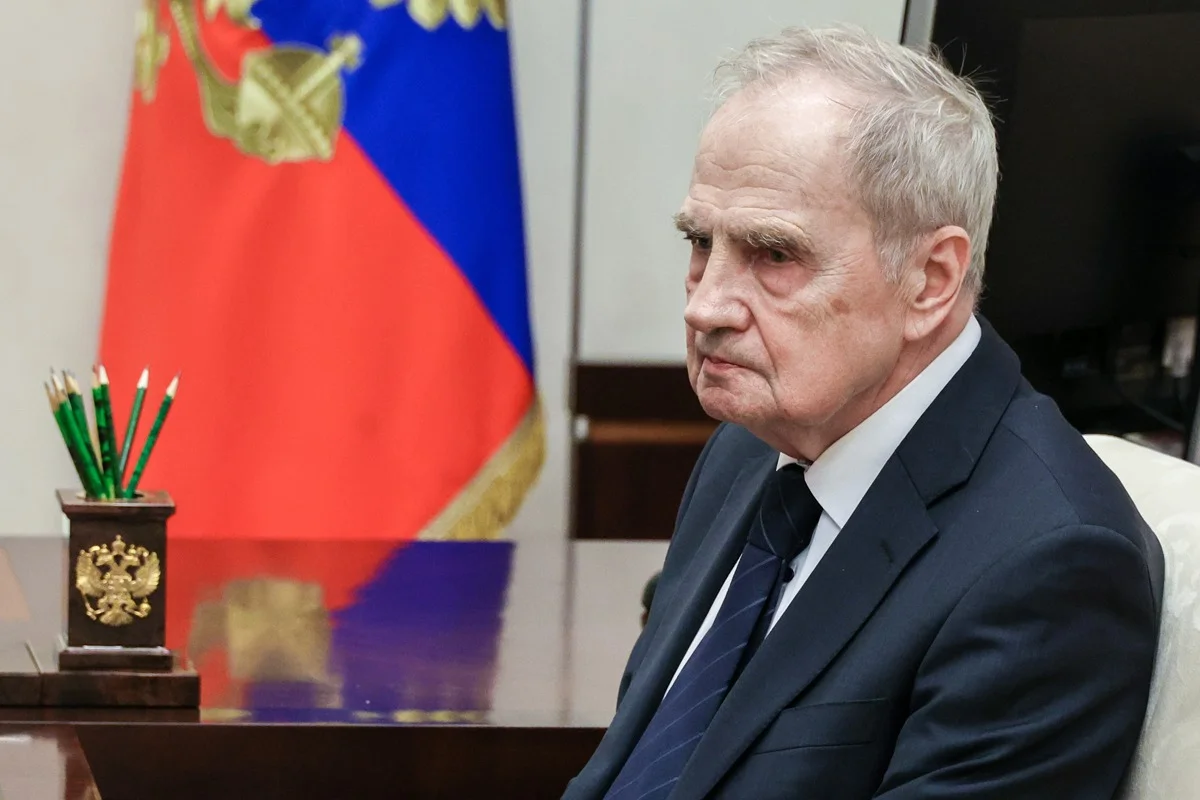
Zorkin did not begin to develop citizens to the president and the topic of social rights and guarantees of citizens, although in the newspaper he paid a lot of attention to her - most likely, such delicacy is related to understanding the absence of resources to the realization of social obligations to citizens.
In general, it is characteristic (and the same thing we could observe at the meeting of the President with the HRC) that the “human rights”, which are translated from French and English, from where their concept is borrowed, are thought of as political, are actually opposed to the so -called social rights, which are allegedly underestimated in the hypocritical West. In fact, the concept of a social state arose in the 19th century in Germany, in Western countries in the twentieth century these rights never left the legislative agenda, but there they are perceived (which is more correct) as ordinary obligations of the social state, and not as political rights requiring consolidation at the constitutional level.
Zorkin spoke ambiguously at a meeting with the president and in relation to the Constitution as such:
“Maybe there are times when it is necessary to change the constitution. But before you do such things that are sometimes called now, it is very often visible through the central channels, you need to think about what it is necessary for, especially after a massive amendment to the constitution was carried out. ”
The “massive amendment” is a know-how (the text is taken from the president’s website, where he undoubtedly carefully read).
Perhaps Zorkin involuntarily talked about what the Constitutional Court, who participated in this procedure in 2020, then preferred not to notice: 206 amendments to the Constitution were processed as one “amendment”.
From what was said by Zorkin, one can so far make a confident conclusion that the issue of the complete replacement of the 1993 Constitution with a new one, in any case, is discussed. And this is very serious: in this order, its chapter 2 on political rights and freedoms, until formally touched by the "correction", can be completely revised.
In conclusion, I would pay attention to the written (and therefore carefully thought out) Zorkin at the very beginning of a lengthy article in the “RG”:
“The Constitution is specified in the system of laws and other regulatory acts, as well as in law enforcement decisions of state bodies and officials, in the lawful actions of individuals and legal entities. In this aspect, the Constitution acts directly "...
According to the unchanged article 15 of the Constitution, it has a “direct action”, and a conscious substitution by some “aspects” is unacceptable for the chairman of the Constitutional Court. But it is necessary to somehow theoretically justify the fact that not only decisions are made in the country, including judicial, but also laws that directly contradict its constitutions. This is what the judges of the Constitutional Court, led by its chairman, are concerned today, seeking justification in Russian traditions (arbitrariness) and (instead of law) in the “spiritual and moral values” of the “Civilization Country”.
Who argues: Russia has its own specificity compared to Europe. But if you make the wheels not round, but square, the cart will not go far.