
Translated material
Henry Sapgir. Vote
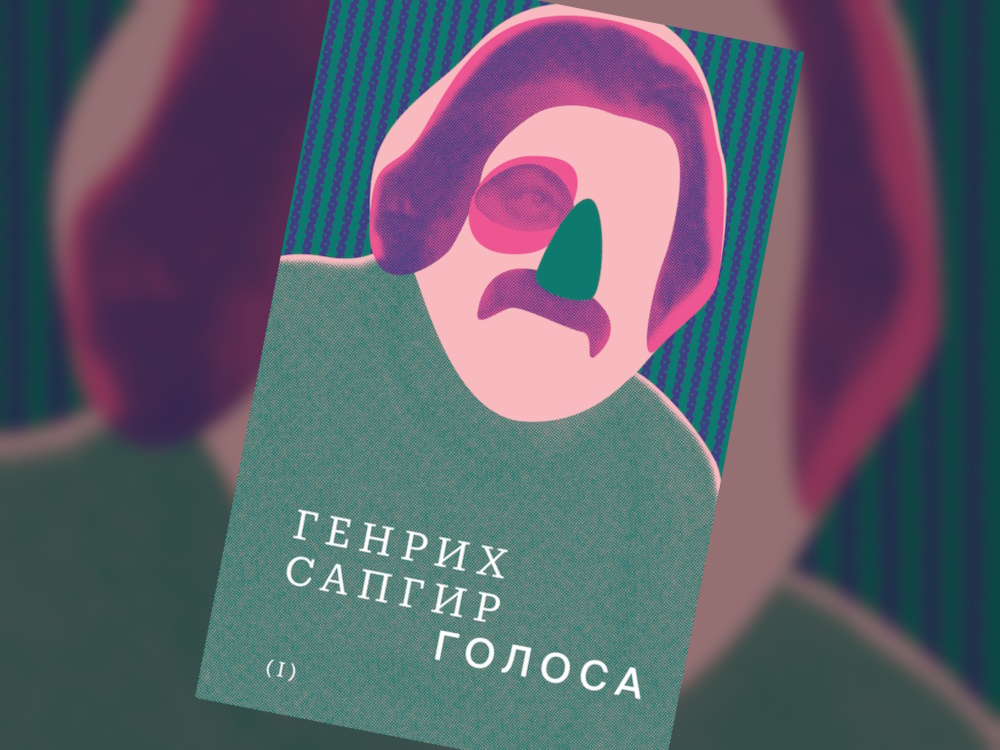
The Publishing House "New Literary Review" represents a new collected works of Henry Sapgira. The first volume is called "Voice".
The new collected works of Henry Sapgira are an attempt not only to gather together most of what was written by a wonderful Russian poet and a prose writer of the second half of the 20th century, but also to create some integral image of this unique (even for this period of our literature) universal writer. He not only wrote with equal pleasure for adults and for children, but also as embodied in the word of the Larion-Goncharovsky concept of “all-handed”: the connections of all the ideas, manners and techniques of modern writing, simultaneously radically avant-garde and extremely rooted in the deepest national tradition and conducted a constant provocative dialogue with it. The first volume of the meeting “Voices” included the different-yarn works of Henry Sapgira, united by the idea of dialogue-with predecessor poets and contemporaries, with social language models and metaphysical forces. Sapgir acts as an interlocutor-opponent, then as a translator of other people's languages, then as an artist-researcher of the human (and inhuman) many many years.
We offer to read one of the memoirs of Henry Sapgira included in the book.
Lianozovo and others
<Groups and mugs of the late 1950s>
The bright surge of the underground of the 60s and especially the 70s in our poetry and painting (and they walked together) spent its roots in the previous decade-at the end of the 50s. And if we talk about the Lianozovo group, which is so much connected with, then you need to start with a long -term, with a two -story hut, which stood on a hill above the long ponds, where our spiritual teacher - poet and artist Evgeny Leonidovich Kropyvnytsky lived in a little goren.
I can say his earliest student. I have known Evgeny Leonidovich since 1943, from my fifteen years. Often I stayed at him to spend the night, and then I was laid on the floor, on which they put a plywood and some clothes-the room was small, his wife-the artist Olga Ananyevna and the daughter of Valentina lived in it. The son of Leo was in the war. Other students appeared over time, both in poetry and in painting. We walked around the surrounding parks and forests, read and talked endlessly about art. It was a true teacher and a magnetic person. As I understand it, he allowed every neopitus to prove himself and supported him in this desire. Why he was not arrested at one time, I don’t know.
I remember how I was struck by his verses of that time. It turned out that poetry was not at all what it seemed to me by reading the poets of the 19th century and the symbolists. Poetry was around - in the very nature of the Moscow Region and in those figures that, swaying, wandered around this prefabricated absurd landscape.
By the mid-50s, when I returned, having served in the army, from the Urals, a lot has been determined in the life of my friends. Not far from Dolgoprudny in the hut built by prisoners of war, the artist Oscar Rabin settled at the Lianozovo station, married the daughter of Yevgeny Leonidovich Kropivnitsky, and the friends and students of our teacher reached there. At first there were Saturdays, then, it seems, Thursdays. But this is not the salt, most importantly, everyone could come, come and show their picture and read their new verses.
At this time, Chertkov’s group gathered in Moscow on Bolshaya Bronnaya, in relation to us a little more conservative - in the apartment of Galochka Andreeva, students Krasovitsky and Khromov gathered, Andrei Sergeyev and others. Andrei even then seemed very scientists to me and reminded Tyutchev and Tynyanov at the same time. All of them were aesthetes and rebels. Leonid Chertkov, as I understand it, was an inspirer and dynamic fuse, and he brought his material from the smoking room of the Lenin library. The brightest poet in the Stas Krasovitsky group drew his inspiration in the horror of the coming atomic war and painted poetic paintings that would be surrealistic if they were not so natural.
Nearby, "on Yuzhinsky", as we said, stood another remarkable house. There, in an ancient pink-haired mansion-communal woman to the prose writer and philosopher Yurochka Mamleev, pale young men and girls, the so-called sexy mystics, came. I visited this semi -dark intricate apartment several times, I did not find any debauchery, on the contrary, only philosophical conversations. But! It was sex in the highest mystical sense! And in Slavophil, too. I remember that in my eight-meter room, where up to thirty people were stuffed, Yura, a short time, leaning for a notebook under a paper lamp of a desk lamp, with a fertile whisper read his first astrally barrel stories. His heroes were ghostly and made their physical departures as a prayer. The main idea: through nothing to the Absolute. It was impressive, life around was just as unrealistic.
At the same time, under the central house of railway workers, the lithobobia, which was led by the Soviet, in the full sense, the poet Grigory Levin grew. He understood the poetry as something sentimental, and this still distinguished him from the cloth and concrete poems of that time. And it allowed the wonderful Bulat Okudzhava and Vsevolod Nekrasov, as far as I remember, Nina Belosinskaya appeared there. But they seemed to be not long there.
Once Igor Kholin and I appeared there, it seemed to read something. I don’t remember the details, but now I called Igor Sergeyevich on the phone, and he told me that they had accepted us well at the highway and we all met. Unlike other places where we also read, and behaved defiantly and arranged scandals, according to him.
There was also such a Literary club “Torch”, which was led by the subsequently known professor-gibramist Melib Agur, then-just a long bald young man. For some reason, I taught novice poets the technique of verse, apparently, they asked me. There I met the talented poets Sasha Laiko and the seeds of Greenberg, and we became friends for life. And yet - Karabchievsky, also from there. Our first performance in public: Agur is sitting on the presidium in large black glasses. This is so that the KGB does not recognize him. But they performed without consequences.
Then, in Moscow, the first unforgettable salon Madame Friede, an elderly lady, the daughter of the royal general, how she certified herself. There you could drink a sweet mash, which the hostess skillfully prepared, fall in love and argue about the new in art. Below, the roofs of Borisoglebsky lane on Arbat were visible. And we were young, young ...
Friends-artists began to come to Lianozovo: Volodya Nemukhin, Lidochka Maskova, in a kind-Lev Kropyvnitsky, Kolya Vechedomov, then-Oleg Tselkov, Volodya Weisberg, Dima Pudvinsky and many, many, over time. There was something to consult. The Moscow youth festival was approaching (an event, who remembers, grandiose!).
Then - the first youth exhibition. New ideas were born, the legacy of the 20s was re-experienced. Poprazing Shakespeare, the connection of the times broke, and it was not enough to find a gap and glue, to fasten - it was necessary to move on. Time was driving.
I am sure that in a person’s life, especially creative, it is time to come when it is necessary to make a decision and make an act - Lee, a novel or a picture. I am sure that there is always a choice. But if you decide, then there is essentially no choice. Something is pushing, it does not allow to stop halfway. Apparently, in the surrounding environment and in you, the content has accumulated so much that it is absolutely necessary to express this in its inherent form. Anyway how to give birth.
So for us such a time came. For all weeks, Igor Kholin and I walked along the autumn boulevards, drowning dry pink foliage, and talked about what, we anticipated, our poetry should be. We also had an example: our teacher. But it was necessary to find your form of expression. I'm not talking here about the form at all. In my deep conviction, the forms of impersonal, abstract does not happen. The form is always concrete - both in relation to the content and as an expression of the clot of a given person. However, it can be mysterious and unclear for the public. She clarifies, usually, then, when they get used to her, they begin to sympathize, empathize, and the understanding comes that to express themselves like this artist, naturally and beautifully.
Since childhood, my friend Oscar Rabin also looked for his form of expression.
He was brought up as a realist. At the Riga Academy, where he had previously studied, he was even called "Our Repin." But he, as others, did not suit the slave copying of reality - all these landscapes and still lifes. And once members of the qualifying commission of the youth exhibition saw: a skinny young man in large glasses puts completely unusual canvases on the wall - on large planes it was depicted ... These were greatly enlarged children's drawings. It was not like anything. These were the first works of Pop Art in Russia. Now this is understandable. But then the members of Mosha, embarrassed completely, took a couple of canvases. And they put up, not suspecting that in kind artist was the drawings of his daughter Katechka.
The artist himself already realized that the deformation of reality would reveal the true reality to him. And he began to write other canvases. First Adam and Eve.
But it was too much. Thick brown strokes, black contours - and in the winter twilight, a steam locomotive with the tail of a commodity rushes on us. On a steep turn. We all immediately accepted this picture as a symbol of our general state.
Meanwhile, the poets had a replenishment. Two young people began to come - Vsevolod Nekrasov and Sasha Aronov. The first - remained, made friends with everyone and became an active Lianozovist and collector of paintings and drawings of our artists. Then generally presenting your drawing or the picture was simple. For a birthday or because I liked it.
So Yevgeny Leonidovich gave his works - and for the good. Now it appears at European exhibitions.
Our familiar poet-translator (especially Lope de Vega) Volodya Bugaevsky once brought his friend, the same mustachioed, also bald, Yakov Satunovsky. He, seeing the yellow completely living barracks of Oscar and hearing poems about their population that Igor Kholin composed, was delighted as if he had met close relatives. He said: "Call me just Yang." And he became a Lianozovan, although he came to his manner earlier and himself.
In total, she, perhaps, is closer to Evgeny Kropyvnytsky-the first prevailing poems were marked in 1937, in my opinion, 1939. Nearby, I would put the early Nikolai Glazkov, who still wrote a lot of nonsense Soviet poems in addition to his present, valuable. But time eliminated the unimportant and unnecessary. Among other things, the poet Glazkov came up with the word "Samsebyazizdat."
Perhaps it can be called the forerunner of a poetic underground.
Now they like to mention that we were all different. Of course, different, but how else! But there was general: time. Everything opened for the first time, Vnov.
With inspiration, composing poetry, I have repeatedly fallen into an ecstatic state.
Others seemed to have a similar feeling. This, frankly, is the same as knowing the truth and God. Such a charge is such a discharge.
They did not create for printing, not for the exhibition: through the eyes of the soul, for the growth and improvement of their own essence. And the reward to the Creator is harmony and luck. I even translated Helterlin and William Blake into Russian, the only thing that I myself in the process of translating their spiritual ecstasies and mental travels myself. Transferred - and did not print. Normally for those years.
There were new artists, but then their forerunners existed in painting. This is now forgotten Yura Vasiliev. He was Van Gogh, and Dali, and Picasso - all taken together. In kind, on canvas - not in reproductions - this made a huge impression. And then Saroyan appeared, in which in the rhythm of rock and roll, points on a white canvas were flickering.
Zlotnikov showed me his “signals”, I did not understand anything, but I felt: completely new. It is impossible not to mention Misha Kulakov, who poured a paint on a huge canvas no worse than Pollak - in the whole workshop.
Meanwhile, at the VI World Festival of Youth and Students, which for some reason was allowed to arrange in the summer of 1957 in Moscow, there was an extraordinary one. A renegade, a deficiency, a painter, a drunkard in his crumpled Tyrole hat Tolya Zverev in several strokes won a gold medal - however, Sikeiros was the chairman of the jury. It was also a victory!
Since 1953, I began to visit the workshop of three sculptors - Silis, Lemport and Sidur. Ernst unknown often visited the same basement. Boris Slutsky was their friend. There, behind a bottle of vodka, which invariably appeared on the table, I often read my poems, and Kolya Silis and Volodya Lemport played the guitar and sang their ironic bits. It was a special circle of art people who, in their own way, understood and felt modern. Lemport and Silis, as it were, played their girls. Sidur already included the elements of abstraction in his figures. At the unknown, muscular stumps were writhed and flew into the air - an explosion! "What are you friends with these crazy ones?" - the young and prosperous sculptor from Mosha reproached me.
Another circle is Eli Belutin with many of his students. In the paintings - complex colors, semi -astracial reality, generalization. For us - for me and Igor Kholin - it was also a friendly audience where new verses were read and tested.
Once the ruddy boy Alik Ginzburg came to Oscar Rabin, who soon turned out to be the outrage of Soviet calm and all of us in the first Syntax magazine in 1959.
The magazine was first “published” in four copies on a typewriter, which did not save him from the rage of his bosses, as well as two decades later, in the late 70s, our Metropol. I remember, I was sick with polyarthritis earned in the army in the Ural swamps, Alik visited me and shared his idea.
I immediately supported her. "Well, of course, one art, no policy."
Alik agreed with me. But his act itself was already a policy. After all, just our existence in this country was then a sharp political issue.
Thank God, a real artist thinks only of his own.
First of all, we tried to express the “thought of the heart”, as the unknown liked to say. And they were not afraid of anything, many had experience of terrible life, poverty and war.
In 1959, I went to Leningrad, where new friends called me. I was driving like a messenger of Lianozov - one might say, arrived with the mission. But before I appeared in St. Petersburg, Misha Kulakov and Gleb Gorbovsky walked around the city and read my poems, and Gleb issued Misha Kulakov, who appeared in St. Petersburg recently, after Sapgir who came from Moscow.
It is quite in the spirit of the Oberiuts.
In St. Petersburg, I met and made friends with many, primarily with the company: Rhine, Bobyshev, Naiman and the very young Joseph Brodsky.
I remember, somewhere we hasten into snowstorms, through the bridge, pass under the muzzles of stone horses ...
I also saw the golden -haired Gorbovsky, who was so drunk that at my performance he wrapped himself in the carpet and so, in the carpet, rolled into another room. It was on Rubinstein Street in the apartment of Zhenya Rhine, forgive the involuntary rhyme. But about the circles and circles of Leningrad, I think, my old friend Viktor Krivulin, who knows the whole of Peter in time and in space deeply and thoroughly, will ever write more than me and. Believe me.
Meanwhile, rumors about us in Moscow multiplied and grew, and foreign guests began to visit us in Lianozovo. Black cars of a famous organization crawled behind foreigners. But this is a separate topic. The state and the artist. This, meanwhile, brought the benefit. Artists began to sell their paintings. Frank poverty, at the level of poverty, moved away. Although she never bother me. In your youth, I think. Not only feuilletons began to write about poets and artists. Serious articles began to appear abroad.
And in Lianozovo, Boris Slutsky once brought Ilya Grigoryevich Ehrenburg with his wife-artist and poet Martynov. When after watching the paintings, everyone, uniting at the table, drank and bite something, I asked Ilya Grigoryevich that he was thinking about the paintings of Rabin and Kropyvnytsky.
“This is all - expressionism,” the venerable writer answered. “Personally Impressionists are closer to me.”
- But what about Picasso? - Knowing that the whole apartment of my interlocutor was hung with his drawings, I asked.
“But he is my friend!” - Ilya Ehrenburg answered with immediate pride.
On this occasion, I would like to notice that Russian art of the late 50s-early 60s is united by undoubted expression. For too long and tightly, the spring was compressed. And now she straightened up with a ringing.