
Translated material
Is there an idea in the "idea of the people"
What spells are based on the stability of Russian life. About humility and its symbols
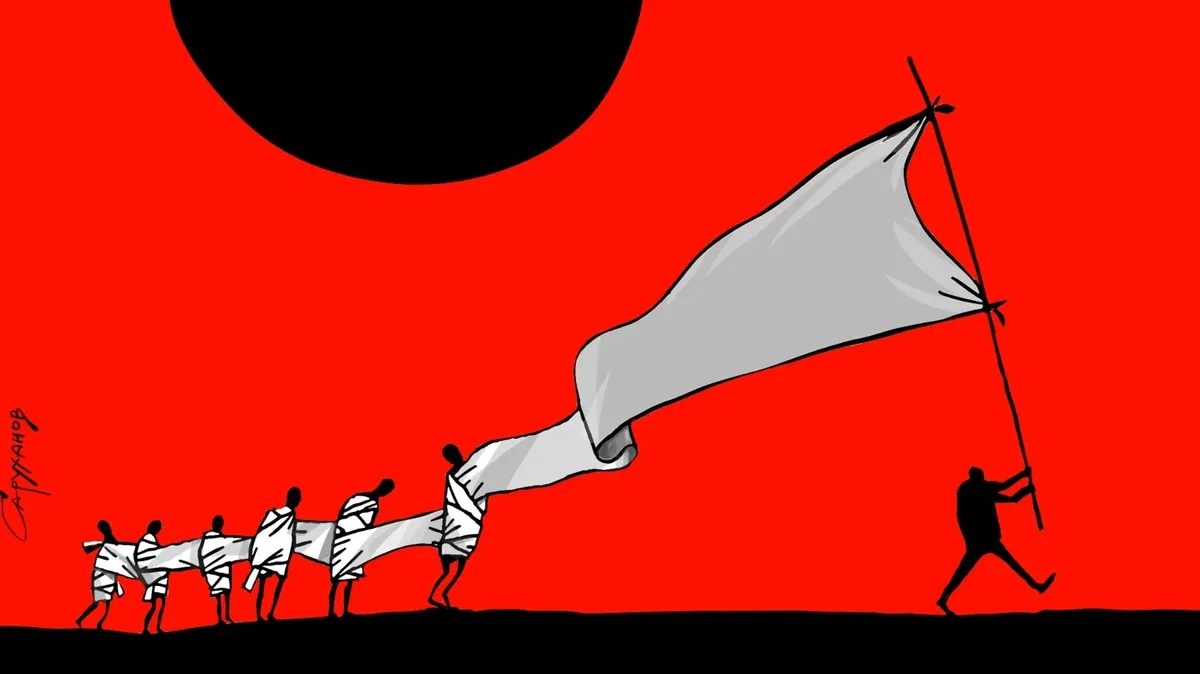
Peter Sarukhanov / "New Gazeta"
Here are quotes from the speeches of one famous Russian politician - the one that is now the only, in fact, legal politician in the country:
“We must believe in the great Russian, Russian people. The Russian national idea is in patriotism, nothing else can be here. The only salvation and condition for moving forward is unity. ”
Such frazes or like they are now using many Russian residents now. Especially in cases where it is required to give at least some justification of what is happening to their country. However, no matter how much you say: “great people”, “patriotism”, “unity” - this will not bring closer to understanding these words, or to understand what the mentioned “national idea” or “the idea of the people” is. However, many are not concerned with understanding. It is also enough that there are such words-are, with the repetition of which anxiety disappears somewhere. For a while.
* * *
In its simplest, formal meaning, “people” are, first of all, a large number of people. In one way or another, with each other close -knit. For rallying, at least two conditions are needed: the unity of the territory and the unity of understanding. Therefore, the people should have a common land with which they identify themselves, as well as a common language. Moreover, the language here is not just a means of communication, but a stable system of symbolic images describing the world and the place in it of these people. And first of all, thanks to this system, and not because he simply lives on this earth - a person gains and feels his “popular” affiliation.
In order for the rally to be stable, the system must be constantly reproduced, repeated the same foundations on which it was held and rested.
If the basics are subject to changes, the cohesion will weaken. Each new generation should reproduce what the previous generations were based on. The stability of folk life is based on repetitions.
In fact, when we talk about the “idea of the people” - we mean primarily that symbolic system that is restored over again, generation after generation. Many things can be modernized and completely modified - the appearance of the people and its land can change beyond recognition. But, if you persistently repeat the “wisdom” of the ancestors, then the story will pass through the people, without affecting anything in it. Whatever new thoughts and revelations appear from time to time, but if the “idea of the people” is strong, this will not affect the lives of people in the life of people. No one will learn the new one, and in general, he will not want something new. The “idea of the people” is a kind of fuse from ensuring that some changes become possible.
How does the “idea of the people” appear or, better to say, is its symbolic system? Probably, it is not given in some finished form, it is not predicted by default. However, the ideas about such preference are very popular - and not only in distant archaic times, but now. They are united by the general concept of “primordial”, which indicates that there is a certain initial, congenital given.
The “primordial” approach, on the one hand, gives good ground for the imagination, which gives rise to epic stories about the inevitable “fate of the people” or about the unchanging “spirit of the people”. On the other hand, such stories radically simplify reality, eliminating from it the vector of variability, hypothetics and in general - evolutionary.
If we are not looking for simple answers, then the source of the symbolic system can be assumed by a nonlinear and intermittent process of its collecting from those emotional reactions, thoughts and images that arise when people experience the dramatic, turning points of history. In short, it is made up of impressions born from the clash of the human “I” and the world. And it is obvious that both impressions and reactions preceding them are not predictable here, for example, for representatives of the animal kingdom.
A person is deprived of a natural program in advance in him, which would determine the reaction. It has the opportunity to feel, think, or act in a very unexpected way. Even if he still thought and acted according to a well -known model. This is the key difference with the animal, and it is called freedom.
Therefore, the “idea of the people” is also gathering and re -displayed again with each new generation, or even more often - but is not issued once and for all in an exceptionally perfect and finished form. And even if this idea is identified by her adherents or opponents as the same idea - in reality it is never equal to herself.
In general, taking into account its “collective” production-the “idea of the people” and does not exist as something that can be equal to itself. There is no invariable substantiality in it - unless, of course, we, as supporters of a primordial approach, - we will not want to attribute it to her. But, even being attributed, such a “substantiality” in front of his eyes demonstrates its variability and heterogeneity.
For example, the idea of the “Soviet people” several times was very radically transformed during its almost centuries -old period of existence. What it was at the beginning of the revolutionary 20s of the last century, then in the autocratic 30s and 40s, then in the “thaw” of the 60s, and what it was under the curtain, in the 70-80s, are very different ideas, different “Soviet peoples”.
Or, already in our time, if we consider the “idea of the people” in the aspect of the political elections, in connection with the electoral preferences of the country's population, then the return of votes for the well-known irremovable candidate for Russian presidents in the zero years, in the 10s and now, in the early 20s, these are the elections of completely different scenarios of history, various concepts and myths that this candidate in the aforementioned periods.
* * *
Ideas are rafting, there is no doubt about it. Sometimes they can unite really huge amounts of individuals who, under their influence, begin to look in one direction and strive for one goals. But more often, ideas make diversity, i.e. In fact, they are divided.
There are no more alienated or even antagonistic to each other individuals or social groups, if they are captured by opposite ideas - even if they speak the same language and live in the same territory, in the same house. There was no such social idea that would not have both devoted apologists and radical critics.
And where the same idea covers the majority of minds - it breaks up into many interpretations and versions, sometimes completely implacable.
Is it possible to imagine a more stringent struggle between interpretations of the idea of social justice, i.e. Socialism, which went throughout the first half of the twentieth century and is not finished to this day? Or imagine large discrepancies and party schisms between those who consider themselves an absolute supporter of a democratic idea?
In addition, if we talk about the “nationality” of ideas and return to the formal understanding of the people as a large number of people accumulated in the same territory, then ideas never arise out of this amount in a certain “natural” way. Like the same in the representations of the inhabitants of the "dark centuries" - mice arise from rotten straw themselves. No, ideas always come from very few cultural elites, from single geniuses and artistically gifted charismatics. Actually, in the "people" ideas acquire only their second life - and very distorted due to radical simplifications. There is a completely obvious proportionality between the level of spread of the idea and its popularity - and the level of its simplifying distortion.
If, as we see, no “folk idea” is too “folk” and, moreover, does not serve as a constant identifier, then what then provides people with their rally?
There is one general property that is invariably moving from century to century. This is a certain hypnotic sparkling before the superior and obvious force of circumstances, which is perceived by people as an unspoken law to which they subordinate their will and consciousness. With the help of no matter what power is identified, the result of its impact will be the same: the humility of the majority. And even in cases where power is accompanied by very extreme ideas that break the usual order of things - it, as a rule, is also ensured by human humility.
But here the conversation begins not about the "folk idea." Here we should already turn to some existential and psychological states, very archaic conditions that precede all idealization.
* * *
Once upon a time, the Italian humanist Pico Mirandola wrote a key to the whole new time: “It's about the dignity of man”, where the main subject showed the human ability to self-determination. The ability is tied to the fact that people by their nature are uncertain creatures - according to the initial plan about them of the "Creator". Therefore, they themselves decide who to become and for what purpose to live. Actually, this is their dignity. The "Creator" shared with people his ability to create something out of nothing - or almost nothing.
“We do not give you, o, Adam, neither a specific place, nor your own image, nor a special duty, so that you have a place, a person, and a duty of your own free will, according to your will and your decision. The image of other creations is defined within the laws established by us. You, not constrained by any limits, determine your image by your decision, in the power of which I provide you. ”
(Pico Della Mirandola. "Reaching the dignity of man")
In general, the concept of Pico Mirandola can be considered as the basis for the above statement that historical space all the time reduces, remakes itself with the help of various ideas and their interpretations. This concept can be justified by such a bright and dramatic game of creative forces in human history and culture. And one could say that in terms of free self -determination, humanity is quite follows the plan of its “creator”.
But. We also see how often such a “expected” creative leap happens in the history of the peoples; How long, for centuries, peoples can tolerate violence of both their own authorities and foreign will.
We see how humble indifference to his fate prevails over the will to "determine his image by his decision."
In general, the substantial uncertainty in which the humanist Mirandola saw the highest dignity of a person is perceived in most cases not only not as something valuable, but, on the contrary, as a heavy burden and a curse, which should be eliminated at the first possibilities. And such opportunities do not force themselves to wait long.
Almost every idea, falling into a wide public context, begins to claim dominance, to the position of the only “correct” idea. It is clear that it is not the idea that the idea is claimed, but its carriers, its apologists. And if they manage to gain actual power over society, then the government also acquires their “correct idea”.
Actually, history often demonstrates to us that such victorious ideas have power and influence in themselves, but only as an additional justification for the power and the influence of their apologists. However, at the same time, the victorious ideas still play a very important role: they give consciousness and feelings that comfortable certainty that the majority needs so acutely. They create a stable and closed symbolic system, which the authorities actually proclaim a genuine “folk idea”. As for the “people” itself, then, as a rule, he is quite satisfied with this and is not eager to penetrate the essence of the ideal world and find out his correspondence to the world of actual circumstances.
* * *
As a rule, any symbolic system around which the community is formed strives to take possession of this community as a whole, without leaving in the minds of empty places and issues. And, as a rule, the community allows you to do this. The more total the power of the rallying ideas and images is over people, the less worries, discontent and fears possess people, these invariable companions of being in the world. Power is achieved through the fact that ideas and images should constantly be in sight, must be continuously broadcast, repeated. This gives people a feeling that it was always so; Gives ideas and images the status of "naturalness".
For example, a religious person develops a feeling of stable faith with a regular visit to the temple, constant communication with co -religionists and periodic participation in prescribed rituals. And he has a certain “natural” way, by virtue of the influence of repetitions, the conviction will increase that the world is rules the image of which he is used to reading in his temple parish.
Or when a person is facing the desire of the people around him to increase the volume of his monetary contentment, then in a person a “natural” way strengthens both the idea and the feeling that the world is, first of all, the place where, as the modern Russian classic wrote, “business meets money”.
* * *
The ritual, repetition, habit, representation and words of others - this is what makes the symbolic system of undoubtedly gives it almost irrevocable power over the minds. This is perfectly stated in Rolan Bart, a philosopher-structuralist who studied the force of the influence of the language:
“Encratic language (the one that arises and spreads under the protection of power) is in its very essence the language of repetition; All official language institutions are cars that constantly chew the same chewing gum; School, sports, advertising, mass culture, song products, means of information non -stop reproduce the same structure, the same meaning, but it happens that the same words: a stereotype is a political phenomenon, this is the very personification of ideology. ”
(Roland Bart "Mythology")
This idea is interesting to continue: yes, power (political power) initially creates the language of repetitions for the community through which it reproduces and ritualizes itself. But the opposite is true - the language of a cohesive community, becoming under the influence of power, mostly the language of repetitions - in itself begins to reproduce this power. It is not necessarily this specific power - but that typology of power, which will best correspond to the current language habit, a stable language standard.
The language of the people itself begins to replicate such an attitude to the authorities with which he got used to, which he is used to talking and thinking. By replicating, he thereby calls for this power. And it resurrects it - even where this power seems to have already left the stage.
Moreover, the language of the people does not have to say the same words here - it is updated, modernized, and changes the stylist. But in essence, he is nostalgically deployed towards the already famous, many times reproduced meaning. At the base of this language, a well -known rhetorical question is always ready, the answer to which by default is already clear: "If not, then how?"
* * *
If we come across a combination of such words as “folk idea” and “unity”, it should be remembered that we are, in fact, about the unity of people in their humility to their authorities. As for the content of the idea, then, it seems, there has not yet been invented such a madness that people would not recognize - if the authorities persistently demand this.