
Translated material
Russians are ready for a truce with Ukraine
They are afraid to talk about it, but the fall of income and fatigue make themselves felt
The readiness of Russians for a truce in the war with Ukraine by the end of 2023 reached a maximum since the beginning of a full -scale invasion. How much people support the war depends on their sources of information and the level of income: “For” the war, expectedly, spectators of the TV with stable earnings, against the Internet content with falling income. “Cold” analyzed the data of the Chronicle research project and tells how the attitude of Russians to the war has changed and what should be expected in 2024.
In order not to miss the main materials of the "cold", subscribe to our Instagram and telegram .
How was the survey conducted?
“Chronicles” began to conduct polls immediately after the start of a full -scale invasion of Ukraine. Sociologists interviewed adult Russians according to a stratified sample by telephone interview. Studies were conducted from February 2022 to October 2023; In total, 11 waves of surveys were conducted in which researchers were interested in the attitude of Russians towards war, and respondents evaluated their psychological state and financial situation. The sample ranged from 1600 to 1800 respondents.
How the attitude of Russians towards war has changed
Immediately after the start of the full -scale invasion of Russia to Ukraine, 59% of the Russians surveyed by the “chronicles” replied that they support a “special military operation”. By April 2022, the share of the war supporting the war increased to 66% - over almost two years, it was then that the Russians supported it most - and then began to fall slowly: by July 2022, 55% of respondents approved the Russian invasion. Mobilization ruined the attitude of Russians to the war - then it supported 51%, but by the end of 2022 the share of the invasion of the invasion increased again and reached 57%. In 2023, the support of the war by the Russians gradually decreased: from 59% in the spring - to 55% in the summer and 52% by the end of autumn.
The Russians who during a telephone survey reply that they do not support the war were much less than those who announced support. In February-March 2022, the invaders of the invasion were 22%. Already in April, the share of condemning the war fell to 8%, and in May it rose a little - to 9%. After the mobilization announces in September 2022, the number of respondents who did not support hostilities increased to 12-13%, and by mid -October, to 9%fell. In 2023, sociologists noted that the number of anti -war answers almost did not change: in July 2023, 12% of respondents spoke out against the invasion, and 10% in October.
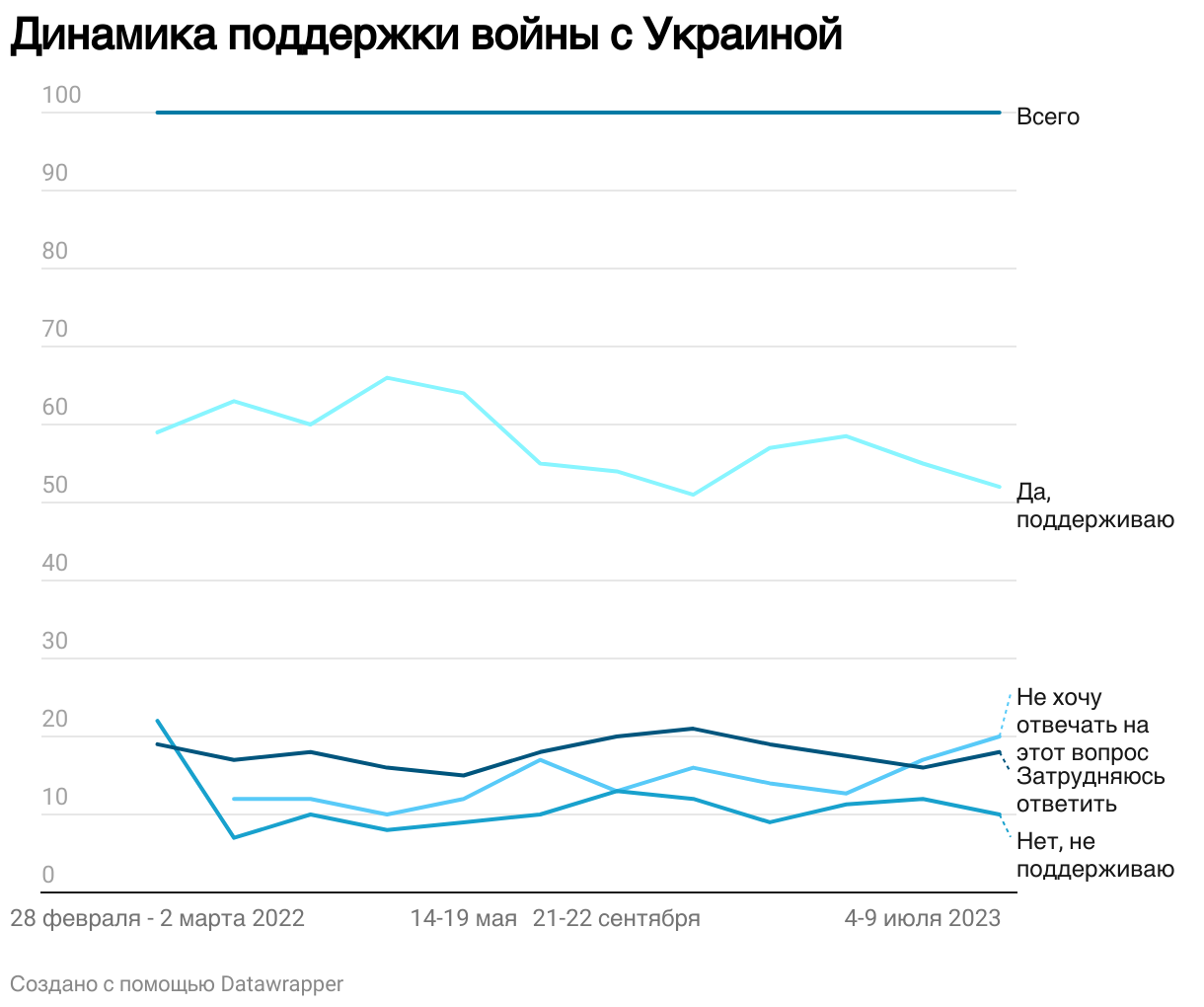
According to the Chronicle, already in March 2022, many Russians began to be afraid of criminal prosecution for answers to an anonymous telephone survey. People were afraid that the security forces would learn about their opinion about the war and could be delayed. Therefore, by mid -March, 12% of respondents refrained from answers about their attitude. By July, the share of failures increased to 17% - the “chronicles” associate this with articles on “discrediting” the army and military “fakes”. After mobilization with sociologists, 16% of respondents did not speak, but the largest number of those refraining from the answer was 20% at the end of October 2023. Most often, young people who fell under mobilization were afraid to talk on the phone with strangers and express their position.
The level of war support largely depends on the channel of the information received. The core of support is citizens over 55 years old, the main source of information for which are federal television channels. The level of support “Sw” is high in men who consume content on RUTUBE and state media. Citizens who actively use the VPN and consume the content of independent media outlets are the core of non -invasion. Also, a high rating for the disapproval of war in women with higher education under 41 years.
How Russians consume information
The main source of information by the end of 2023 is still television: about 68% of respondents consume the content of federal channels. The second place in popularity is information from your own nearest circle of communication: friends, relatives and colleagues. In this way, 40% of Russians use information.
Cloth the three various Internet sites, which are used by 35% of respondents. A little less (34%) consume information content of telegram channels. Cloth the five most popular sources of information for Russians YouTube Canals, which are used by 27% of respondents.
Television among Russians is also confirmed by the data of the Levada Center: in March 2023, 64% of respondents said they were watching the TV. In second place are social networks and online publications. Most of those who watch news on TV are over 55 years old. People aged 18 to 40 most often learn news from the Internet.
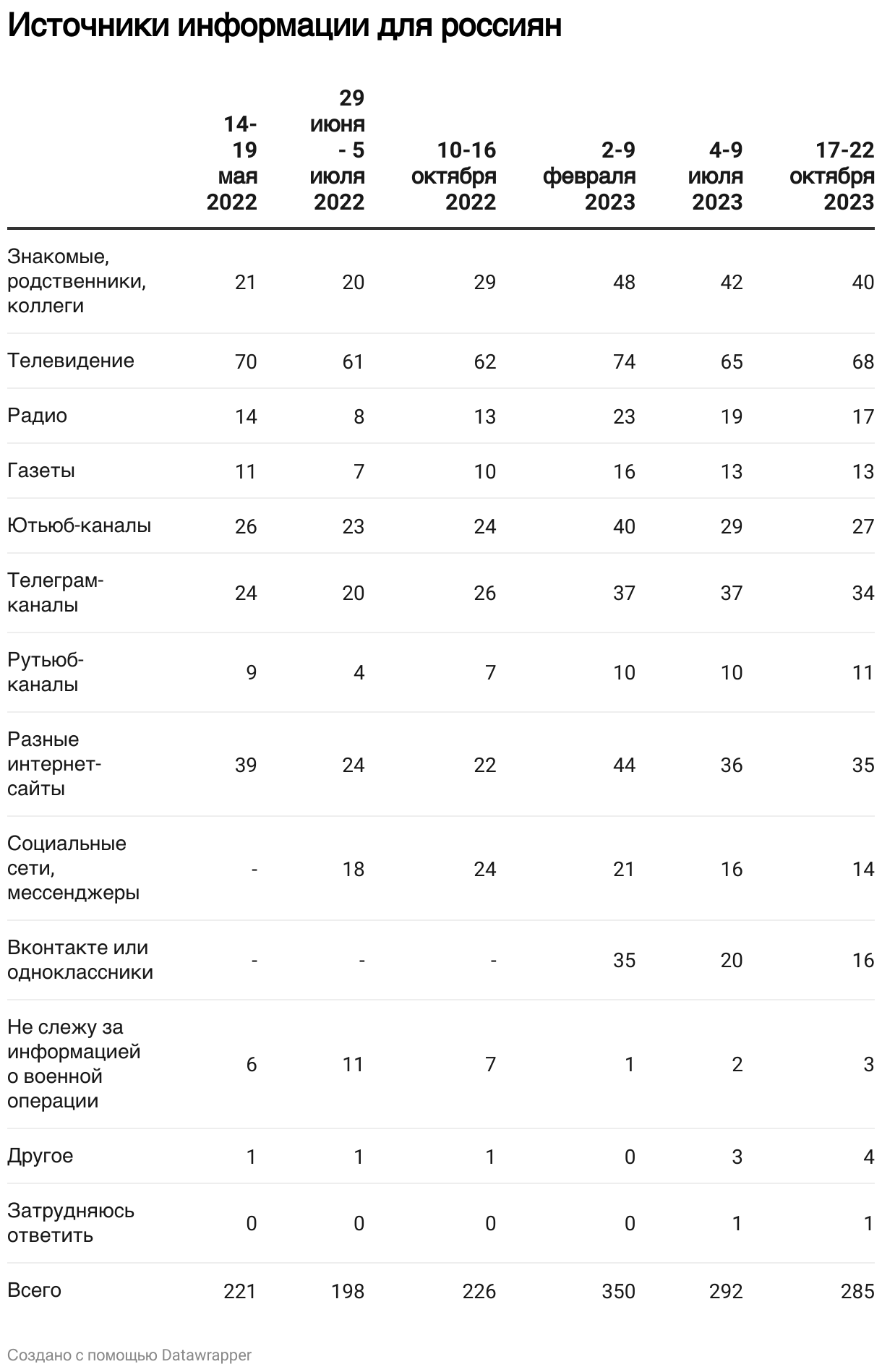
The data of the Chronicle research project indicate only one pronounced trend-an increase in content consumption from telegram channels: if in May 2022 24% of respondents used them, then by October 2023 the share increased to 34%. The growth of the popularity of the Russian competitor YouTube - the RUTUBE video hosting, fully controlled by the Russian authorities, is noticeable. If in May 2022 9%of Russians spoke about the consumption of service content, and in July 2022 4%generally, then by the end of October 2023 this share increased to 11%.
According to the project, the level of Internet penetration in Russia is quite high - 77% of Russians use it every day, 13% do not use it at all, but the use of VPN and awareness about what it is is falling. If on July 2022 22% of the respondents spoke about the bypass of the locks, then October 2023 this share fell to 18%. The share of those who stated that they do not use VPN at all, during this period, on the contrary, increased from 55% to 61%. The proportion of those who do not know what VPN is at all is stable in the region of 20%.
“After Prigozhinsky rebellion, the percentage of users [VPN] was at the level of 20%, and in October fell to 18%,” said Andrey Tkachenko, economist of the Chronicle project. -Since the beginning of 2022, the proportion of people using VPN has definitely increased two to three times due to blocking of social networks and independent media. My feeling that it will not increase, because the state does a lot for VPN locks. ”
According to the Chronicle study, in October 2023 the connection between the use of the VPN and the disapproval of the war decreased, but the influence of television on the approval of hostilities also decreased. Experts associate this with the fact that many Russians are tired of the war and began to consume less information content.
Russians are poor, but believe in the best
Since the Russian invasion of Ukraine, the share of Russians, whose income has suffered as a result of the invasion, has stably lasted around 40%. If in March 2022 39% of respondents spoke about this, then by October 2023 it increased to 44%. In October 2023, 21% of respondents announced the growth of income in October 2023.
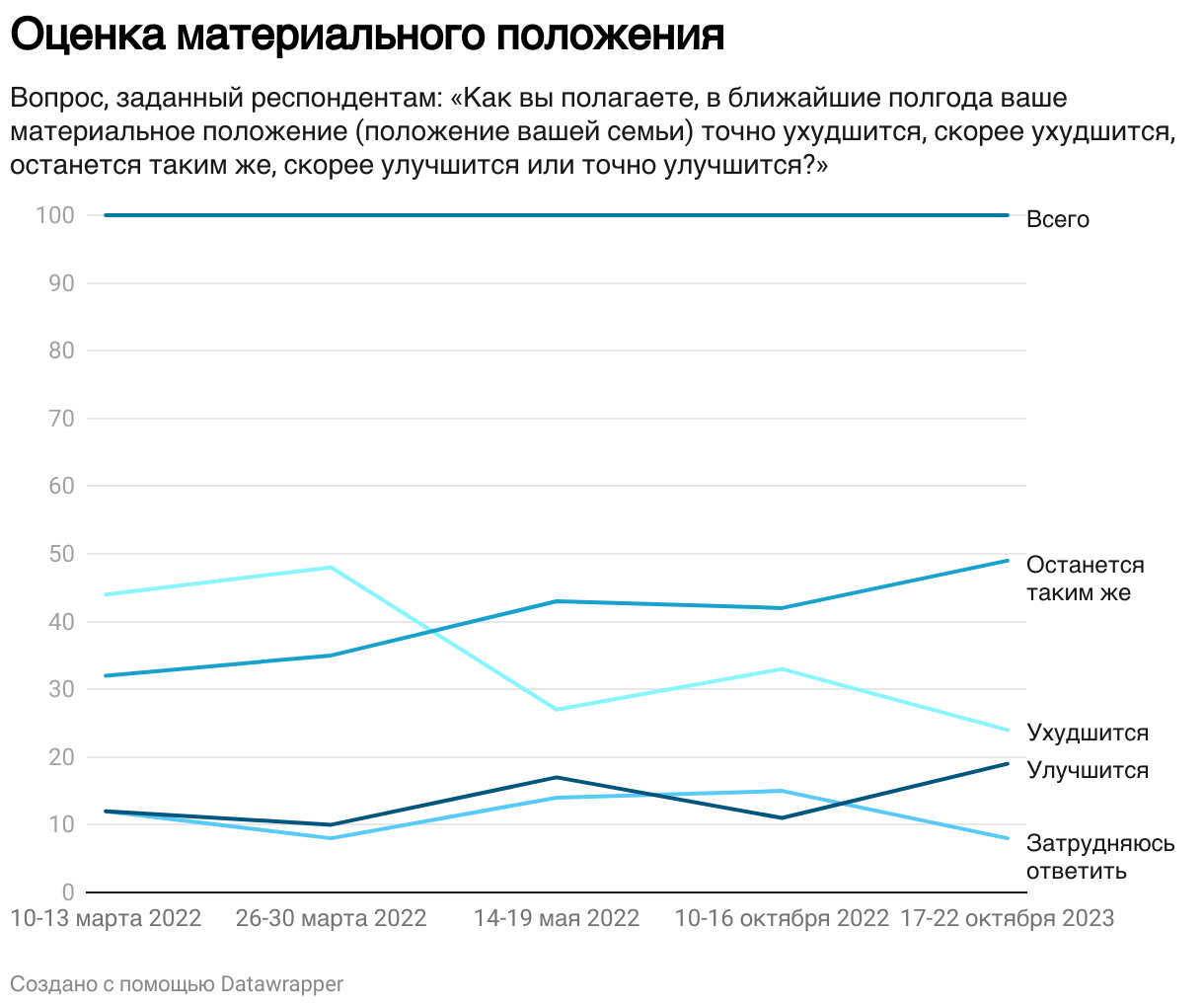
At the same time, the share of Russians who believe that in the next six months their financial condition will fall even more, decrease: if in early March 2022 44% of Russians expressed such fears, then in October 2023 only 24%. Now the majority (49%) believes that in the next six months their financial condition will not change. The number of optimists has increased who believe that their income will grow: from 12% in March 2022 to 19% in October 2023.
Researchers of the Chronicle project note that the support of the war by Russians depends on the level of income. People with high income more often support war than with low ones: 75% versus 59%. The level of material well -being directly affects the psychological state of the respondents: the poorer, the more often they answered that they felt anxiety and anxiety.
In October 2023, the Chronicles interviewed Russians about their attitude to Russia's expenses for the army and defense industry. 46% replied that, first of all, the state should spend budget money on the social sphere, and only 26% said that the expenses for the army and war should be priority. Most of those who supported spending on the defense industry turned out to be people of retirement age - that is, a category that is most dependent on social benefits and payments. At the same time, 28% of respondents found it difficult to answer this question.
Are the Russians ready for a truce?
The participant in the Chronicle project Andrei Tkachenko told the Cold that now the readiness of Russians for a truce is the highest from the beginning of the invasion. In addition, from the beginning of the invasion, the core of approval of the war has almost doubled.
“Among the respondents I“ support ”there are at least two groups:“ hawks ”who are radically advocated for the war, and loyalists are those who support everything that Putin does. Therefore, we needed to consider people with composite opinions: “I support the war and are not ready for a ceasefire”, “I support and ready for a truce”, “I do not support the war and is ready for a truce,” says Andrei Tkachenko.
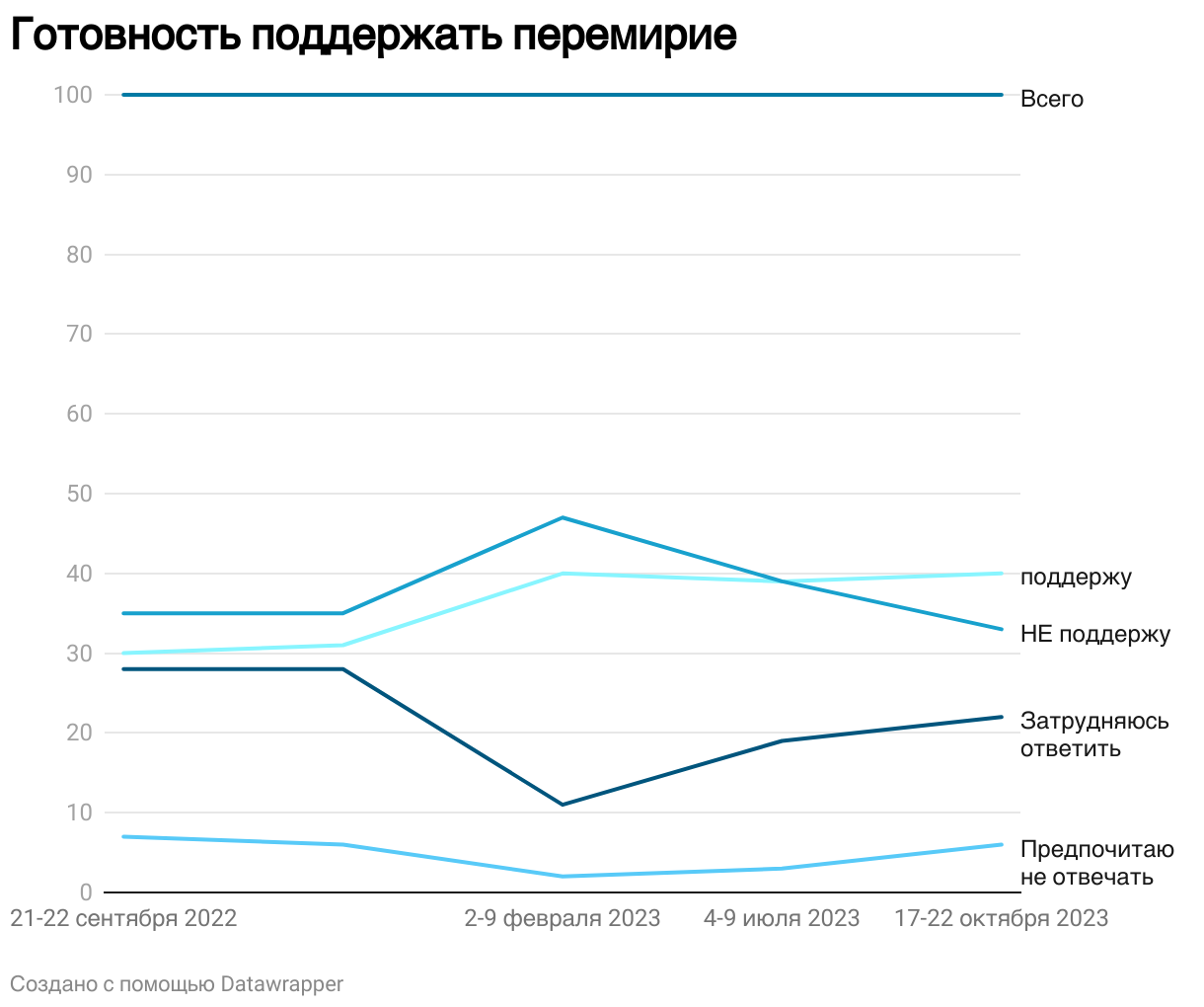
Polls confirm this dynamics. If in September 2022 the share of those who supported the decision on a truce without achieving the initially set goals was 30%, then by October 2023 their share increased to 40% and exceeded the share of those who would not support the decision on a truce. However, the number of supporters of the continuation of hostilities, judging by the polls, is really reduced: from 35% in September 2022 to 33% in October 2023. The share of those who did not decrease during this time decreased from 28% to 22%, and the share of those who did not want to answer remained at about the same level.
“For the first time, the proportion of ready -to -celestials turned out to be higher than the unprepared ones. I believe that such a trend will remain in 2024. The proportion of ready -to -ceasefires will remain, and the unprepared ones will fall, ”says Andrei Tkachenko.
The increase in the number of supporters of the end of the war, perhaps, could affect the Kremlin’s position. In 2024, Russia entered from the standpoint of power: the Ukrainian counter -offensive did not bring the expected results, further financial and military assistance to Kiev stalled in long -term discussions among European and American officials, and Russia on informal channels signaled the readiness to resume the negotiation process. However, the Ukrainian side did not express such readiness, besides, Kiev does not consider it possible to negotiate peace until Vladimir Putin remains the president of Russia.