
Translated material
Shield and relics
The shrines are sacrificed, the icons are “charged” to win, prayer for peace is an occasion to deprive the dignity, indulgence in exchange for “magical” objects. Overview of the "theology of military operations"
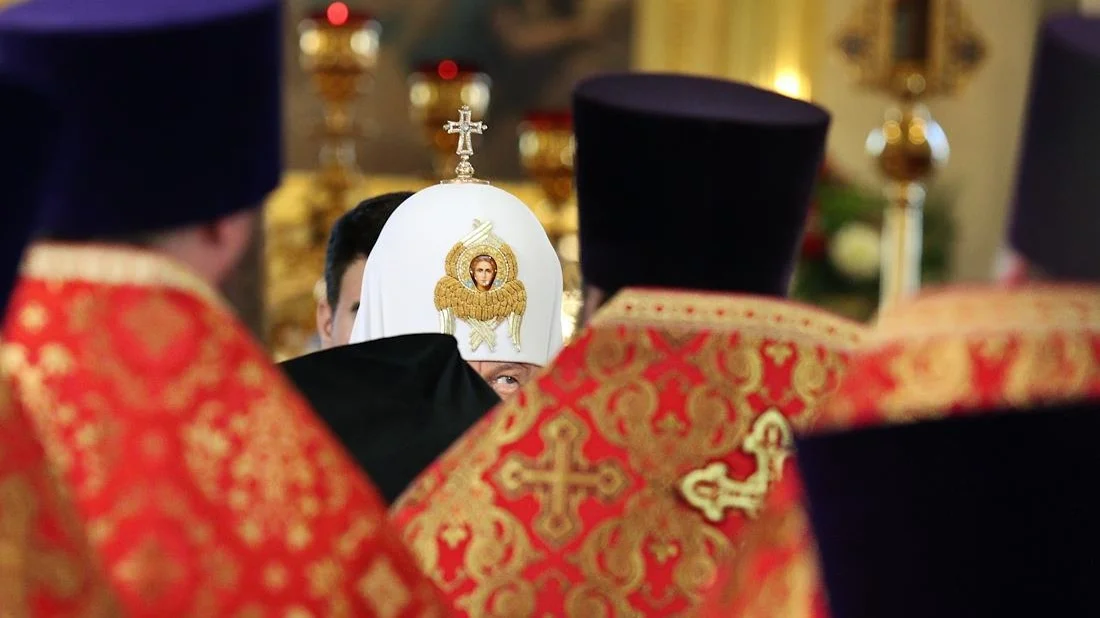
Photo: Artem Dergunov / Kommersant
Special operation under Christmas
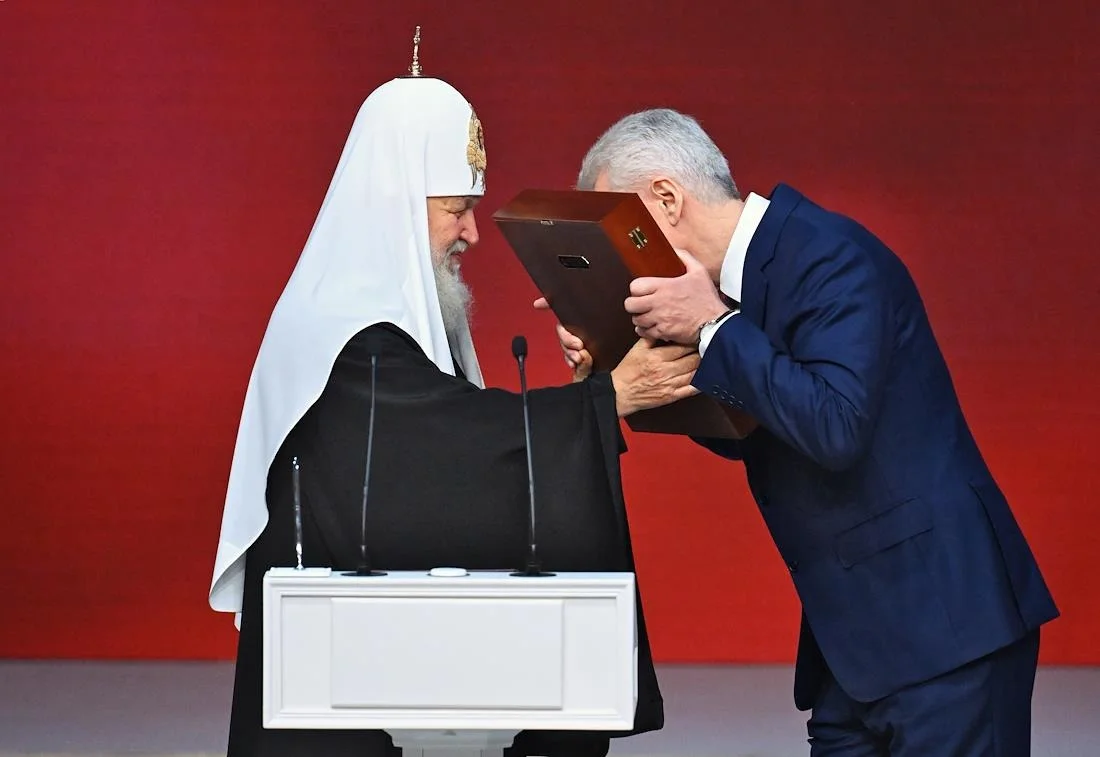
The current Christmas turned out to be Patriarch Kirill bright and, probably, from his point of view, successful. Literally on the eve of the holiday, he not only eliminated the “main stronghold” of the Orthodox intelligentsia in Moscow, having fired, forbidding in the service and betraying the church court Fr. Alexy Uminsky, but also managed to take Andrei Rublev from the Grabar’s scientific and restoration center.
The president signed the decision to transfer this national shrine of the Russian Orthodox Church, contrary to the Federal Law “On the Museum Fund of the Russian Federation”. Despite the protests of the scientific and cultural public, the icon briefly brought the icon to the Cathedral of Christ the Savior and to the Trinity-Sergius Lavra, which quite predictably caused a rarity to such a damage, after which a long and painstaking restoration was required. The boards on which the icon (three of them) was written is dilapidated in 600 years, the colorful layer is crumbling in more than 150 areas, and the cracks between the boards are expanding.
After last year’s “experiment”, the Ministry of Culture hastened to assure that the icon remains in the museum fund, in the collection of the Tretyakov Gallery, and the Russian Orthodox Church is transferred only “for temporary use” - “total” for 49 years. After the shrine returned to the restoration, in July last year, the parties seemed to have agreed that it would last a year-and the scientific and cultural public calmed down more or less.
The Christmas "The abduction of the Trinity" was much tougher than all the manipulations with the icon last year. We are now not talking about any climatic capsule that ensures its safety (it seems like it was instructed to make corporations "Rosatom"), or about special transportation conditions. In a special operation, with the participation of law enforcement agencies late in the evening of January 5, the icon was removed from the center, carried it in the frost, placed in a cargo van and taken to the Cathedral of Christ the Savior, where restoration braces were removed from it that strengthened the layer of paint. According to the stories of restorers, the procedure was carried out in a hurry, with a violation of all regulations.
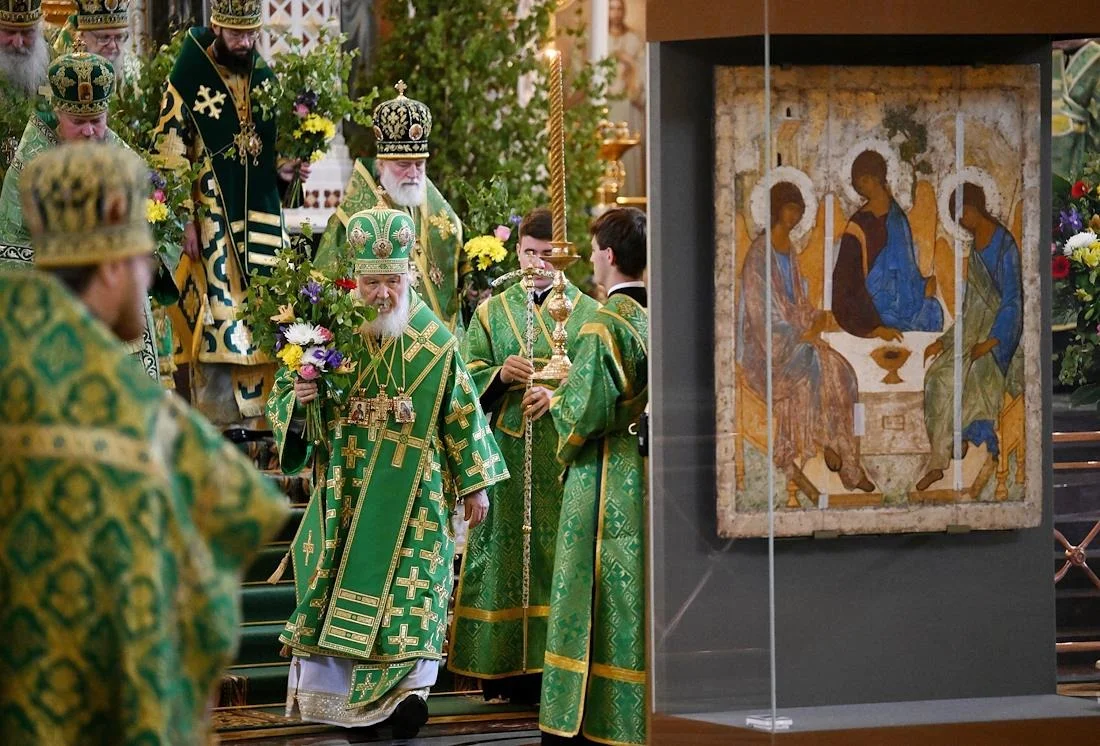
Then the shrine was placed in a regular showcase, without climate control, next to the right-wing clergy, on which a VIP person is placed during the patriarchal services. Around the window, vases with flowers that increase the level of humidity were placed, although in the temple that thousands of people visit, and so there is no stable temperature and humidity regime.
The Patriarch threatens that in such deadly conditions, the Trinity will stay until the end of June, after which she will be even a more difficult test-the transportation “to a historical place”, in the Trinity-Sergius Lavra.
Representatives of the Grabar center are horrified and do not have any information about the further accession of specialists to the shrine and the continuation of restoration work.
What is happening with ancient icons, if they find themselves in an unfavorable climatic environment, is evidenced by the history of the Bogolyubsky icon of the Mother of God, transmitted in the early 1990s of the Russian Orthodox Church of the Vladimir-Suzdal museum-reserve. Contrary to the agreement between the museum and the church, representatives of the latter could not provide the temperature and humidity regime for the work of the 12th century, which began to be covered with mold. It took an emergency restoration of the monument for more than six years, and only a miracle managed to save it.
Divine energies
The persistence of Patriarch Kirill, who is not considered a clear danger of the loss of the main monument of ancient Russian art, can be explained by two considerations. With all the desire, both are difficult to call the actual religious, especially Christian.
As the Novaya already wrote , Cyril began to seek the “return of the Trinity”, supporting the new “theology of military operations”, adopted by the Russian Orthodox Church after the beginning of his and partly supported by the military-political leadership of Russia.
From a religious point of view, this “theology” has a pronounced occult-magical character, and in the minds of the current head of the Russian Orthodox Church it was formed gradually. Even in his youth, he participated in the magic sessions close to the Soviet leaders of the “healer” of Juna, in the 1980-1990s he began to insert passages into his sermons about “bioenergy” and “aura”, and becoming a patriarch, he already made a detailed teaching about the energy charge of the great shrines, which could be effectively directed to the achievement of military-political goals. The disgraced theologian Andrei Kuraev, recognized by the authorities of the Russian Federation as a “foreign agent”, calls this teaching Barnaul and Novorossiysk dogma (at the places of pronouncing the corresponding sermons).
In September 2015, in one of the churches of Barnaul, Cyril said that sacred objects are a kind of accumulators of divine energy, which can be directed for specific goals. And two years later, in September 2017, after the service in the Assumption Cathedral of Novorossiysk, Cyril proclaimed the doctrine of the infallibility of the Patriarch of the Russian Orthodox Church: “If someone else has doubts, whether the Patriarch has been doing, leave all doubts! And strictly do what I command! .. There is no other way for our church today! ”
Of these two "dogmas" there is a logical conclusion:
The Patriarch is the only subject in the Russian Federation that can correctly redirect the energy flows of the greatest shrines to achieving goals that he defines as correct.
So the head of the Russian Orthodox Church offers himself to the Kremlin not just as an ideological service service or prophet “theology of military operations”, but almost as a demiurge, capable of on certain conditions - to turn back the adverse course of history.
The bets in this game with divine energies, of course, are very high, but for a religious leader who connected his fate with the political regime and his main geopolitical project, as they say, there is nothing to lose. It is possible that the Patriarch perceived these forecasts as a good opportunity to “rehabilitate” in the eyes of the president, who demonstratively refused to take communion in his temple in Novo-Ogarev, which was perceived as an alarming call at the Russian Orthodox Church.
Finally, you can not write off the “hardware” side of the patriarch’s actions. Having a second time, having achieved the transmission of the “Trinity”, contrary to the resistance of rather influential people and communities, he sent the elites a signal that remains one of the most influential leaders of the country, and rumors about the upcoming replacement of him with Tikhon (Shevkunov) were deprived of the grounds.
By the way, Metropolitan Tikhon, who has recently been “exiled” to the Crimea, confidentially communicating with Putin for many years, heads the ROC Culture Council, calling for care to ancient shrines and the development of the church ancient storage systems, in which museum conditions for storage of antiquities of antiquity would be ensured.
The religious scholar and creator of the independent project “Religolis” Mikhail Sitnikov, in an interview with “New”, drew attention to another, less obvious aspect of manipulations with the Rublevo masterpiece. After this icon was open to world culture at the very beginning of the twentieth century, it became a "symbol of the spiritual value of freedom and peace as synonyms of love between the faces of the Holy Trinity." Priest Pavel Florensky writes in detail about this “Revelation” of Rublevskaya “Trinity” in the article “Trinity-Sergius Lavra and Russia”. Such a perception of the image causes irritation among the current ideologists of the “Russian world”, so the “world -lover” image should be sacrificed.
Indulgence through relics
And how is all this “high theology” and the church policy arising from it are projected, so to speak, to the lower level? Are they perceived by a simple church people?
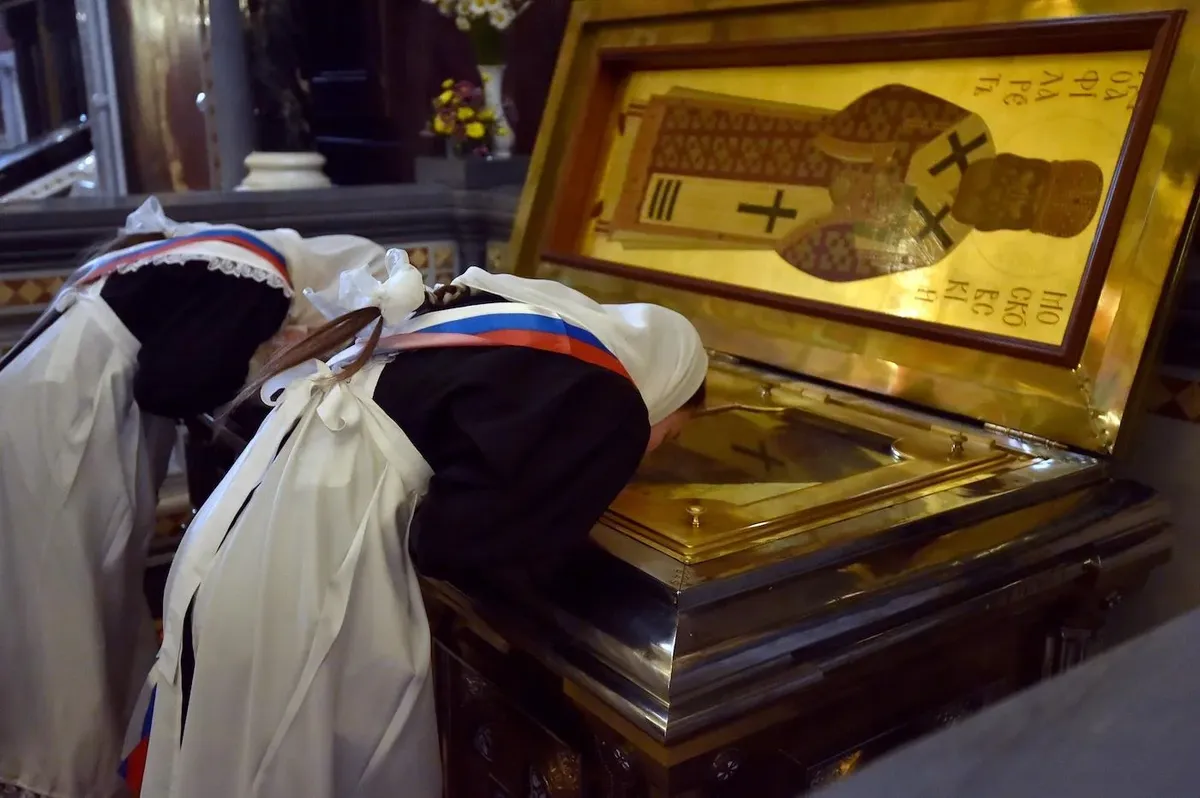
A curious answer to these questions is given by the story with the Moscow businessman Mikhail Danilov, the owner of the sensational club "Mutabor" and another eight establishments of this type. In the Christmas Christmas Eve, Danilov, before the camera, presented the rector of the temple of the Sign of the Mother of God on the Sheremetyevo Court (today it is the court of the journalism department of Moscow State University, in the very center of Moscow) Archpriest Mikhail Gulyaev, a particle of the relics of St. Nicholas, to which a beautiful certificate in Latin was attached. The video was widely dispersed through social networks, but the source-the Mash telegram channel-soon deleted it. The ostentatious desire to atone for the Fatherland and Heroes of Her (it was in such categories that official propaganda commented on the “almost naked” party in the “Mutabor”) put the club owner in an even more difficult situation.
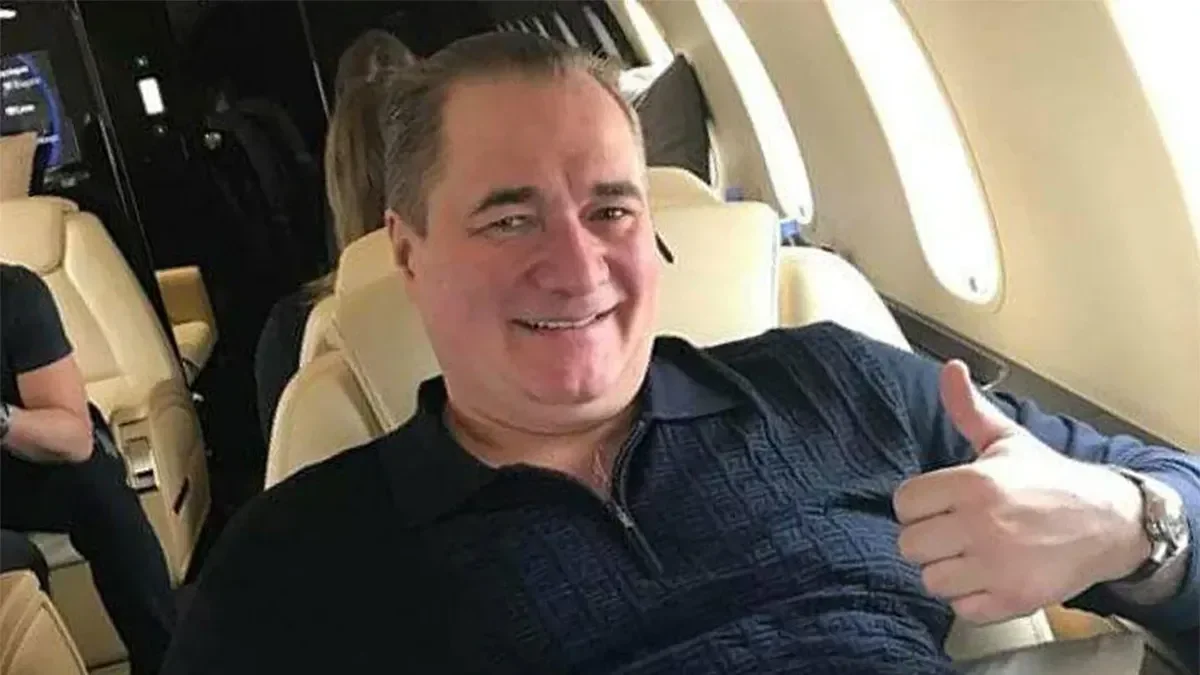
The temple, to which Danilov handed over the shrine, was chosen for a reason. It is located in the territory belonging to the management of the President of the Russian Federation, and until recently there was no free access to the temple. There are no other clergycs in the parish, except for the father of Michael, who has a reputation as an elite priest (on his website, for example, personal greetings from the envoy of President Igor Schegolev and governors are posted). Thus,
The indirect message of the “sinning” businessman is read as follows: through the court church, he sends the sacred gift of the highest power in the hope that the name of St. Nicholas will forgive him and will not bring enemies to the register.
Danilov accurately caught the connection between the ideology of his and church symbols/artifacts that inform her of sacredness.
The atmosphere around Mutabra was so heated that I had to act in a hurry. And it turned out what is called "Hurry up - make people laugh." Danilov said that he bought a particle of relics in early November in the Vatican for money, including from the "sinful" club.
But, firstly, neither the Vatican, nor at all any canonical units of the Roman Catholic Church are not sold, but even particles of the relics of the saints do not give out. In 2017, Pope Francis signed a rather strict instruction on this score, the violation of which leads to canonical punishments.
Secondly, the canonical norms of the Russian Orthodox Church prohibit the adoption of donations related to income from the “sinful” business, including from entertainment institutions that violate the rules of chastity.
But the core of the scandal is not even this. Experts found that Danilov acquired his particle not in the Vatican, but from very dubious dealers who collaborate with the former keeper of the relics of the Novarian Catholic diocese in the Italian Piedakon subdiacon Franco Cherroti. It is his signature that is under the certificate of the authenticity of the relics, which Danilov demonstrated to the video.
However, there is an important nuance: from the diocese of Cherruti left in 2015, and the certificate was discharged in 2018. It turns out a confusing conflict worthy of attention of both the Catholic hierarchy and law enforcement agencies. If the relics are genuine, then Cherruti, quitting from the diocese, appropriated his relics and began to illegally write certificates on them on behalf of the diocese. If the relics are not genuine, then we are dealing with fraud, which is very common in the black market of relics.
Infernal market
This strange market has blossomed in the zero years, when the temples newly opened in the post -Soviet space began to compete in the “collecting” of particles of the relics of various saints that attract believers. For example, in almost every urban and even in some rural churches of particles of the relics of different Kiev Pechersk Monk, they explain by the fact that the Kiev-Pechersk Lavra, which was under the jurisdiction of the Moscow Patriarchate, became the main center of this market in the CIS.
Today, the law enforcement agencies of Ukraine are suspected by the governor of Lavra Metropolitan Paul (Lebidi) that he exported the shrines from the country. A special commission of the Ministry of Culture of Ukraine is an inventory of the holy remains damaged in Lavra caves.
Among the Moscow priests, the “reliable supplier of relics” had the “confessor of Kirkorov” by Abbot Timofei (Simedov), who died suddenly at a fairly young age two years ago.
According to the director of the St. Petersburg Center for the Study of Orthodox Sanners, Mikhail Artyev,
Most Christian relics that penetrated Russia from abroad in recent decades are false. In a number of countries - primarily in Greece and Italy - whole artels work to falsify the relics.
“A certain person,” says Artyev, “introducing himself as a novice of the Greek monastery, offers for $ 800,“ cheap ”, buy the relics of saints from him. There was a Greek deacon (later convicted by the court. - A.S.), who dug up the bones in the cemetery, cooked them in the world and sold them - sold four suitcases of such bones to Russia that it established the investigation. "
General shrines very rarely fall into antique shops, and on Internet auctions (such are carried out, for example, in the EBAY system-either frank fakes or the so-called relics of the 2nd and 3rd classes are sold, that is, not the relics themselves, but objects in contact with them.
“Radio Liberty”, recognized by the authorities of the Russian Federation “foreign agent”, discovered four certificates signed by Franco Cherruti, on shrines exhibited for worshiping in the temples of the Russian Orthodox Church. It is assumed that they were bought at Internet-agricultures by Russian entrepreneurs, which are indicated on the sites of the corresponding temples as donors.
So, in the Kazan Cathedral of St. Petersburg, a fragment of the Virgin Mary belt is stored, transferred there as chairman of the board of directors of PJSC Aurora Vadim Zhimirov. Cherruti, who was then still an official employee of the Novari diocese, indicated in the certificate that the belt does not come from his diocese, but right from the Holy Mount Athos in Greece.
Moscow entrepreneur Yuri Evdokimov presented in 2018 the Liven Diocese of the Russian Orthodox Church by a particle of the relics of St. Spyridon of Trimifunta with a certificate of the same Cherruti. Other controversial shrines of similar origin are in several temples of the St. Petersburg Metropolis.
The theme of commercial falsification of the relics with their subsequent use in the temples of the Russian Orthodox Church (also not without commercial purposes) deserves a separate large study. But the fact that it was already possible to find out is enough to question the modern operation of the shrines in the Russian Federation - no less than the sermons of Patriarch Kirill.