
Translated material
Pologradus to the disaster
The average temperature of the planet almost reached the critical value of the 21st century. The world is the end?
According to the World Meteorological Organization, each next decade, starting in the 1980s, has been warmer than the previous one, and the last nine years have been record-hot . The average global temperature last year was 1.45 ° C higher than the values in the pre -industrial period, and scientists admit that, taking into account January and February 2024, the average temperature for 12 months will be higher than 1.5 degrees pre -industrial. Meanwhile, 2 degrees are indicated in the Paris climatic agreement as a maximum of warming by the end of the 21st century, within which the countries agreed to be held with all their forces in order to prevent many catastrophic consequences: more than the waves of heat and conjugated deaths , fires, floods, lifting the ocean, melting ice. What awaits us because of such warming is in the material of the Cold.
In order not to miss the main materials of the "cold", subscribe to our Instagram and telegram .
The schedule of average global temperature over the past 600 years was first published in 1998. It looks like a relatively flat line that, at a point corresponding to the beginning of the twentieth century, rushes sharply and rushes up, so this schedule was called a “club” or “Mann's Book” - in honor of Professor Michael Mann, the author of the article in which this schedule first appeared. Over a quarter of a century, which has passed since that publication, climatologists received new data sources, new computing power and drew many new schedules, but the picture of the curve curly upward upwards did not disappear from them.
Today, a new point has appeared on this schedule, which, unfortunately, continues the “club”, showing how our planet is getting hotter.
What exactly happened? The World Meteorological Organization (WMO) officially announced that 2023 was the hottest in the history of observations. The average global temperature last year was 1.45 ± 0.12 ° C above the pre -industrial level - an indicator, as which climatologists use the average global temperature in the period from 1850 to 1900.
This information was obtained on the basis of six data sets collected by the NOAA American meteorological department, the NASA Goddard Institute, the study of the climate of the University of East England, the Hadley Center of the British Meteorological Administration and the Berkeley University study group. In all these data, 2023 was record -hot. The Copernicus European program previously published its estimates, which turned out to be even higher than the WMO data - 1.48 degrees above the pre -industrial level. Moreover, Europeans admit that, taking into account January and February 2024, the average temperature in 12 months will be higher than 1.5 degrees pre -industrial.
One and a half degrees is a symbolic threshold. This value is indicated in the Paris Climate Agreement as the boundary of warming by the end of the 21st century, which the countries that signed it set themselves as a goal. If warming can be kept at a level of up to 2 degrees, this will prevent many negative consequences: more than the heat of the heat and the deaths of deaths , fires, catastrophic floods, lifting the ocean, melting ice, death of corals.
The document, however, is about the average temperature in a decade, and not in a year, that is, strictly speaking, the border has not yet been crossed. The record heat last year has a specific reason- the climatic phenomenon of El Nigno (abnormal warming of the surface of the water in the equatorial part of the Pacific Ocean), and when it ends, the heat may retreat. But is it far and for a long time? Do we have the hope that the boundary of 1.5 degrees will not be crossed?
According to WMO, each next decade, starting in the 1980s, was warmer than the previous one, and the last nine years have been record-hot. The concentration of greenhouse gases - carbon dioxide and methane - is constantly growing and has already reached 419 PPM (parts per million) and 1902 PPB (parts per billion). In the pre -industrial era, the concentration of carbon dioxide was 280 PPM.
So far, the efforts of all those countries that develop green energy are invisible on the graphics of the concentration of carbon dioxide, and even the pandemia of coronavirus infection affected it little . The volumes of emissions are growing. According to the UN Environmental Program report , even if all current obligations of countries to reduce emissions will be fulfilled, then by the end of the century the level of global warming will be 2.7 degrees - much higher than the purpose specified in the Parisian agreement.
This will mean that approximately a third of humanity (from 22 to 39%) will be in very bad conditions for existence by the end of the century and they will have to fundamentally rebuild their lives or turn into climatic refugees . If it is possible to limit a warming of 1.5 degrees, then the number of such potential victims will be reduced by five times.
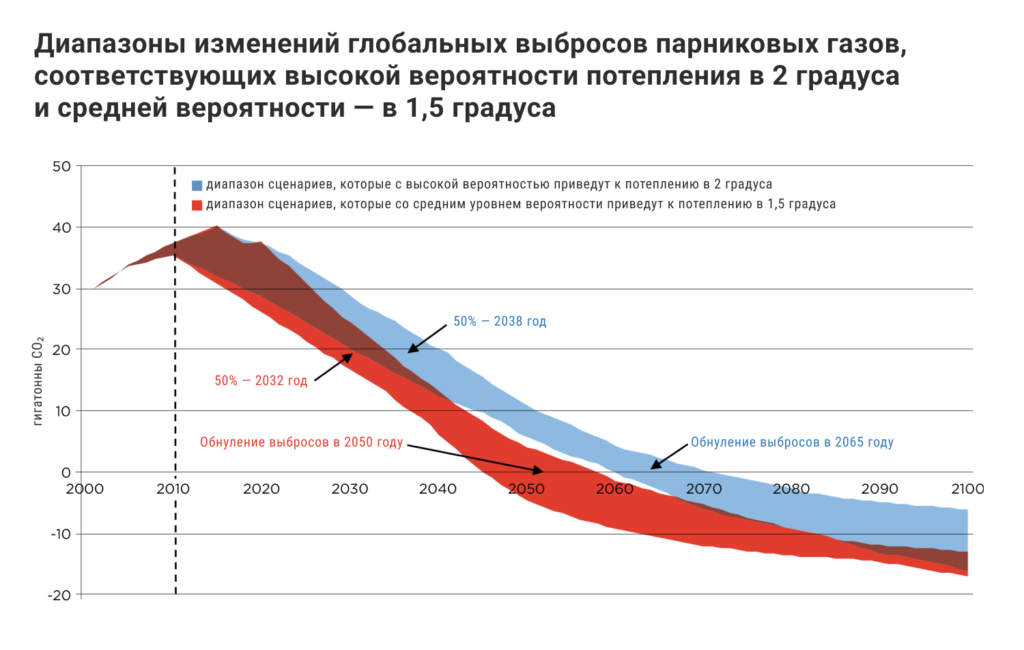
In order to stay in these borders, according to calculations , humanity needs to halve the emissions by half by the 2030s, to zero to the middle of the century, and then go to negative emissions-that is, to take the removal of carbon dioxide from the atmosphere. Can we seriously expect this from humanity?