
Translated material
The keeper of happiness
Leo Rubinstein always remained an optimist - even in the most difficult times for optimists. Literary critic Lisa Birger - about how he succeeded
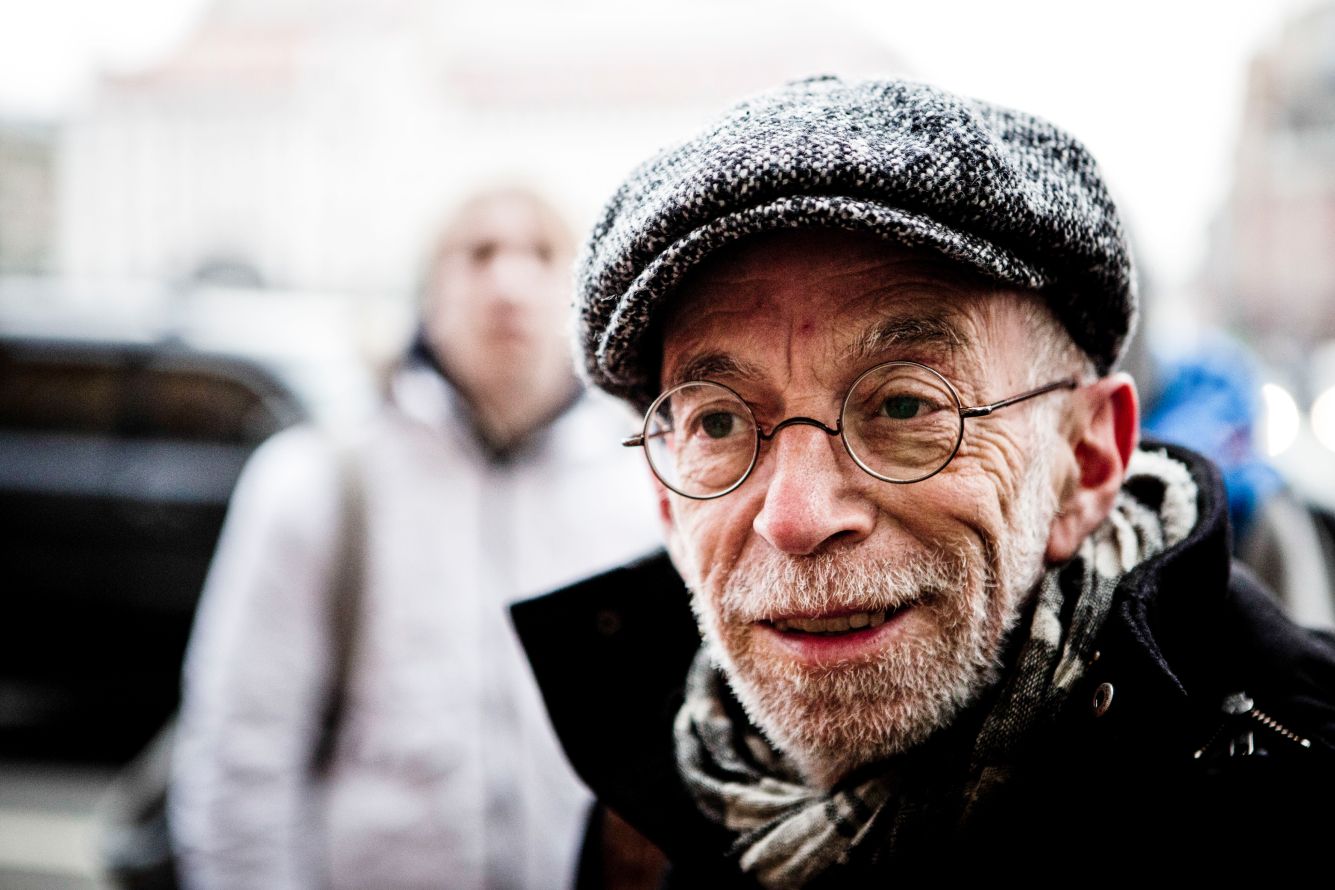
In Moscow, at the age of 76, the poet and essayist Lev Rubinstein, one of the founders of Moscow conceptualism, laureate of the Nose Prize, died. On January 8, Rubinstein shot down a car, he was hospitalized at the Sklifosovsky Research Institute in serious condition. After the poet’s operation, they loaded into an artificial one, but could not be saved. The literary critic Lisa Birger recalls Leo Rubinstein and his habit of looking for happiness in yesterday and today.
With the departure of Lev Semenovich, social networks filled memories of him - the stories of personal meetings, retold jokes and jokes. All this suits him very much: for many years he himself was an endless source of a living city joke. Wherever you met him - at a concert, a poetic evening or a rally , he generously shared his stories, jokes, and stories about his own life. His main work of recent years was the constant work of memory, active recalling, allowing the past to live again and again - but only in his happy, joyful moments. Then this memory was transmitted further - through articles and speakers, entries on Facebook, but primarily through personal meetings and gatherings. In them, Lev Semenovich was a real master.
In one of the last New Year's essays, he wished readers "friendly curiosity towards another and incomprehensible." Rubinstein himself consisted completely of such curiosity: he always paid attention to him back to his interlocutor, he always asked, interested, listened, even when only him wanted to listen to him - co -founder of Moscow conceptualism and one of the most famous living poets. It seems that this is a friendly hearing and was his main activity, especially in recent years, when he almost did not write poetry, replacing their essays and short texts in the format of Facebook memories.
Such work with attention to the environment, of course, was a strategy. Including a poetic way, in the text in the text where the speaker and listener are found, where there is no self -love and speech is addressed to another. But this approach was also a human strategy, a way of resisting an inhuman state.
This method itself has grown from the practices of Moscow conceptualism. The philosopher and art critic Boris Groys, who invented this phrase, wrote about “Moscow romantic conceptualism” as the last spiritual practice of Russian art, built on the poet’s almost mystical connection with the reader. It would seem that in conceptualism there should be no place for romanticism: these are opposite things. But for Moscow conceptualists, the game with concepts and forms became the opportunity to get to a direct source of feelings, pure, primarily children's, experience.
The poetic invention of Rubinstein, his famous cards are the embodied card index of experience and memory, an attempt to catalog. In Rubinstein performance , the cards were more performance than the text. They were filled with copyright remarks, sighs, points, voids, repetitions, which allowed to create between the author and the reader "that special level of understanding, when the questions seemed unnecessary, and the silence seemed ambiguous and not at all painful."
Mutual understanding with the reader was born at the point of meeting of silence and noise, a sincere word and verbal garbage, breaking into cards with a loud Moscow street. Each card text has a plot of a gradual coming to the main thing - to the final point of silence, the fullness of the present moment, and, most often, to the revelation of the true to myself: “And this is in my underpants and in a T -shirt under the blanket running along the solar lawn, and my marf with me.”
In recent years, Leo Rubinstein did not write cards. But this did not mean that his poetic work was completed. She simply moved to another format - Facebook memories, table stories, essays. Each of these stories or short Rubinstein texts made it possible to live the very essence of the present moment, or rather, to find at this moment the possibility of happiness and joy. One of the favorite quotes of Lev Semenovich - Kharmsovskaya , somewhat rewritten so that it became almost Rubinstein - "Life always defeats the death of an unknown science in a way." He knew how to be and remain an optimist in all conditions worsening for optimism.
“History works for us. And you’ll stop her horseradish, ”he wrote in 2012 in his manifesto against despondency for The New Times. And more recently, in a column for Republic, I was looking for a visual image of happiness and found it in memory from the first grade, in a conversation with a classmate of 1 “B”, firmly squeezing a feathers in his hand. What could be more Rubinsteinsky than a constant search for happiness in memory? He became the main keeper of happiness in Moscow life. Those who have always reminded that life defeats death, that the tragedy is not final, that you need to be able not to despair and look for forms of sympathy and friendly attention to each other. This was all his stories that he so generously shared, all his texts, all his conviction of the possibility of normal life even in abnormal circumstances.
If you try to find a geometric figure that most fully expresses Rubinstein, then this is a circle. Not only a literal circle of friends, a huge circle of people covered by his attention, but also a circle as a way of the text of the text. The most striking example is his personal calendar “all year round”, which he had been engaged for almost ten years. He came up with this project together with the Shadow Theater-for every day of the leap of 2016, Rubinstein recorded some memories, and the theater artists turned them into video postcards . Two years later, the book “The whole year” was published in the UFO publishing house based on these texts. And the whole 2023, Lev Semenovich, together with the poet and critic by Leo Oborin, was released by the Levlev Podkast , where, with the same sincere intonation, he talked about the events of the past.
In the book “The whole year”, Leo Rubinstein wrote about the property of the calendar to be a more instructive sign of time than the so -called high culture objects: “He is intended to serve a year, and at the same time has the ability to get stuck in memory for whole decades.” We have yet to evaluate this ability of Rubinstein, his stories and texts for many decades.
The year of his death turned out to be a leap - like the year of his calendar. And let this death itself seem to be a broken promise - after all, Rubinstein promised so many times that everything will be fine - instead of the will remains. About simple, about every minute search for happiness, about the triumph of insignificance over any tragedy. And the fact that the author among us is no longer there can still not affect the infinitely returning feeling of simple happiness shown by him.
Lisa Birger