
Translated material
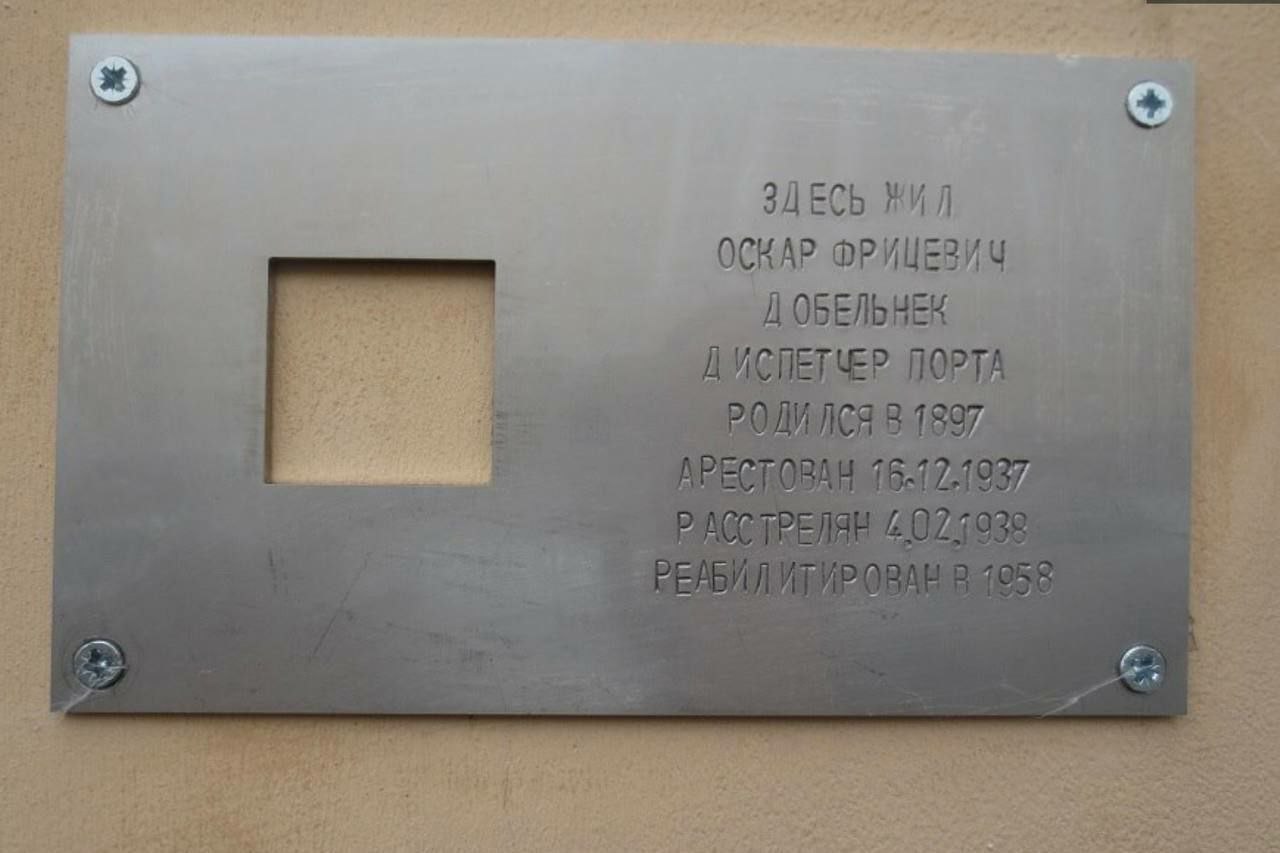
Repressed signs
The name was changed at the request of the hero
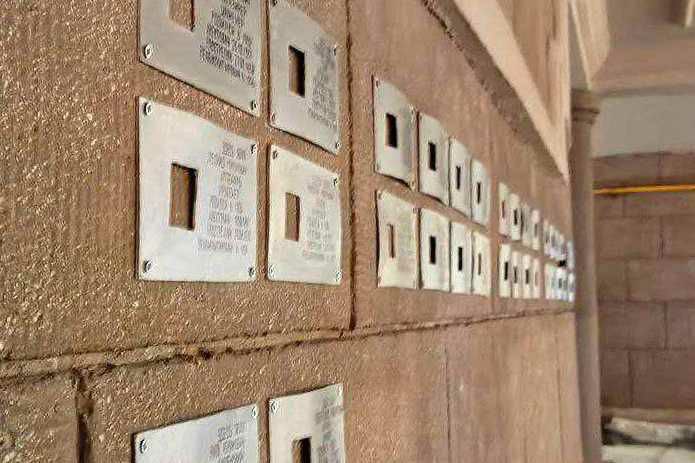
Sometimes a series of signs was also dismantled. For example, in October 2020, 16 tablets were removed from the Dovlatovsky House on Rubinstein Street.
The website of the "Last Address" refers to 433 signs installed in the city
In its work, the “Last Address” is guided by the Law on the Russian Federation “On the Rehabilitation of Victims of Political Repressions” of 10/18/1991. According to it, political repressions are coercion measures used by the state for political reasons.
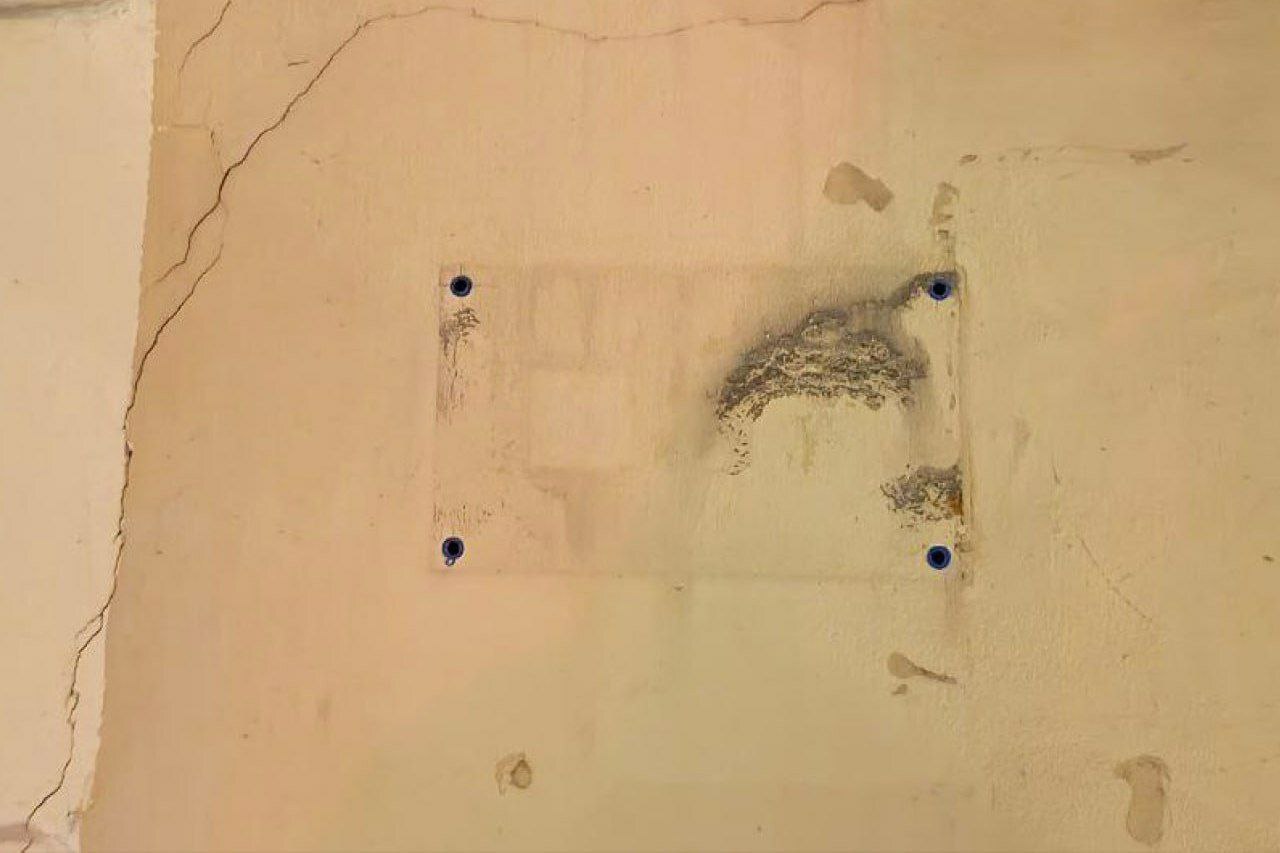
In 2023, in St. Petersburg, commemorative signs of the “Last Address” project about the victims of Soviet political repression began to disappear massively. In most cases, signs are removed due to anonymous complaints.
Many residents of the houses are trying to defend signs and continue to support the memory of repressed on their own. And in the place of the dismantled signs, their cardboard copies began to appear - who sets them, remained unknown. “Paper” found the author of cardboard signs, and also talked with supporters and opponents of the entire project.
How a Petersburger noticed the loss of signs
The Petersburger Konstantin every day in the warm season runs in the Vyborg district. Since he first saw on the house on the Lesnoy Avenue the “Last Address” sign in memory of the repressed, this place has entered its permanent route.
Konstantin (name changed)
activist
-About a year and a half or two ago I ran and saw on the forest, 61 these signs. There were fewer of them - pieces 28. And I began to constantly run past and look at them. At some point, despite the fact that the war was already going on, there were more of them. I was delighted, took a photo. And on September 1, 2023 I am running and I see that there is not a single tablet.
In the Lesnoy, the 61sts in the 30s, the Soviet elite lived: directors, engineers, workshops, military bosses, scientists. Konstantin did not find information about why the tablets with the names of the repressed disappeared. Then he announced the loss of journalists.
The next day, the man came to look at the installation of a signs on the house of Konstantin Blagovo on the 14th line of Vasilyevsky Island, and a day later a freshly installed sign also disappeared-the Petersburger says that it became for him the “last straw”.
Who complains about the signs
The project "The Last Address" has been setting a signs with the names of the victims of Soviet repressions since 2015 on St. Petersburg houses. As the coordinator of the project in St. Petersburg Yevgeny Kulakov explained to the “paper” , the signs disappeared throughout their work, but not often.
Evgenia Kulakova
Coordinating project "Last address"
- All previous losses were single . In some cases, we knew what happened: for example, a resident of the house appeared, who was against, but did not declare himself at the approval stage - and he took off these signs or complained to the management company. But most often, it was not possible to find out about what happened to the sign.
When the plate disappeared, a duplicate was hung in its place. Usually he remained in place. This fall, the situation has changed. First, from the house on Lesnoy Prospekt, 61 immediately 34 signs disappeared . Then, in November, 11 more plates at eight addresses disappeared.
The project employees drew attention to the fact that sometimes the signs were removed after complaints on the portal “Our St. Petersburg”-this is how it was on the Forest Prospekt, 61. “Paper” managed to find earlier complaints. So the person under the nickname Alexander K.-the author of 199 messages on various topics, mainly about poor cleaning the streets-complains about the “last address” signs since August 2020. At his request, four signs were dismantled : two-on the Staro-Petergof Prospekt, German Reingold Guttalloher and Greek Ivan Topuzis, one at 31 Zhukovsky’s address, the musician and photographer Evgeny Henkin and one Grigory Gidoni on the Fontanka embankment, 28.
And in April 2023, Alexander K. was refused. At the Housing Agency of the Central District, at his request to dismantle seven tablets on house 11 on Pestel Street replied that they were not “illegal advertising structures”, but are established “in memory of people who became victims of political repressions during the years of Soviet power.”
For 2023, according to the calculations of the “Paper”, a minimum of 19 complaints about the names of the victims of repression were sent to the portal “Our St. Petersburg”. Most complainants left 1-2 messages, the user under the nickname Mikhail M.-four messages, users Alexander K. and Alexander S.-five messages each.
At the same time, the formulations of messages sent to the portal on behalf of different users partially coincide-although it is difficult to find previous complaints about the same topic due to a large stream, memorial signs are not highlighted in a separate category. Some complaints mention that the “last address” was initiated by the organization “Memorial”, “recognized by the foreigner and liquidated”. Others begin according to the fact that in St. Petersburg "installed 417 metal tablets ".
The administration of the Admiralty district, as before, in the housing agency of the Central District, refused to dismantle the signs on Voznesensky Prospekt and Civil Street, as this is not “advertising structures”. But in most cases, the complaints sent to the portal were satisfied (six are now under consideration). On Lesnoy, 61 after the complaint "Alexander S." The management company removed the signs on the portal.
But a few days later, a copy of the memory plate appeared on the house, a professor of philosophy of Haim Garber, made of cardboard, shot in 1937. The Last Address said that he had nothing to do with this.
Who and why makes cardboard copies of the shot tablets
The memorial sign to the philosopher Garber was one of the first signs of the “last address” in St. Petersburg, the author of the copy believes. “It seemed to me symbolic to return the sign with which it all began,” Konstantin explains.
A man who took his own hands restore, in his understanding, historical justice, was a runner who was the first to report the loss of signs.
Konstantin (name changed)
activist
-To make metal signs, I would have to contact some workshop. This means that additional witnesses would have appeared who would know my name, and for a long time I could not do this. It is easy to cut the cardboard even with scissors, it is cheap, it turned out that the binding cardboard feels good on the street even in our bad weather-it doesn’t get wet, does not swell, it bends slightly, but I already found a way to prevent it.
Photo: "Last address"
Before the war, Konstantin worked as a sales manager in a St. Petersburg company. Two years ago, the man was fired-as he claims, because of participation in rallies. Now he does not work, he says that he managed to accumulate a living. Konstantin recalls that a resident of the house helped him to hang the first cardboard copy.
Konstantin (name changed)
activist
- I go to the right house and see that at the site of the Garber memory signs there is a sheet in the file, and on it is a list of 34 names with rooms of repressed apartments. And he hangs in the very holes where there was a tablet I needed. I begin to outweigh this sheet and hear behind my back the loud voice “The man, what are you doing?”. I turn around - behind the back there is a peasant, a resident of the house. I show him a cardboard copy, he looks at her: “Where did you get it from?”, Thought that this was the original. I turn over, explain that this is a cardboard. Then the peasant says: “Come on, give me a screwdriver from me and screws this sign itself.
The author of the copies says that, despite the precautions, he is often noticed by residents of the houses - and as a rule, they meet his venture with approval. Konstantin laughs that he almost does not encounter negative reactions of residents because of his complexion: “I am fat and tall, who wants to contact?” There were cases when residents defended the activist in front of their neighbors - for example, during the installation of a cardboard copy of the signs of Peter Nikolaev.
What are the legal status of the tablets and the position of the "last address"
Repressed memory signs do not belong to the elements of improvement - memorial boards - or objects of external information or advertising. On the one hand, this means that coordination with the authorities of the installation of plates is not required, on the other hand, the law does not regulate the procedure for their installation and does not protect them in case of damage or destruction.
The project coordinators define the signs as “elements of the facade of the building”, the decision on the installation of which is made by the owners of the house at the general meeting. It can be initiated by the residents themselves or the management company, but in practice it is almost impossible to gather representatives of the house.
“We walk around the apartments and achieve answers from the residents,” says Evgenia Kulakova. “However, in most cases, we get not clear refusal or consent, but indifference or fear of put a signature.”
The recognition of the tablets by the elements of the improvement is achieved by the deputy of the Zaks Boris Vishnevsky. In 2018, at his request, Vice-Governor Nikolai Linchenko said that "it was decided to determine the legal framework for the implementation of the project." However, since then no one has dealt with this issue in Smolny. Vice-Governor Boris Piotrovsky believes that the “last address” signs are not included in the sphere of competence of the working group on the memory of the victims of political repression, because they are not memorial boards.
In cases where there is an officially published decision of the district authorities to remove the plate, the “last address” does not replace it with a duplicate, but first tries to challenge it, says coordinator.
Evgenia Kulakova
Coordinating project "Last address"
- We wrote letters to all district administrations that made decisions on dismantling. We explained that at the dawn of the project we wrote to different committees, asked to coordinate the signs - everyone refused us. So far, we have not received an answer from the administrations. Now we have physically restored most of the tablets, but we will not hang them back until there is permission.
Konstantin believes that in order to restore commemorative signs there is no need to wait for the decision of the “last address” or anyone else.
Konstantin (name changed)
activist
- The owners of these tablets are not employees of the “last address”, but all of us. The information on them is needed, first of all, to ourselves. I am not one of those people who believe that someone should do something for him. They showed me an example: the sign hangs. I took and did the same myself. I do not need a nobody of resolution.
How residents react and what the opponents of the installation of signs think
Residents of houses join the struggle for the return of the tablets. After the disappearance of commemorative signs from the house on Lesnoy Prospekt, the initiative group announced a gathering to discuss how to return them.
Yanina
A resident of the house on Lesnoy Prospekt 61
- Many came, the indignation was enormous. We decided to print the list of names on paper and hang on the wall in files. They made several copies taking into account the fact that they can be disrupted. We tried to reach the management company, which removed the signs.
Yanina explained to the “paper” that it was not possible to collect the house of the house, as before. But residents held several meetings. And if the voices of the opponents of the signs sounded in the chat of the house, then the full -time meetings came mainly to the defenders of the project. Now residents regularly bring fresh flowers to copies of signs.
Yanina
A resident of the house on Lesnoy Prospekt 61
- These signs are witnesses of what was. They do not allow to delete ugly and terrible facts from history. Therefore, against the signs, they are hungry.
The need to remember the victims of political repression is also indicated by a resident of the Admiralty district, who asks not to name her name. She monitors the fate of the memory of the memory of the executed poet Benedict Livshits, who was also dismantled after the complaint.
In December 2023, the Petersburger wrote an appeal to the district administration with a request to explain the dismantling. The administration replied that the plate will not be restored "due to the lack of currently agreed on the installation documents appropriately." Soon, a cardboard copy appeared on the site of the tablet.
“The plate was installed for a long time and it was unlikely that it would have been documented to confirm the approval,” the resident noted in a conversation with “paper” . She does not want to contact the administration again - she is afraid that she will draw attention to a copy and she is also dismantled.
Olga Petersburger was repressed, shot and posthumously rehabilitated by both grandfathers. One of them, the design engineer Lev Bekerman, Olga, along with the “last address”, installed a sign on the house where he lived-on the 7th Soviet, 6. Another in the Nizhny Novgorod region on the building of the metallurgical plant where he worked.
Olga
The granddaughter of the repressed
- I would not want all this to happen: the cult of personality, all these repressions. I would like to have a normal society.
Olga told Paper that she recently visited the 7th Sovetskaya plate and saw that someone had written a “Menshevik rubbish” on it with a marker. Olga bought an alcohol solution and tried to erase the record, but she did not succeed. As a result, the inhabitants of the house came to the rescue: “They just passed by and saw how I was tormented,” Olga says.
Olga says she understands who opposes the signs:
- Recently I was visiting, a conversation on this subject came and a person with a “right head” said that if everyone hangs signs, the city will turn into a continuous cemetery. He said: "When I grew up, I was proud that I live in the best country." The signs, in his opinion, will be a reminder to children about what the wrong country we have, what is our wrong story.
One of the opponents of the “Last Address” signs agreed to talk to the “paper”. A man signed in VKontakte as Vadim Linin said that he lives in house 28 on Zagorodnoy Prospekt, where three tablets were installed. According to him, his mother has a repressed status, and one of the grandfathers disappeared in the camps, but he does not understand why it is precisely the victims of repression in Soviet times who died in Soviet times.
Vadim
A resident of the house on Zagorodny Prospekt, 28
- Why are the inhabitants of the besieged Leningrad, who died from the Nazis, worse? They do not deserve the same perpetuating? Why such selectivity? In addition, there is a lot of information about how “rehabilitation” was massively carried out. Often, a person stole, for example, and judged him as a German spy. When considering the case for rehabilitation, it was: “Was not a German spy? Rehabilitated. "
Vadim believes that placing tablets on the houses in memory of only repressed is political PR, and the only correct way to preserve the memory of the victims of repression is “a real and honest study of their biographies and affairs”.
At the same time, Vadim, he said, never tried to fight the signs. But among the inhabitants of the houses where commemorative signs are installed, there are more active opponents of the “last address”. One of the employees of the project told the “Paper” that a resident of the 13th house of the Vasilievsky Island, on which a commemorative sign of the repressed artist Vera Ermolaeva hangs, called the girl three times, said that he had personal information about her, threatened to “put her in a pre-trial detention center” and “hesitate it in full” if she does not remove the plate.
How opponents react to the installation of copies
In Moscow in October 2023, an enthusiast appeared also, who sets cardboard copies at the site of the disappeared signs. This is 56-year-old local historian Alexei Orlov.
On December 18, Orlov wrote on social networks that after the deutsche Welle report on how he restores the signs, the serial scammer Anna Korobkova, who was fame for writing letters to his victims, put an ultimatum to him: or he ceases to perform in the “media-ago” or she reports the activities of Orlov to the Ministry of Justice.
The St. Petersburg colleague Orlov did not agree to speak with reporters for a long time. He is sure that any of his access to public space will lead to denunciation and political affairs, because of which he will have to interrupt the activity: “Remember, Skochilenko painted the price tags ? So I have painted more than she! ” The man says that he is not ready for prison, because he has new “grandiose plans” ahead.
Konstantin (name changed)
activist
- Do you know what the peculiarity of the serial maniac? The maniac begins very carefully and secretly, but over time, when he commits crimes and they do not entail punishment, he loses vigilance. Now I have such a situation: I'm losing vigilance, I am becoming more impudent.
In total, last year, Konstantin installed 56 signs, six copies later had to be changed. Four - signs on Nevsky Prospekt, 52 - in early December ruined unknown people, drawing crosses and a sickle and a hammer. On Moika, 32 and Lesnoy, 61 on one copy disappeared - the man also replaced them with new ones.
When asked about whether the repressed ones were in his family, Konstantin replies: the one who believes about his family, that there were no repressed in it, just knows its story poorly.

What else to read:
- "It is not necessary to be special to fall under repression." How in St. Petersburg they continue to install the “last address” signs and who removes them
Photo of the cover provided by the Hero of the Material