
Translated material
Complete scoundrels
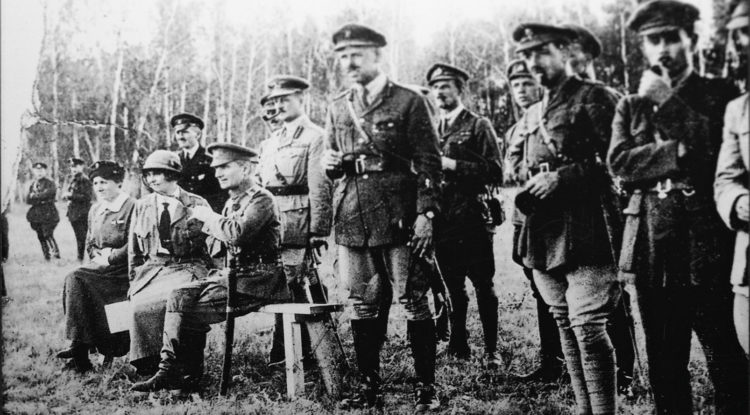
The refusal of white emigrants to negotiate with the Bolsheviks led to a terrible social experiment in Russia. Could this be avoided?
For many years, the Russian opposition has been scattered, no one wants to conclude unions with anyone and everyone insists on their vision of the political struggle and structure of Russia. The result is well known: there is a war, in the country censorship and thousands of political prisoners, autocrat runs permissively. All this resembles the beginning of the twentieth century, when after a shameful loss in the First World War and the revolution, Russian society was already irreconcilably split. About how the inconsistency of white emigrants led to the defeat of good ideas and the beginning of one of the most cruel social experiments of the twentieth century, in the material of the "cold"
In order not to miss the main materials of the "cold", subscribe to our Instagram and telegram .
How to solve "Russian issue"
In January 1919, the Entente countries, who won the First World War, tried to determine the rules of post -war life in the Old World in Paris in Paris. They invited the participants in conflicts in the former territory of the Russian Empire to gather at the conference on the Princess Islands in the Marmary Sea near Istanbul in order to put an end to the bloody and destructive civil war.
The civil war itself was the result of the First World War. In October 1917, the Bolsheviks seized power in St. Petersburg, who advocated the world “without annexes and indemnities” (that is, without violent seizures of territories and any payments from some countries by another).
Why was the war unpopular among Russians and what did the Bolsheviks have to do with it?
Russia entered the First World War as one of the members of the Entente, the military-political bloc, which included the UK, France, the Russian Empire, Italy, Japan and the USA.
Military operations did not go for her very successfully: there were long periods of defeats and significant digressions. Gradually, society was more and more tired of the war, which, among other things, was unbearable for the national economy. The accumulating discontent of different strata of society and members of important state institutions (part of the generals and aristocracy, a significant part of the State Duma, industrial circles) led to the February revolution of 1917 and the fall of the monarchy.
Political emigrants returned to Russia, who left in the tsarist time, including the long -term radical enemies of the tsarist regime; The freedom of agitation and political activity was declared, which spread including the army. All this, as well as the revolution of public administration inherent in revolutions, led to the fact that the war became more and more unpopular.
This, in turn, made a very popular party of the Bolsheviks who called for immediately end the war and conclude the world "without annexations and indemnities." The Bolshevik agitators, actively speaking in the troops and at the front, actually laid out the army, and the soldiers no longer saw the reasons to continue to fight. Mass desertion began from the front.
They abandoned the obligations of the Russian Empire to the Entente. The “Decree of Peace”, which was released by them in the first hours after coming to power, contained a call to the peoples participating in the war, immediately switch to negotiations about a fair world. However, the hopes that this call will lead to fermentation in the warring countries and force their authorities to move on to negotiations has not been justified. The Entente countries rejected the proposals of the new revolutionary power. Germany still felt confident enough to offer Russia peace from the standpoint of power with its allies.
As a result, in March 1918, Soviet Russia signed a difficult Brest world with Germany and other central powers %20%E2%80%94%20%D0%D0%BE%D0%B5%D0%BD%D0%BD%D0%BE%2D%D0%BF%D0%BB%D0%B8%D1%82%D0%D0%D0%D0% B8%D1%87%D0%B5%D1%81%D0%D0%B8%D0%B9,%D0%92%D0%B5%D0%D0%B3%D1%D0%D1%8F%20%E2% 80%94%20%D1%80%D0%B0%D1%81%D0%BF%D0%BE%D0%BB%D0%B0%D0%D0%D0%D0%D0%D1%81%D1%8C%2 2 2 0%D0%B2%20%D1%86%D0%B5%D0%BD%D1%82%D1%80%D0%B5%20%D0%95%D0%B2%D1%80%D0%BF%D1%8B.). According to it, Russia abandoned the significant territories that were part of the empire until 1917, and paid Berlin a contribution in the amount of six billion marks. The authorities of the warring powers of the Entente (especially France) regarded the fact that the Bolsheviks brought Russia out of the war, like treacherous treason.
Meanwhile, in the south of the country, officers of the Armed Forces of the Russian Empire formed the forces of resistance to the Bolsheviks, called the Volunteer Army. Wanting, among other things, to wash off the “shame” of the Brest world from Russia, they declared their struggle with the Bolsheviks fulfilling allied obligations to the Entente - which was favorably perceived in London and especially in Paris, but was only symbolic.
In the spring of 1918, the Allies continued the heavy war with Germany, wanting to protect the military cargoes set before the fall of 1917 to Russia, sent expeditionary corps to Russian ports, where these cargoes were stored. In Arkhangelsk and Murmansk, where the forces of the British and Americans landed, the Bolshevik power was soon liquidated and the Provisional Government of the Northern Region, headed by the veteran of the Narodnaya movement, Nikolai Tchaikovsky.
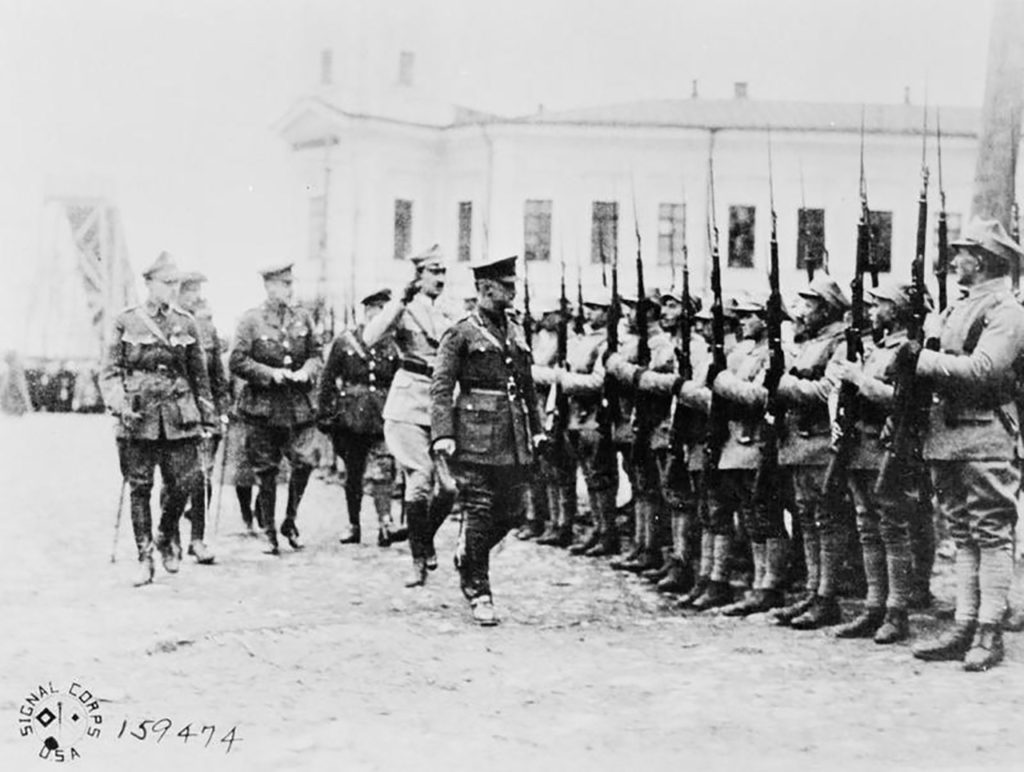
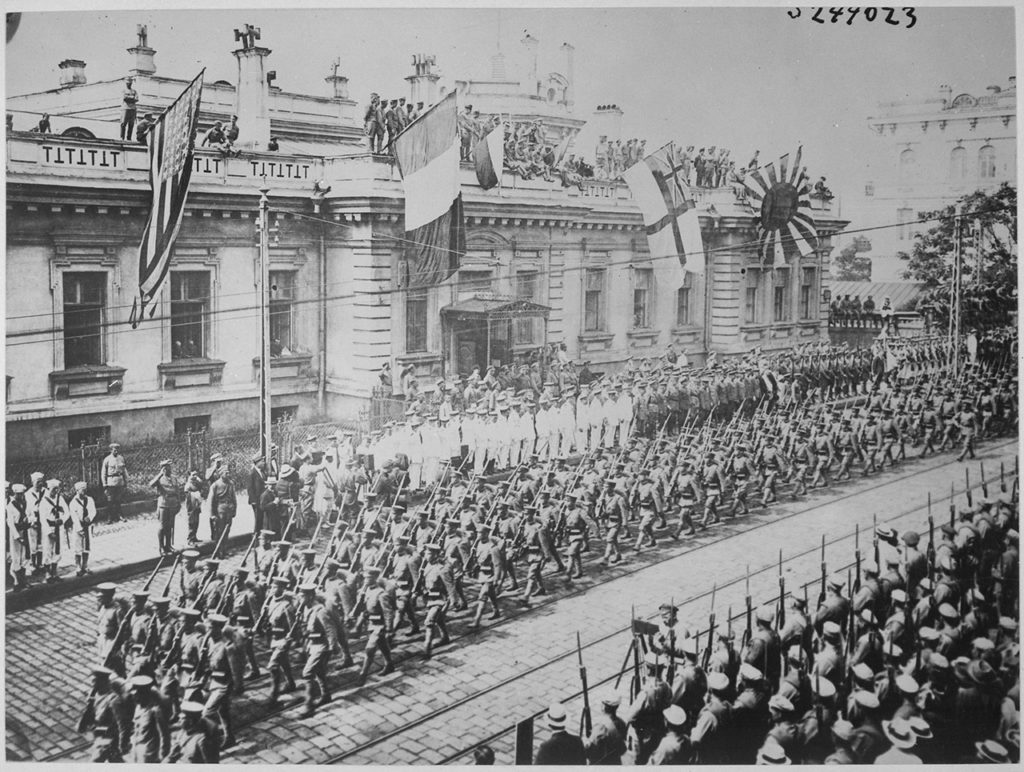
On the right: soldiers and sailors of the Sanizer countries, including the United States, in front of the headquarters of allies. Vladivostok, 09.1918
Photo: National Archives at College Park; Imperial War Museums
In August 1918, the allied troops landed in the Far East, where large military warehouses were also located along the Trans -Siberian Railway. In May 1918, the Czechoslovak corps raised an uprising against the Bolsheviks.
What is the Czechoslovak corps?
Former prisoners of war, who wanted to fight on the side of the Entente, and crossed the Russian side during the war Czechs and Slovaks (the lands where they lived, were part of Austria-Hungary until 1918, the German ally in the war) after January 1918 crossed the French command. By his order, the Czechoslovak corps was supposed to be relocated to the Western Front through Murmansk and Arkhangelsk. But, since it was likely that this path would be cut off by the Germans, it was decided to send units to Europe in a much longer way: through Siberia, Vladivostok and further by the sea. Fearing that the Western powers use Czechoslovaks for intervention, the Bolsheviks tried to stop the advancement of the corps to the east and disarm the soldiers. In response, the Czechoslovaks rebelled .
As a result, Soviet Russia has lost control of the huge territories in the Volga region and Siberia, where anti -Bolshevik governments with its armed forces were also formed.
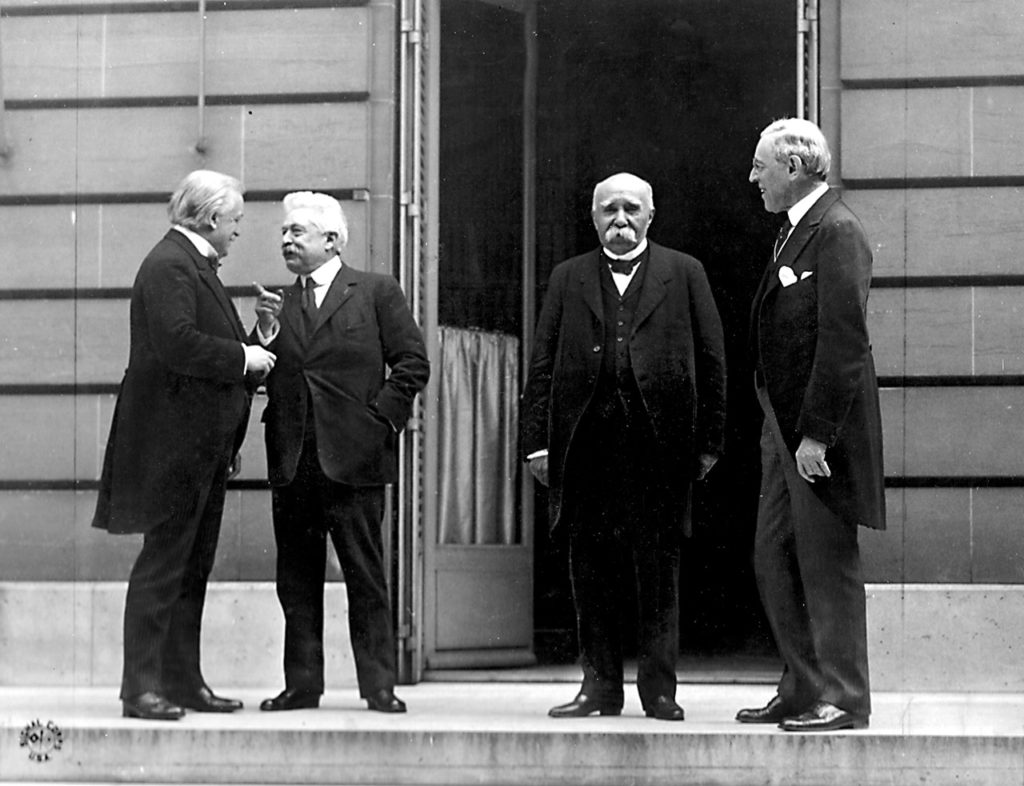
After the central powers recognized the defeat in the First World War, in January 1919 the winners and defeated began to develop the conditions of peace in Paris. At the same time, it was necessary to understand what to do with what was happening in Russia. British Prime Minister David Lloyd-Jorde formulated this: “Russia, in the end, represents almost two-thirds of Europe and most of Asia. This is a problem that we cannot leave from. ”
However, it was not easy to come up with a solution to the “Russian question”. The allies did not recognize the power of the Bolsheviks, but it was not clear who could represent Russia in Parisian negotiations about the world.
Anti -Bolshevik governments arose in different regions of the former empire independently of each other. Some of them enjoyed the support of the Entente’s troops, but after the First World War ended, the soldiers tired of the war, and in general, society in Europe and the USA, did not understand what their troops were doing in Russia. Meanwhile, the “white” practically had no opportunity to provide themselves with weapons and depended on the support of the allies.
He is a killer, but what to do
The Russian political meeting became the Russian interests at the conference - an impromptu structure that included Russia's ambassadors in Italy, France and the United States: they received their posts before the October Revolution, and their powers recognized Western countries. Also, authoritative politicians, in particular, were one of the former chairmen of the Provisional Government, Prince Georgy Lvov, who were outside Russia. At the same time, the anti -Bolshevik forces from different parts of Russia managed to agree that the Minister of Foreign Affairs representing the interests of White Russia in the negotiations will be one of the latest foreign ministers of the Russian Empire, Sergei Sazonov, who also had long -standing relations with the leaders of the Entente.
The ambassadors who created the meeting decided to expand it at the expense of politicians who openly opposed the former monarchy: the above-mentioned Netskikh Nikolai Tchaikovsky and Boris Savinkov, the former Socialist Revolutionary, who once successfully organized attempts on the royal dignitaries and ministers-the Minister of Internal Affairs of Vyacheslav Pleve and the General of Moscow Grand Duke Sergei Alexandrovich.

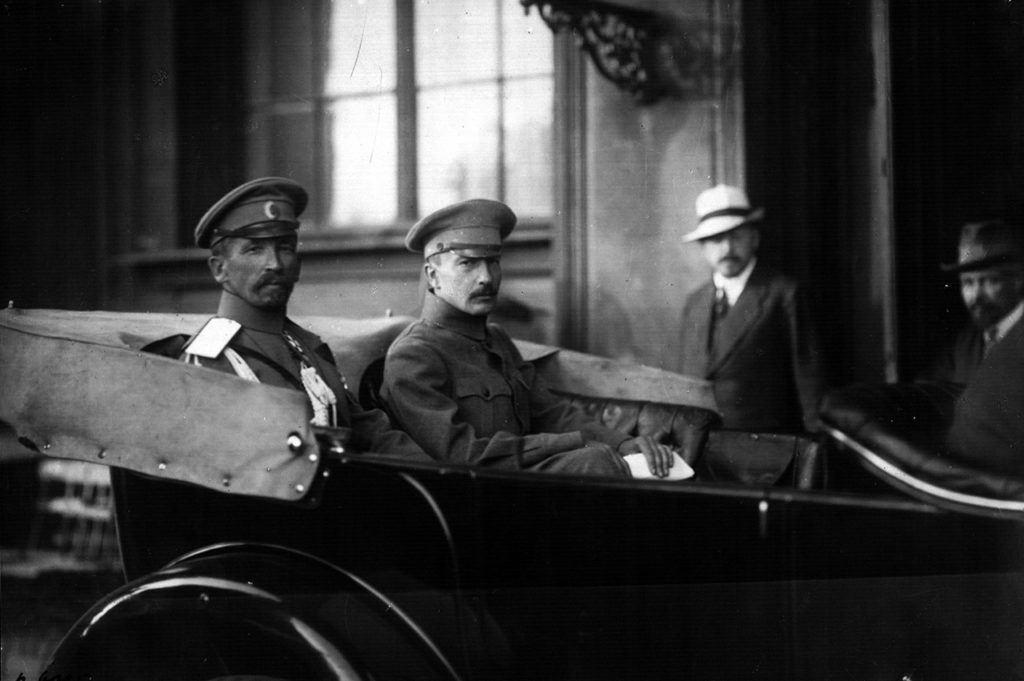
Savinkov lived abroad for many years, became a famous writer, and after the October Revolution he returned to Russia, where at one time he seriously counted on the role of the dictator. He was an irreconcilable enemy of the Bolsheviks and was very popular in Europe (especially in England).
It is noteworthy that other members of the political meeting, including former imperial dignitaries, did not argue about how appropriate to invite the former head of the Socialist -Revolutionar combat organization. Winston Churchill, who at that time held the post of military minister, recalled how in the summer of 1919 he asked Sergei Sazonov how he got along with Savinkov. According to Churchill, Sazonov, making an hostile gesture, replied: “He is a killer, and I am horrified that I work with him. But what to do. He is a competent person full of strength and determination. ”
Any opinion except that it really prevails in Russia
Attempts by the Russian political meeting to represent Russia at a peace conference were not successful. The Allies did not agree to consider a delegation collected on a live thread and associated with unstable governments in different regions of the former empire, a full -fledged voice of the Russian state.
The Allies also decided that the members of the Russian political meeting would only be invited to certain meetings of peace negotiations, where issues were touched on one way or another related to Russia and the former Russian Empire. Their role was advisory.
Probably, these restrictions were explained by the fact that the positions of some participants in the meeting seemed to the allies not very adequate. As the Ambassador of the United States said to Italy Thomas Page, who talked with Sergey Sazonov in Rome, he “does not realize how much the world has changed. He examines everything from a pre-war point of view and speaks of Russia, as if it had not changed and still an ally and a powerful member of the Entente. ”
However, even the modest status of Russian politicians and diplomats in Paris gave them certain lobbying opportunities. In particular, members of the political meeting convinced the allies that it was worth considering Russia as a unified state experiencing a crisis. A separate task of the Russian group in Paris was to convince the Entente countries not to stop assistance from anti -Bolshevik forces in Russia after the end of the World War, as well as ensure the international isolation of the Bolsheviks.
The Russian political meeting represented the Bolshevik government as an anomaly, which, with the help of the Allies, had to be eliminated in order to restore Russian statehood and the foundations of international order in the country. However, the allies began to think about how much this position is true.
David Lloyd George ironically said at a meeting of the leaders of the Entente states on January 12, 1919 that members of the Russian political meeting "represent any opinion, except that really prevails in Russia."
At the beginning of 1919, it became more and more obvious that the Bolsheviks withheld power in Central Russia, organized effective armed forces with their sources of supply and ammunition and enjoy the support of the population. There was no hope for their fall at that time.
The protracted civil war, where the anti -Bolshevik forces strongly depend on allied supplies, looked more and more real. And this prospect seemed to the allies gloomy not only from humanitarian reasons. Winston Churchill, who was generally skeptical of the idea of negotiations with the Bolsheviks, at a meeting in Paris in February 1919 invited the allies to think that the defeated Germany is still a large economic force that could again pose a military threat in the future. It is from Russia that Germany is capable of obtaining the necessary resources for this. And if now the allies simply “abandon” Russia, it will fall into the economic and political orbit of Germany, with all the gloomy prospects of such an outcome where the allies will again have to fight with Germany.

The allies tried to seal representatives of Russian warring forces at the negotiating table, and this meant that it was necessary to conduct a dialogue with the Bolsheviks. At the same time, the allies were not ready to consider such a conversation part of the Paris Peace Conference. Therefore, the idea arose to hold such a forum somewhere far from Paris.
On January 22, when peaceful negotiations in Paris have already begun, representatives of the Entente made a statement: recognizing “the absolute right of the Russian people to arrange their own affairs without any dictation or instructions from the outside,” as well as wanting to “pacify Russia and give it the opportunity to find a way out of the current disorder”, the allies stated that the world in Europe is impossible without the world in Russia and therefore they consider it their duty to “come to the aid of Russia as many It is generously, disinterestedly, thoughtfully and willingly how they would come to the aid of any other friend and ally, and they are ready to provide this service by the most acceptable for the Russian people. ”
The leaders of the Entente called on “all organized groups that are now exercising or trying to exercise political power or military control anywhere in Siberia or the European part of Russia”, send their representatives to the Princess Islands-the Archpella in the Marble Sea near Istanbul (the former capital of the Ottoman Empire was then occupied by the Allied forces).
The condition of the start of negotiations was to proclaim a truce between its participants. The allies pledged to help bring the negotiators to the archipelago, where they wanted to know the opinion of different representatives of the Russian people about the future of their state and help them agree to something. Participants were expected until February 15, 1919. Since the allies supported direct contacts far from all participants in the civil war, the invitation to negotiations was transferred to the radio.
There is no and there can be no talk of the exchange of views with the Bolsheviks
It is difficult to imagine how the conference on the Princess Islands could look if it took place. The selection criteria were rather free-it was only necessary to control some territory within Siberia or the European part of Russia, as well as express a desire to participate.
The reaction of the authorities of Soviet Russia was favorable. Lenin proceeded from the fact that Soviet Russia does not and will not be able to directly resist such a powerful rival as the country of the Entente. Therefore, taking into account the fact that the allied troops were in Russia - it was reasonable to demonstrate readiness for the world.
The note of the People’s Commissariat of Foreign Affairs, released on February 4, 1919, reported that the Government of Soviet Russia, according to the negotiations on the Princess Islands and was ready to lead them with both representatives of the allies and anti -Bolshevik governments. The Bolsheviks also outlined the economic proposals that they are ready to make to the Western powers: for example, partially recognize the debts of the Russian Empire (shortly after the Bolshevik government came to power, they announced that it did not consider it necessary to pay the debts that were taken by the tsarist authorities), and also give foreign businesses the opportunity to open their enterprises (concessions) for the production and processing of raw materials for the controls of the Bolsheviks underlined Bolsheviks territories.
At the same time, it was said that it was necessary to discuss the issue of annexations, which understood the presence of the Entente’s military forces “or those contained by the governments of consent ( that is, the Entente. - approx.“ Cold ” ) or use their financial, technical, military or other support”. In other words, the Bolsheviks actually called the white governments puppets of the Western countries.
The proposal to discuss in negotiations on the termination of bloody strife in Russia the recognition of royal debts and access to Russian raw materials was perceived by the addressees as an insult. The mention of the concessions was considered outrageous by the US President Woodrow Wilson, a politician with firm Christian beliefs, longed for America to make a light of mankind and conclude a strong and fair world in Europe. Lloyd-Jorde also said in one of the private conversations that the Bolsheviks, apparently, are finished scoundrels and do not believe in anyone’s sincere higher motives, since they themselves do not have those.
Реакция представителей белых правительств тоже не заставила себя ждать. Переговоры они отвергли как морально недопустимые, поскольку, по их мнению, большевики предали дело союзников, угрожали основам мирового порядка, а значит, их нельзя было допускать за один стол с победителями в войне и силами, желающими вернуть Россию в мировую семью. В ноте от имени Русского политического совещания прямо говорилось: «В нынешних условиях нет и не может быть речи об обмене мнениями с большевиками».
Одновременно белым правительствам нужна была поддержка союзников, и в предложении переговоров с Советской Россией они увидели перспективу будущего отказа в этой поддержки. Адмирал Колчак, который с ноября 1918 года имел практически диктаторские полномочия в Сибири и был провозглашен Верховным правителем России, в ноте, направленной 28 января в Париж, писал, что предложение о переговорах на Принцевых островах подорвало моральный настрой в войсках: там начали циркулировать слухи, что союзники отказываются от поддержки белых.
Из Архангельска, который контролировало белое Временное правительство Северной области, пришла обширная нота, где говорилось, что план переговоров с перемирием «является невозможным по нравственным причинам, невыполним фактически и не может обещать никаких политических результатов, кроме усиления в России разрушительных элементов». Миллер писал, что «во внешней политике большевики — изменники и продажные предатели, а во внутренней политике — это разбойники, грабители, убийцы, опирающиеся на поддержку худших элементов преступно настроенной и развращенной толпы», поэтому «для разговоров с ними невозможно найти ни одной точки соприкосновения».
Для многих вождей белого движения противостояние с большевиками было священной войной за освобождение несчастной родины, и сама мысль сесть с ними за стол переговоров казалась им кощунством.
Впрочем, и государственные деятели стран Антанты не были единодушны и последовательны в своем намерении добиться мира в России. Франция, настроенная наиболее скептически по поводу встречи на Принцевых островах, но не желавшая выносить разногласия среди союзников на публику, негласно донесла до представителей разных антибольшевистских сил в России, что отказ приехать на конференцию не повлияет на их поддержку Парижем. Такие же сигналы относительно военной помощи Великобритании посылал и Уинстон Черчилль.
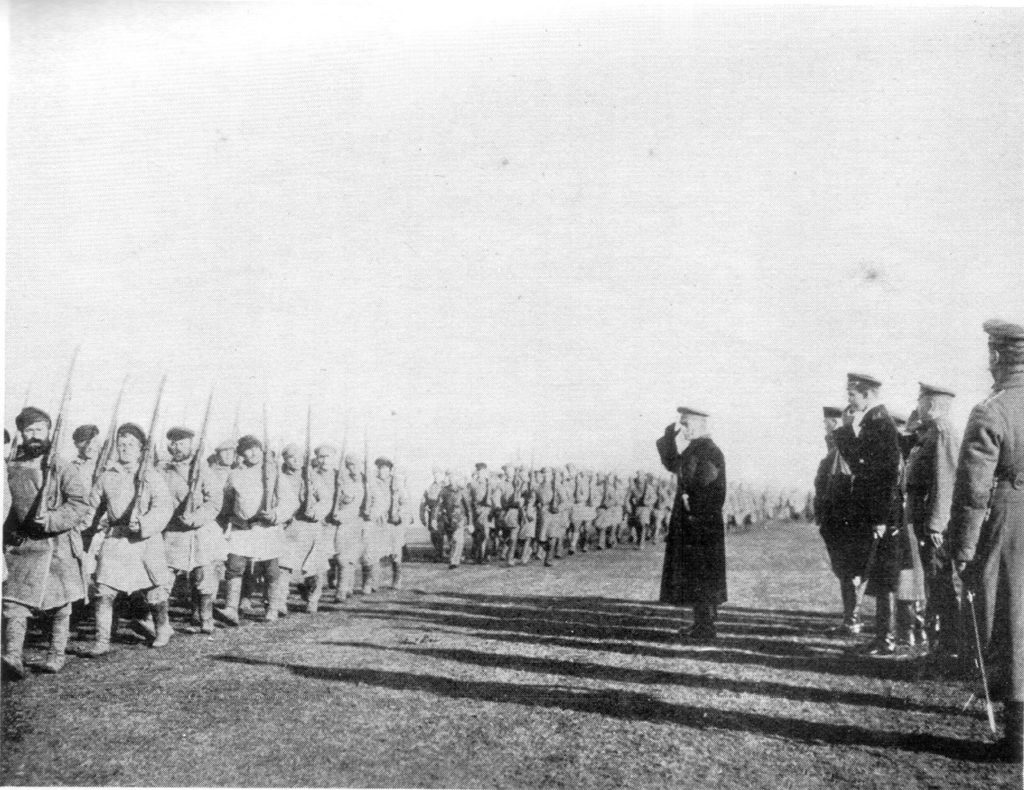
Белые правительства решили ориентироваться на эти сигналы и следовать своим убеждениям. Еще одного общего предложения от союзников закончить Гражданскую войну в России посредством переговоров не поступило. Она продолжилась. Спустя какое-то время политики во всех державах Антанты пришли к выводу, что военная и экономическая помощь белым не приводит к победе, и постепенно свернули поддержку. Война закончилась полной победой большевиков.
Источники: J, M. Thompson. Russia, Bolshevism and Versaille Peace. Princeton University Press, 1966; Б. Е. Штейн. «Русский вопрос» на Парижской мирной конференции . — М., 1949; архивные материалы.