
Translated material
The disappearance of the museum
Fire in the Sukhum Gallery. The work of Shervashidze and Bubnova is lost forever
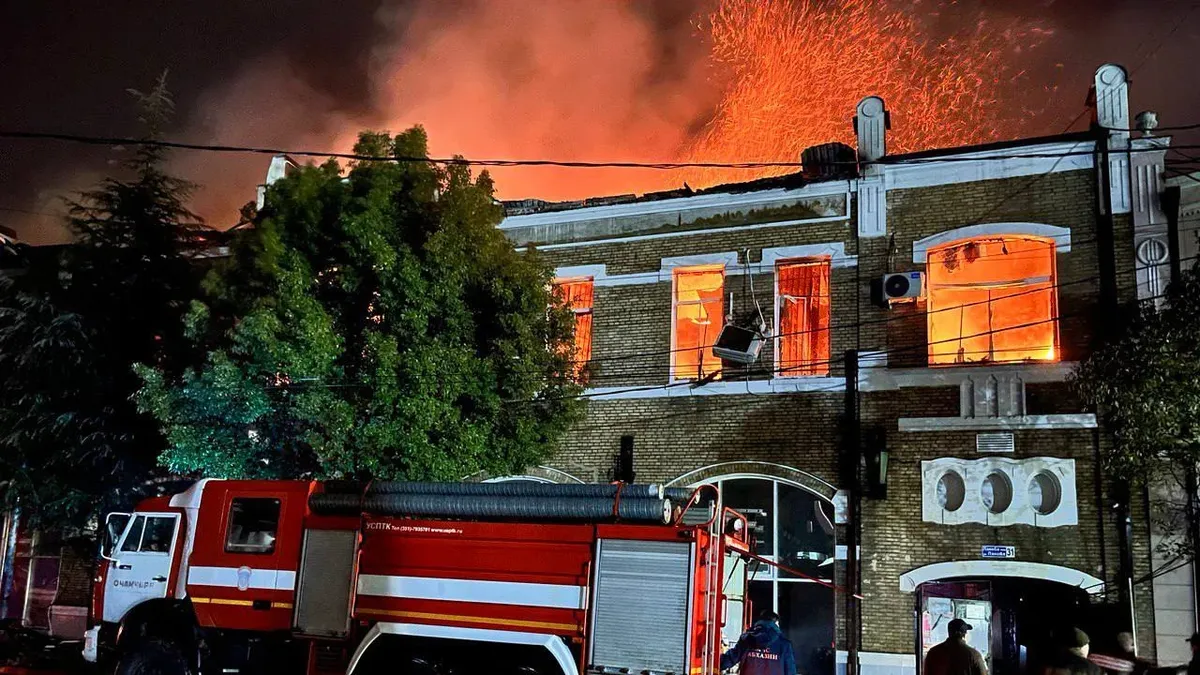
Photo: "APSNPRES"
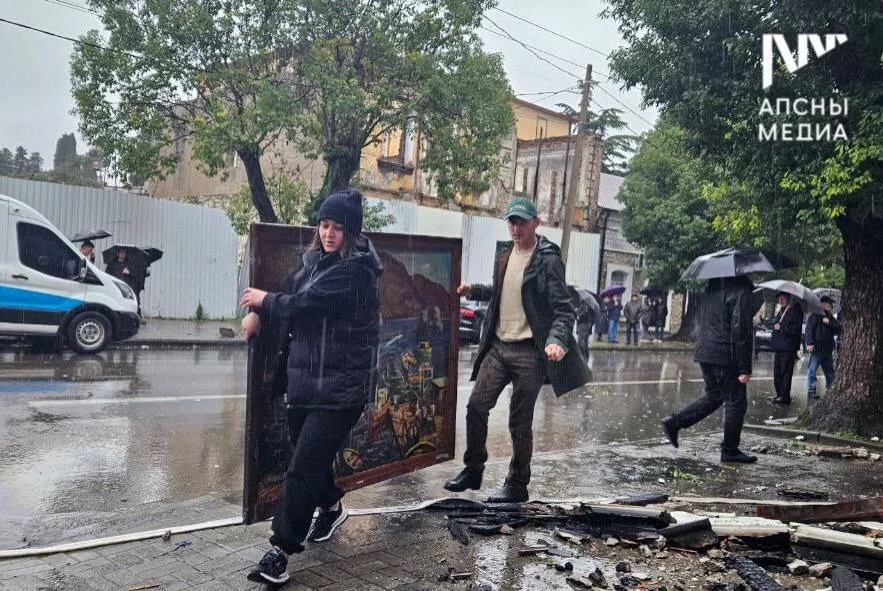
In Sukhumi, on the night of January 20 to 21, the central exhibition hall burned out, which housed the national art gallery and its storerooms. The fire that gripped the entire building was localized in three hours, but this did not save the collection. Almost all exhibits were killed - out of more than 4,000 works, it was possible to save hardly 200. This is a real disaster, from which the museum is unlikely to recover in the coming decades.
The gallery stored paintings by such authors as Alexander Chachba-Sharvashidze, Varvara Bubnova, Boris Petrov, Vladimir Contarev, Marina Eshba, Vitaliy Lakrba, Valery Gamgia, Vitaly Deniki, Amiran Adleib, Olga Brandel, and many other artists of Abkhazia and Russia of the XIX and XX centuries. These are almost the entire “golden fund” of Abkhaz masters, but Russian culture also lost the works of the most important authors, primarily Varvara Bubnova and Alexander Shervashidze.
After the revolution, both artists were forced to leave the country, but Bubnova (1886–1983), going to visit his sister in Japan and lived there for 34 years, after the Second World War, she still returned to the USSR. In Japan, she became a real classic, thanks to her, in particular, the art of lithography was established there.
This is not the first time Rock overtook Bubnov: in Tokyo, during the war, a house with her workshop and all the work there burned out to the ground. After returning for 20 years, she lived in the capital of Abkhazia, spent the last four years of her life in Leningrad, where she died, but buried her at the Mikhailovsky cemetery Sukhumi.
In the mid-90s in Sukhumi they decided to create a Bubnova house-museum, they were going to open it in the house of engineer Dahl, the documents were executed, but the work never began-there was no money.
At one time, it hoped for help from Yoko, it was a famous professorist, musician, widow John Lennon not only studied the violin from Anna Bubnova, but also had a relative, albeit not blood: not blood:
Yoko it was the nephew of her husband Anna Bubnova; According to some reports, Varvara Bubnova was engaged in visual arts with her. But the miracle did not happen-Yoko did not reach Sukhumi, the Museum of Bubnov did not rebuild, only the Musical Society named after Professor Anna Bubnova-Ono, created in Japan in 1946 and still organizing memorable concerts, provided him with help. But the money raised by the society at one time was enough only to repair the roof.
Already in our century the museum was abolished. And so there would have been preserved some of the work of Bubnova, probably transferred from the national gallery.
But the Russian theater suffered the most significant losses. About 300 works by Prince Alexander Shervashidze (1867–1968), the first professional artist-Abkhaz, died in the fire. The famous painter and scenographer, he studied first with Polenov, then for many years - in academies and workshops in Paris. Having returned to Petersburg, he worked for the Mariinsky and Alexandrinsky Theaters in St. Petersburg, was an ally of Alexander Golovin in renewing the artistic language of scenery, his name more than once with obvious respect mentions the legendary director of the imperial theaters Vladimir Telyakovsky on the pages of his diary.
Shervashidze was also known as an insightful historian of world art, he collaborated with Apollo magazine, his book “A hundred years of French painting” was quoted with confidence and even enthusiasm. But the main thing is that Shervashidze worked with Russian Seasons. He himself did not create decorations for the troupe of Sergei Diaghilev, mainly carried out the plans of other artists, but did it so professionally that his name is often mentioned in the reviews and correspondence dedicated to Diaghilev performances - an increase in the sketch to a full -fledged decoration was considered a special art in the theater. The picture is widely known, capturing the team of artists led by Picasso, painting the legendary curtain to the ballet “Parade” to the music of Eric Sati and Libretto Jean Cocteau, ”Shervashidze is also captured there.
After the revolution, Shervashidze left for Europe and stayed there forever. This led to the tragic consequences for his family members who were persecuted because of a relative, especially since in the 20s he still handed them money. The ex -wife and daughter were sent to Vologda, the daughter never saw her father - she was able to come to France a week after his death - but she was engaged in his heritage. 10 years before his death, he gave the USSR 500 of his works: “Everything that I have is ready to give for museums in Tiflis and Sukhumi.”
The Sukhumsky Museum itself gathered its work-in particular, back in the 70s, the portrait of Mary Shervashidze transferred the Tatar Autonomous Soviet Socialist Museum of Fine Arts for permanent storage (today-the State Museum of Fine Arts of the Republic of Tatarstan). Apparently, the portrait also died, although it could be shown in December 2022. Then, Sukhumi opened a large retrospective of Shervashidze, where, in particular, the sketches for the ballets “Swan Lake”, “Spring Spring” and to the play of Jewish “Merry Death” were put up.
The main version of the electrical wiring malfunction remains the main thing when investigating the fire, but the police do not exclude the version of arson.
Russian experts will come to Abkhazia in order to start saving the slightly preserved from the collection of the Sukhumi museum.