
Translated material
The plot of "small"
"Nose" Rolana Bykov and the film "Master and Margarita" Mikhail Lokshin
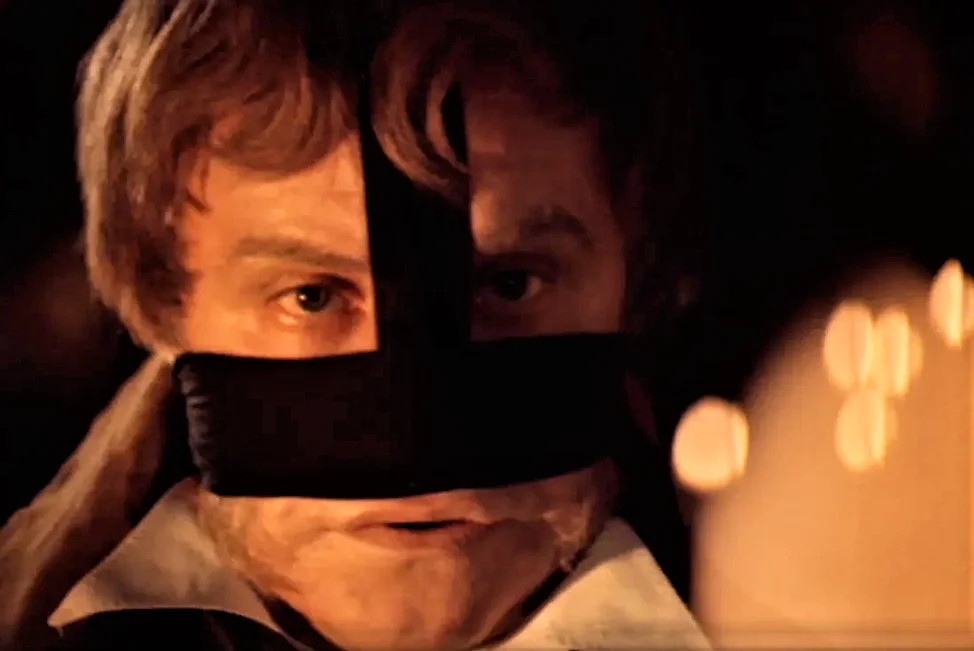
Around the "Master and Margarita" Mikhail Lokshin rose a terrible noise. The film is accused of all conceivable and unthinkable sins. Vladimir Soloviev, on this occasion, was not even an obscenely chosen by the Ministry of Culture (look, what a buffet!).
Successful adaptations of the classics rarely appear on domestic screens. Lokshin’s film is a beautiful independent picture, and I am sure that the vile denunciations will not interfere with its thoughtful analysis in any way.
Initially, I was going to write about her. But in the process of preparation, I decided to previously speculate about another film - the “Nose” of Roland Bykov in 1977. It seems to me that his understanding will help to start a conversation about the new Master and Margarita.
Any film adaptation is forced to balance between two lights. The first danger lies in excessive illustrativeness. Landwallist cinema, carefully and sadly retelling the original, does not reveal anything to the audience, except what is already contained in the source;
Since the meanings in good literature do not exist on their own, but require extracting, such films narrow the scope for interpretation, make the work flat, like the face of Major Kovalev.
The second danger threatens the directorial arbitrariness. For paintings shot without attention to the source, the book is just the starting material, raw materials, no more; The literary scenario with which the filmmakers are free to do everything that they like. Large directors usually do so: Kubrick shoveled Burzes and King, Alfred Hitchcock - Robert Blokh.
There are many adherents of both approaches. But, understanding the film adaptation as a synthetic work in which loyalty to the original source is no less important than its original reading, we come to the fact that the ideal adaptation should not fall into any of the extremes. In Russia, with its painful attitude to the printed word, this rarely comes out.
If you shift the “nose” to the screen literally, a psychedelic cartoon will come out, something like the “walls” of Alan Parker. The story of how the golden uniform, who escaped from the college assessor Kovalev, becomes a state adviser and prays in the Kazan Cathedral, and then, as if nothing had happened, grows back - expanse for hallucinogenic fantasies. And there are such scenes in the Bykovsky film, just recall the flashback with a walk of Major Kovalev along Nevsky Prospekt. But how to literally transfer Gogol's verbal games to the screen, breaking the fourth wall and directly addressing the reader, but to the writer himself? All these “... the benefits of the Fatherland are strongly none ...” and “Now, for the consideration of everything, we see that there is a lot of implausible in it ...”?
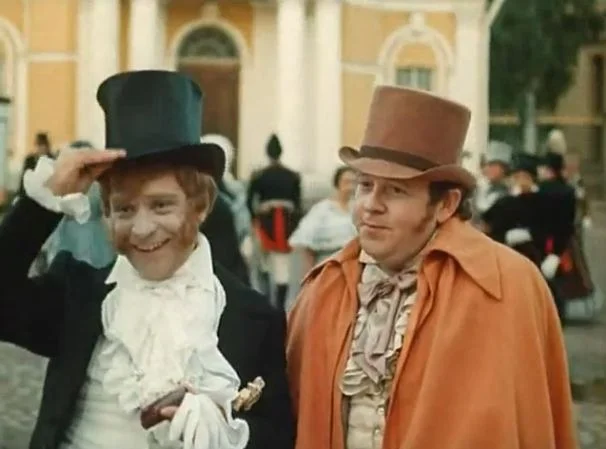
The tightness of the “nose” helps to cope with Bykov. Gogol, in essence, wrote not a story, but a grand self -referential hyperlink. Where do not start reading, for which plot or psychological thread do not pull-you want, you want, you will have to stretch the rest. Thanks to this feature of the text, all reincarnation of the “nose” are in a continuous dialogue with each other. The film by Roland Bykov recalls both the opera Shostakovich, written half a century before him and the cartoon Andrei Khrzhanovsky, who was released after almost fifty years.
From the first in the film, in addition to obvious musical parallels*, arrogant artistic techniques-Shostakovich wrote the first anthrax entirely for drums, but Bykov played in the film not only Kovalev, barber and nose, but also a peasant with a convoy of horses, who "left in February and where to go not glory." In turn, from Khrzhanovsky near Bykov (or by Bykov from Khrzhanovsky? The multiplier conceived his work back in 1966) a sad intonation in the middle of the film.
His core - when Kovalev, looking at the flying birds, realizes that “... people do not fly like birds” - it becomes possible thanks to an elegant artistic solution. Bykov shifts the chronological framework for a month in advance, so that all events fall exactly to the bows: “It is good to die on a holiday! Not everyone is so lucky, ”a grandmother with a silver tooth smiles at the cemetery.
And she smiles at the death of Kovalev - and this is probably the main plot liberty, which Bykov allowed himself, otherwise almost not retreating from the plot of the story.
In the original, as we recall, Kovalev, returning his nose to a place, continued to live as if nothing had happened. In the film by Bykova Klipova, in the spirit of the MTV television channel, the events followed by this: marriage to the puppet-type Lolita, a rewarding by the Order of Vladimir of the third degree, a work in college advisers and real state advisers, the appointment of an executive in the department, vice-governor ... from an overabundance of feelings, Kovalev is dying. And at the cemetery, where all his friends come - even a prostitute from Nevsky, played by Iya Savvina - the actual state adviser is buried in the neighborhood of Ivan Alexandrovich Khlestakov, other Gogol impostor.
Bykov’s film is paradoxical: it seems to be absurd, grotesque, jazz spontaneity, but performed with such love for people who did not dream of Erasmum of Rotterdam and David to the Human combined.
Everything in the film Bykov hits one goal, in pity for the little one; Each detail pays the audience to those who seem to be nothing.
The brightest episode of the film is the one that was not in Gogol’s story at all. In it, the barber Ivan Yakovlevich (“... his surname is lost ...” The titer delicately prompts) woves around the flooded Petersburg home. Wet to the thread, in a sung flask, nobody needs him in the world, even a peasant who is not going to be hidden where. The wife throws him out into the street, the quarterly overseer drags him by the scruff. And only Bonvivan Kovalev - a cynic and a careerist, ready to marry money - sees him in his own legless reflection.
Pity for the little one is the spirit of Gogol’s “nose”, just as the spirit of the “master and Margarita” is a thirst for peace, Schubert, love. And if in order to convey a spirit, it is required to sacrifice a word, then let them bring this victim. Writers will not be offended.