
Translated material
What will happen to a person if he lives for 500 days in a dark cave in full isolation?
Spanka Beatrice Flamini decided to check it on herself
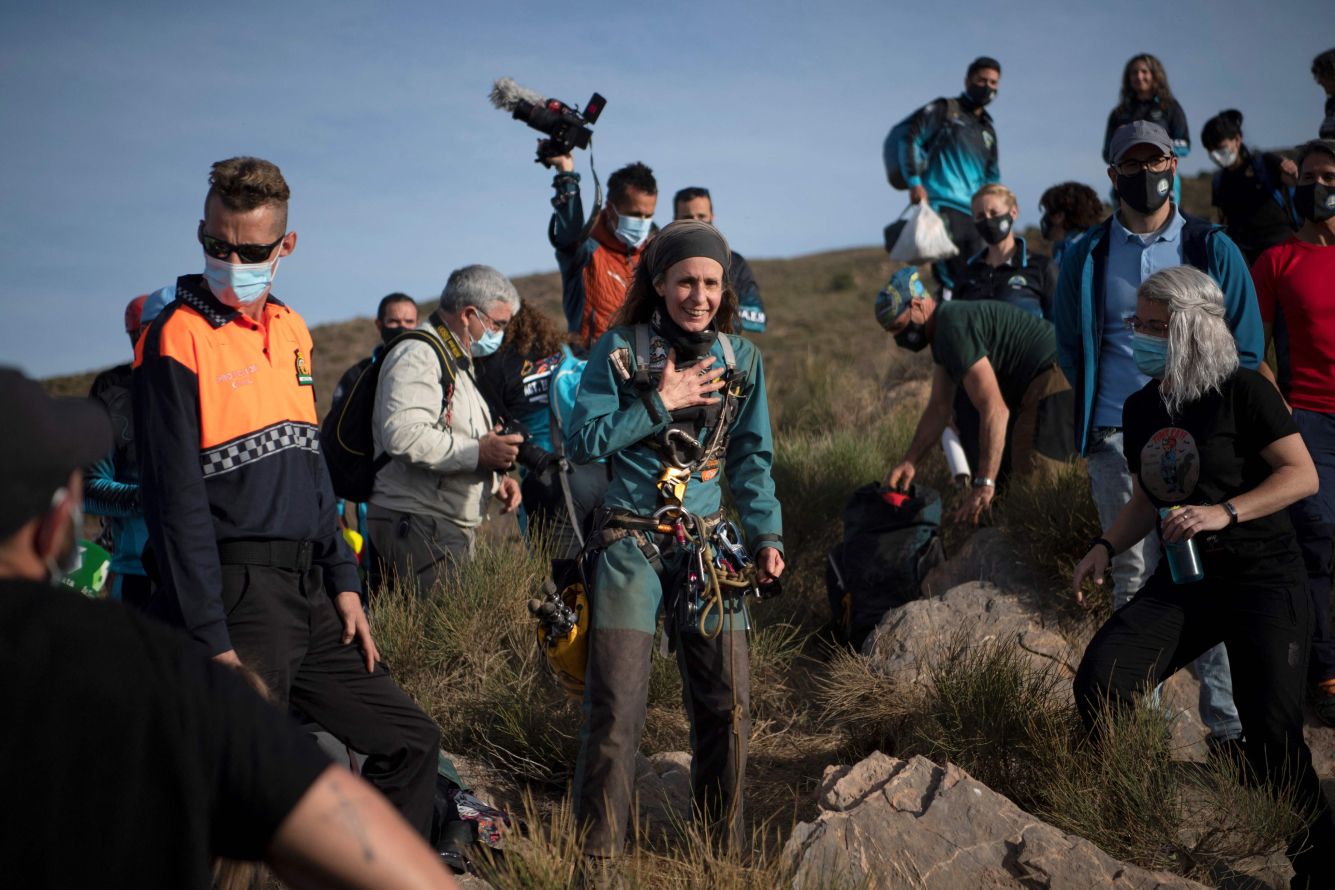
Beatrice Flamini always strove to solitude, and after the beginning of the Pandemia of Coronavirus decided to spend 500 days in the cave in full insulation - to set a record and morally prepare for a long journey through the goby desert. During the experiment, the Spanologiy was observed by the Speleologists and other scientists, but she herself did not contact the outside world in any way. Flamini came out of the cave in April 2023, without breaking the record, but with enthusiasm describing her impressions with delight. However, the psychologists who observed the experiment suspect that the Spaniard developed a post -traumatic disorder, and her insulation experience was very far from the positive. "Medusa" retells the material of The New Yorker about what happened to the flaminum in the cave.
Flamini wanted to walk the Gobi desert. To prepare for prolonged loneliness, she decided to spend 500 days without contacts with the outside world
Beatrice Flamini was born in Madrid in 1973 and since childhood loved to spend time alone. In the early 1990s, she decided to learn from a sports instructor and at the same time (though not one, but with her friend) for the first time visited the regorillo cave, located near Madrid and known for the drawings of the Paleolithic era. According to Beatrice, she immediately fell in love with the cave - and the feeling of calmness that she experienced there.
Having graduated from the university, Flamini began to teach aerobics in Madrid. By the age of 40, Beatrice achieved a lot in life: she had long and strong relations, a house and a car. But she did not feel satisfaction. It seemed to her that she was not doing what she really wants. “You realize that [someday] will die,” said Flamini to reporters. - Today, tomorrow, in 50 years. What do you want to do in life before this happens? "
The Spaniard decided to go to the mountains and settled on the Sierra de Gredoos ridge in Central Spain, settling to work as a caretaker in the reserve. Having received certificates that allowed us to work on top, and having passed first aid courses, she became a lifeguard in the mountains, and her free time was engaged in high -hacking and climbing. Once, Flamini saved the man who was covered with an avalanche. Another time I saw how a tourist died from a blow with lightning. She spent most of her time alone and even stopped communicating with relatives. However, at that time, she had not yet completely broken contacts with the outside world: for example, she continued to lead Instagram account .
In 2020, when the Pandemia of Coronavirus began, Flavino settled in an abandoned monastery in the Catalan mountains. In solitude, she walked a lot, occasionally talked on the phone with her friend and from her learned how the situation with coronavirus in Madrid and the world is.
With the end of Lokdown, Flamini decided not to interrupt the self -isolation, but to go to an even more deserted place - the Gobi Desert in Mongolia. After a few months of training, she felt that she was ready to travel physically - but not morally. Flamini had never remained alone longer than 95 days, and the transition through Gobi would definitely take more time.
Beatrice began to look for information about people who lived in caves for a long time. In 1970, the record was set by Serb Milutin Velkovich, who was in the cave of 463 days. However, neither he nor anyone else spent this time in complete solitude. For example, Velkovich from time to time called up with the residents of the nearest village and learned about what was happening in the world on the radio. Flamini decided not only to beat his record, but also to do it in complete isolation. She was confident in her abilities, as she participated many times in the speleological expeditions. The Spaniard set a goal - to live 500 days in a cave without contacts with the outside world.
The experiment volunteered to observe scientists. Flamini agreed to install the camera in the cave, but insisted that no one from outside could contact her
Participants of the Speleological Club from the municipality of Granada offered Beatrice a suitable cave - north of the city of Motor on the Andalusian coast. Humidity and temperature allowed us to live in it all year round, and the entrance was located next to a cliff with a height of more than 60 meters: random tourists could not disturb the Spanka. The main part of the cave was about 30 meters in length and nine in width, about 12 meters high. It was dark and damp inside, and the floor was covered with stone fragments.
Initially, Flamini planned to bring enough food and water to the cave, so that it was enough for 500 days, not to interact with people and return to the outside world in order to immediately go to Mongolia. However, the speleologists convinced her that it will be extremely difficult to deliver such a volume of food to the selected place. Another difficulty was that without outside help, she could not dispose of the waste without leaving the cave. Flamini agreed with the cavers that they would leave supplies on the ledge above the cave, and she would climb the cable and take what they brought. One of the Spanish public catering enterprises was caused to provide Beatrice with canned goods for the entire expedition.
In addition, she agreed that two tracking cameras, an alarming button and a computer to be installed in the cave, through which, if necessary, one -sided signal could be sent. In order for the communications to work, Wi-Fi had to be held in the cave, but Beatrice did not take any devices for communication with other people-this was still her main condition. Moreover, in order to achieve a “complete separation”, she decided not to look in the mirror for her own face all 500 days.
Flamini agreed to observe the isolation of researchers from the universities of Granada and Almeria. They were going to evaluate a change in its psychological state and circadian rhythms in conditions of isolation and constant darkness. Before letting the Spaniard into the cave, scientists held several tests. Neuropsychologist Maria Dolores Roadan-Tapapi from the University of Almerian concluded that Beatrice is an “extremely decisive, motivated and disciplined personality”.
Flamini also met with a sporting psychologist Deborah Hoods of Iskierdo - she advised to say her thoughts in order not to lose touch with reality. The Spanish company Dokumalia, which specializes in the shooting about survival in wild conditions, provided Beatris with two GoPro cameras so that she could keep a diary. Solar panels became the source of electricity in the cave, their volunteers left the same way as supplies. The energy from them was enough for the work of two nightlights and a Wi-Fi router.
In mid -November, 2021, Flamini published a post on Instagram with the signature: “On Saturday, November 20, the boat goes on a new voyage. We will again get in touch in April or May of 2023. ” When the time came to go down, Beatrice and volunteers gathered outside - this was her last interaction with people until the end of the experiment. She with difficulty squeezed into the cave, showed her tongue remaining outside and joked: "Until tomorrow."
Flamini lost a sense of time in the cave, her hallucinations began. She described her condition as "hibernation"
At the beginning of the experiment, Flamini kept a diary on the computer and sent notes to scientists, but soon stopped doing it. She tried to account for days, but went astray by the middle of the second month. Before descent, Beatrice promised observers that she would perform cognitive exercises , but two weeks later she complained that the computer did not work: it turned out, she could not remember the password and entered the wrong ones. Researchers asked Flamini to use the computer how they agreed, but she ignored them.
According to the records from the GoPro camera, it can be seen that in the early days Beatrice maintained order in the areas where she cooked and ate, as well as a tent, a place for physical exercises and a computer station. She arranged them at a distance from each other to move regularly.
Once Flamini brought a branch to the cave and painted it with markers - according to her, in order to "keep a sense of color." And another time she sat for a long time and looked in front of her, then explaining at the camera that she trains her eyesight.
But soon the mood of Flamini worsened noticeably. After the experiment, she admitted that after the first few months she stopped remembering the details of what was happening, and spent 95% of the time sitting or lying in the dark in a state of “hibernation”. In one of the records with GoPro, Beatrice told how difficult it is to not know the time of the day, and added that she has “always four in the morning”.
The longer Flamini lived alone, the more strange she behaved. For example, at some point, she stood in front of the camera, Bayka thermos, and then sharply turned to the wall and exclaimed, turning to the cave: “How beautiful you are! You are wonderful and friendly! You are kind, and many crickets live in you. I think these are crickets. You are just charming! " Laying to sleep, Flamini, according to her, sometimes heard the drum fraction in her head and imagined that a shaman was sending her a welcome signal.
“I am sure that if I last 30 days, everything will go perfectly,” Beatrice said on one of the records. Then she believed that she lived in a cave for 19 days, but in fact she was there almost twice as long. Another time, Beatrice decided that autumn had come outside and it was necessary to collect all the stones from the bottom of the cave: it seemed to her that in this way the body said that it was time to harvest. But in reality at that moment there was only the beginning of summer. Flamini tried to keep an account of time using the menstrual cycle, but it became too irregular.
In January 2022, Beatrice said she hears something strange. In the next entry with GoPro, she asked the volunteers to give her the recorder, assuring her that she had no paranoia or hallucinations. Trying to find a rational explanation for what was happening, she suggested that a large animal had failed in the cave, and decided to sleep with a knife in a tent.
Soon she stopped monitoring the order: on the recordings from the cameras it is clear that clothes, blankets, books, pots and pans were scattered throughout the camp. Then Beatrice began to be afraid of darkness. The intervals between the records in her video day became longer. When they nevertheless appeared, it was clear that it was far from being tuned as decisively as at the beginning of the experiment. At some point, Flamini thought that the floor in the cave was moving. The sounds that first fascinated her began to annoy.
About six months later, since the beginning of the experiment, Flavmini realized that attempts to follow the time only strengthen her anxiety. “In the cave, the linear movement of time ceases, and everything just soars around you,” she explained after the experiment. -Some time ago I was born. Some time ago I was going to go to Mongolia. There is neither the future nor the past. Everything happens in the present or already happened some time ago. It is difficult and strange. ”
The only confirmation that time is on was the waste disposal schedule that Flamini took out Flamini to the toilet in the package to the place where the volunteers took them and left her fresh products.
In April 2022, Beatrice complained about painful sensations and dumbness in her legs. At that time, she spent most of the time in the tent and slept a lot.
Sometimes she drew comics about her adventure and even portrayed volunteers in one of them - however, people had no faces in these drawings. Flamini knitted woolen caps for friends, and for the whole experiment I read about 60 books (although she later admitted that she did not remember almost any of them). In addition, Beatrice began to communicate with Gopro as if she interacted with real people. She hugged the cameras and even flirted with them, parodyed the bats living in a cave and said that she had done a new hairstyle.
Once Beatrice thought she was dying. According to her, she experienced relief. “There was no difference between what I felt then, and how I was presenting death,” Flamini told after the end of the experiment.
In September 2022, when the experiment lasted almost 300 days, Flamini had to violate its main condition due to interference that came from the router. From them, Beatrice began headaches and bleeding from the nose. Then she took out the tent and installed it in front of the entrance to the cave. Six days later, David Reyes came to her - the head of the speleological team, which monitored her condition. Flamini explained to him that she could not be in the same room with a router. Volunteers called specialists to replace the equipment. And Beatrice returned to the cave and resumed the experiment.
After that, Flamini broke several times on the speleologists. Once she recorded a ten -minute tirade, accusing the volunteers of that they, without warning, changed their knot on the cable, along which she climbed up for supplies. She later admitted that she herself bandaged this knot, but forgot about it.
Despite the deterioration of her mental state, the Spaniard almost achieved the goal and spent 492 days in the cave (her tent stood on the outside for eight days due to problems with the router). Beatrice later recalled that when Reyes went down to the cave, she lay and “drifted”, but his voice led her out of a stupor.
Flavino assured that she spent an “amazing” time in the cave. Experts suspect that she developed PTSR
Almost immediately after leaving the cave, Flamini held a press conference. She held on to reporters better than one could expect, given almost a year and a half of isolation, - she joked and smiled. When asked if she thought at least once to interrupt the experiment, Beatrice answered negatively and added that she was already bored with a cave. Scientists who monitored the progress of the experiment suggested that such behavior at a press conference could be a protective mechanism and a reaction to injury. Saying goodbye to journalists, Flavi almost immediately lost consciousness. She was taken to the hospital, but, according to the Spanish herself, all indicators were normal. However, she did not remember how she behaved at a press conference.
Many researchers and professional speleologists have expressed doubt that Flamini, as she claims, spent an “amazing” and “unique” time in the cave. According to her stories, the experiment seemed almost a vacation. "Everyone thought that I would leave the zombie, but they were mistaken!" She joked, adding that she did not even have time to miss anyone in 500 days.
Later, already in a conversation with The New Yorker D. Max correspondent, the Spaniard admitted that after the experiment she began to scare sounds, of which she did not see the source. If something happens from behind or from the side of it, she becomes uncomfortable: in a dark cave she was used to looking only in front of her-in the direction where the light of a piercur lamp fell. She also said that she would not advise other people to repeat her experience on herself, because "the darkness sucks life," and "loneliness absorbs you."
If Flamini spoke with The New Yorker, then she refused further studies that scientists who were observing the entire experiment, she flatly refused. She explained this by the fact that her experience is unique, and she should work it in its own way. Scientists suggested that she was still not ready to seriously discuss the stay in the cave and analyze her experiences. “All her behavior speaks of the presence of PTSD,” the neuropsychologist Maria Dolores Roadan-Tapapi is sure. - Survival in the cave caused her injury, although it was voluntary. Judging by many of the data we have, her experience turned out to be rather negative. ”
In addition, in 500 days, Flamini lost a significant part of the muscle mass in the cave (the doctors did not find other health problems). The conquest of Gobi had to be postponed indefinitely.
Beatris failed to beat Milutin Velkovich Milutin Velkovich due to an eight-day break to replace the router. But she still submitted an application in the “Guinness Book of Records” - as a record holder among women (her request is still considered). Now Flamini again abandoned almost all external contacts and lives in the mountains of Kantabria on the northern coast of Spain.
"Jellyfish"